TR
TR EN
EN

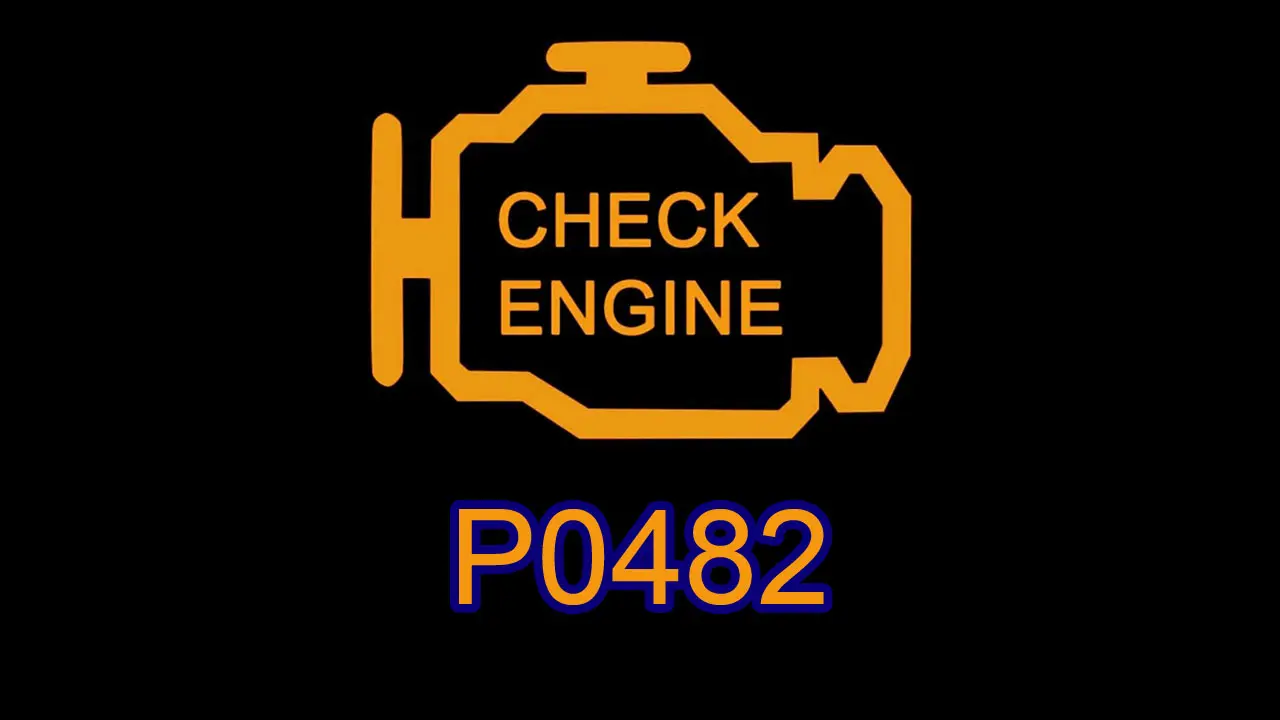
P0482 Cooling Fan 3 Control Circuit Malfunction
The P0482 trouble code means the engine control module (ECM/PCM) has detected a malfunction in the control circuit for Cooling Fan 3.
The important point is that P0482 is primarily a fan control-circuit diagnosis. It does not automatically mean that the cooling fan motor has failed.
The vehicle may use multiple electric fan circuits, multiple relays, different fan speeds, or an electronic fan-control module. Therefore, “Fan 3” does not necessarily mean there are three separate fan motors.
On some vehicles, Fan 3 may represent a third control stage or relay. On others, it may correspond to a specific fan assembly or control circuit.
What Does “Cooling Fan 3” Mean?
The cooling system may use several strategies to control fan operation.
An older vehicle might use:
Fan relay 1 → low speed
Fan relay 2 → medium speed
Fan relay 3 → high speed
Another vehicle may use several physical fans, with each fan having its own control circuit.
Modern vehicles may instead use an electronic fan module that continuously varies fan speed.
For this reason, the meaning of Fan 3 is manufacturer-specific.
The first step in diagnosing P0482 is therefore determining what the manufacturer has designated as Cooling Fan 3.
How Does the Cooling Fan System Work?
The electric cooling fan forces air through the radiator and A/C condenser when natural airflow is insufficient.
The ECM or another control module determines fan operation based on inputs such as:
-
Engine coolant temperature
-
A/C refrigerant pressure
-
Engine load
-
Vehicle speed
-
Transmission temperature
-
Intake-air temperature
-
Charge-air temperature
-
Emissions strategy
The control system can then activate one or more fan stages.
For example:
Low cooling demand → Fan 1
Higher cooling demand → Fan 2
Very high cooling demand → Fan 3
This is only an example. The actual strategy can be completely different depending on the vehicle.
What Does “Control Circuit Malfunction” Mean?
P0482 is a relatively broad circuit code.
The ECM has detected that the designated Fan 3 control circuit is not behaving as expected.
Possible electrical conditions include:
-
Open circuit
-
Short to ground
-
Short to voltage
-
Incorrect relay operation
-
Missing power supply
-
Poor ground
-
Excessive resistance
-
Faulty control module
-
Damaged wiring
-
Connector failure
-
Incorrect feedback
-
Failed fan-control component
Therefore, the code does not identify one specific failed component.
Common Symptoms of P0482
Possible symptoms include:
-
Check Engine Light
-
Cooling fan not operating at one or more speeds
-
Fan operating only at certain speeds
-
Fan running continuously
-
Fan switching on and off unexpectedly
-
Engine temperature increasing at idle
-
Poor A/C performance while stationary
-
Cooling fan operating at an incorrect speed
-
Overheating in severe cases
-
Additional cooling-fan fault codes
Some vehicles may continue operating normally because the remaining fan stages are still functional.
For example, if Fan 3 represents the highest cooling stage, the vehicle may appear normal during ordinary driving but develop temperature problems during heavy traffic or high ambient temperatures.
Common Causes of P0482
Faulty cooling fan relay
If the vehicle uses separate relays for different fan stages, the Fan 3 relay can fail.
The relay may have:
-
Burned contacts
-
High internal resistance
-
Stuck contacts
-
An open coil
-
Incorrect control voltage
A relay can also fail intermittently.
Damaged wiring
The fan circuit carries significant electrical current, and the wiring may be exposed to heat, moisture and vibration.
Look for:
-
Melted insulation
-
Chafing
-
Broken wires
-
Corrosion
-
Previous poor repairs
-
Loose terminals
Corroded connector
Cooling-fan connectors are commonly exposed to water, road dirt and heat.
A connector may appear plugged in while having poor terminal contact internally.
Blown fuse
A blown fuse can interrupt the Fan 3 circuit.
However, the reason the fuse failed should also be determined.
A replacement fuse that immediately blows again indicates that an underlying short or excessive-current condition may still exist.
Faulty fan motor
A fan motor can fail electrically or mechanically.
Depending on the system, one fan motor may be associated with the designated Fan 3 circuit.
A seized or internally damaged motor can prevent the commanded fan stage from operating.
Faulty fan-control module
Modern vehicles often use electronic fan-control modules rather than simple relays.
A failed module can prevent the fan from responding to the ECM command.
Poor ground
A high-resistance ground can cause a fan to operate incorrectly or not operate at all.
The ground should be tested under load rather than relying only on a continuity check.
Control signal problem
The ECM may not be able to deliver the expected control signal because of:
-
Wiring damage
-
Short circuit
-
Open circuit
-
Control-module failure
-
Communication problem
Incorrect replacement component
An aftermarket fan, relay or control module with different electrical characteristics can create control-system problems.
P0482 Does Not Automatically Mean the Fan Motor Is Bad
This is one of the most important diagnostic points.
Suppose Fan 3 does not operate.
That does not immediately prove the motor has failed.
The fault could be:
ECM command → wiring → relay/control module → power supply → fan motor
A failure anywhere along this path can prevent the fan from operating.
For example:
Bad relay → no power to fan → Fan 3 does not operate → P0482
In this case, replacing the fan motor would accomplish nothing.
How to Diagnose P0482
A proper diagnosis should begin with identifying exactly what Fan 3 represents on that vehicle.
1. Scan all control modules
Check for additional codes involving:
-
Cooling fan
-
Fan speed
-
Engine coolant temperature
-
A/C pressure
-
System voltage
-
Fan-control module
-
CAN communication
A related code may reveal whether the problem is electrical, mechanical or command-related.
2. Check freeze-frame data
Determine when P0482 was recorded.
Pay attention to:
-
Coolant temperature
-
Engine RPM
-
Vehicle speed
-
A/C operation
-
Battery/system voltage
-
Fan command
-
Fan speed, if available
If the code appears only when the vehicle requests high cooling capacity, that is valuable information.
Use a Bi-Directional Scan Tool
If supported, command the individual fan stage or fan output ON.
Observe:
-
Does the fan respond?
-
Does the correct fan operate?
-
Does the relay activate?
-
Does the fan reach the expected speed?
-
Does the control module report the expected feedback?
This can quickly separate a command problem from a downstream electrical problem.
However, not every vehicle allows individual fan-stage control through a scan tool.
Check the Fuse and Relay
If Fan 3 uses a dedicated fuse or relay, inspect them according to the wiring diagram.
Do not assume that the highest-numbered relay corresponds physically to the highest fan speed.
The manufacturer may use a relay combination where several relays work together to create different fan speeds.
Check:
-
Fuse condition
-
Fuse voltage
-
Relay power
-
Relay ground
-
Relay control signal
-
Relay output
-
Terminal condition
Check Voltage at the Fan
If the fan does not operate, measure voltage at the fan or appropriate control point while Fan 3 is commanded ON.
This is much more useful than simply checking battery voltage elsewhere.
Possible results can be interpreted as:
Correct voltage + good ground + fan does not operate
→ suspect fan motor or integrated fan electronics.
No voltage at fan
→ trace backward through relay, fuse, wiring and control module.
Voltage present but significant voltage drop under load
→ suspect high-resistance wiring, connector or ground.
Perform Voltage-Drop Testing
Cooling fans are high-current devices.
A circuit can show good continuity while still having excessive resistance.
For example, a corroded connector may allow a small test current to pass easily.
When the fan attempts to draw substantial current, however, the connection may develop a significant voltage drop.
This can result in:
-
Low fan speed
-
Fan failure
-
Excessive connector heat
-
Intermittent operation
-
Fan-control codes
Therefore, load testing and voltage-drop testing are more valuable than continuity testing alone.
Check Fan Current Draw
If the fan is receiving the correct voltage but does not operate correctly, measure its current draw where appropriate.
An unusually high current may indicate:
-
Seized motor
-
Bearing failure
-
Mechanical obstruction
-
Internal motor damage
An unusually low current can suggest:
-
Open motor winding
-
Poor power supply
-
Poor connection
-
Internal electrical failure
The actual current specification must come from the manufacturer.
There is no universal cooling-fan current value that applies to every vehicle.
Inspect the Fan Mechanically
With the system safely disabled and following the manufacturer's procedure, inspect the fan assembly.
Look for:
-
Broken blades
-
Foreign objects
-
Damaged shroud
-
Fan rubbing
-
Bearing problems
-
Physical obstruction
Do not place your hands near an electric cooling fan simply because the ignition is switched off.
Cooling fans can start automatically without warning.
Check the Fan-Control Module
If the vehicle uses an electronic fan controller, determine whether the ECM is sending the expected command.
The controller may receive:
-
PWM command
-
Digital command
-
CAN communication
-
Another manufacturer-specific control signal
The module then regulates the fan motor.
A controller failure can therefore produce P0482 even when the fan motor itself is perfectly functional.
Can a Coolant Temperature Sensor Cause P0482?
A faulty coolant temperature sensor can cause the ECM to command the fan incorrectly.
For example, if the ECM believes the engine is excessively hot, it may command high fan operation.
However, an incorrect fan command is not necessarily the same thing as a Fan 3 control-circuit malfunction.
If P0482 is present, determine whether:
The ECM is commanding Fan 3 incorrectly
or
The ECM is commanding Fan 3 correctly but the control circuit does not respond.
This distinction is critical.
Can the A/C System Cause P0482?
Yes, indirectly.
A/C refrigerant pressure can influence cooling-fan operation.
When condenser pressure rises, the vehicle may command additional fan speed.
If P0482 occurs specifically when the A/C is operating, inspect:
-
A/C pressure data
-
Fan command
-
Fan-control module
-
Fan stage operation
-
Electrical circuit
But do not assume that the A/C system itself is defective simply because the fan is activated when the A/C is turned on.
Can P0482 Cause Overheating?
Yes, depending on what Fan 3 represents.
If Fan 3 is an important high-speed cooling stage, losing it may not cause overheating during normal driving.
The problem may become apparent when:
-
Sitting in traffic
-
Idling for long periods
-
Driving in very hot weather
-
Operating the A/C at low vehicle speed
-
Climbing steep grades
-
Towing or carrying heavy loads
If other fan stages remain operational, the engine may stay within a safe temperature range under light conditions.
Can P0482 Affect the A/C?
Yes.
The radiator fan often also cools the A/C condenser.
If a required fan stage does not operate, condenser pressure can rise when the vehicle is stationary.
Possible consequences include:
-
Weak A/C at idle
-
A/C cycling abnormally
-
Increased refrigerant pressure
-
A/C compressor protection shutdown
Therefore, A/C performance can provide a useful clue when diagnosing a cooling-fan problem.
P0482 vs P0481
P0481 – Cooling Fan 2 Control Circuit Malfunction
concerns the designated Fan 2 control circuit.
P0482 – Cooling Fan 3 Control Circuit Malfunction
concerns the designated Fan 3 control circuit.
The numbers identify different control circuits according to the vehicle's diagnostic strategy.
They do not necessarily mean three physical fans exist.
P0482 vs P0483
P0483 – Cooling Fan Rationality Check
is generally associated with the ECM determining that fan operation is inconsistent with what should be happening.
P0482 is more specifically associated with a malfunction in the designated Fan 3 control circuit.
P0482 vs P0484
P0484 – Cooling Fan Circuit Over Current
indicates that the fan circuit is drawing more current than expected.
P0482 instead indicates a malfunction in the designated Fan 3 control circuit.
A vehicle could potentially have both codes if a Fan 3 circuit has an electrical fault that also creates excessive current.
Should You Replace the Cooling Fan?
Not immediately.
Before replacing the fan assembly, determine:
What exactly is Fan 3 on this vehicle?
Then check:
-
Fuse
-
Relay
-
Power supply
-
Ground
-
Control signal
-
Wiring
-
Connector
-
Fan-control module
-
Fan motor
-
Actual fan operation
-
Current draw
-
Fan-speed feedback where available
Only after these tests should the failed component be identified.
Final Diagnostic Summary
P0482 – Cooling Fan 3 Control Circuit Malfunction means the ECM/PCM has detected a problem with the designated Cooling Fan 3 control circuit.
It does not automatically mean that the cooling fan motor has failed, and “Fan 3” does not necessarily mean the vehicle has three separate fan motors.
The first diagnostic step is to determine exactly how the manufacturer defines Fan 3. It may be a separate fan, a relay-controlled speed stage, or part of an electronically controlled fan assembly.
The most useful diagnostic sequence is:
Fan 3 command → fuse/relay or fan controller → wiring → power/ground → fan operation → current draw → feedback
If the ECM commands Fan 3 but the circuit does not respond, trace the circuit from the controller toward the fan.
If the fan receives proper power and ground but fails to operate, investigate the fan motor or integrated fan electronics.
If the electrical circuit works correctly but the ECM is commanding the wrong fan stage, investigate the inputs and control strategy, including coolant temperature and A/C pressure.
The key question with P0482 is therefore not simply:
“Is the cooling fan working?”
It is:
“What does Fan 3 represent on this vehicle, and why is its control circuit not responding as the ECM expects?”