TR
TR EN
EN

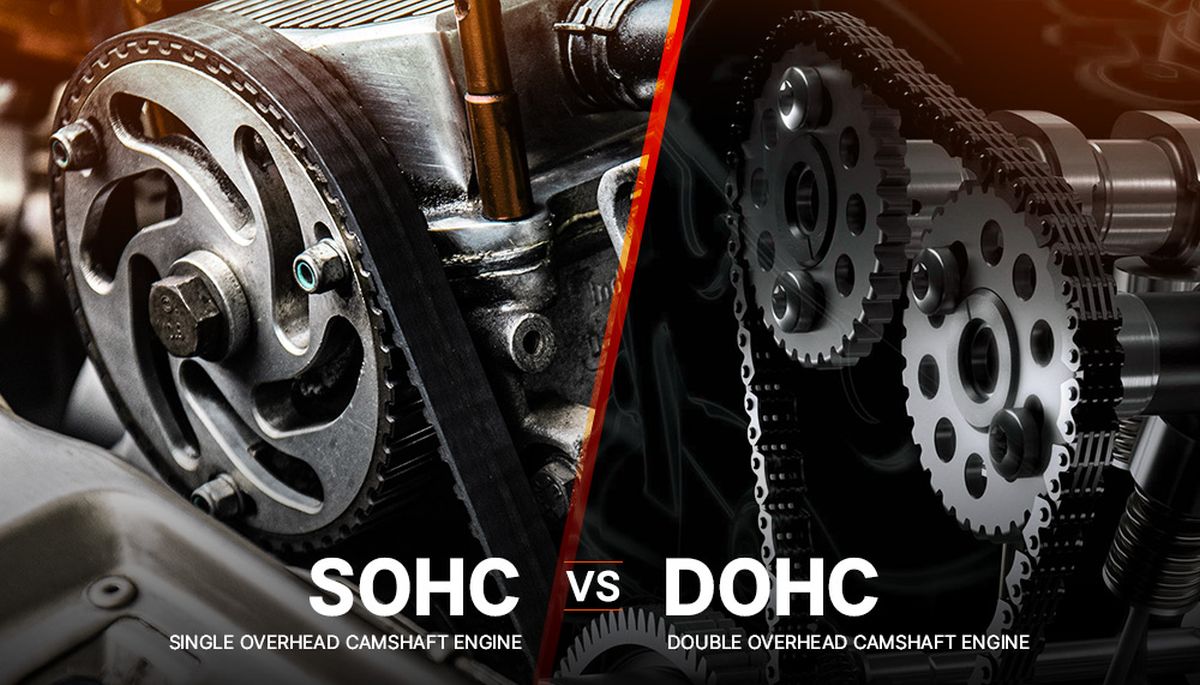
SOHC and DOHC Engines: What Are Their Advantages and Disadvantages?
When looking at an engine’s specifications, you may come across terms such as SOHC and DOHC. These abbreviations describe the way the engine’s camshafts are arranged and how the intake and exhaust valves are operated.
Although both systems perform the same basic job—controlling when the valves open and close—their design is different. This difference affects engine size, valve control, performance, manufacturing cost, maintenance, and the engine’s ability to operate efficiently at high RPM.
Understanding the difference between SOHC and DOHC is therefore useful when comparing engines, evaluating a used car, or simply trying to understand how a modern internal combustion engine works.
What Does SOHC Mean?

SOHC stands for Single Overhead Camshaft.
In an SOHC engine, a single camshaft is positioned in the cylinder head above the combustion chamber. This camshaft controls the opening and closing of the engine’s valves.
Depending on the engine design, one SOHC camshaft can operate both the intake and exhaust valves. Different arrangements can be used to transfer the camshaft’s movement to the valves, including rocker arms and other valvetrain components.
The important point is that there is one camshaft per cylinder head.
For an inline four-cylinder engine, there is normally one cylinder head and therefore one overhead camshaft. In a V6 or V8 engine with two cylinder banks, each bank can have its own SOHC camshaft.
What Does DOHC Mean?
DOHC stands for Dual Overhead Camshaft, also commonly called Double Overhead Camshaft.
A DOHC engine uses two camshafts in each cylinder head. Typically, one camshaft operates the intake valves while the other controls the exhaust valves.
This arrangement gives engineers greater freedom when designing the combustion chamber and valve train. It is particularly useful when an engine has four valves per cylinder—two intake valves and two exhaust valves.
For example, a four-cylinder DOHC engine generally has two camshafts in its cylinder head, while a V6 DOHC engine normally has two camshafts per cylinder bank.
The Main Difference Between SOHC and DOHC
The fundamental difference is the number of camshafts used in the cylinder head.
An SOHC engine uses one camshaft, while a DOHC engine uses two.
However, the difference is not simply about having one extra camshaft. The camshaft arrangement changes how engineers can position the valves, design the combustion chamber, control valve timing, and optimize the engine for different operating conditions.
DOHC therefore offers more flexibility, but it also introduces additional components and can increase manufacturing and maintenance complexity.
How Does an SOHC Engine Work?
The camshaft rotates in synchronization with the crankshaft. As the camshaft lobes rotate, they push against the components that operate the valves.
The intake valves must open at the appropriate point to allow the air-fuel mixture—or air in a direct-injection diesel engine—to enter the cylinder. The exhaust valves then open to allow combustion gases to leave the cylinder.
Because one camshaft is responsible for operating both valve groups, the design of the valvetrain becomes particularly important.
Some SOHC engines use rocker arms to transfer camshaft movement to the valves. This allows a single camshaft to operate multiple valves despite their positions in the cylinder head.
How Does a DOHC Engine Work?
A DOHC engine separates the valve operation between two camshafts.
One camshaft generally controls the intake valves, while the other operates the exhaust valves.
This arrangement makes it easier to position the valves directly above the combustion chamber and allows engineers to optimize intake and exhaust valve timing independently.
This is one reason why DOHC became particularly common in engines designed for higher performance, higher RPM, and improved breathing.
Why Are Four-Valve Engines Often DOHC?
One of the biggest advantages of DOHC is its compatibility with four valves per cylinder.
A typical four-valve cylinder has:
-
Two intake valves
-
Two exhaust valves
Using four smaller valves instead of two large valves can improve airflow into and out of the cylinder. Smaller valves can also be lighter, which can help the valvetrain operate at higher engine speeds.
With two camshafts, it is relatively straightforward to arrange one camshaft for the intake valves and the other for the exhaust valves.
This layout is extremely common in modern gasoline and diesel engines.
SOHC engines can also use multiple valves per cylinder, so four valves do not automatically mean an engine must be DOHC. However, DOHC provides greater freedom in designing and controlling such a system.
Advantages of SOHC Engines
Simpler mechanical design
An SOHC system generally contains fewer camshaft-related components than a DOHC system. This can simplify the overall cylinder-head design.
Lower manufacturing cost
Because there is only one camshaft per cylinder head, an SOHC engine can potentially be less expensive to manufacture, although the actual cost depends heavily on the engine’s overall design.
Potentially lower weight
Using one camshaft instead of two can reduce the weight of the valvetrain and cylinder head.
Compact cylinder-head design
Depending on the configuration, an SOHC cylinder head can be relatively compact. This can be useful when engineers have limited space in the engine bay.
Good everyday performance
An SOHC engine is fully capable of delivering good torque, fuel economy, reliability, and smoothness. The presence of a single camshaft does not automatically mean that an engine is outdated or inefficient.
Disadvantages of SOHC Engines
Less freedom in valve arrangement
A single camshaft has to operate both intake and exhaust valves. This can limit how freely engineers can position the valves and design the combustion chamber.
More complicated valve actuation in some designs
When one camshaft operates valves that are positioned in different locations, rocker arms or other components may be necessary.
Additional valvetrain components can affect weight, friction, and the complexity of the system.
Less flexibility for high-performance applications
SOHC engines can achieve impressive performance, but DOHC architecture generally provides more freedom for optimizing valve timing and airflow, particularly at high RPM.
Limited independent valve timing
Depending on the specific engine, controlling the intake and exhaust cam timing independently can be more difficult with a single camshaft.
Advantages of DOHC Engines
Better control of intake and exhaust valves
Separate camshafts allow engineers to control the intake and exhaust valves more independently.
This becomes especially valuable when variable valve timing is used.
Excellent high-RPM potential
DOHC architecture is well suited to engines that need to breathe efficiently at high engine speeds. This is one reason why many performance engines use DOHC cylinder heads.
Better airflow potential
DOHC engines can easily accommodate four valves per cylinder, providing an efficient path for intake air and exhaust gases.
Better airflow can improve power, efficiency, and combustion quality.
Greater flexibility in combustion-chamber design
The separate camshafts give engineers more freedom when positioning the valves and designing the combustion chamber.
Works well with variable valve timing
Modern engines often use systems that continuously adjust or switch valve timing and sometimes valve lift.
DOHC architecture provides a convenient platform for independently adjusting intake and exhaust valve timing.
Disadvantages of DOHC Engines
More mechanical complexity
Two camshafts mean more components, more moving parts, and a more complicated cylinder-head design.
Higher manufacturing cost
The additional camshaft and associated components can increase manufacturing costs.
Potentially more expensive repairs
When a DOHC engine requires cylinder-head or valvetrain repairs, there may be more components involved compared with a simpler SOHC design.
Larger or heavier cylinder head
Although modern engineering has reduced this disadvantage considerably, a DOHC cylinder head can require more space and components.
Timing system complexity
Many DOHC engines use a timing chain or belt system that has to synchronize two camshafts with the crankshaft. Some engines also use additional chain guides, tensioners, gears, or variable valve timing mechanisms.
Does DOHC Always Mean More Power?
No.
This is an important point because it is easy to assume that DOHC is automatically superior to SOHC.
Engine power depends on many factors, including:
-
Engine displacement
-
Turbocharging or supercharging
-
Compression ratio
-
Cylinder-head design
-
Valve size
-
Valve timing
-
Valve lift
-
Intake and exhaust design
-
Fuel system
-
Ignition system
-
Engine management software
-
Operating RPM
A well-designed SOHC engine can outperform a poorly designed DOHC engine.
DOHC simply gives engineers more possibilities when developing the engine.
SOHC vs. DOHC and Variable Valve Timing
Modern engines often use variable valve timing (VVT) to improve performance and efficiency.
The system changes the timing of valve operation according to engine speed, load, temperature, and other operating conditions.
DOHC architecture is particularly useful because the intake and exhaust camshafts can potentially be controlled separately.
For example, an engine may advance or retard the intake camshaft differently from the exhaust camshaft. This allows engineers to optimize the engine for low-speed torque, high-speed power, emissions, and fuel economy.
However, variable valve timing can also be used with SOHC engines.
The exact capabilities depend on the engine design rather than simply the SOHC or DOHC label.
SOHC vs. DOHC at Low RPM
At low engine speeds, the difference between SOHC and DOHC is not necessarily dramatic.
A properly designed SOHC engine can produce strong low-speed torque and excellent drivability.
In fact, engine characteristics such as camshaft profile, compression ratio, intake manifold design, turbocharger characteristics, and ECU calibration often have a greater effect on low-RPM behavior than the number of camshafts alone.
SOHC vs. DOHC at High RPM
The advantages of DOHC become more apparent as engine speed increases.
At high RPM, the engine has less time to fill each cylinder and remove exhaust gases. Efficient valve control and good airflow therefore become increasingly important.
A DOHC layout can provide an efficient four-valve-per-cylinder arrangement and more precise control of the intake and exhaust valves.
This does not mean every DOHC engine is designed for high RPM, but the architecture provides the flexibility needed for high-speed operation.
Which Is More Reliable: SOHC or DOHC?
Neither system is automatically more reliable.
Reliability depends on the complete engine design, component quality, lubrication, cooling, maintenance, operating conditions, and service history.
A simple SOHC engine may have fewer components that can fail, which can be an advantage from a mechanical-simplicity perspective.
On the other hand, a well-designed DOHC engine can be extremely durable and may operate reliably for hundreds of thousands of kilometers when properly maintained.
The timing system is particularly important in both designs.
A worn timing belt, stretched timing chain, failed tensioner, or damaged guide can cause serious engine problems regardless of whether the engine is SOHC or DOHC.
SOHC and DOHC Maintenance Differences
Routine maintenance does not usually require an owner to treat SOHC and DOHC engines completely differently.
Both systems depend heavily on clean engine oil and correct oil pressure.
Oil lubricates the camshafts, camshaft bearings, timing components, variable valve timing mechanisms, and other parts of the valvetrain.
Neglecting oil changes can therefore accelerate wear in either type of engine.
DOHC engines can have more components to inspect when problems occur, particularly when they use sophisticated variable valve timing systems.
SOHC engines may have a simpler arrangement, but they are not maintenance-free.
Can a DOHC Engine Have Two Valves Per Cylinder?
Yes.
DOHC does not automatically mean four valves per cylinder.
An engine can technically use two camshafts while having two valves per cylinder.
However, the combination of DOHC and four valves per cylinder became extremely common because the architecture works particularly well with that valve arrangement.
Likewise, an SOHC engine can have two, three, or four valves per cylinder depending on its design.
Can an SOHC Engine Be Powerful?
Absolutely.
The number of camshafts does not determine whether an engine is powerful.
There have been high-performance SOHC engines capable of producing substantial power.
Forced induction can also dramatically increase the output of an SOHC engine. Turbocharging, for example, can force more air into the cylinders and allow the engine to produce considerably more power without increasing displacement.
Therefore, judging an engine purely by its SOHC or DOHC designation can be misleading.
Why Did DOHC Become So Common?
The increasing demand for better fuel economy, lower emissions, higher specific power, and more precise engine control helped make DOHC architecture popular.
Modern engines need to operate efficiently across a wide range of conditions. They may need to produce strong torque at low RPM while also maintaining good breathing at high RPM.
DOHC provides engineers with considerable freedom to optimize valve timing and lift for these different conditions.
The development of sophisticated variable valve timing and variable valve lift systems has further increased the usefulness of the architecture.
Which Is Better: SOHC or DOHC?
There is no universal winner.
SOHC can be a better choice when simplicity, compactness, lower component count, and cost are important.
DOHC is generally more advantageous when the priorities include high airflow, high RPM performance, four-valve cylinder heads, and sophisticated control of intake and exhaust valve timing.
For a modern passenger car, DOHC is often associated with greater technical flexibility, but that does not make every DOHC engine better than every SOHC engine.
What Should You Look at When Buying a Used Car?
If you are comparing two used cars, the SOHC or DOHC designation should not be the deciding factor.
Instead, pay attention to the engine's overall condition.
Look for:
-
Regular oil changes
-
Correct engine oil specification
-
Timing belt or timing chain condition
-
Variable valve timing system condition
-
Oil leaks
-
Compression and cylinder condition
-
Cooling system condition
-
Unusual engine noises
-
Service history
-
Cold-start behavior
-
Exhaust smoke
-
Diagnostic trouble codes
A well-maintained SOHC engine can be a much better purchase than a neglected DOHC engine.
Final Perspective
SOHC and DOHC describe two different ways of arranging camshafts above the engine's valves.
SOHC uses one overhead camshaft per cylinder head, while DOHC uses two. The SOHC layout can offer simplicity, compactness, and potentially lower cost, while DOHC provides greater flexibility for valve placement, airflow, high-RPM operation, and independent control of intake and exhaust valves.
The important thing to remember is that DOHC is not automatically better, and SOHC is not automatically inferior. Engine performance and reliability depend on the entire design.
For everyday driving, a well-engineered SOHC engine can be smooth, economical, durable, and perfectly capable. For modern high-performance and efficiency-focused applications, DOHC offers engineers additional tools to optimize the engine across a wide operating range.