TR
TR EN
EN

What Are EFB, AGM, Lead-Acid, and Calcium Batteries? What Are the Differences?
The battery is one of the most important components in a vehicle's electrical system. It provides the power required to start the engine and supports electrical systems when the engine is not running. It also helps stabilize the vehicle's electrical supply when the alternator cannot immediately meet demand.
However, not all car batteries are the same. Traditional lead-acid batteries, EFB batteries, AGM batteries, and calcium batteries use different technologies and offer different levels of performance, durability, and charging capability.
Choosing the correct battery is particularly important in modern vehicles because features such as start-stop systems, regenerative braking, advanced driver-assistance systems, and numerous electronic control units can place considerably greater demands on the battery.
What Is a Lead-Acid Battery?
The conventional lead-acid battery is one of the oldest and most widely used automotive battery technologies.
It contains lead plates immersed in an electrolyte consisting primarily of sulfuric acid and water. When the battery discharges, a chemical reaction between the lead plates and electrolyte produces electrical energy. The charging process reverses this reaction.
Traditional lead-acid batteries have been used in vehicles for decades because they are relatively inexpensive, reliable, and capable of delivering the high starting current required by an internal combustion engine.
They are particularly suitable for vehicles with relatively simple electrical systems that do not have heavy start-stop or high electrical-load requirements.
However, conventional lead-acid batteries have limitations. Repeated deep discharge and frequent charging and discharging cycles can significantly shorten their service life.
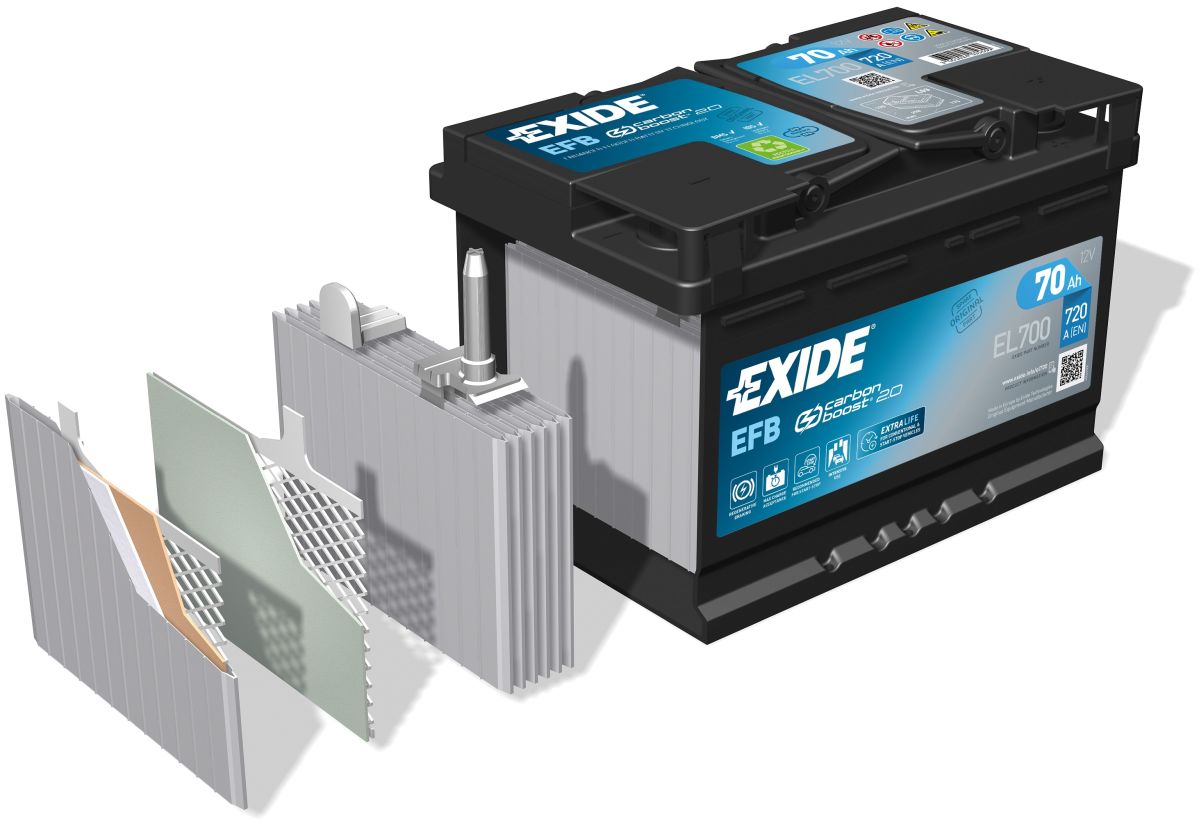
What Is an EFB Battery?
EFB stands for Enhanced Flooded Battery.
An EFB battery is essentially an improved version of the conventional flooded lead-acid battery. It uses a liquid electrolyte, but its internal construction is optimized to withstand more frequent charging and discharging cycles.
EFB technology was developed largely to meet the demands of vehicles equipped with basic or intermediate start-stop systems.
In a vehicle with a start-stop system, the engine may shut down whenever the car stops at a traffic light or in heavy traffic. The battery must then provide the energy required to restart the engine repeatedly.
A conventional battery may not be designed for this level of cycling.
An EFB battery offers better cycle resistance and improved charge acceptance compared with a standard flooded battery.
What Is an AGM Battery?
AGM stands for Absorbent Glass Mat.
AGM batteries are also lead-acid batteries, but their internal construction is significantly different from conventional flooded batteries.
Instead of allowing the electrolyte to move freely around the plates, AGM technology uses fiberglass mats to absorb and hold the electrolyte.
This construction provides several advantages.
AGM batteries have excellent resistance to repeated charge and discharge cycles, strong starting performance, and good charge acceptance. They are particularly suitable for vehicles with high electrical loads and advanced start-stop systems.
AGM batteries are also capable of handling the demands associated with regenerative braking systems, where the alternator may charge the battery intensively during deceleration.
Why Are AGM Batteries More Expensive?
AGM batteries generally cost more than conventional lead-acid and EFB batteries because they use more advanced internal construction and materials.
However, the higher purchase price is associated with greater cycling capability and better performance under demanding operating conditions.
A vehicle with numerous electrical systems, a sophisticated start-stop system, or regenerative braking may require these characteristics.
Installing a cheaper conventional battery simply because it physically fits the battery tray may therefore be a mistake.
What Is a Calcium Battery?
A calcium battery is a type of lead-acid battery in which calcium is added to the lead plates.
Calcium reduces water loss during normal operation and allows the battery to operate with lower maintenance requirements.
Many modern conventional automotive batteries use calcium-calcium technology, sometimes referred to as Ca/Ca batteries.
The term "calcium battery" does not necessarily mean that the battery is a completely different battery technology from lead-acid batteries. Instead, it describes the alloy used in the battery's plates.
Calcium technology can provide good resistance to corrosion, reduced electrolyte loss, and a relatively long service life under appropriate conditions.
EFB vs AGM
EFB and AGM batteries are both designed to handle more demanding electrical conditions than conventional flooded batteries, but AGM generally offers higher performance.
An EFB battery is commonly used in vehicles with relatively simple start-stop systems.
AGM batteries are better suited to vehicles with advanced start-stop systems, regenerative braking, high electrical consumption, or applications where the battery experiences frequent cycling.
In simple terms, EFB can be considered an enhanced version of the conventional flooded battery, while AGM represents a more advanced battery construction.
Lead-Acid vs EFB
The main difference between a conventional lead-acid battery and an EFB battery is cycle durability.
A traditional flooded battery works well when it is primarily used for starting the engine and then kept relatively well charged.
An EFB battery is designed to tolerate significantly more frequent charging and discharging.
For example, a vehicle equipped with a start-stop system may shut down and restart the engine dozens of times during a typical journey. The battery must be able to handle this repeated cycling without its capacity deteriorating rapidly.
This is where EFB technology provides an advantage.
EFB vs AGM: Which Is Better?
AGM is generally the more capable technology, but that does not mean it is always the better choice for every vehicle.
If a vehicle was designed for an EFB battery, an EFB replacement that meets the manufacturer's specifications may be completely adequate.
An AGM battery may be appropriate as an upgrade in certain applications, but this should only be done when the vehicle's charging system, battery-management system, and manufacturer specifications allow it.
The correct battery is determined by the vehicle, not simply by choosing the most expensive technology available.
Can an AGM Battery Replace an EFB Battery?
In some vehicles, an EFB battery can be replaced with an AGM battery.
However, the replacement should be compatible with the vehicle's battery-management system.
Modern vehicles often have a Battery Management System (BMS) or intelligent battery sensor that monitors battery condition and controls charging.
After replacing the battery, some vehicles also require the new battery to be registered or coded in the vehicle's electronic system.
If this process is ignored, the charging strategy may not be optimized for the new battery.
Therefore, an AGM-to-EFB or EFB-to-AGM conversion should not be treated as a simple physical replacement.
Can a Normal Lead-Acid Battery Replace an AGM Battery?
This is generally not recommended unless the vehicle manufacturer specifically allows it.
An AGM battery can tolerate high cycling demands that a conventional flooded battery may not be able to withstand.
If a vehicle was designed around AGM technology and a conventional battery is installed instead, the battery may deteriorate much more quickly.
Start-stop operation may also become unreliable, and the vehicle's energy-management system may not operate as intended.
In some cases, the vehicle may disable the start-stop function because the battery does not meet the required conditions.
What Is the Difference Between Calcium and AGM?
These terms describe different aspects of battery construction.
Calcium technology generally refers to the alloy used in the battery's lead plates.
AGM refers to the way the electrolyte is contained within the battery using absorbent glass mats.
Therefore, "calcium" and "AGM" are not necessarily direct alternatives in the same sense as EFB and AGM.
An AGM battery can also use calcium-containing lead alloys in its internal construction.
This is why battery specifications should be evaluated as a whole rather than based on a single label.
Which Battery Has the Longest Service Life?
There is no universal answer because battery life depends heavily on operating conditions.
Temperature, charging voltage, driving patterns, electrical load, vibration, and the quality of the battery all affect service life.
In general, AGM batteries can provide excellent durability in vehicles that subject the battery to frequent cycling.
EFB batteries generally offer better cycle life than conventional flooded batteries.
A conventional lead-acid battery can still provide a long service life when used in a vehicle with relatively low electrical demand and appropriate charging conditions.
Using the wrong battery technology, however, can significantly reduce its lifespan regardless of the battery's nominal quality.
How Does Cold Weather Affect These Batteries?
Low temperatures reduce a battery's available starting power.
This is particularly important because engine oil also becomes more viscous in cold weather, meaning the starter motor must work harder to turn the engine.
At the same time, the battery has less available capacity.
A weak battery that starts the vehicle without problems during summer may therefore fail when temperatures drop significantly.
AGM batteries generally offer strong cold-cranking performance, but no battery is immune to the effects of extreme cold.
Battery condition is therefore particularly important before winter.
How Does Hot Weather Affect Car Batteries?
High temperatures can also shorten battery life.
Heat accelerates chemical reactions inside the battery and can increase water loss and internal degradation.
This is one reason why a battery that operates in a very hot climate may have a shorter service life than one operating in milder conditions.
Modern maintenance-free batteries reduce electrolyte loss considerably, but they are still affected by high temperatures.
Why Does a New Battery Sometimes Need to Be Registered?
Modern vehicles increasingly use intelligent charging systems.
The vehicle monitors battery voltage, current, temperature, and state of charge. The charging strategy can then be adjusted according to the battery's condition.
When a new battery is installed, the vehicle may need to be informed that the battery has been replaced.
This procedure is often called battery registration, battery adaptation, or battery coding, depending on the manufacturer.
Some vehicles also require the battery's capacity and technology to be programmed.
For example, replacing an AGM battery with another AGM battery may still require registration, while changing from EFB to AGM may require additional configuration.
Which Battery Should You Choose?
The safest approach is to use the battery technology specified by the vehicle manufacturer.
When selecting a replacement battery, you should consider:
-
Battery technology
-
Voltage
-
Capacity (Ah)
-
Cold Cranking Amps (CCA)
-
Physical dimensions
-
Terminal arrangement
-
Start-stop compatibility
-
Battery-management system requirements
A battery can have the correct physical dimensions and still be unsuitable for the vehicle.
For example, installing a conventional lead-acid battery in a vehicle designed for AGM technology may result in reduced battery life and charging problems.
The Main Difference Between EFB, AGM, Lead-Acid, and Calcium Batteries
Conventional lead-acid batteries are suitable for many vehicles with relatively simple electrical systems and conventional starting requirements.
EFB batteries are enhanced flooded batteries designed to withstand more frequent cycling and are commonly used with basic start-stop systems.
AGM batteries use absorbent glass mat technology and offer excellent cycle durability, charge acceptance, and performance under high electrical loads.
Calcium batteries use calcium-containing lead alloys to reduce water loss and improve certain aspects of battery durability. Calcium is more accurately considered a battery construction or plate-alloy technology rather than a completely separate category from lead-acid batteries.
The most important point is that the best battery is not necessarily the one with the highest specifications. It is the one that matches the vehicle's electrical architecture and charging system.
A battery that is perfectly suitable for a conventional vehicle may be completely inadequate for a modern car with start-stop, regenerative braking, and a high electrical load. Choosing the correct battery technology can improve reliability, prevent charging-system problems, and ensure that the vehicle's electronic systems operate as intended.