TR
TR EN
EN

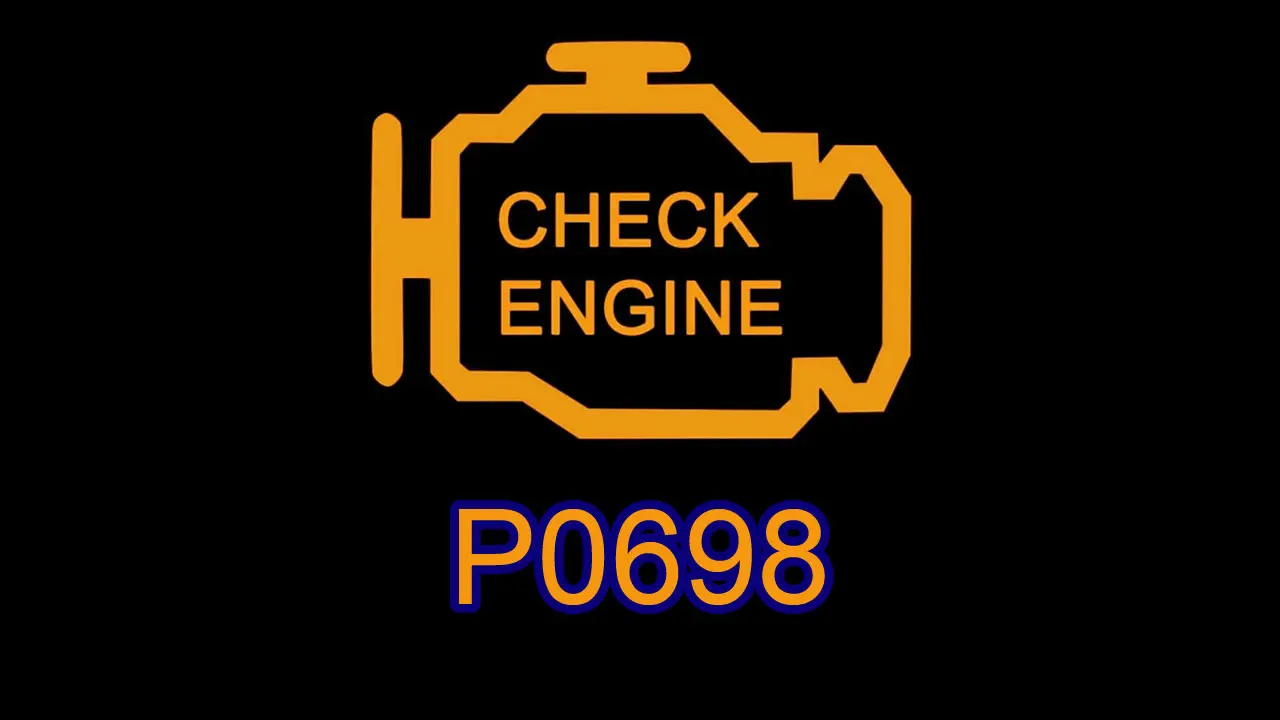
P0698 Sensor Reference Voltage "C" Circuit Low
The P0698 – Sensor Reference Voltage "C" Circuit Low diagnostic trouble code (DTC) indicates that the engine or transmission control module has detected a lower-than-expected voltage on the Sensor Reference Voltage "C" circuit.
This is a general electrical fault code. It does not necessarily identify one particular failed sensor. The affected reference circuit may supply one or several sensors, depending on the vehicle manufacturer and electrical system design.
In many vehicles, sensor reference circuits operate at approximately 5 volts. If the voltage on Reference "C" drops below the expected range, the control module can store P0698.
What Does P0698 Mean?
Modern vehicle sensors often receive a stable reference voltage from the ECU.
A simplified circuit looks like:
ECU → Reference Voltage → Sensor → Signal → ECU
The ECU expects the reference circuit to remain within a specific voltage range.
With P0698, the control module detects:
Reference Voltage "C" = Too Low
The exact voltage threshold varies by manufacturer.
It is therefore important not to assume that every vehicle must show exactly 5.00 volts. The manufacturer's specification should always be used.
What Does the "C" Mean?
The "C" refers to a particular sensor-reference circuit, not necessarily one specific sensor.
This distinction is important.
One vehicle may use Reference "C" for:
-
A transmission pressure sensor
-
A throttle-related sensor
-
An engine pressure sensor
Another vehicle may use the same designation for several sensors.
Therefore, the exact sensors connected to Reference "C" must be identified using the vehicle's wiring diagram or manufacturer service information.
Is P0698 a Specific Sensor Fault?
No, not necessarily.
P0698 identifies a low reference-voltage condition, not automatically a failed sensor.
Possible causes include:
-
Short to ground
-
Faulty sensor
-
Damaged wiring
-
Corroded connector
-
Poor sensor ground
-
Open reference circuit
-
Excessive resistance
-
Multiple sensors loading the circuit
-
ECU internal fault
This is why replacing a sensor immediately after seeing P0698 can be a mistake.
Symptoms of P0698
Symptoms depend on which sensors use the affected reference circuit.
Possible symptoms include:
Check Engine Light
The MIL will normally illuminate.
Reduced engine performance
Incorrect sensor information can cause the ECU to enter a protective strategy.
Poor acceleration
Engine control may be affected if a critical sensor is involved.
Rough engine operation
Incorrect sensor signals can disturb fuel or air calculations.
Transmission shifting problems
If the affected circuit supplies a transmission sensor, gear changes can become abnormal.
Limp mode
The vehicle may limit engine or transmission operation.
Incorrect sensor readings
The ECU may receive values that do not correspond to actual operating conditions.
Intermittent symptoms
The problem may appear only under certain temperatures, vibrations, or loads.
What Causes P0698?
Several different faults can produce a low sensor reference voltage.
Short to ground
The reference wire may be contacting ground.
Faulty sensor
An internally damaged sensor may pull the reference circuit down.
Damaged wiring
The reference wire may be broken, pinched, or damaged.
Corroded connector
Corrosion can create abnormal resistance or an unreliable connection.
Poor terminal contact
A loose terminal can cause voltage loss.
Multiple sensors loading the circuit
If several sensors share Reference "C", one faulty sensor can affect the entire circuit.
Open or high-resistance reference circuit
A damaged wire can prevent the correct voltage from reaching the sensor.
Poor ECU ground
An ECU grounding problem can produce abnormal reference-voltage behavior.
Faulty ECU
In less common cases, the ECU's internal reference-voltage circuit may be defective.
Can a Bad Sensor Cause P0698?
Yes.
A sensor connected to Reference "C" can fail internally and pull the reference voltage below its normal value.
This is particularly important when several sensors share the same reference supply.
For example:
ECU → 5V Reference "C" → Sensor A
** → Sensor B**
** → Sensor C**
If Sensor B develops an internal fault and pulls the circuit toward ground, the reference voltage for the other sensors can also drop.
Can a Short to Ground Cause P0698?
Yes.
A short to ground is one of the primary things to investigate.
If the reference wire contacts ground, the voltage can fall dramatically.
Possible causes include:
-
Chafed insulation
-
Pinched wiring
-
Melted insulation
-
Damaged connector
-
Incorrect wiring repair
-
Water contamination
Can Wiring Cause P0698?
Yes.
Inspect the wiring carefully.
Look for:
-
Broken wires
-
Chafing
-
Melted insulation
-
Pinched wires
-
Corrosion
-
High resistance
-
Short circuits
-
Incorrect previous repairs
Pay particular attention to areas near:
-
Engine brackets
-
Transmission
-
Exhaust components
-
Sharp edges
-
Moving components
Can a Bad Connector Cause P0698?
Yes.
A connector with corrosion or poor terminal contact can cause voltage loss in the reference circuit.
Check for:
-
Corroded terminals
-
Bent pins
-
Loose terminals
-
Water
-
Oil
-
Transmission fluid
-
Damaged seals
-
Poor terminal tension
If several sensors are affected, inspect common connectors and wiring junctions.
Can Low Battery Voltage Cause P0698?
Low battery voltage is not normally the direct meaning of P0698.
P0698 specifically indicates a low condition on a sensor reference-voltage circuit.
However, if the vehicle has widespread electrical problems, battery voltage and charging-system operation should still be checked.
Can a Bad ECU Cause P0698?
Yes, but it should be considered after external causes are eliminated.
The ECU creates and monitors the sensor reference voltage.
An internal ECU failure could cause the reference circuit to produce insufficient voltage.
Before replacing the ECU, verify:
-
Sensor reference wiring
-
Sensor condition
-
Sensor grounds
-
Connectors
-
Power supply
-
ECU grounds
-
Short circuits
Can P0698 Cause Transmission Problems?
Yes, depending on the vehicle.
If Reference "C" supplies a transmission sensor, P0698 can affect transmission operation.
Possible symptoms include:
-
Harsh shifting
-
Delayed shifting
-
Incorrect gear selection
-
Limp mode
-
Abnormal pressure control
-
Torque converter problems
This is why the code should not automatically be considered an engine-only fault.
Can P0698 Cause Throttle Problems?
Potentially.
If an engine or throttle-related sensor uses the affected reference circuit, the ECU may receive incorrect information.
This can cause:
-
Reduced throttle response
-
Reduced engine power
-
Acceleration problems
-
Limp mode
The exact relationship depends on the vehicle.
Can P0698 Cause Limp Mode?
Yes.
If the ECU cannot trust important sensor signals, it may enter a protective strategy.
Depending on the affected circuit, this can restrict:
-
Engine power
-
Throttle operation
-
Transmission operation
-
Available gears
-
Vehicle speed
Can P0698 Cause a No-Start Condition?
Potentially.
If the affected reference circuit supplies a sensor required for engine operation, a sufficiently low reference voltage may prevent the ECU from receiving a valid signal.
However, P0698 by itself does not prove that it is responsible for a no-start condition.
How Is P0698 Diagnosed?
The most important first step is to determine which sensors use Reference Voltage "C" on that specific vehicle.
1. Scan all control modules
Record:
-
Stored DTCs
-
Pending DTCs
-
Freeze-frame data
Look for other sensor-related codes.
2. Identify Reference "C"
Use the vehicle wiring diagram to determine:
-
Which module supplies the reference
-
Which sensors use it
-
Where the circuit branches
-
Which connectors are involved
3. Measure the reference voltage
With the ignition in the correct position according to the service procedure, measure the reference circuit.
Compare the reading with the manufacturer's specification.
4. Check sensor ground
A poor sensor ground can cause abnormal voltage measurements and incorrect sensor operation.
5. Check for a short to ground
If the reference circuit is being pulled toward ground, identify where the short occurs.
6. Disconnect sensors systematically
If several sensors share the reference circuit, disconnect them one at a time according to the manufacturer's procedure.
If the reference voltage returns to normal after one sensor is disconnected, that sensor becomes a strong suspect.
7. Inspect the wiring
Check for:
-
Opens
-
Shorts
-
High resistance
-
Chafing
-
Corrosion
-
Incorrect repairs
8. Inspect connectors
Check terminals and connector housings carefully.
9. Verify ECU power and ground
Make sure the control module has a stable electrical supply.
10. Test the ECU
Only after the sensors, wiring, connectors, power, and grounds have been verified should an internal ECU fault be considered.
Why Is Disconnecting Sensors Useful?
A shared reference circuit can make diagnosis confusing.
Suppose three sensors share Reference "C":
Sensor A + Sensor B + Sensor C → Reference "C"
If Sensor B internally shorts the reference circuit toward ground, the ECU may report a low reference voltage.
Disconnecting Sensor B could cause the voltage to return to normal.
This provides strong evidence that Sensor B or its wiring is responsible.
However, the exact testing method should follow the manufacturer's service procedure.
Can a Multimeter Diagnose P0698?
Yes.
A multimeter is one of the most useful tools for this fault.
It can measure:
-
Reference voltage
-
Sensor ground
-
Battery voltage
-
Continuity
-
Resistance
-
Voltage drop
-
Short circuits
The key is to compare measurements with the correct vehicle-specific specifications.
Can an Oscilloscope Help?
Yes.
An oscilloscope can be useful when the reference voltage problem is intermittent.
It can reveal:
-
Voltage drops
-
Electrical noise
-
Intermittent interruptions
-
Sensor signal instability
For a constant low reference voltage, a multimeter is usually sufficient for the initial diagnosis.
What If P0698 Appears With Multiple Sensor Codes?
This can be a very important clue.
For example, if several unrelated sensors suddenly report low voltage, it is unlikely that all of those sensors failed at exactly the same time.
A shared circuit problem becomes much more likely.
Inspect the common:
-
Reference wire
-
Connector
-
Ground
-
Harness
-
ECU circuit
before replacing several sensors.
What If P0698 Appears After Engine Repair?
Inspect wiring that may have been moved or disturbed.
Check:
-
Sensor connectors
-
Engine harness
-
Ground straps
-
Wiring around brackets
-
Harness routing
-
Pinched wires
A harness trapped underneath a component can create a short to ground or high-resistance condition.
What If P0698 Appears After Transmission Repair?
If transmission sensors use Reference "C", inspect:
-
Transmission harness
-
Transmission connectors
-
Pressure sensor wiring
-
Speed sensor wiring
-
TCM connections
A damaged harness or incorrectly installed connector can pull the reference circuit low.
Is P0698 a Serious Problem?
It can be.
The seriousness depends on which sensors are affected.
If Reference "C" supplies a critical engine or transmission sensor, the vehicle may experience major drivability problems.
If it supplies a less critical sensor, the vehicle may continue operating with relatively minor symptoms.
Can You Drive With P0698?
If the vehicle operates normally and only the warning light is illuminated, a short trip to a diagnostic facility may be possible.
However, avoid continued driving if:
-
The engine loses significant power
-
The throttle becomes unresponsive
-
The transmission enters limp mode
-
Shifting becomes abnormal
-
The engine stalls
-
Multiple warning lights appear
-
The vehicle behaves unpredictably
How Is P0698 Repaired?
The repair depends on the confirmed cause.
Possible repairs include:
-
Replacing a faulty sensor
-
Repairing a shorted reference wire
-
Repairing damaged wiring
-
Repairing a connector
-
Cleaning or replacing corroded terminals
-
Correcting poor sensor grounding
-
Repairing an incorrectly installed component
-
Removing an electrical modification that interferes with the circuit
-
Repairing the ECU circuit
-
Replacing the ECU when an internal fault is confirmed
Does P0698 Require Sensor Replacement?
Not automatically.
The first task is to determine why the reference voltage is low.
A sensor should be replaced only when testing demonstrates that the sensor is responsible.
Otherwise, the real problem may remain in:
Wiring → Connector → Ground → Another sensor → ECU
Does P0698 Require ECU Replacement?
Usually not.
ECU replacement should be one of the last steps.
A good diagnostic sequence is:
Identify Reference "C" → Measure voltage → Check ground → Check for short to ground → Isolate sensors → Inspect wiring → Inspect connectors → Verify ECU power/ground → Test ECU
Common Diagnostic Mistakes
Replacing the sensor immediately
P0698 does not identify a specific failed sensor.
Replacing several sensors
One shared reference-circuit fault can affect multiple sensors.
Replacing the ECU too early
External wiring and sensor problems should be eliminated first.
Ignoring the sensor ground
Reference voltage and sensor ground must be evaluated together.
Ignoring wiring
A short to ground or high-resistance connection can easily cause a low reference voltage.
Using generic voltage specifications
The exact reference-voltage limits vary by vehicle.
Clearing the code without diagnosis
If the electrical problem remains, P0698 will return.
P0697 vs. P0698 vs. P0699
These codes are closely related.
P0697 – Sensor Reference Voltage "C" Circuit Open
Indicates an open or interrupted Reference "C" circuit.
P0698 – Sensor Reference Voltage "C" Circuit Low
Indicates that the reference voltage is lower than expected.
P0699 – Sensor Reference Voltage "C" Circuit High
Indicates that the reference voltage is higher than expected.
In simple terms:
P0697 → Reference "C" circuit is open
P0698 → Reference "C" voltage is too low
P0699 → Reference "C" voltage is too high
How Do You Clear P0698?
Do not simply erase the code and consider the problem solved.
The proper process is:
Scan all modules → Record all DTCs → Identify Reference "C" → Measure voltage → Check sensor ground → Check for shorts → Isolate sensors → Inspect wiring/connectors → Repair the confirmed fault → Clear codes → Start the vehicle → Monitor sensor data → Road test → Rescan
If P0698 returns, the low-reference-voltage problem has not been resolved.
Final Thoughts on P0698
P0698 – Sensor Reference Voltage "C" Circuit Low indicates that the control module has detected a lower-than-expected voltage on the Sensor Reference Voltage "C" circuit.
The most likely areas to investigate include a short to ground, faulty sensor, damaged wiring, poor connector, high resistance, poor sensor ground, or, less commonly, an internal ECU problem.
The letter "C" does not represent one universal sensor. Its exact meaning depends on the vehicle's electrical architecture.
The most effective diagnostic strategy is:
Identify the Reference "C" circuit → Measure the voltage → Check sensor grounds → Check for a short to ground → Identify all sensors sharing the circuit → Disconnect sensors systematically → Inspect wiring and connectors → Verify ECU power and ground → Test the ECU only after the external circuit has been verified.
Most importantly, P0698 does not automatically mean that a sensor or ECU must be replaced. When several sensors share the same reference circuit, one defective sensor or one damaged wire can pull the entire circuit low and create multiple seemingly unrelated fault codes.