TR
TR EN
EN

What Is Common Rail?
Common Rail is a high-pressure electronic fuel injection system used primarily in modern diesel engines. The system is called Common Rail because multiple fuel injectors receive fuel from a shared high-pressure fuel rail.
Unlike older diesel injection systems, Common Rail separates the process of generating fuel pressure from the timing of fuel injection. The high-pressure pump supplies fuel to the common rail, while the engine control unit (ECU) electronically determines when each injector opens and how much fuel it injects.
This allows modern diesel engines to achieve more precise fuel control, improved performance, better fuel economy, and lower emissions.
How Does a Common Rail System Work?
The basic fuel path is:
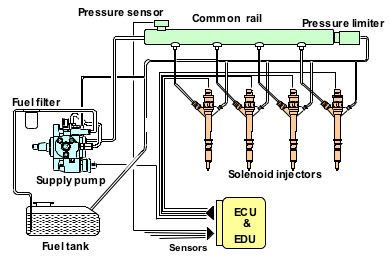
Fuel Tank → Fuel Filter → High-Pressure Pump → Common Rail → Injectors → Combustion Chamber
Diesel fuel is drawn from the fuel tank and passes through the fuel filter. Depending on the vehicle design, a low-pressure fuel pump may assist with fuel delivery.
The fuel then reaches the high-pressure pump, which raises the fuel pressure significantly.
The pressurized fuel is stored in the common rail. The rail acts as a shared high-pressure reservoir for all of the injectors.
The engine ECU continuously evaluates information from various sensors, including:
-
Engine speed
-
Accelerator pedal position
-
Engine load
-
Engine coolant temperature
-
Rail pressure
-
Airflow
-
Crankshaft position
-
Camshaft position
-
Boost pressure
Based on this information, the ECU controls the fuel injectors according to the engine's current operating conditions.
Why Was Common Rail Technology Developed?
Older diesel injection systems relied more heavily on mechanical components to determine fuel pressure and injection timing.
Common Rail technology introduced a more flexible electronic control strategy.
The high-pressure pump can maintain fuel pressure in the rail while the ECU independently controls the timing and duration of injector operation.
This allows fuel injection to be adjusted much more precisely according to engine speed and load.
Main Components of a Common Rail System
Fuel Tank
The fuel tank stores the diesel fuel. Depending on the vehicle, it may contain an electric low-pressure fuel pump.
Fuel Filter
The fuel filter removes contaminants and protects the high-pressure components from dirt and water.
Fuel cleanliness is particularly important in Common Rail systems because the high-pressure pump and injectors operate with very tight tolerances.
High-Pressure Fuel Pump
The high-pressure pump raises the fuel pressure to the level required by the injection system and supplies fuel to the common rail.
Common Rail
The common rail is the shared high-pressure fuel reservoir connected to the injectors.
This component is responsible for distributing pressurized fuel to the individual injectors.
Fuel Injectors
The injectors deliver fuel into the combustion chambers.
Their opening time and injection quantity are electronically controlled by the engine management system.
Rail Pressure Sensor
This sensor measures the pressure inside the common rail and sends the information to the ECU.
Fuel Pressure or Quantity Control Valve
Depending on the system design, a fuel metering valve on the high-pressure pump or a pressure-control valve on the rail may be used to regulate fuel pressure.
Engine Control Unit (ECU)
The ECU is the electronic control center of the system. It processes sensor information and controls injection timing, injection quantity, fuel pressure management, and other engine functions.
Why Are Common Rail Injectors So Important?
Common Rail injectors are among the most precise components in a modern diesel engine.
Their job is not simply to spray fuel into the cylinder. The ECU can control:
-
When injection begins
-
How long the injector remains open
-
How much fuel is injected
-
How many injection events occur during one combustion cycle
This allows modern diesel engines to use several separate injection events during a single cycle.
Pilot, Main, and Post Injection
One of the major advantages of Common Rail technology is the ability to divide fuel delivery into multiple injection events.
Pilot Injection
A small amount of fuel is injected before the main injection. This can help control the beginning of combustion and reduce combustion noise.
Main Injection
The main amount of fuel required to produce engine power is injected during the primary combustion event.
Post Injection
Depending on the engine's operating strategy, additional fuel may be injected after the main injection. This can be used for emissions-control strategies and, on some diesel engines, to help increase exhaust temperature during DPF regeneration.
The exact injection strategy varies according to the engine and fuel-injection system.
Why Does Common Rail Use Such High Pressure?
High injection pressure helps diesel fuel atomize into very small droplets as it leaves the injector.
Better atomization helps the fuel mix more effectively with the air inside the combustion chamber.
This can contribute to:
-
More controlled combustion
-
Better engine efficiency
-
Improved power
-
Lower emissions
However, extremely high fuel pressure also explains why Common Rail components are sensitive to contamination and improper servicing.
Symptoms of a Common Rail Problem
A Common Rail problem can produce different symptoms depending on which component is affected.
Common symptoms include:
-
Hard starting
-
Extended cranking
-
Failure to start
-
Rough idle
-
Engine misfire
-
Poor acceleration
-
Reduced engine power
-
Increased fuel consumption
-
Excessive exhaust smoke
-
Engine stalling
-
Power loss at high RPM
-
Limp mode
-
Check Engine light
These symptoms do not automatically prove that the Common Rail system itself is faulty. Similar symptoms can also be caused by turbocharger problems, EGR faults, DPF restriction, air leaks, electrical faults, or mechanical engine problems.
What Happens When a Common Rail Injector Fails?
A faulty injector may deliver too much fuel, too little fuel, or fuel at the wrong time.
Possible symptoms include:
-
Rough engine operation
-
Misfires
-
Poor idle quality
-
Increased fuel consumption
-
Excessive smoke
-
Reduced power
-
Difficult starting
-
Uneven cylinder operation
Injector condition can be evaluated using several diagnostic methods.
One particularly useful test is an injector leak-off or back-leakage test, which measures the amount of fuel returning from the injectors.
High-Pressure Fuel Pump Failure
If the high-pressure pump cannot generate sufficient pressure, the common rail may fail to reach the required pressure.
This can cause:
-
Difficult starting
-
Reduced engine power
-
Engine stalling
-
Poor high-load performance
-
Failure to start
-
Rail-pressure-related fault codes
However, low rail pressure does not automatically mean that the high-pressure pump is defective.
Other possible causes include:
-
Restricted fuel filter
-
Low-pressure fuel supply problems
-
Air entering the fuel system
-
Excessive injector return flow
-
Fuel pressure-control problems
-
Rail pressure sensor problems
-
Wiring or connector faults
The entire fuel-pressure system should therefore be tested before replacing an expensive high-pressure pump.
Why Does Common Rail Pressure Drop?
Low rail pressure can have several different causes.
Possible causes include:
-
Weak high-pressure pump
-
Restricted fuel filter
-
Low-pressure fuel supply problem
-
Air in the fuel system
-
Excessive injector return flow
-
Faulty pressure-control valve
-
Faulty fuel metering valve
-
Faulty rail pressure sensor
-
Wiring or connector problems
-
Incorrect fuel
-
Fuel system leakage
For this reason, replacing the high-pressure pump based only on a low-pressure reading is not a proper diagnostic strategy.
Common Rail and DPF
The Common Rail system and the Diesel Particulate Filter (DPF) are different systems, but they work closely together.
During DPF regeneration, the ECU may use different injection strategies to increase exhaust temperature.
Additional fuel injection can be used as part of the regeneration strategy on some engines.
Therefore, problems involving:
-
Injectors
-
Injection timing
-
Fuel pressure
-
Fuel quantity
can also affect DPF operation.
Is Common Rail the Same as a Turbocharger?
No.
Common Rail is a fuel injection technology.
A turbocharger is an air-compression system that forces additional air into the engine.
The two systems perform different functions, but they work together through the engine ECU.
For example, when the turbocharger increases the amount of air entering the engine, the ECU can adjust fuel injection accordingly.
This is why the turbocharger, Common Rail system, EGR, DPF, and other engine systems can be closely interconnected.
Why Is Fuel Quality Important in Common Rail Systems?
Fuel quality is extremely important because Common Rail components operate under very high pressure and with very small internal clearances.
Contaminated diesel fuel can damage or affect:
-
High-pressure pumps
-
Fuel injectors
-
Fuel filters
-
Fuel pressure-control components
Water contamination can be particularly harmful because diesel fuel systems rely on the fuel itself for lubrication in certain components.
Using the correct fuel filter and maintaining the fuel system properly can help reduce the risk of expensive component damage.
Can Bad Diesel Fuel Damage a Common Rail System?
Yes.
Water, dirt, incorrect fuel, and contaminated diesel can cause serious problems in a Common Rail system.
Possible consequences include:
-
Injector wear
-
High-pressure pump damage
-
Poor fuel pressure
-
Hard starting
-
Reduced engine power
-
Fuel system corrosion
-
Excessive injector return flow
If a problem appears immediately after refueling, fuel quality should be considered as part of the diagnosis.
Common Rail Maintenance
Proper maintenance is important for the long-term reliability of the system.
Important practices include:
-
Use good-quality diesel fuel.
-
Replace the fuel filter according to the manufacturer's maintenance requirements.
-
Prevent dirt from entering the fuel system during repairs.
-
Investigate fuel-pressure problems promptly.
-
Do not ignore difficult starting or repeated fuel-system fault codes.
-
Use appropriate diagnostic procedures before replacing expensive components.
When the high-pressure fuel system is opened, cleanliness is extremely important.
How Is a Common Rail Problem Diagnosed?
A proper Common Rail diagnosis involves more than simply reading an OBD fault code.
A technician may check:
-
Stored diagnostic trouble codes
-
Requested rail pressure
-
Actual rail pressure
-
Fuel pressure during cranking
-
Fuel pressure under load
-
Injector correction values
-
Injector leak-off quantities
-
Fuel filter condition
-
High-pressure pump operation
-
Fuel metering or pressure-control valves
-
Rail pressure sensor
-
Wiring and electrical connections
One of the most useful diagnostic comparisons is the difference between requested rail pressure and actual rail pressure.
If the ECU requests a certain pressure but the actual pressure consistently remains significantly lower, the technician can investigate the fuel supply, pressure-control system, pump, injectors, and related components.
Common Rail Fault Codes
Common Rail-related problems can trigger various diagnostic trouble codes.
Depending on the vehicle and system, codes may relate to:
-
Fuel rail pressure
-
Fuel pressure sensors
-
Fuel pressure regulation
-
Fuel metering
-
Injector circuits
-
Injector performance
-
Fuel pump control
An OBD code identifies a monitored circuit, system, or condition. It does not automatically prove which physical component has failed.
For example, a rail-pressure fault code does not necessarily mean that the high-pressure pump must be replaced.
Why Are Common Rail Systems More Sensitive Than Older Diesel Systems?
The main reason is precision.
Modern Common Rail systems operate with:
-
Very high fuel pressure
-
Extremely precise injector control
-
Very small internal clearances
-
Electronic pressure management
-
Sophisticated ECU control
This technology provides major advantages in performance and emissions, but it also means contamination, incorrect fuel pressure, poor maintenance, and electrical faults can have significant effects.
Advantages of Common Rail
Common Rail technology offers several important advantages:
-
Precise fuel injection
-
High injection pressure
-
Better fuel atomization
-
More controlled combustion
-
Improved engine performance
-
Better fuel-efficiency potential
-
Lower emissions potential
-
Reduced diesel combustion noise
The actual benefits depend on the engine design, calibration, emissions system, and overall condition of the vehicle.
Common Rail vs. Older Mechanical Diesel Injection
Older mechanical diesel systems generally depended more heavily on mechanical components for fuel pressure and injection timing.
Common Rail systems separate high-pressure fuel generation from injection timing.
This gives the ECU much greater control over the combustion process.
As a result, modern diesel engines can adapt fuel injection much more precisely to changing conditions such as engine speed, load, temperature, and emissions requirements.
The Most Important Point About Common Rail
Common Rail is not a single component such as an injector or high-pressure pump. It is a complete electronically controlled diesel fuel-injection system in which the high-pressure pump, common rail, injectors, pressure sensors, control valves, and engine ECU work together.
The technology allows modern diesel engines to inject very precise quantities of fuel at precisely controlled times. This improves combustion control, performance, fuel economy, and emissions.
At the same time, the system is highly sensitive to fuel quality, contamination, pressure problems, and incorrect diagnosis. When a Common Rail fault is suspected, replacing one component based only on an error code is not enough. The fuel pressure, injectors, high-pressure pump, sensors, control valves, and electrical connections should be evaluated as a complete system.