TR
TR EN
EN

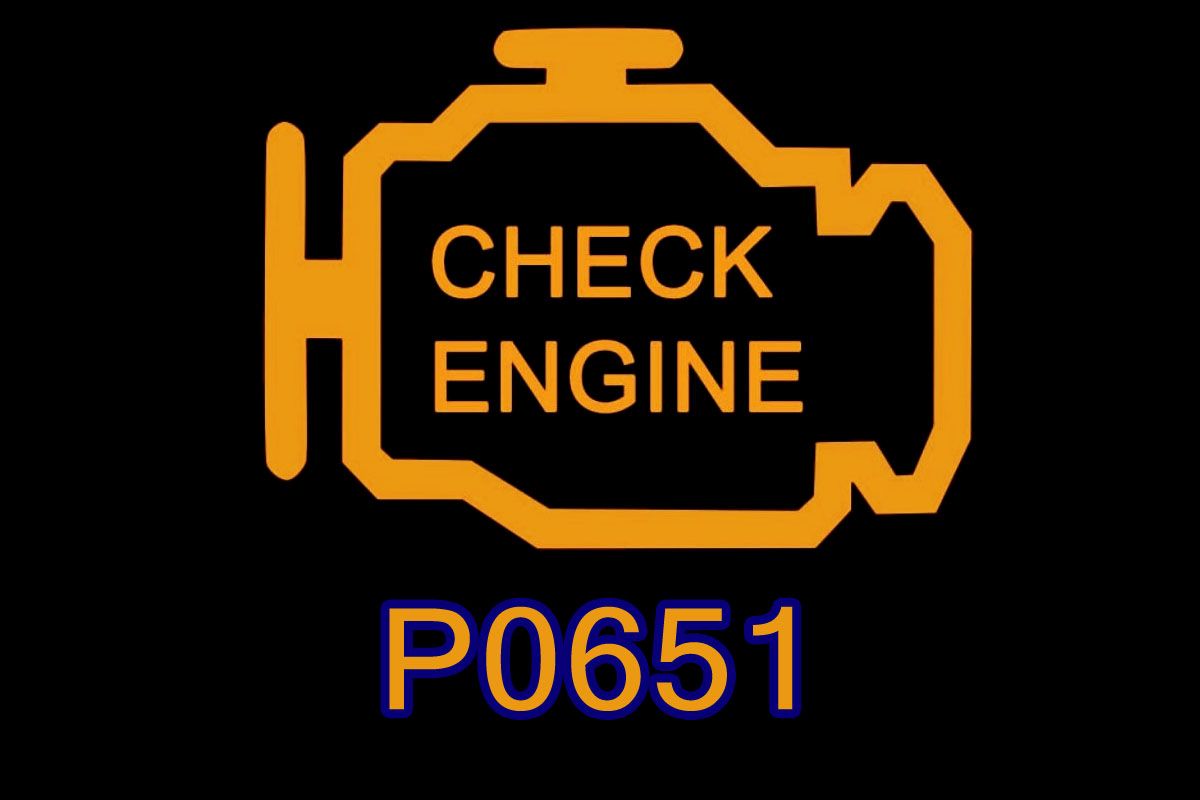
P0651 Sensor Reference Voltage "B" Circuit/Open
The P0651 – Sensor Reference Voltage "B" Circuit/Open diagnostic trouble code (DTC) indicates that the ECM/PCM has detected an open or interrupted circuit in the Sensor Reference Voltage "B" system.
Modern engines use regulated reference-voltage circuits to provide sensors with a stable electrical reference, commonly around 5 volts. The ECM uses these reference signals to accurately interpret sensor outputs.
P0651 is important because the Reference Voltage "B" circuit may supply several sensors at the same time. Therefore, the code does not automatically mean that one particular sensor has failed.
What Does P0651 Mean?
In simple terms:
The ECM/PCM is not detecting the expected electrical connection in the Sensor Reference Voltage "B" circuit.
A simplified system can look like:
ECM/PCM → 5V Reference "B" → Sensor(s) → Sensor Signal → ECM/PCM
If the reference wire is broken or disconnected, the sensors connected to that circuit may no longer receive the required reference voltage.
For example:
ECM → 5V Reference B → Sensor A
** → Sensor B**
** → Sensor C**
If the Reference B wire becomes open:
ECM → X → Sensor A / Sensor B / Sensor C
the ECM may detect P0651.
What Does "Circuit/Open" Mean?
The word "open" means that the electrical path is interrupted.
An open circuit can be caused by:
-
Broken wire
-
Disconnected connector
-
Loose terminal
-
Corroded terminal
-
Damaged fuse or power connection
-
Internal sensor failure
-
Broken circuit inside a component
-
Damaged ECM connector
-
Poor previous wiring repair
Unlike P0652, which indicates low voltage, P0651 specifically points toward an open or interrupted reference circuit.
What Does "B" Mean?
The "B" designation is manufacturer-specific.
It does not universally mean:
-
Bank 2
-
Sensor 2
-
Rear sensor
-
Second sensor
Instead, "B" identifies a particular reference-voltage circuit in the vehicle's electrical architecture.
One manufacturer may connect certain sensors to Reference B, while another manufacturer may use the same designation for completely different sensors.
Therefore, the vehicle-specific wiring diagram is essential for accurate diagnosis.
What Causes P0651?
Possible causes include:
-
Broken 5V reference wire
-
Disconnected sensor connector
-
Corroded connector
-
Loose terminal
-
Damaged wiring harness
-
Open circuit inside a sensor
-
Damaged ECM connector
-
Poor terminal contact
-
Sensor ground problem
-
Water intrusion
-
Previous wiring repair
-
ECM/PCM internal fault
A wiring or connector problem should generally be investigated before assuming that the ECM has failed.
Can a Bad Sensor Cause P0651?
Yes, potentially.
Although P0651 indicates an open reference circuit, a sensor connected to the circuit can sometimes create an apparent open condition if its internal circuitry has failed.
For example, an internal break in a sensor's reference circuit could interrupt the electrical path.
However, many sensor failures produce separate sensor-specific DTCs, so all stored codes should be considered together.
Can a Broken Wire Cause P0651?
Yes.
A broken reference wire is one of the most straightforward causes.
The wire can be:
-
Completely broken
-
Pulled out of a connector
-
Corroded internally
-
Damaged by heat
-
Chafed against metal
-
Pinched
-
Damaged by vibration
The insulation can sometimes look perfectly normal even though the conductor inside is broken.
Can a Bad Connector Cause P0651?
Yes.
A loose or corroded connector can effectively create an open circuit.
Inspect the relevant connectors for:
-
Corrosion
-
Bent pins
-
Pushed-back terminals
-
Loose terminals
-
Broken locking tabs
-
Water intrusion
-
Damaged seals
A terminal that has moved backward inside a connector may look connected but fail to make electrical contact.
Can a Sensor Connector Being Disconnected Cause P0651?
Yes.
If a sensor connected to Reference Voltage "B" is disconnected, the ECM may detect that the expected circuit is open.
This is especially relevant after:
-
Engine repairs
-
Sensor replacement
-
Intake manifold removal
-
Transmission work
-
Wiring repairs
-
Engine cleaning
A connector that was not fully locked into place can cause an intermittent or permanent P0651.
Can a Poor Ground Cause P0651?
Potentially.
A sensor requires both an appropriate reference voltage and a reliable ground.
A poor sensor ground can cause abnormal sensor behavior and related DTCs.
However, a true open-reference fault should be distinguished from a ground problem through voltage and continuity testing.
Can Low Battery Voltage Cause P0651?
Usually not directly.
The sensor reference voltage is generated and regulated by the ECM/PCM.
A weak battery generally produces low-system-voltage problems rather than a true open reference circuit.
Nevertheless, if P0651 appears together with several unrelated electrical DTCs, check:
-
Battery voltage
-
Charging system
-
Battery terminals
-
Main grounds
Can the Alternator Cause P0651?
Usually not directly.
An alternator normally does not control the sensor reference circuit.
However, unstable charging voltage can cause control-module errors and multiple unrelated DTCs.
If several electrical faults appear simultaneously, the charging system should be checked.
Can the ECM/PCM Cause P0651?
Yes.
The ECM/PCM generates the regulated sensor reference voltage.
An internal ECM fault could therefore cause a reference-voltage circuit problem.
However, ECM failure should generally be considered after the wiring, connectors and sensors have been tested.
Symptoms of P0651
Symptoms depend on which sensors are connected to Reference Voltage "B".
Possible symptoms include:
-
Check Engine Light
-
Poor engine performance
-
Hesitation
-
Rough running
-
Reduced power
-
Poor acceleration
-
Incorrect sensor readings
-
Transmission problems
-
Limp mode
-
Increased fuel consumption
-
Stalling
-
Difficult starting
-
Cruise-control problems
Some vehicles may show only the Check Engine Light.
Can P0651 Cause Limp Mode?
Yes.
If the open reference circuit affects an important engine or transmission sensor, the ECM may activate a fail-safe strategy.
Possible results include:
-
Reduced engine power
-
Limited RPM
-
Limited throttle operation
-
Transmission limp mode
-
Disabled cruise control
The exact response depends on which sensors are affected.
Can P0651 Cause Transmission Problems?
Yes, depending on the vehicle.
Some transmission-related sensors may use the Reference Voltage "B" circuit.
If those sensors lose their required reference voltage, the transmission control system may receive incorrect information.
Possible symptoms include:
-
Harsh shifting
-
Delayed shifting
-
Incorrect gear selection
-
Transmission warning light
-
Limp mode
If transmission DTCs appear together with P0651, they should be diagnosed as part of the same electrical problem.
Can P0651 Cause Throttle Problems?
Potentially.
If a throttle-related sensor uses Reference Voltage "B", an open reference circuit can affect throttle-related measurements.
Possible symptoms include:
-
Poor throttle response
-
Reduced power
-
Limited RPM
-
Electronic throttle warning
-
Limp mode
However, P0651 does not automatically mean that the throttle body is defective.
Can P0651 Cause a No-Start Condition?
It can, depending on the affected sensor.
If a critical engine sensor loses its reference voltage, the ECM may not have the information required to operate the engine correctly.
Possible consequences can include:
-
Difficult starting
-
Stalling
-
No-start condition
If the vehicle does not start, also check:
-
Crankshaft position signal
-
Camshaft position signal
-
Fuel pressure
-
Ignition
-
Battery voltage
-
Immobilizer
-
ECM communication
Can P0651 Damage the Engine?
P0651 itself does not normally cause mechanical engine damage.
The problem is that incorrect or missing sensor information can cause the engine management system to operate improperly.
If the vehicle experiences severe:
-
Misfiring
-
Loss of power
-
Overheating
-
Fuel-control problems
continued driving should be avoided until the fault is diagnosed.
How Is P0651 Diagnosed?
A systematic electrical diagnosis is the best approach.
1. Scan all control modules
Record every stored and pending DTC.
Do not diagnose P0651 in isolation.
Additional sensor codes may identify the affected circuit.
2. Check freeze-frame data
Record:
-
Engine RPM
-
Engine temperature
-
Vehicle speed
-
Engine load
-
Battery voltage
This can help determine when the fault occurred.
3. Identify Reference Voltage "B"
Use the vehicle manufacturer's wiring diagram to determine:
-
Which ECM pin supplies Reference B
-
Which sensors receive it
-
Where the circuit runs
-
Which connectors are involved
4. Measure the reference voltage
Check the voltage directly at the relevant reference circuit.
Compare the measurement with the manufacturer's specification.
5. Inspect the wiring
Look for:
-
Broken wires
-
Chafing
-
Melted insulation
-
Pinched wires
-
Corrosion
-
Previous repairs
6. Inspect connectors
Check each sensor and ECM connector associated with Reference B.
7. Test continuity
With the circuit properly isolated, check whether the reference wire has electrical continuity between the appropriate points.
8. Check sensor grounds
Verify that affected sensors have good ground connections.
9. Check individual sensors
If several sensors share Reference B, test them according to manufacturer procedures.
10. Check the ECM/PCM
If the wiring and sensors are confirmed good but the reference circuit remains open, the ECM may require further testing.
Why Is the Wiring Diagram So Important?
P0651 cannot be diagnosed accurately by simply looking up a generic list of sensors.
The Reference Voltage "B" circuit is manufacturer-specific.
The wiring diagram tells you:
-
Which sensors are connected
-
Which ECM terminal supplies the reference
-
Whether the circuit branches
-
Where connectors are located
-
Which grounds are used
-
How the system is monitored
Without this information, it is easy to replace the wrong component.
Can a Multimeter Diagnose P0651?
Yes.
A multimeter can be used to check:
-
Reference voltage
-
Continuity
-
Resistance
-
Sensor ground
-
Voltage drop
-
Short circuits
A continuity test should be performed with the appropriate circuit isolated according to the manufacturer's procedures.
Can an Oscilloscope Help Diagnose P0651?
Yes, especially if the fault is intermittent.
An oscilloscope can reveal:
-
Reference-voltage interruptions
-
Momentary voltage drops
-
Electrical noise
-
Intermittent connections
This can be useful when the wiring appears visually normal but P0651 continues to return.
Can a Scan Tool Diagnose P0651?
A scan tool is useful, but it usually cannot identify the exact failed component by itself.
It can provide:
-
Additional DTCs
-
Live sensor data
-
Freeze-frame information
-
Module voltage information
-
Communication status
If several sensors show abnormal readings at the same time, a shared reference circuit becomes a strong suspect.
What If P0651 Returns Immediately After Clearing?
If P0651 returns immediately, the open circuit is likely still present.
Concentrate on:
-
Reference-voltage wiring
-
Sensor connectors
-
ECM connectors
-
Broken wires
-
Loose terminals
-
Disconnected sensors
If the code returns only while driving, investigate intermittent wiring and connector faults.
What If P0651 Is Intermittent?
An intermittent open circuit can be caused by:
-
Loose terminal
-
Corroded connector
-
Broken wire inside insulation
-
Harness movement
-
Engine vibration
-
Heat-related damage
-
Water intrusion
-
Sensor internal failure
A harness wiggle test while monitoring the reference voltage can sometimes reproduce the fault.
Is P0651 a Serious Code?
P0651 can range from moderate to serious.
The severity depends on which sensors use Reference Voltage "B".
If a non-critical sensor is affected, the vehicle may continue to run relatively normally.
If an important engine or transmission sensor loses its reference voltage, the vehicle may enter limp mode or experience significant drivability problems.
Can You Drive With P0651?
If the vehicle drives normally, a short trip for diagnosis may be possible.
However, continued driving is not recommended if you experience:
-
Severe power loss
-
Stalling
-
Transmission problems
-
Limp mode
-
Difficult starting
-
Multiple warning lights
The vehicle should be diagnosed as soon as practical.
How Is P0651 Repaired?
The correct repair depends on the confirmed cause.
Possible repairs include:
-
Repairing broken wiring
-
Repairing an open reference circuit
-
Replacing damaged terminals
-
Repairing connectors
-
Reconnecting a disconnected sensor
-
Replacing a faulty sensor
-
Repairing the wiring harness
-
Repairing ECM connector problems
-
Repairing the ECM/PCM reference circuit
-
Replacing the ECM/PCM in rare cases
Does P0651 Mean a Sensor Must Be Replaced?
No.
This is one of the most important points when diagnosing this code.
P0651 identifies an open Sensor Reference Voltage "B" circuit, not a specific failed sensor.
The fault may be as simple as:
Loose connector → Open reference circuit → P0651
or:
Broken wire → Open reference circuit → P0651
Replacing a sensor without testing the circuit may therefore fail to solve the problem.
Can One Open Circuit Cause Several Sensor Codes?
Yes.
If several sensors share Reference Voltage "B", one open circuit can affect all of them.
For example:
ECM → Reference B → Sensor A
** → Sensor B**
** → Sensor C**
If the shared reference wire is interrupted:
Reference B open → Sensor A affected
Reference B open → Sensor B affected
Reference B open → Sensor C affected
The result can be several sensor-related DTCs at the same time.
This is why a cluster of sensor codes should prompt investigation of the shared reference circuit rather than replacing several sensors individually.
P0651 vs. P0652 and P0653
These codes are closely related but describe different electrical conditions.
P0651 – Sensor Reference Voltage "B" Circuit/Open
The reference circuit is detected as open or interrupted.
P0652 – Sensor Reference Voltage "B" Circuit Low
The reference voltage is below the expected level.
P0653 – Sensor Reference Voltage "B" Circuit High
The reference voltage is above the expected level.
This distinction is useful because P0651 generally directs attention toward an open connection, disconnected component, broken wire, or related interruption.
Common Diagnostic Mistakes
Replacing a sensor immediately
P0651 does not identify a specific sensor.
Assuming "B" means Bank 2
"B" refers to the reference circuit designation, not necessarily an engine bank.
Replacing the ECM immediately
The problem may simply be a broken wire or disconnected connector.
Ignoring other DTCs
Additional sensor codes can reveal which branch of the reference circuit is affected.
Testing only the sensor signal
The reference voltage and sensor ground must also be checked.
Ignoring connectors
A pushed-back terminal can create an open circuit even when the connector appears plugged in.
Using generic wiring information
The Reference Voltage "B" circuit differs between vehicle manufacturers.
How Do You Clear P0651?
The recommended diagnostic sequence is:
Scan all modules → Record all DTCs → Check freeze-frame data → Identify Reference Voltage "B" → Measure reference voltage → Identify connected sensors → Inspect connectors → Inspect wiring → Test continuity → Check sensor grounds → Test individual sensors → Verify ECM/PCM output → Repair the confirmed fault → Clear DTCs → Test-drive → Rescan
If P0651 returns, the open reference circuit has not been properly corrected.
Final Thoughts on P0651
P0651 – Sensor Reference Voltage "B" Circuit/Open indicates that the ECM/PCM has detected an interruption in the Sensor Reference Voltage "B" circuit.
The most likely areas to investigate are:
Broken wire → Disconnected connector → Loose/corroded terminal → Sensor problem → Harness damage → ECM/PCM
The most important point is that P0651 does not automatically mean a particular sensor has failed.
Several sensors may share the same reference-voltage circuit, meaning a single broken wire or disconnected connector can affect multiple sensors and generate several DTCs.
The most effective diagnostic strategy is therefore to identify exactly which sensors use Reference Voltage "B", measure the circuit directly, inspect the wiring and connectors, and isolate the interruption before replacing expensive components.