TR
TR EN
EN

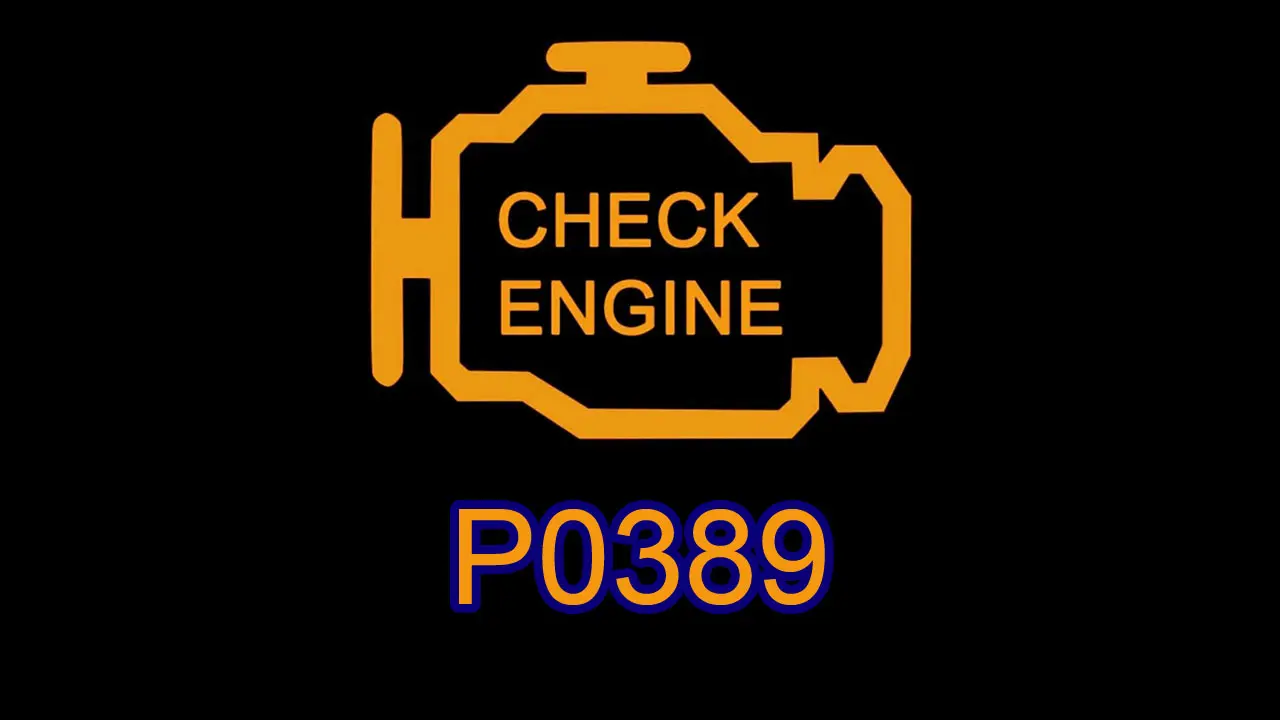
P0389 Crankshaft Position Sensor "B" Circuit Intermittent
The P0389 diagnostic trouble code (DTC) means that the engine control module (ECM/PCM) has detected an intermittent or unstable signal from the Crankshaft Position Sensor “B” circuit.
The crankshaft position sensor is one of the most important sensors in the engine management system. It allows the ECM to determine the crankshaft's position and rotational speed. This information is used to control ignition timing, fuel injection, engine synchronization, and, on many engines, variable valve timing.
The word “intermittent” is especially important in P0389. The sensor may work normally most of the time, but its signal may suddenly disappear, become erratic, drop out, or behave abnormally for a short period. This can make the problem difficult to reproduce.
P0389 does not automatically mean that the crankshaft position sensor itself is defective. The problem can also be caused by its wiring, connector, power supply, ground, reluctor/tone wheel, electrical interference, or another mechanical or timing-related problem.
What Does “Sensor B” Mean?
The “B” designation is manufacturer-dependent.
Some vehicles have more than one crankshaft position sensing circuit or use multiple sensing elements. Others may define Sensor B differently within their engine management architecture.
Therefore, it is not safe to assume that “Sensor B” always means a particular physical sensor location.
The correct sensor and circuit should be identified using the vehicle's wiring diagram and manufacturer service information.
This is particularly important because replacing the wrong crankshaft sensor will obviously not solve the problem.
What Does “Intermittent” Mean in P0389?
An intermittent fault is different from a simple low or high signal fault.
With P0389, the ECM may see a crankshaft signal that:
-
Suddenly disappears
-
Drops out for a short period
-
Contains irregular pulses
-
Changes unexpectedly
-
Becomes noisy or distorted
-
Appears and disappears depending on engine speed
-
Changes when the wiring or connector moves
-
Fails when the engine becomes hot
-
Works when cold but becomes unreliable at operating temperature
The engine may therefore start and drive normally for a while before the fault occurs.
This is one reason intermittent crankshaft sensor problems can be frustrating to diagnose.
Why Is the Crankshaft Position Sensor So Important?
The crankshaft position sensor provides the ECM with information about the crankshaft's rotational position and speed.
The ECM uses this information together with signals from other sensors, particularly the camshaft position sensors, to determine when combustion events should occur.
Depending on the engine design, the crankshaft signal can influence:
-
Fuel injection timing
-
Ignition timing
-
Engine synchronization
-
Variable valve timing control
-
Engine RPM calculation
-
Misfire detection
-
Starting strategy
-
Automatic transmission control
If the crankshaft signal disappears completely while the engine is running, the ECM may no longer know exactly where the crankshaft is.
In some vehicles, this can cause the engine to stall immediately.
Common Symptoms of P0389
The symptoms can vary considerably depending on how frequently the signal becomes intermittent.
Possible symptoms include:
-
Check Engine Light
-
Extended cranking
-
Difficult starting
-
Intermittent no-start condition
-
Engine stalling
-
Sudden loss of power
-
Rough running
-
Hesitation during acceleration
-
Engine misfires
-
Unstable RPM readings
-
Poor acceleration
-
Reduced engine performance
-
Intermittent limp mode
-
Poor fuel economy
-
Variable valve timing problems
-
Engine restarting normally after a short period
Some vehicles may show almost no noticeable drivability problem if the signal interruption is very brief.
For example, the engine may continue running normally while the ECM records P0389 because the signal dropout was too short to cause a noticeable stall.
Can P0389 Cause a No-Start?
Yes.
The severity depends on the vehicle's engine management strategy and how badly the crankshaft signal is interrupted.
If the ECM cannot obtain a reliable crankshaft position signal during cranking, it may not be able to correctly synchronize fuel injection and ignition.
This can result in:
-
Extended cranking
-
Intermittent starting
-
A complete no-start condition
An especially useful diagnostic clue is an engine that sometimes starts normally and sometimes cranks without starting.
However, a no-start condition does not prove that the crankshaft position sensor is defective. Other problems can produce the same symptom.
Common Causes of P0389
Several different faults can produce an intermittent crankshaft position sensor signal.
1. Failing crankshaft position sensor
The sensor itself can develop an internal fault.
Some sensors fail only under certain conditions, such as:
-
High engine temperature
-
High RPM
-
Vibration
-
Moisture
-
Electrical load
A sensor may therefore pass a basic resistance test when cold but fail while the engine is hot.
2. Damaged wiring
The wiring between the sensor and ECM can become:
-
Chafed
-
Broken internally
-
Melted
-
Pinched
-
Contaminated with oil
-
Damaged by vibration
-
Too close to ignition or other sources of electrical interference
An internally broken wire is particularly difficult because it may look perfectly normal from the outside.
3. Loose or corroded connector
A connector with poor terminal tension can intermittently lose electrical contact.
Corrosion, moisture, oil contamination, or a partially locked connector can also cause the signal to drop out.
4. Poor power or ground
Depending on the sensor design, an inadequate power supply or ground can cause an unstable signal.
This is especially important with Hall-effect crankshaft sensors that require an external power supply.
5. Damaged reluctor or trigger wheel
The crankshaft position sensor normally reads a toothed, slotted, or otherwise patterned trigger mechanism.
If the reluctor is:
-
Damaged
-
Bent
-
Cracked
-
Loose
-
Contaminated
-
Incorrectly positioned
the sensor signal may become irregular.
A missing or damaged tooth can also create a synchronization problem.
6. Excessive sensor-to-reluctor gap
The distance between the sensor and the trigger mechanism is important.
If the sensor is incorrectly positioned or the reluctor is damaged, the signal may become weak or unstable.
7. Metal debris or contamination
Some crankshaft sensors can be affected by metallic debris accumulating around the sensing area.
Oil contamination can also cause problems depending on the sensor design.
8. Electrical interference
Sensor wiring routed incorrectly near ignition components, alternators, motors, or other high-current circuits can sometimes develop electrical interference.
This can produce a signal that appears unstable to the ECM.
9. Mechanical timing problems
A stretched timing chain, damaged timing components, or incorrect mechanical timing can affect the relationship between crankshaft and camshaft signals.
The result may be interpreted as a sensor or synchronization problem even though the sensor itself is functioning.
10. Rare ECM/PCM fault
An ECM failure is possible but should generally be considered only after the sensor, wiring, power, ground, signal, trigger mechanism, and synchronization have been properly tested.
Replacing an ECM simply because P0389 is present is usually poor diagnostic practice.
Crankshaft Sensor Problems Can Be Temperature-Dependent
Temperature is an important clue when diagnosing P0389.
A sensor may operate normally when the engine is cold and begin producing an intermittent signal after reaching operating temperature.
The opposite can also happen.
For example, an engine may:
-
Start normally in the morning
-
Drive normally for 20–30 minutes
-
Stall after becoming hot
-
Restart only after cooling down
This pattern can strongly suggest a heat-related electrical or sensor problem, although wiring and other components can produce similar symptoms.
A technician should therefore reproduce the fault under the same conditions in which it normally occurs.
Hall-Effect and Variable-Reluctance Sensors
Crankshaft position sensors are not all electrically identical.
Two common technologies are Hall-effect sensors and variable-reluctance (VR) sensors.
A Hall-effect sensor generally requires an electrical supply and produces a digital-style signal.
A VR sensor generates its own alternating signal as the trigger wheel passes the sensing element.
Because these systems work differently, their diagnostic procedures are also different.
For this reason, there is no universal voltage or resistance specification for P0389.
The correct test values must come from the specific vehicle's manufacturer information.
How P0389 Should Be Diagnosed
A good diagnosis starts with the complete vehicle condition rather than immediately replacing the sensor.
1. Scan for all stored codes
First check every DTC stored in the ECM and other relevant modules.
Other crankshaft, camshaft, ignition, fuel, or communication codes may provide important clues.
P0389 should not be considered in isolation.
2. Check the freeze-frame data
Freeze-frame information can show the conditions under which the ECM detected the intermittent fault.
Look at information such as:
-
Engine RPM
-
Engine temperature
-
Vehicle speed
-
Load
-
Throttle position
-
Operating time
-
Other stored faults
If the code repeatedly occurs at a particular RPM or temperature, that can be extremely useful.
3. Identify the correct Sensor B circuit
Confirm exactly what the manufacturer means by Crankshaft Position Sensor B.
Do not rely solely on generic component-location information.
4. Inspect the sensor and connector
Check for:
-
Loose terminals
-
Corrosion
-
Oil contamination
-
Water intrusion
-
Broken locking tabs
-
Damaged connector housing
-
Poor terminal tension
The connector should be secure and the terminals should make proper electrical contact.
5. Inspect the wiring carefully
Follow the harness from the sensor toward the ECM.
Look for areas where the harness could:
-
Rub against the engine
-
Touch the exhaust
-
Become trapped
-
Vibrate against another component
-
Become soaked with oil
-
Become exposed to excessive heat
An intermittent fault often requires more than a quick visual inspection.
6. Test power, ground and signal
The appropriate electrical tests depend on the sensor design.
Check the manufacturer's specifications for:
-
Supply voltage
-
Ground integrity
-
Signal behavior
-
Continuity
-
Resistance where applicable
Voltage-drop testing can be particularly useful when a poor connection or ground is suspected.
A simple continuity test may show a wire as good even though it fails under vibration or load.
7. Monitor live RPM data
During cranking, scan-tool RPM data can be very useful.
If the engine is being cranked but the ECM intermittently loses its crankshaft speed/position information, the RPM signal may drop out.
However, scan-tool data is not always fast enough to capture every brief signal interruption.
8. Use an oscilloscope when necessary
For difficult intermittent faults, an oscilloscope can provide much more information than a basic scan tool.
The waveform can reveal:
-
Missing pulses
-
Irregular pulses
-
Electrical noise
-
Signal dropouts
-
Distorted waveforms
-
Trigger-wheel abnormalities
This can help determine whether the problem originates from the sensor, wiring, or trigger mechanism.
9. Check the reluctor/trigger mechanism
If the electrical circuit appears healthy, inspect the crankshaft trigger mechanism.
Look for damaged teeth, incorrect positioning, looseness, contamination, or other mechanical abnormalities.
10. Check camshaft/crankshaft synchronization
If the crankshaft signal appears normal but synchronization remains questionable, compare crankshaft and camshaft signals.
A timing-chain problem can sometimes mimic a sensor fault.
11. Repair and verify
After the actual cause has been corrected, clear the DTC and reproduce the conditions that originally caused the fault.
The vehicle should then be rescanned to confirm that P0389 does not return.
Why Replacing the Sensor Does Not Always Fix P0389
Replacing the crankshaft position sensor is tempting because the code mentions the sensor.
But P0389 identifies a problem detected in the sensor circuit, not necessarily a failed sensor.
For example, replacing the sensor will not repair:
-
A broken wire
-
A loose connector terminal
-
A poor ground
-
A shorted signal wire
-
A damaged trigger wheel
-
Excessive sensor gap
-
Timing-chain problems
-
Electrical interference
If the original sensor is replaced without testing the rest of the system, the vehicle may continue to set P0389.
P0389 vs. Other Crankshaft Position Codes
P0389 specifically indicates an intermittent condition involving Crankshaft Position Sensor B.
Other crankshaft sensor codes may indicate different electrical conditions.
For example:
-
P0385 – Crankshaft Position Sensor “B” Circuit
-
P0386 – Crankshaft Position Sensor “B” Circuit Range/Performance
-
P0387 – Crankshaft Position Sensor “B” Circuit Low
-
P0388 – Crankshaft Position Sensor “B” Circuit High
-
P0389 – Crankshaft Position Sensor “B” Circuit Intermittent
The exact diagnosis depends on what the ECM is seeing.
A low or high code generally points toward a specific electrical signal condition, while intermittent indicates that the signal is unstable or repeatedly dropping out.
Can You Drive With P0389?
It depends on the symptoms.
If the Check Engine Light is on but the engine starts easily, runs smoothly, and does not stall, the vehicle may remain driveable for a short period.
However, an intermittent crankshaft signal problem should not be ignored.
The vehicle could potentially:
-
Stall unexpectedly
-
Become difficult to restart
-
Lose power
-
Develop a no-start condition
Driving should be avoided if the engine is already stalling, suddenly losing power, running very roughly, or repeatedly failing to start.
A Practical Diagnostic Strategy
For an intermittent P0389, a logical diagnostic sequence is:
P0389 → scan all codes → examine freeze-frame data → identify Sensor B → inspect connector → inspect harness → verify power and ground → monitor crankshaft signal → reproduce the fault → check waveform if necessary → inspect trigger mechanism → verify cam/crank synchronization → repair the actual cause → clear codes and retest.
The biggest mistake is treating P0389 as a simple instruction to replace the crankshaft position sensor.
An intermittent fault requires finding where the signal is being lost and why. In many cases, the sensor is only one possibility among several.