TR
TR EN
EN

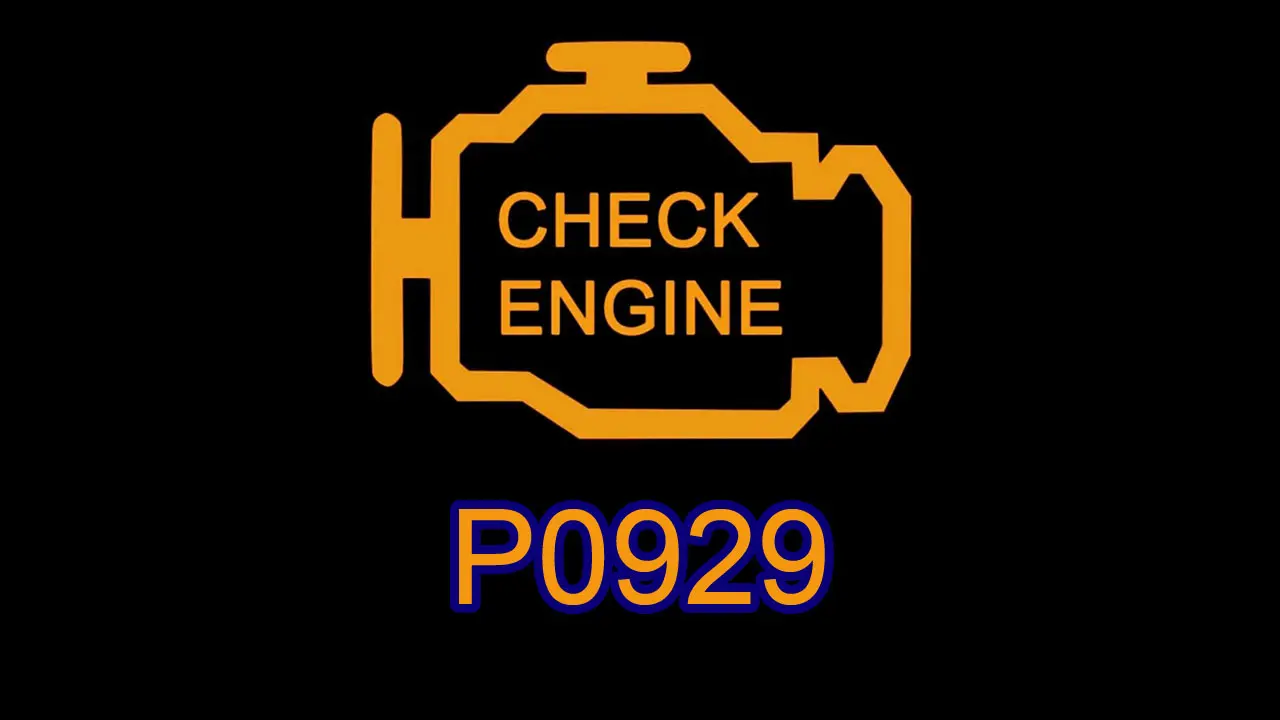
P0929 Gear Shift Lock Solenoid/Actuator Control Circuit "A" Range / Performance
The P0929 trouble code is an OBD-II diagnostic trouble code related to the gear shift lock solenoid or actuator control circuit.
P0929 – Gear Shift Lock Solenoid/Actuator Control Circuit “A” Range / Performance
This code means that the vehicle's control module has detected that the “A” gear shift lock solenoid/actuator control circuit is not operating within the expected range or is not responding as expected.
The gear shift lock system is responsible for preventing the transmission selector from being moved out of Park (P) unless the required conditions are met. In most vehicles, pressing the brake pedal is one of those conditions.
Unlike P0930, which indicates a low circuit condition, or P0931, which indicates a high circuit condition, P0929 is a range/performance fault. The circuit may have voltage and continuity, but the system's response does not match what the control module expects.
Possible causes include:
-
Faulty gear shift lock solenoid
-
Faulty shift lock actuator
-
Damaged or restricted shift-lock mechanism
-
Wiring problems
-
High circuit resistance
-
Loose electrical connection
-
Corroded connector
-
Faulty brake pedal switch
-
Incorrect brake switch signal
-
Selector mechanism problem
-
Low system voltage
-
Body control module fault
-
Transmission control module fault
The exact control strategy varies by vehicle manufacturer.
What Does P0929 Mean?
P0929 – Gear Shift Lock Solenoid/Actuator Control Circuit “A” Range / Performance
The gear shift lock is an electronic safety system designed to prevent unintended movement of the transmission selector.
A simplified system can be represented as:
Brake pedal → Brake switch → Control module → Shift lock solenoid → Selector lock
When the required conditions are satisfied, the control module commands the shift-lock solenoid to release the selector.
P0929 is stored when the control module determines that the circuit or actuator does not respond within the expected operating range.
For example:
Control module commands unlock → Solenoid receives command → Expected movement does not occur → P0929
The problem is therefore not necessarily a simple electrical open, short, high-voltage or low-voltage condition.
What Is a Gear Shift Lock Solenoid?
The gear shift lock solenoid is an electrically controlled component that prevents the gear selector from moving out of Park unless the necessary conditions are satisfied.
It is commonly installed in or around the:
-
Gear selector assembly
-
Center console
-
Shift lever mechanism
-
Electronic shifter
When the control module commands the system to unlock, the solenoid moves a mechanical locking mechanism.
Depending on the vehicle, the system can also include:
-
Brake pedal switch
-
Shift position sensor
-
Selector position sensor
-
Body control module
-
Transmission control module
-
Shift-lock wiring
-
Fuse
-
Manual shift-lock release mechanism
What Does “Range / Performance” Mean?
The term “Range / Performance” is important for understanding P0929.
It means the control module believes the system is not performing as expected, even though the circuit may not have a straightforward high or low voltage fault.
For example:
Commanded unlock → Solenoid activates → Lock does not move far enough → P0929
Or:
Brake pedal signal correct → Unlock command issued → Selector status does not change as expected → P0929
This means P0929 can involve both electrical and mechanical problems.
Symptoms of P0929
Symptoms can vary depending on the vehicle.
Possible symptoms include:
-
Check Engine Light
-
Transmission warning light
-
Gear selector stuck in Park
-
Difficulty moving the selector out of Park
-
Intermittent shift-lock operation
-
Shift lock not releasing
-
Shift lock releasing inconsistently
-
Selector position not recognized correctly
-
Warning message on the instrument cluster
-
Difficulty selecting gears
-
Abnormal selector operation
Some vehicles may store P0929 while the selector continues to operate normally.
Common Causes of P0929
Faulty shift-lock solenoid
The solenoid may be electrically functional but mechanically weak or sticking.
Possible problems include:
-
Internal wear
-
Mechanical sticking
-
Weak actuator movement
-
Internal contamination
-
Heat damage
-
Incorrect resistance
-
Internal electrical failure
Damaged shift-lock mechanism
The electrical solenoid may operate correctly while the mechanical locking mechanism fails to move properly.
Possible causes include:
-
Broken plastic components
-
Bent parts
-
Mechanical obstruction
-
Foreign objects
-
Excessive wear
-
Misalignment
Wiring problems
Wiring problems do not always create a complete open or short.
High resistance or poor connections can cause the solenoid to operate weakly or inconsistently.
Corroded connector
Corrosion can increase electrical resistance and interfere with solenoid operation.
Loose terminal
A terminal that does not make reliable contact can cause intermittent or reduced actuator performance.
Faulty brake pedal switch
The shift lock normally depends on a brake-pedal signal.
If the control module receives an incorrect brake signal, the shift-lock operation may not occur as expected.
Selector position sensor problem
The control system needs to know the current selector position.
An incorrect position signal can cause a mismatch between commanded and actual selector status.
Low system voltage
Low battery voltage or poor electrical supply can affect actuator operation.
If P0929 appears together with multiple unrelated electrical codes, the vehicle's power supply should be checked.
Body control module problem
On many vehicles, the BCM controls or participates in shift-lock operation.
A BCM fault can therefore cause range/performance problems.
Transmission control module problem
Some vehicles involve the TCM in the shift-lock system.
However, a TCM fault should generally be considered only after the solenoid, wiring, selector and related inputs have been tested.
Can Low Transmission Fluid Cause P0929?
Low transmission fluid does not normally cause P0929 directly.
The shift-lock solenoid is primarily an electrical and mechanical selector-lock component.
Low transmission fluid can cause:
-
Slipping
-
Delayed engagement
-
Harsh shifting
-
Hydraulic pressure problems
-
Transmission overheating
But these problems are separate from the shift-lock control circuit.
Can a Bad Brake Switch Cause P0929?
Yes, a faulty brake switch can contribute to shift-lock range/performance problems.
The brake switch provides the control system with the information that the brake pedal has been pressed.
If the switch produces an incorrect signal, the control module may not command the shift lock correctly.
Check:
-
Brake light operation
-
Brake switch status in live data
-
Brake switch wiring
-
Switch adjustment where applicable
However, a brake switch should not automatically be replaced just because P0929 is present.
Is P0929 an Internal Transmission Problem?
Usually, P0929 does not indicate internal transmission damage.
The gear shift lock is primarily a selector safety mechanism.
It should not be confused with transmission shift solenoids that control hydraulic pressure and gear changes inside the transmission.
Therefore, a P0929 diagnosis should normally begin with:
-
Shift-lock solenoid
-
Selector mechanism
-
Brake switch
-
Wiring
-
Connectors
-
Control-module inputs and outputs
before considering major transmission repairs.
P0929 vs. P0930
P0929 – Gear Shift Lock Solenoid/Actuator Control Circuit “A” Range/Performance
The system is not operating within its expected range or performance characteristics.
P0930 – Gear Shift Lock Solenoid/Actuator Control Circuit “A” Low
The electrical signal or voltage is lower than expected.
P0929 is therefore focused on system performance, while P0930 identifies a low electrical condition.
P0929 vs. P0931
P0929 indicates a range/performance problem.
P0931 – Gear Shift Lock Solenoid/Actuator Control Circuit “A” High indicates that the electrical signal or voltage is higher than expected.
P0929 vs. P0932
These codes concern different systems.
P0929 concerns the gear shift lock solenoid/actuator.
P0932 concerns the hydraulic pressure sensor circuit.
P0929 is therefore related to the selector lock, while P0932 relates to transmission hydraulic pressure monitoring.
How Serious Is P0929?
P0929 is usually a moderate fault, but it can prevent normal operation of the vehicle.
If the shift lock does not operate correctly, the gear selector may become stuck in Park or behave unpredictably.
The problem is particularly important if:
-
The selector is stuck
-
The selector releases intermittently
-
The brake lights are not functioning
-
The selector can move without the required brake input
Because the shift-lock system is a safety feature, it should not be ignored.
Can You Drive With P0929?
If the selector operates normally and the vehicle can be safely shifted, it may be possible to drive to a repair facility.
However, avoid forcing the selector if it becomes stuck.
If the brake lights do not operate correctly, the vehicle should not be driven normally until the problem is repaired.
Some vehicles have a manual shift-lock release that can temporarily move the selector out of Park. This should only be used according to the manufacturer's instructions.
How to Diagnose P0929
P0929 requires both electrical and mechanical diagnosis because a range/performance fault does not necessarily mean that the circuit has completely failed.
1. Scan all relevant control modules
Use a professional diagnostic scanner to check:
-
BCM
-
TCM
-
PCM
-
Selector module
-
Other body-control systems
Record all stored and pending codes.
2. Check freeze-frame data
If available, review:
-
Battery voltage
-
Brake pedal status
-
Selector position
-
Vehicle speed
-
Ignition status
This can help identify the conditions when the fault occurred.
3. Check brake light operation
Press the brake pedal and verify that the brake lights respond correctly.
If they do not, inspect the brake switch and its circuit.
4. Monitor brake switch live data
Use the scan tool to check whether the control module correctly detects:
Brake pedal released → OFF
and
Brake pedal pressed → ON
The exact terminology varies by vehicle.
5. Test shift-lock operation
Determine exactly what happens when the brake pedal is pressed.
For example:
-
Selector remains locked
-
Solenoid clicks but selector does not release
-
Selector releases intermittently
-
Selector releases slowly
-
Selector works normally but the code returns
These observations are valuable for diagnosis.
6. Inspect the shift-lock solenoid
Check:
-
Connector
-
Wiring
-
Terminals
-
Physical condition
-
Signs of contamination
-
Signs of overheating
7. Measure solenoid resistance
Where specifications are available, measure the solenoid's resistance.
Compare the result with manufacturer specifications.
An abnormal reading can indicate an internal solenoid problem.
8. Check power and ground
Verify that the solenoid receives the correct electrical supply.
Check for:
-
Voltage drop
-
High resistance
-
Poor ground
-
Loose connections
9. Inspect wiring
Look for:
-
Chafing
-
Pinched wires
-
Broken conductors
-
Damaged insulation
-
Previous repairs
-
Liquid contamination
The wiring around the center console should receive particular attention.
10. Perform an actuator test
If supported by the diagnostic scanner, command the shift-lock solenoid.
Observe whether it:
-
Activates
-
Moves correctly
-
Produces the expected mechanical response
If the electrical command is present but the mechanism does not move correctly, a mechanical problem may exist.
11. Inspect the mechanical shift lock
Check for:
-
Broken parts
-
Mechanical obstruction
-
Foreign objects
-
Sticking components
-
Misalignment
-
Excessive wear
12. Check selector position data
Verify that the control module correctly recognizes:
-
Park
-
Reverse
-
Neutral
-
Drive
-
Other available selector positions
An incorrect selector-position signal can cause a range/performance fault.
13. Check system voltage
Measure battery and charging-system voltage.
Low or unstable voltage can affect electronic actuator operation.
14. Check control-module commands
Determine whether the appropriate control module is commanding the shift lock correctly.
If the command is missing despite correct inputs, further control-module diagnosis may be necessary.
15. Evaluate the BCM or TCM
If the solenoid, wiring, brake switch, selector and power supply all test correctly, investigate the relevant control module.
Module replacement should be the final step after proper testing.
Why P0929 Can Be Misdiagnosed
P0929 can be difficult because the system may appear electrically functional.
For example:
Solenoid receives voltage → Solenoid clicks → Mechanical lock does not fully release → P0929
In this situation, replacing wiring may not solve the problem.
Another example:
Brake switch works intermittently → Control module receives inconsistent input → Shift lock operation becomes inconsistent → P0929
The solenoid itself may be completely functional.
This is why both electrical signals and mechanical operation need to be checked.
P0929 and a Selector Stuck in Park
If P0929 is accompanied by a selector stuck in Park, begin with the simplest checks.
Check:
-
Brake lights
-
Brake pedal switch
-
Shift-lock fuse
-
Solenoid power supply
-
Solenoid operation
-
Wiring
-
Connector
-
Mechanical selector mechanism
-
Selector position data
-
Control-module commands
Do not force the selector.
If the vehicle has a manual shift-lock release, it can be used according to the manufacturer's instructions to move the vehicle when necessary, but the underlying fault should still be repaired.
P0929 and Brake Lights
Brake-light operation is particularly relevant because the shift-lock system normally relies on brake-pedal information.
If you have:
P0929 + No brake lights
the brake switch, fuse and related wiring should be investigated early in the diagnostic process.
P0929 After Center Console Repair
If P0929 appeared after work around the gear selector or center console, inspect the wiring and connectors in that area.
Possible causes include:
-
Pinched wiring
-
Disconnected connector
-
Partially inserted connector
-
Damaged terminal
-
Wiring trapped under the console
-
Liquid contamination
A problem introduced during interior work can easily create a shift-lock performance fault.
P0929 After Transmission Replacement
If P0929 appears after transmission replacement, remember that the shift-lock mechanism is usually part of the selector and vehicle electrical system rather than the internal transmission.
Check:
-
Selector wiring
-
Shift-lock connector
-
Brake switch
-
Fuses
-
Ground connections
-
Control-module communication
-
Required programming
A transmission replacement does not automatically mean that the transmission itself caused P0929.
Can P0929 Damage the Transmission?
P0929 does not normally cause direct internal transmission damage.
The shift-lock system primarily controls the selector's safety mechanism.
However, forcing a malfunctioning selector can damage:
-
Shift lever
-
Locking mechanism
-
Solenoid
-
Selector assembly
-
Related cables or linkages
The correct approach is to diagnose the shift-lock system rather than forcing the selector.
Common Diagnostic Mistakes With P0929
Common mistakes include:
-
Replacing the solenoid without testing it
-
Ignoring the brake switch
-
Ignoring selector position data
-
Assuming “Range/Performance” means low or high voltage
-
Replacing the transmission unnecessarily
-
Replacing the BCM or TCM without testing the circuit
-
Ignoring mechanical problems inside the selector
-
Failing to inspect wiring beneath the center console
What Is the Correct Repair for P0929?
The correct repair depends on the confirmed cause.
Possible repairs include:
-
Replacing the shift-lock solenoid
-
Replacing the shift-lock actuator
-
Repairing damaged wiring
-
Repairing high-resistance connections
-
Replacing damaged connector terminals
-
Cleaning or repairing corroded connectors
-
Replacing a faulty brake pedal switch
-
Repairing the selector mechanism
-
Removing mechanical obstructions
-
Repairing selector position sensors
-
Correcting power or ground problems
-
Repairing BCM or TCM-related faults where necessary
-
Performing required calibration or adaptation
-
Updating control-module software where applicable
-
Replacing a control module only after it has been conclusively diagnosed as faulty
After the repair, clear the code and verify that the shift-lock system works correctly.
The selector should remain locked when the required conditions are not met and release correctly when the brake pedal is pressed.
Final Thoughts on P0929
P0929 – Gear Shift Lock Solenoid/Actuator Control Circuit “A” Range / Performance indicates that the vehicle's control system has detected that the “A” gear shift lock solenoid/actuator circuit is not operating within its expected range or is not responding as expected.
Unlike P0930, which identifies a low circuit condition, and P0931, which identifies a high circuit condition, P0929 is primarily a range/performance fault. This means the electrical circuit may still have power and continuity, but the actual response of the solenoid, actuator or selector mechanism does not match what the control module expects.
Possible causes include a faulty shift-lock solenoid, mechanical obstruction, damaged selector mechanism, wiring problems, high electrical resistance, corroded connectors, brake switch problems, selector position sensor faults or control-module issues.
The best diagnostic approach is to check the brake switch and brake lights, inspect the shift-lock fuse and wiring, test solenoid resistance and operation, monitor selector position data and verify the mechanical operation of the locking mechanism.
P0929 does not automatically mean that the transmission is damaged or needs to be replaced. In many cases, the problem is located in the shift-lock solenoid, selector mechanism, wiring, brake switch or related control system rather than inside the transmission itself.