TR
TR EN
EN

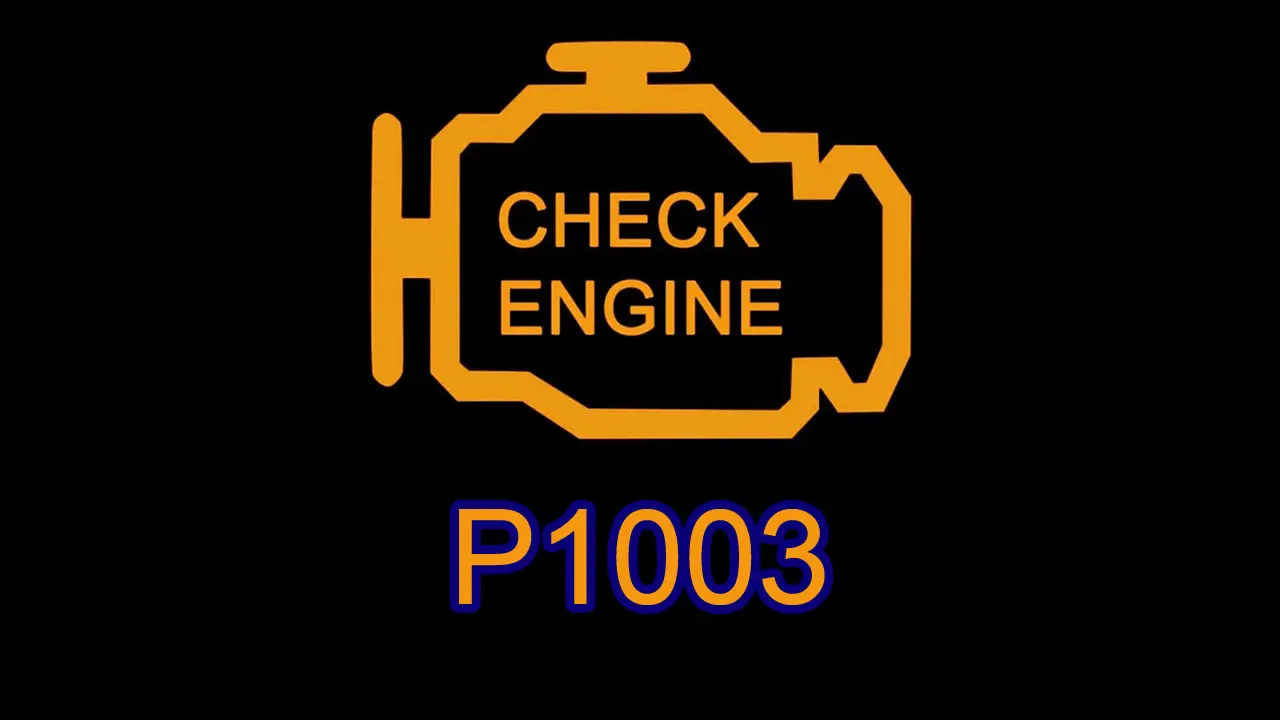
P1003 Fuel Composition Signal Message Counter Incorrect
P1003 Fuel Composition Signal Message Counter Incorrect is a manufacturer-specific diagnostic trouble code indicating that the Engine Control Module (ECM/PCM) has detected an invalid or incorrect message counter in the fuel composition signal data.
In simple terms, the vehicle's engine computer receives information about the fuel composition from another control module or fuel-composition sensing system. The communication message contains a counter value that changes in a predictable sequence.
If the ECM/PCM receives a counter value that is missing, repeated, out of sequence, or otherwise incorrect, it may store P1003.
The important point is that P1003 is primarily a communication/data-integrity problem.
It does not automatically mean that the fuel itself is contaminated or that the fuel composition sensor is defective.
Depending on the vehicle, the problem may involve:
-
Fuel composition sensor
-
Fuel composition signal
-
CAN or vehicle communication network
-
Wiring
-
Electrical connectors
-
Power or ground supply
-
Control module communication
-
Invalid message data
-
Software or calibration problems
-
Another module transmitting incorrect information
Because P1003 is a manufacturer-specific code, the exact component and diagnostic procedure can vary significantly between vehicle manufacturers.
What Does P1003 Mean?
The commonly used description is:
Fuel Composition Signal Message Counter Incorrect
The code contains two important concepts:
Fuel Composition Signal
This refers to data concerning the composition of the fuel.
Depending on the vehicle, the fuel composition system may provide information related to:
-
Ethanol content
-
Fuel mixture
-
Fuel quality characteristics
-
Fuel temperature
-
Fuel composition percentage
The exact parameters depend on the vehicle's fuel-composition strategy.
Message Counter
Modern vehicle control modules frequently exchange data over communication networks such as CAN.
Messages may contain counters or sequence information that allows a receiving module to determine whether the messages are arriving correctly.
For example, a counter may progress approximately like:
1 → 2 → 3 → 4 → 5 → ...
If the receiving module unexpectedly sees something such as:
1 → 2 → 2 → 5
the data may be considered invalid.
This allows the ECM/PCM to detect communication problems that might otherwise be difficult to identify.
Why Does a Message Counter Exist?
Modern vehicles contain many electronic control modules.
Examples include:
-
ECM
-
PCM
-
BCM
-
TCM
-
ABS module
-
Fuel pump module
-
Instrument cluster
-
Body-control systems
These modules continuously exchange information.
A simple message can contain:
-
Sensor data
-
Status information
-
Command information
-
Diagnostic information
-
Counter information
-
Checksum information
The message counter helps the receiving module determine whether the data is being received in the correct sequence.
A counter error can therefore indicate a communication problem even when the physical sensor itself is working correctly.
Is P1003 a Fuel Quality Code?
Not necessarily.
This is an important distinction.
P1003 does not directly state that the fuel is:
-
Bad
-
Contaminated
-
Old
-
Incorrect
-
Too low in octane
-
Too high in ethanol
Instead, the code indicates that the message counter associated with the fuel composition signal is incorrect.
Fuel quality can potentially contribute to other fuel-related problems, but P1003 itself is primarily concerned with the validity of the transmitted signal.
Therefore, replacing fuel or adding fuel-system cleaner should not be considered the first repair for P1003 unless there is separate evidence of a fuel-quality problem.
What Is a Fuel Composition Sensor?
Some vehicles use a fuel composition sensor to determine characteristics of the fuel.
These systems are particularly useful in vehicles designed to operate with different fuel compositions.
For example, flex-fuel systems can use information about ethanol content to allow the engine management system to adjust:
-
Fuel injection
-
Ignition timing
-
Cold-start strategy
-
Fuel enrichment
-
Emissions control
The ECM needs reliable fuel-composition information to make these adjustments.
However, not every vehicle uses the same type of fuel-composition sensor or communication strategy.
How Does the Fuel Composition Signal Reach the ECM?
Depending on the vehicle architecture, the signal may reach the ECM through:
Direct sensor communication
or
Another module → vehicle communication network → ECM
In modern vehicles, the information may be transmitted digitally.
A simplified example is:
Fuel composition sensor → control module → CAN network → ECM/PCM
If the message arrives with an incorrect counter, the ECM may reject the data and store P1003.
This is why a communication problem can produce the code even when the underlying fuel-composition measurement is correct.
Symptoms of P1003
Symptoms vary considerably depending on the vehicle and how the ECM responds to invalid fuel-composition data.
Check Engine Light
The Check Engine Light is the most common symptom.
The vehicle may continue to operate normally while the ECM records P1003.
Poor Fuel Economy
If the ECM cannot trust fuel-composition information, it may use a substitute or default value.
Depending on the vehicle, this can result in less-than-optimal fuel control.
Possible symptoms include:
-
Increased fuel consumption
-
Reduced fuel efficiency
-
Changes in fuel trim
Engine Hesitation
Incorrect or unavailable fuel-composition information can affect fuel-control calculations on applicable vehicles.
The driver may notice:
-
Hesitation
-
Delayed throttle response
-
Surging
-
Uneven acceleration
Rough Running
If the invalid fuel-composition signal causes the ECM to use an inappropriate fallback value, the engine may not operate optimally.
Possible symptoms include:
-
Rough idle
-
Uneven engine operation
-
Engine vibration
Difficult Cold Starting
Fuel composition can affect the amount of fuel required during cold starts.
If the ECM cannot obtain reliable composition information, cold-start performance may be affected on some systems.
Possible symptoms include:
-
Longer cranking
-
Difficult starting
-
Poor cold-start operation
Reduced Engine Performance
Depending on the strategy used by the ECM, invalid fuel-composition information may cause the system to enter a fallback operating mode.
This can result in:
-
Reduced engine response
-
Reduced power
-
Limited fuel-control optimization
Increased Emissions
Incorrect fuel-composition information can affect fuel and ignition calculations.
This may result in:
-
Increased exhaust emissions
-
Poor emissions performance
-
Additional emissions-related diagnostic codes
No Noticeable Symptoms
Many vehicles may show only the Check Engine Light.
The ECM can detect the message-counter error even if engine operation remains apparently normal.
This is especially possible when the system immediately substitutes a default or previously learned fuel-composition value.
Common Causes of P1003
Communication Message Error
A temporary communication error can cause an invalid message counter.
Possible causes include:
-
Interrupted communication
-
Missing message
-
Repeated message
-
Out-of-sequence message
-
Communication timing problem
CAN Bus Wiring Problem
Modern vehicles frequently use CAN communication networks to exchange data.
A problem with the CAN network can interfere with fuel-composition messages.
Possible causes include:
-
Damaged CAN wiring
-
Short to ground
-
Short to power
-
CAN High/Low wiring problems
-
Open circuit
-
Poor connection
Damaged Electrical Connector
A loose or corroded connector can interrupt communication between the fuel-composition system and the ECM.
Check for:
-
Corrosion
-
Water intrusion
-
Bent pins
-
Loose terminals
-
Damaged connector locks
-
Poor electrical contact
Fuel Composition Sensor Problem
A faulty sensor can potentially transmit invalid information.
Possible failures include:
-
Internal electronic failure
-
Incorrect signal
-
Intermittent operation
-
Internal communication fault
However, P1003 alone does not prove that the sensor must be replaced.
The communication path should be tested before replacing the sensor.
Faulty Control Module
Another control module may be responsible for transmitting the fuel-composition message.
If that module generates incorrect data, the ECM may detect the invalid counter.
Possible causes include:
-
Module software error
-
Internal electronic fault
-
Communication processor failure
Power Supply Problem
Control modules and sensors require stable electrical power.
Low or unstable voltage can cause communication errors.
Possible causes include:
-
Weak battery
-
Poor charging system
-
Loose battery terminal
-
Poor ground
-
Voltage drop
-
Damaged power wiring
Ground Problem
A poor ground connection can cause intermittent electronic communication problems.
Possible causes include:
-
Corroded ground connection
-
Loose ground strap
-
Damaged ground wire
-
High-resistance ground
Low Battery Voltage
A weak battery or voltage drop during starting can sometimes create communication-related faults.
This is especially relevant if P1003 appears together with multiple unrelated communication codes.
Intermittent Wiring Fault
A communication circuit may work normally most of the time but fail because of:
-
Vibration
-
Engine movement
-
Heat
-
Moisture
-
Harness chafing
This can make P1003 intermittent.
Software or Calibration Problem
Because P1003 is manufacturer-specific, a software issue may cause the ECM to incorrectly interpret or validate the fuel-composition message counter.
A technical service bulletin or software update may exist for some vehicles.
How Is P1003 Diagnosed?
P1003 should be diagnosed as a communication and data-integrity problem, rather than immediately assuming that the fuel itself is the problem.
A useful diagnostic sequence is:
Scan all modules → check communication codes → review freeze-frame data → identify the module transmitting fuel-composition data → inspect wiring and connectors → check power and grounds → monitor the fuel-composition message → verify message counter sequence → test the sensor/module → check software → repair → verify communication
Step 1: Confirm the Exact Manufacturer Definition
Because P1003 is manufacturer-specific, the vehicle's:
-
Make
-
Model
-
Model year
-
Engine
-
Fuel system
should be identified.
A generic scanner may display:
Fuel Composition Signal Message Counter Incorrect
but the manufacturer's service information may identify:
-
Which module sends the message
-
Which network carries the message
-
Expected counter sequence
-
Message timeout
-
Checksum requirements
-
Fuel-composition data parameters
-
Specific test procedures
This information is essential.
Step 2: Scan Every Control Module
Do not scan only the ECM.
A full vehicle scan should check modules such as:
-
ECM/PCM
-
BCM
-
Fuel pump module
-
Body-control modules
-
Instrument cluster
-
TCM
-
Other modules connected to the relevant communication network
Look for:
-
CAN communication codes
-
U-codes
-
Fuel-composition sensor codes
-
Low-voltage codes
-
Module internal fault codes
If several modules have communication errors, the problem may be in the network rather than the fuel-composition sensor.
Step 3: Check Battery and Charging Voltage
Verify the vehicle's electrical supply.
Check:
-
Battery condition
-
Battery terminals
-
Charging system
-
Ground connections
-
Voltage stability
A low-voltage condition can create multiple communication problems.
Step 4: Identify the Source of the Fuel Composition Message
The technician should determine which component or module is transmitting the fuel-composition signal.
The architecture may be different from one vehicle to another.
For example:
Fuel composition sensor → ECM
or:
Fuel composition sensor → fuel module → CAN network → ECM
Without identifying the actual communication path, replacing components can become guesswork.
Step 5: Inspect Wiring and Connectors
Inspect the relevant harness carefully.
Look for:
-
Broken wires
-
Chafing
-
Melted insulation
-
Corrosion
-
Water intrusion
-
Loose terminals
-
Poor connector retention
Wiring near the fuel tank and engine can be exposed to vibration, heat, moisture, and road contamination.
Step 6: Check CAN Network Wiring
If the fuel-composition signal is transmitted through CAN, inspect the relevant CAN circuits.
The technician may need to verify:
-
CAN High
-
CAN Low
-
Wiring continuity
-
Short circuits
-
Network resistance
-
Signal integrity
The exact electrical specifications are vehicle-specific.
Step 7: Monitor Live Data
Use a professional scan tool to monitor the fuel-composition parameters.
Depending on the vehicle, available data may include:
-
Fuel composition percentage
-
Ethanol percentage
-
Fuel temperature
-
Fuel composition status
-
Signal validity
-
Message status
-
Communication status
If the value repeatedly becomes unavailable or invalid, the communication path should be investigated.
Step 8: Check Message Counter Behavior
This is the most important part of diagnosing the specific P1003 fault.
The ECM expects the message counter to follow the manufacturer's defined sequence.
If the counter:
-
Repeats unexpectedly
-
Skips values
-
Stops changing
-
Resets unexpectedly
-
Arrives out of sequence
the receiving module may identify the message as invalid.
A professional diagnostic tool or manufacturer-specific diagnostic software may be required to view this information.
Step 9: Perform a Wiggle Test
If the fault is intermittent, carefully move the relevant wiring harness while monitoring the signal.
This can help identify:
-
Broken internal wire strands
-
Loose terminals
-
Poor connector contact
-
Harness chafing
The test should be performed safely and according to the manufacturer's diagnostic procedure.
Step 10: Check Power and Ground at the Relevant Component
Measure the power supply and ground under the conditions specified by the manufacturer.
A component may have power but still experience excessive voltage drop under load.
Therefore, voltage-drop testing can be more useful than simply checking continuity.
Step 11: Test the Fuel Composition Sensor
If the communication circuit and power supply are correct, test the fuel-composition sensor according to manufacturer specifications.
Depending on the vehicle, this may involve checking:
-
Output signal
-
Sensor communication
-
Fuel-composition reading
-
Fuel temperature reading
-
Supply voltage
-
Ground
-
Internal diagnostic status
Do not replace the sensor solely because P1003 is present.
Step 12: Check the Transmitting Control Module
If another control module sends the fuel-composition message, that module should be investigated.
Check for:
-
Internal diagnostic codes
-
Software updates
-
Communication faults
-
Power supply problems
-
Ground problems
-
Network connectivity
Step 13: Check for Software Updates
Manufacturer technical information should be checked for:
-
ECM software updates
-
Fuel-system module updates
-
CAN communication updates
-
Technical Service Bulletins
-
Revised calibration
A software update may correct a known message-counter interpretation problem.
Step 14: Clear Codes and Perform a Drive Cycle
After repairing the confirmed problem:
-
Clear the diagnostic trouble codes.
-
Start the engine.
-
Monitor fuel-composition data.
-
Verify communication.
-
Confirm the message remains valid.
-
Test the vehicle under different operating conditions.
-
Complete the manufacturer's required drive cycle.
-
Rescan all modules.
P1003 should not return if the fuel-composition message is being transmitted and received correctly.
How to Fix P1003
The correct repair depends on the confirmed cause.
Repair CAN Wiring
If damaged communication wiring is found, repair the wiring according to manufacturer specifications.
Possible repairs include:
-
Replacing damaged wires
-
Repairing connectors
-
Correcting shorts
-
Repairing open circuits
-
Restoring proper network connections
Repair or Replace Electrical Connectors
Corroded or loose terminals should be repaired or replaced as required.
Water intrusion should also be corrected to prevent the problem from returning.
Repair Power or Ground Problems
If the fuel-composition sensor or transmitting module has a poor power supply or ground, repair the affected circuit.
Replace the Fuel Composition Sensor
If testing confirms that the sensor itself is transmitting invalid data or has an internal electronic fault, replacement may be necessary.
The sensor should not be replaced simply because P1003 is stored.
Repair or Replace the Transmitting Module
If another control module is responsible for generating the fuel-composition message and testing confirms an internal failure, the module may need to be repaired or replaced.
Module replacement may require:
-
Programming
-
Configuration
-
Security initialization
-
Calibration
-
Relearn procedures
The exact procedure is vehicle-specific.
Update ECM/PCM Software
If the manufacturer identifies a software issue, update the ECM/PCM or relevant control module.
Check and Repair Fuel-System Problems Separately
If there is independent evidence of incorrect fuel composition, contamination, or fuel-system problems, those issues should also be addressed.
However, they should not automatically be assumed to be the cause of P1003.
Can You Drive With P1003?
In many cases, a vehicle with P1003 can still be driven.
If the ECM can substitute a default fuel-composition value, the vehicle may continue to operate normally.
However, depending on the vehicle's fuel-management strategy, the driver may experience:
-
Poor fuel economy
-
Hesitation
-
Rough running
-
Difficult cold starting
-
Reduced performance
-
Increased emissions
If the Check Engine Light is accompanied by severe engine running problems, stalling, or multiple communication faults, the vehicle should be inspected promptly.
Is P1003 a Serious Code?
P1003 is generally a moderate diagnostic code, but its importance depends on the vehicle and the failure causing it.
The code itself does not normally indicate immediate mechanical engine damage.
However, an invalid fuel-composition signal can affect the ECM's ability to calculate the appropriate fuel strategy.
The situation becomes more important when P1003 appears together with:
-
Multiple U-codes
-
Fuel-system codes
-
Low-voltage codes
-
Engine misfire codes
-
Sensor communication faults
In such cases, the underlying electrical or network problem should be diagnosed rather than simply clearing the code.
P1003 vs. Fuel Composition Sensor Failure
These should not automatically be considered the same problem.
P1003
Indicates that the message counter associated with the fuel-composition signal is incorrect.
Fuel composition sensor failure
Means that testing has confirmed that the sensor itself is defective.
A faulty sensor can potentially contribute to invalid data, but P1003 alone does not prove that the sensor is bad.
P1003 vs. CAN Communication Fault
A CAN network problem can potentially cause P1003.
For example:
Fuel-composition data → CAN network → ECM
If a message is interrupted, corrupted, repeated, or received out of sequence, the ECM may detect an incorrect message counter.
Therefore, CAN wiring and communication should be considered during diagnosis.
P1003 vs. U-Codes
U-codes generally indicate communication problems between vehicle control modules.
If P1003 appears together with U-codes, the communication network deserves particular attention.
For example, a common root problem could be:
Low voltage → module communication interruption → invalid fuel-composition message → P1003
or:
Damaged CAN wiring → corrupted/missing messages → incorrect counter → P1003
The additional U-codes can therefore provide valuable diagnostic information.
How to Prevent P1003
Because P1003 is primarily related to electronic communication and fuel-composition data, prevention focuses on maintaining the vehicle's electrical and communication systems.
Recommended practices include:
-
Keep the battery and charging system in good condition.
-
Repair charging-system problems promptly.
-
Keep battery terminals clean and secure.
-
Repair damaged wiring quickly.
-
Protect electrical connectors from water intrusion.
-
Address corrosion in connectors.
-
Repair CAN network wiring correctly.
-
Do not ignore repeated communication faults.
-
Maintain the fuel system according to manufacturer recommendations.
-
Address fuel-composition sensor problems when they are confirmed.
-
Keep ECM and other control-module software updated when required.
-
Avoid replacing electronic components without proper diagnosis.
Final Thoughts
P1003 Fuel Composition Signal Message Counter Incorrect indicates that the ECM/PCM has detected an incorrect message-counter value associated with fuel-composition data.
The message counter is used by modern vehicle control systems to verify that electronically transmitted data is arriving correctly and in the expected sequence.
The most important point is that P1003 does not automatically mean the fuel is bad and does not automatically mean the fuel-composition sensor must be replaced.
Possible causes include:
-
Communication message errors
-
CAN bus problems
-
Damaged wiring
-
Corroded or loose connectors
-
Poor power or ground
-
Low battery voltage
-
Faulty fuel-composition sensor
-
Faulty transmitting control module
-
Software or calibration problems
Diagnosis should begin by confirming the exact manufacturer-specific definition and scanning all vehicle control modules, not only the ECM.
The technician should identify which component or module is transmitting the fuel-composition signal, inspect the relevant wiring and connectors, verify battery voltage and module grounds, check the CAN network when applicable, and monitor the fuel-composition data.
The specific message-counter behavior should then be evaluated using manufacturer-specific diagnostic equipment when necessary.
If the communication circuit is functioning correctly but the sensor is confirmed to be producing invalid data, the fuel-composition sensor may need to be replaced.
If another control module is transmitting incorrect data, that module may require software updating, programming, repair, or replacement.
After the repair, the codes should be cleared and the vehicle tested while monitoring the fuel-composition signal and communication status.
A final scan should confirm that the fuel-composition message is valid, the message counter follows the expected sequence, communication remains stable, and P1003 does not return.