TR
TR EN
EN

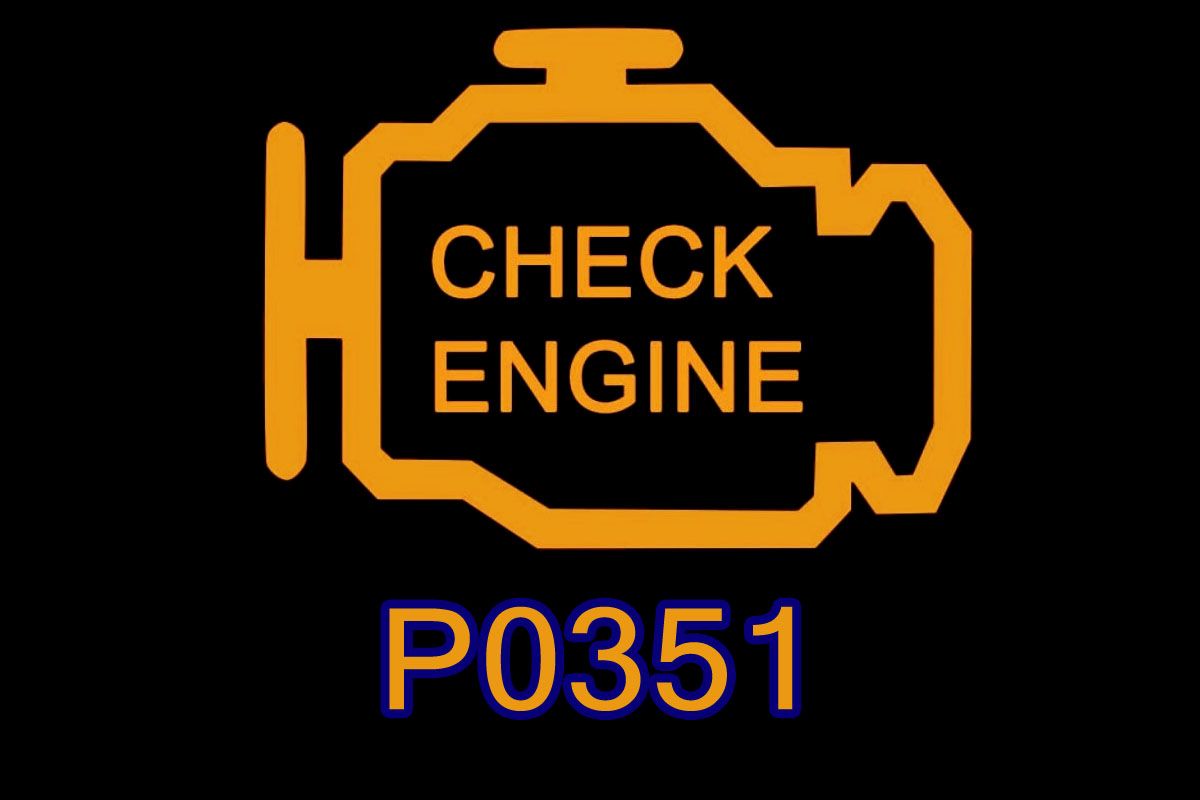
P0351 Ignition Coil "A" Primary/Secondary Circuit Malfunction
The P0351 diagnostic trouble code (DTC) means that the engine control module (ECM/PCM) has detected a malfunction in the primary or secondary ignition circuit of Ignition Coil “A.”
In practical terms, the engine computer is monitoring the electrical operation of one of the ignition coils and has determined that the circuit is not behaving as expected.
Although the ignition coil is one of the most obvious suspects, P0351 does not automatically mean that the coil itself is defective. The fault can also be caused by the coil connector, wiring, power supply, control circuit, spark plug, or, less commonly, the ECM/PCM itself.
The exact cylinder represented by Ignition Coil “A” is manufacturer-specific. On some engines it may correspond to the first cylinder, but this should not be assumed for every vehicle.
What Does P0351 Mean?
An ignition coil converts the vehicle's relatively low electrical voltage into the much higher voltage required to produce a spark at the spark plug.
The ignition system can be considered as having two sides:
Primary circuit
This is the low-voltage/control side of the ignition coil. The ECM/PCM controls this circuit to build and collapse the magnetic field inside the coil.
Secondary circuit
This is the high-voltage side that ultimately produces the spark required for combustion.
When the ECM detects an abnormal condition related to the operation of Ignition Coil A, it can store P0351.
The wording “Primary/Secondary Circuit Malfunction” is intentionally broad. It does not necessarily tell the technician that the primary winding has failed or that the secondary winding is defective. Further testing is required to determine what is actually wrong.
What Is Ignition Coil “A”?
The letter “A” identifies the ignition coil according to the vehicle manufacturer's diagnostic strategy.
It is tempting to interpret Coil A as automatically meaning cylinder 1, but that is not a universal rule.
The correct coil position should be confirmed using the vehicle's service information or wiring diagram.
This becomes particularly important on engines with multiple coils, coil-on-plug ignition, paired ignition systems, or manufacturer-specific coil numbering.
Common Causes of P0351
Several different problems can cause this DTC.
Defective ignition coil
The most obvious possibility is an internally damaged ignition coil.
A coil can fail completely, but it can also become weak and only malfunction under certain operating conditions.
For example, the engine may idle normally but develop a misfire during acceleration.
Damaged coil connector
A loose, broken, corroded, or contaminated connector can interrupt the electrical connection to the coil.
A terminal may also have insufficient contact pressure even though the connector appears visually normal.
Damaged wiring
The wires supplying or controlling Coil A can become damaged from:
-
Engine vibration
-
Excessive heat
-
Oil contamination
-
Rubbing against brackets
-
Previous repairs
-
Connector stress
-
Internal wire breakage
An internally broken wire can be particularly difficult to identify because it may look perfectly normal from the outside.
Loss of coil power supply
Many ignition coils receive their operating power from a shared circuit.
If that power supply has a problem, the fault may affect one coil or several coils depending on the electrical architecture.
Control circuit problem
The ECM/PCM normally controls the ignition coil through an electronic control circuit.
An open circuit, short circuit, excessive resistance, or other electrical fault can prevent the coil from operating correctly.
Faulty spark plug
A worn or damaged spark plug can increase the voltage demand on the ignition system.
An incorrect spark plug gap, cracked insulator, heavy carbon deposits, or severe electrode wear can contribute to ignition problems and may expose a marginal ignition coil.
Oil or water contamination
Oil leaking into the spark plug well can damage the coil boot and create an electrical leakage path.
Water or moisture inside the coil or connector can produce similar problems.
ECM/PCM ignition driver fault
The ECM contains electronic drivers that control the ignition coils.
A failed driver can cause P0351, but this is generally considered only after the external components and circuits have been tested properly.
Symptoms of P0351
The symptoms depend on the severity of the ignition problem.
Possible symptoms include:
-
Check Engine Light
-
Engine misfire
-
Rough idle
-
Engine vibration
-
Shaking during acceleration
-
Hesitation
-
Poor throttle response
-
Reduced engine power
-
Poor acceleration
-
Hard starting
-
Extended cranking
-
Engine stalling
-
Increased fuel consumption
-
Unstable engine operation
-
Flashing Check Engine Light
In mild cases, the driver may notice only an occasional hesitation.
In more severe cases, the engine can run very roughly because one cylinder is no longer contributing normally to combustion.
Why Can P0351 Appear Only During Acceleration?
An ignition coil can sometimes work adequately at idle but fail when the engine is under load.
During acceleration, cylinder pressure increases. A higher ignition voltage may be required to force the spark across the spark plug gap.
A weak coil, worn spark plug, damaged boot, or insulation problem may therefore remain hidden during an idle inspection.
This is why a vehicle that starts and idles normally can still have a genuine P0351 ignition problem.
P0351 and Misfire Codes
P0351 may be accompanied by a cylinder-specific misfire code such as a P030X code.
A P030X code tells the ECM that a particular cylinder is experiencing a misfire.
P0351, on the other hand, indicates that the ECM has detected an abnormal condition involving the ignition-coil circuit designated as Coil A.
When both types of codes appear together, they can provide valuable diagnostic information.
For example, if a particular cylinder is consistently misfiring and the vehicle's service information identifies that cylinder's ignition coil as Coil A, the relationship becomes much more meaningful.
However, the code descriptions should not be used to assume the cylinder without confirming the manufacturer's coil designation.
How Is P0351 Diagnosed?
A proper diagnosis should begin with the complete electrical and engine picture.
1. Scan for all DTCs
Do not diagnose P0351 in isolation.
Check for misfire codes, low-voltage codes, injector faults, crankshaft/camshaft sensor codes, and other ignition-related DTCs.
Additional codes may reveal whether the problem is isolated to Coil A or part of a larger electrical issue.
2. Examine freeze-frame data
If freeze-frame information is available, check the conditions under which P0351 was stored.
Engine speed, engine load, coolant temperature, and vehicle speed can help determine whether the fault occurs during startup, idle, acceleration, high RPM, or another operating condition.
3. Identify Coil A
Use the vehicle-specific wiring diagram or service documentation to determine exactly which ignition coil is designated as Coil A.
Do not simply assume that Coil A is cylinder 1.
4. Inspect the coil and connector
Look for:
-
Broken connector locks
-
Loose terminals
-
Corrosion
-
Oil contamination
-
Water intrusion
-
Burn marks
-
Damaged insulation
-
Cracked coil housing
-
Damaged coil boot
The connector should be checked for proper terminal tension as well as visible damage.
5. Check the power supply
Verify that the ignition coil receives the correct power supply under the manufacturer's specified test conditions.
There is no single universal voltage or resistance value that applies to every ignition system.
Vehicle-specific wiring diagrams and specifications should be used.
6. Check the control circuit
The control signal between the ECM and ignition coil should be tested according to the specific ignition system design.
An oscilloscope can be extremely useful because ignition-control signals can change too quickly for a basic multimeter to reveal every problem.
7. Test the coil
If the vehicle uses interchangeable ignition coils, swapping the suspected coil with another known-good position can be a useful diagnostic technique.
If the misfire or related fault moves with the coil, the coil becomes a strong suspect.
However, this test should be interpreted together with the DTCs and misfire data.
8. Inspect the spark plug
The spark plug associated with the affected coil should also be inspected.
Look for:
-
Excessive electrode wear
-
Incorrect gap
-
Cracked ceramic
-
Carbon fouling
-
Fuel fouling
-
Oil contamination
-
Abnormal deposits
A bad spark plug can create conditions that stress the ignition coil.
9. Check the wiring under operating conditions
If the problem is intermittent, inspect the harness while the engine is operating.
Engine vibration and movement can cause a marginal connection to open temporarily.
A carefully performed wiggle test, temperature-related test, or signal monitoring can sometimes reveal a fault that is invisible during a static inspection.
10. Evaluate the ECM only after the circuit is proven good
If the ignition coil, spark plug, power supply, wiring, connector, and control circuit all test correctly, the ECM ignition driver may need to be investigated.
The ECM should not be replaced simply because P0351 remains after installing a new coil.
Can a Bad Spark Plug Cause P0351?
A spark plug can contribute to an ignition problem, but it is important to distinguish between a direct coil-circuit fault and a problem that causes the ignition system to operate under abnormal conditions.
A badly worn spark plug requires a higher ignition voltage. This can put additional stress on the coil and may cause a weak coil or insulation problem to become apparent.
Therefore, if P0351 occurs together with a misfire, the spark plug should be inspected rather than assuming the coil is the only possible cause.
Can Wiring Cause P0351?
Yes.
In some cases, the wiring is more important than the ignition coil itself.
Potential wiring faults include:
-
Open circuit
-
Short to ground
-
Short to power
-
High resistance
-
Intermittent connection
-
Damaged insulation
-
Loose terminals
-
Corroded terminals
-
Internal conductor break
An intermittent wiring problem can be particularly challenging because the vehicle may operate normally during a workshop inspection.
The fault may appear only when the engine is hot, when the harness moves, or when the vehicle is accelerating.
Can P0351 Be Caused by a Bad ECM?
Yes, but it is relatively important to treat this as a diagnosis of last resort, not the first replacement candidate.
The ECM's ignition driver controls the coil. If the driver circuit fails, the ECM may no longer be able to operate Coil A correctly.
Before blaming the ECM, the technician should verify:
-
Correct Coil A identification
-
Coil condition
-
Spark plug condition
-
Coil power supply
-
Ground circuits where applicable
-
Connector condition
-
Wiring continuity
-
Wiring isolation from shorts
-
Control signal
-
Related electrical circuits
Only after the external circuit has been proven correct should an internal ECM driver problem be seriously considered.
Is P0351 Serious?
It can be, particularly if the engine is actively misfiring.
When combustion fails, unburned fuel can enter the exhaust system. This can raise catalytic-converter temperature and potentially cause expensive secondary damage.
A flashing Check Engine Light is a particularly important warning.
If the engine is shaking heavily, losing substantial power, stalling, or the Check Engine Light is flashing, it is better to avoid continued driving until the problem is diagnosed.
If the Check Engine Light is steady and the engine operates normally, the vehicle may be driven cautiously for a short distance to a repair facility, but the fault should still be addressed promptly.
P0351 vs. P0352, P0353 and Other Coil Codes
The difference between these codes is primarily the ignition coil designation.
P0351 – Ignition Coil A primary/secondary circuit malfunction
P0352 – Ignition Coil B primary/secondary circuit malfunction
P0353 – Ignition Coil C primary/secondary circuit malfunction
P0354 – Ignition Coil D primary/secondary circuit malfunction
The same basic diagnostic principles apply to each code, but the physical coil represented by each letter depends on the vehicle.
The letter should therefore be treated as an identifier rather than as a guaranteed cylinder number.
Why Replacing the Coil May Not Solve P0351
Replacing the ignition coil is sometimes the correct repair, but replacing parts without testing the circuit can lead to unnecessary expense.
If the actual fault is a damaged wire, poor connector contact, missing power supply, spark plug problem, or ECM control issue, installing another coil will not repair the underlying cause.
If a new coil is installed and P0351 returns, the next step should normally be a more detailed circuit diagnosis rather than another coil replacement.
A Practical Diagnostic Path
A logical approach can be summarized as:
P0351 → scan all codes → check freeze-frame → identify Coil A → inspect coil and connector → inspect wiring → verify power and ground → test control signal → inspect spark plug → test or swap coil if appropriate → evaluate misfire data → investigate mechanical causes if necessary → evaluate ECM driver → repair → clear codes → road test → rescan.
This approach prevents the diagnosis from becoming a simple “P0351 means replace the coil” exercise.
Final Perspective
P0351 indicates that the ECM/PCM has detected a malfunction associated with the primary/secondary circuit of Ignition Coil A.
The code does not, by itself, prove that the ignition coil has failed.
The actual cause may be the coil, spark plug, connector, power supply, wiring, control circuit, or—in less common cases—the ECM ignition driver. The exact location of Coil A must also be confirmed for the specific engine.
If P0351 is accompanied by an active misfire or a flashing Check Engine Light, the vehicle should not be driven unnecessarily. Prompt diagnosis can prevent a relatively simple ignition problem from turning into catalytic-converter damage or a more serious drivability problem.