TR
TR EN
EN

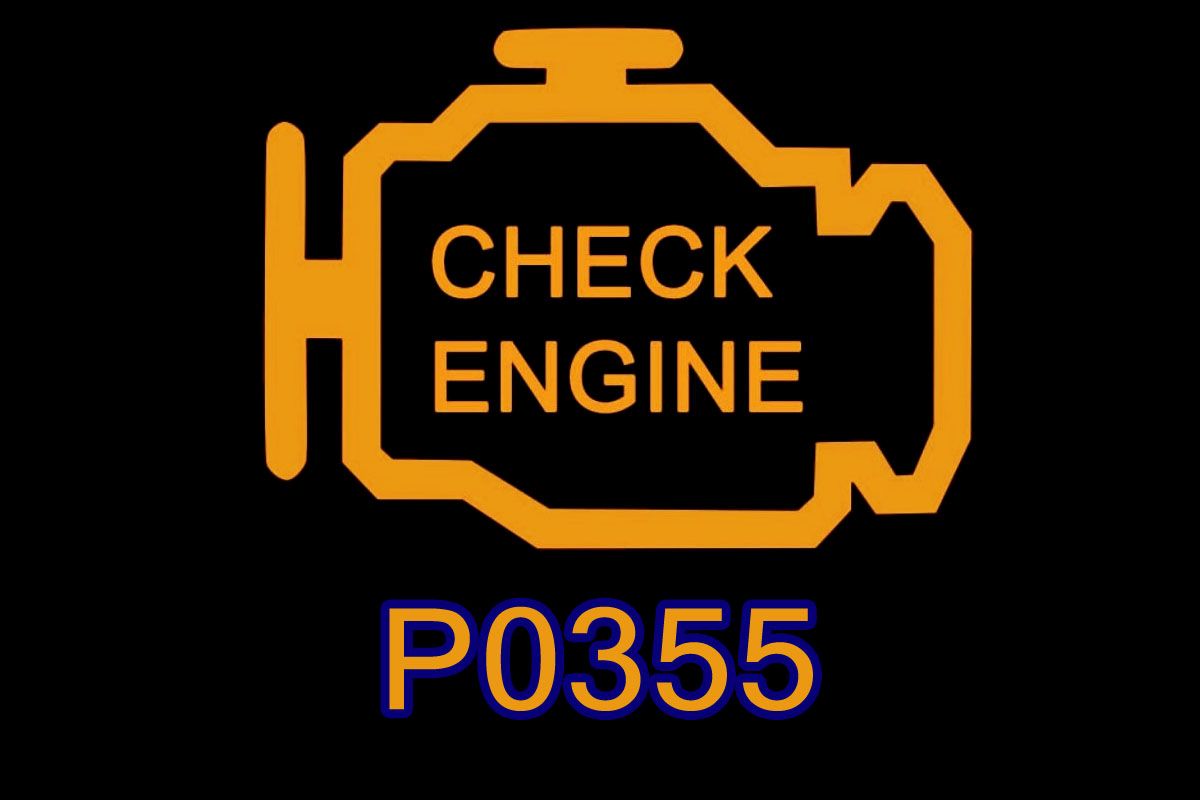
P0355 Ignition Coil "E" Primary/Secondary Circuit Malfunction
The P0355 diagnostic trouble code means that the engine control module (ECM/PCM) has detected a malfunction in the primary or secondary electrical circuit of Ignition Coil "E".
This code belongs to the ignition-coil circuit family. The ECM monitors the electrical behavior of the ignition coil and determines that Coil E is not operating within the expected parameters.
Although a defective ignition coil is one of the most common possibilities, P0355 does not prove that the coil itself is bad. The problem can also be caused by the coil's power supply, ground, control circuit, connector, wiring, spark plug, or the ECM's ignition-driver circuit.
The exact cylinder associated with Ignition Coil E depends on the vehicle manufacturer.
What Is Ignition Coil "E"?
In modern engines, individual ignition coils are often identified by letters.
Depending on the engine-management system, you may see designations such as:
-
Ignition Coil A
-
Ignition Coil B
-
Ignition Coil C
-
Ignition Coil D
-
Ignition Coil E
-
Ignition Coil F
-
Ignition Coil G
-
Ignition Coil H
-
Ignition Coil I
-
Ignition Coil J
-
Ignition Coil K
Coil E does not universally mean a specific cylinder.
For example, the manufacturer may associate Coil E with one particular cylinder on one engine and use a different physical arrangement on another engine.
Therefore, the exact location of Coil E should be confirmed using the vehicle-specific wiring diagram or service information.
How Does an Ignition Coil Work?
An ignition coil transforms the vehicle's relatively low electrical voltage into the much higher voltage needed to create a spark at the spark plug.
The basic process is:
Power supply → primary circuit → magnetic field → ECM-controlled switching → magnetic field collapse → high voltage → spark plug
The coil has two important electrical sides:
Primary circuit
This is the low-voltage side controlled by the ignition system.
Secondary circuit
This is the high-voltage side responsible for delivering ignition energy to the spark plug.
A problem in either portion can potentially result in P0355.
What Does "Primary/Secondary Circuit Malfunction" Mean?
P0355 is a general circuit malfunction code.
Unlike codes that specifically identify a low signal, high signal, or intermittent condition, P0355 does not tell you exactly how the circuit has failed.
The ECM may have detected an abnormal condition involving:
-
Coil primary winding
-
Coil secondary winding
-
Coil power supply
-
Coil ground
-
Coil control signal
-
Connector
-
Wiring
-
Ignition driver
Consequently, simply seeing P0355 does not mean that replacing the coil is guaranteed to solve the problem.
Symptoms of P0355
The symptoms depend on how severely the ignition system is affected.
Common symptoms can include:
-
Check Engine Light
-
Engine misfire
-
Rough idle
-
Engine shaking
-
Hesitation
-
Poor acceleration
-
Reduced engine power
-
Poor throttle response
-
Increased fuel consumption
-
Difficult starting
-
Extended cranking
-
Engine stalling
-
Flashing Check Engine Light
If Coil E controls one cylinder and that cylinder stops firing, the engine may feel as though it is running on fewer cylinders.
Can P0355 Cause an Engine Misfire?
Yes.
If Coil E cannot produce the required spark, the associated cylinder may fail to ignite the air-fuel mixture.
The ECM may then detect a cylinder-specific misfire and store another code from the P0300 series.
For example:
-
P0300 – Random/Multiple Cylinder Misfire
-
P0301 – Cylinder 1 Misfire
-
P0302 – Cylinder 2 Misfire
-
P0303 – Cylinder 3 Misfire
-
P0304 – Cylinder 4 Misfire
The exact P030X code depends on the cylinder involved.
If P0355 is stored together with a cylinder-specific misfire code, the two codes should be investigated together.
Common Causes of P0355
Defective ignition coil
The internal primary or secondary winding may be damaged.
A coil may fail completely or may work at idle and fail when the engine is hot or under heavy load.
Damaged connector
Loose, corroded, bent, or contaminated terminals can interfere with coil operation.
Broken wiring
The coil's power, ground, or control wire may be broken or partially broken.
Short circuit
The control circuit may be shorted to ground, battery voltage, or another electrical circuit.
Missing power supply
Without the correct supply voltage, the ignition coil cannot operate normally.
Poor ground
A high-resistance or damaged ground can interfere with ignition-coil operation.
Faulty spark plug
A worn, damaged, contaminated, or incorrectly gapped spark plug can cause misfire and place additional stress on the ignition system.
Oil contamination
On engines with coil-on-plug ignition, leaking valve-cover or cam-cover seals can allow oil into the spark-plug well.
Oil contamination can damage the coil boot and cause misfires.
Water intrusion
Water around the ignition coil or connector can cause poor electrical contact and ignition failure.
Carbon tracking
High-voltage leakage can leave a visible carbon path on the coil boot or spark-plug insulator.
ECM ignition-driver fault
The ECM may have a problem controlling the ignition coil.
This is possible, but the coil, wiring, connector, power and ground should be tested first.
How to Diagnose P0355
A proper diagnosis should begin with the complete ignition circuit.
1. Scan for all DTCs
Do not diagnose P0355 by itself.
Check whether there are additional codes related to:
-
Misfire
-
Other ignition coils
-
Camshaft position
-
Crankshaft position
-
Engine synchronization
-
Fuel injection
-
Battery voltage
If several coils report circuit problems at the same time, a common power or ground problem may be more likely than several coils failing simultaneously.
2. Check Freeze-Frame Data
If freeze-frame information is available, record the conditions when P0355 was stored.
Useful parameters include:
-
Engine RPM
-
Engine temperature
-
Engine load
-
Vehicle speed
-
Battery voltage
This can help establish whether the fault occurs during starting, idle, acceleration, or high engine load.
3. Identify Ignition Coil E
Confirm which physical coil the manufacturer identifies as Coil E.
Do not assume that the fifth coil in a particular physical sequence is necessarily Coil E.
The wiring diagram should identify the coil's:
-
Power supply
-
Ground
-
Control wire
-
Cylinder association
-
ECM connection
4. Inspect the Ignition Coil
Look for:
-
Cracks
-
Burn marks
-
Oil contamination
-
Water contamination
-
Damaged boot
-
Carbon tracking
-
Corrosion
-
Physical damage
A damaged coil boot can allow high voltage to escape before it reaches the spark plug.
5. Inspect the Connector
Carefully examine the Coil E connector.
Check for:
-
Loose terminals
-
Bent pins
-
Corrosion
-
Moisture
-
Oil contamination
-
Broken locking mechanism
-
Terminals pushed backward
A connector can look perfectly connected externally while one terminal has poor electrical contact.
6. Inspect the Wiring Harness
Follow the wiring away from Coil E.
Look for:
-
Chafed insulation
-
Broken wires
-
Heat damage
-
Pinched wiring
-
Stretched wires
-
Previous repairs
-
Poor aftermarket splices
Pay particular attention to wiring routed near hot exhaust components or areas exposed to engine movement.
7. Verify Coil Power
Check whether the ignition coil receives the correct power supply.
The measurement should be compared with the manufacturer's specification.
A supply that appears normal with the engine stopped can still suffer from voltage drop when the circuit is operating.
If multiple ignition coils lose their supply simultaneously, investigate the shared fuse, relay, power feed, or wiring.
8. Check the Coil Ground
Where applicable, verify the coil ground circuit.
A voltage-drop test can be useful for identifying high resistance that may not be visible through a simple continuity check.
Do not rely on a generic resistance or voltage value because ignition systems differ substantially between manufacturers.
9. Test the Control Circuit
The ECM must control the ignition event at the appropriate time.
Depending on the vehicle, the control signal can be tested with suitable diagnostic equipment.
An oscilloscope can be especially useful because it allows the technician to observe the actual switching behavior.
If the control signal is missing, the ECM should not immediately be blamed.
The wiring between the ECM and ignition coil must first be checked for:
-
Open circuits
-
Short circuits
-
High resistance
-
Poor terminals
ECM power and ground should also be verified.
Inspect the Spark Plug
The spark plug associated with Coil E should be inspected as part of the diagnosis.
Look for:
-
Excessive electrode wear
-
Incorrect gap
-
Carbon deposits
-
Fuel fouling
-
Oil fouling
-
Cracked ceramic
-
Abnormal deposits
A spark plug problem can produce symptoms very similar to an ignition-coil failure.
Can You Swap Coil E With Another Coil?
If the vehicle uses interchangeable individual ignition coils, swapping the suspected coil with another suitable coil can sometimes be useful as a diagnostic test.
Suppose a cylinder is misfiring and the suspected coil is moved to another cylinder.
If the misfire follows the coil, the coil becomes a strong suspect.
If the misfire remains on the original cylinder, attention should move toward:
-
Wiring
-
Connector
-
Spark plug
-
Injector
-
Compression
-
Mechanical timing
However, the coils must actually be interchangeable, and the test should be performed according to the vehicle manufacturer's diagnostic procedure.
Why an Ignition Coil Can Fail Only During Acceleration
A weak coil may perform normally at idle but fail when the engine is under load.
As cylinder pressure increases, the ignition system may require a higher voltage to produce a spark across the spark-plug gap.
A marginal coil can therefore produce:
-
Normal idle
-
Misfire during acceleration
-
Hesitation under load
-
Misfire at high RPM
-
Power loss
This is why checking the engine only while stationary may not reproduce the fault.
Could a Bad Spark Plug Cause P0355?
A spark plug can cause an ignition-related misfire and can increase the demand placed on the ignition coil.
However, P0355 specifically indicates that the ECM has detected a malfunction in the Coil E primary/secondary circuit.
Therefore, the spark plug should be inspected, but it should not automatically be considered the source of the circuit fault.
The coil's electrical circuit still needs to be tested.
Could Low Battery Voltage Cause P0355?
Abnormally low system voltage can affect ignition-system operation.
If the vehicle has starting problems or multiple unrelated electrical codes, check:
-
Battery condition
-
Battery terminals
-
Cranking voltage
-
Charging-system operation
-
Engine and chassis grounds
However, if system voltage is normal and only Coil E is affected, a localized coil, connector, wiring, or control-circuit problem is more likely.
Could the ECM Be the Problem?
It is possible, but the ECM should normally be one of the last components considered.
Before replacing or repairing the ECM, verify:
-
Coil power supply
-
Coil ground
-
Control signal
-
Wiring continuity
-
Wiring isolation from shorts
-
Connector condition
-
Coil operation
-
Spark-plug condition
If the complete external circuit is confirmed to be good but the ECM still cannot control Coil E correctly, further ECM testing may be appropriate.
P0355 and Other Misfire Codes
The combination of codes can provide valuable diagnostic information.
For example:
P0355 + P0303
would indicate a Coil E circuit fault together with a detected misfire on Cylinder 3.
The technician should then confirm whether Coil E corresponds to Cylinder 3 on that particular vehicle.
If the Check Engine Light is flashing, the misfire may be severe enough to damage the catalytic converter.
Is It Safe to Drive With P0355?
If the engine is actively misfiring, continued driving is not recommended.
A severe ignition misfire can send unburned fuel into the catalytic converter, causing excessive heat and potentially expensive damage.
Pay particular attention to:
-
Flashing Check Engine Light
-
Severe engine shaking
-
Major power loss
-
Strong hesitation
-
Engine stalling
-
Strong fuel smell from the exhaust
If these symptoms occur, the vehicle should be diagnosed as soon as possible.
If the Check Engine Light is steady and the engine runs normally, a short trip to a repair facility may be possible, but the fault should still be investigated promptly.
P0355 vs P0356, P0357, P0358 and P0359
The codes in this group identify ignition-coil circuit problems involving different coil designations.
P0355 refers to Ignition Coil E.
P0356 refers to Ignition Coil F.
P0357 refers to Ignition Coil G.
P0358 refers to Ignition Coil H.
P0359 refers to Ignition Coil I.
The letter identifies the monitored ignition coil, while the exact cylinder associated with that coil depends on the manufacturer's system.
A Practical Diagnostic Sequence
A reliable diagnostic path is:
P0355 → scan all codes → identify Coil E → check freeze-frame data → inspect coil → inspect spark plug → inspect connector → inspect wiring → verify power supply → verify ground → test control circuit → check ignition waveform if necessary → compare coil operation where appropriate → investigate ECM control only after the external circuit is proven good → repair → clear codes → road test → rescan
This sequence helps prevent unnecessary replacement of the ignition coil or ECM.
Final Thoughts
P0355 – Ignition Coil "E" Primary/Secondary Circuit Malfunction means that the ECM/PCM has detected abnormal operation in the electrical circuit associated with Ignition Coil E.
The ignition coil itself may be faulty, but the actual problem can also be a bad connector, damaged wiring, missing power supply, poor ground, control-circuit fault, spark-plug problem, or ECM ignition-driver issue.
If the engine is misfiring, the affected cylinder should be identified and the ignition system tested under the conditions in which the problem occurs.
The most reliable repair is therefore based on testing the complete circuit rather than automatically replacing Coil E.