TR
TR EN
EN

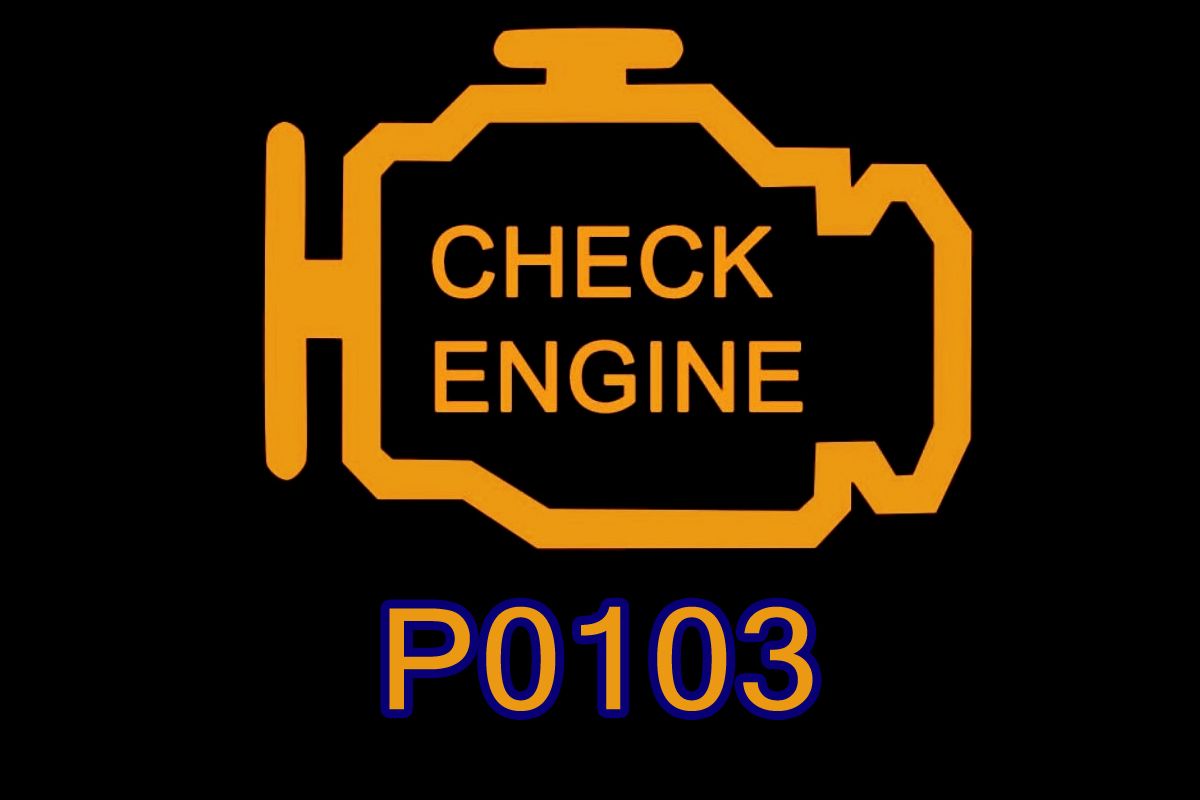
P0103 Mass Air Flow (MAF) Sensor "A" Circuit High Input
A P0103 code can be misleading because “High Input” does not necessarily mean the engine is receiving too much air.
The ECM/PCM has detected a higher-than-expected electrical input from the Mass Air Flow (MAF) Sensor “A” circuit.
The MAF sensor may actually be reporting unusually high airflow. But there is another possibility: the engine airflow is normal and the electrical signal reaching the ECM is incorrect.
That distinction is at the heart of diagnosing P0103.
What the MAF Sensor Is Measuring
The MAF sensor measures the amount of air entering the engine.
On many modern vehicles, a hot-wire or hot-film sensing element is used. As air passes through the sensor, the sensing element's electrical characteristics change. The MAF electronics convert that information into a signal the ECM can use.
The ECM combines MAF information with other data such as:
-
Engine RPM
-
Throttle position
-
Intake air temperature
-
MAP pressure
-
Engine load
-
Fuel-trim information
This allows the engine computer to estimate how much air is entering the engine and determine the appropriate fueling and engine-control strategy.
So What Does “High Input” Mean?
In P0103, high input refers primarily to the electrical signal being higher than expected.
It does not automatically mean:
-
Too much air is entering the engine
-
The turbocharger is producing too much boost
-
The engine is running rich
-
The MAF sensor is definitely defective
The ECU simply sees a MAF signal that doesn't fit the expected range or operating conditions.
The reason for that signal has to be established separately.
One of the Most Useful Questions
When P0103 appears, ask:
Is the MAF sensor genuinely measuring high airflow, or is the MAF circuit falsely reporting high airflow?
This question immediately divides the diagnosis into two directions.
If actual airflow is unusually high, investigate the engine's air-management system.
If airflow is normal but the electrical signal is high, investigate the sensor and its circuit.
What Can Cause P0103?
A contaminated MAF sensor
MAF sensing elements are sensitive.
Oil vapor, dust and other contamination can alter the sensor's ability to measure incoming air accurately.
This is particularly possible when the air filter or intake system hasn't been maintained correctly.
A faulty MAF sensor
The sensor's internal electronics can fail and produce an incorrect signal.
A sensor can therefore report excessive airflow even when the engine is operating normally.
Signal wire problem
A damaged signal circuit can cause an abnormally high input.
Depending on the circuit design, this may involve:
-
Short to voltage
-
Damaged insulation
-
Incorrect wiring repair
-
Internal wire damage
-
Connector problems
Reference or power-supply problem
Some MAF systems use a dedicated power supply, while others have more complex electronic circuitry.
An abnormal supply can cause the sensor's output to become unreliable.
Ground problem
A poor ground can alter the signal seen by the ECM.
This can create an apparently high MAF reading even though the actual airflow hasn't changed.
Air-intake problems
The MAF sensor must measure the air entering the engine correctly.
Problems around the airbox, filter housing or intake duct can interfere with the measurement.
Incorrect sensor installation
A MAF sensor can sometimes be installed incorrectly or in an unsuitable housing.
Airflow direction and sensor orientation can matter.
Aftermarket intake modifications
Changes to the intake system can alter airflow characteristics around the sensing element.
A sensor calibrated for a particular housing may not behave correctly when installed in a substantially different intake arrangement.
Look at the MAF Data Before Replacing It
P0103 is a good example of a code where live data can save unnecessary parts replacement.
Look at MAF information together with:
-
RPM
-
Throttle position
-
Engine load
-
MAP
-
Intake air temperature
-
Fuel trims
A MAF reading should make sense for the engine's operating condition.
For example, if the engine is idling steadily but the reported airflow is implausibly high, either the sensor is over-reporting or another factor is causing an abnormal airflow calculation.
There is no single universal MAF value that applies to every engine.
The Ignition-On, Engine-Off Test
One useful starting point is observing the MAF data with the engine not running, if the vehicle's scan tool provides a meaningful reading in that state.
There should be no substantial engine airflow because the engine isn't operating.
If the sensor already reports an implausible value before the engine starts, an electrical or sensor-related problem becomes more suspicious.
The exact expected value depends on the sensor and vehicle design, so manufacturer information should be used rather than a generic number.
Then Watch What Happens at Idle
Start the engine and observe the MAF signal.
As engine speed and load change, the measured airflow should respond accordingly.
A useful diagnostic pattern is to watch whether the signal:
-
Changes smoothly
-
Jumps unexpectedly
-
Remains excessively high
-
Drops out
-
Becomes implausible at particular RPM
-
Responds appropriately to throttle changes
A sensor that suddenly produces an abnormal value without a corresponding change in engine operation deserves further investigation.
Compare MAF With MAP
MAP and MAF don't measure the same thing, but together they can provide a useful picture.
The MAF tells the ECM about air mass entering the engine.
The MAP sensor tells it about pressure in the intake system.
If MAF indicates extremely high airflow while MAP, throttle position, RPM and engine load don't support that conclusion, the MAF signal becomes more suspicious.
If all the data changes consistently, the high airflow may actually be real.
Inspect the MAF Connector
Before replacing the sensor, inspect the connector carefully.
Check for:
-
Corrosion
-
Loose terminals
-
Bent pins
-
Water intrusion
-
Oil contamination
-
Damaged locking tabs
-
Broken wiring near the connector
A connector can appear plugged in while one terminal has poor contact.
Follow the Wiring
Trace the MAF harness away from the sensor.
Look for:
-
Chafing
-
Melted insulation
-
Broken conductors
-
Previous repairs
-
Loose harness routing
-
Contact with hot engine components
If P0103 is intermittent, the harness becomes particularly interesting.
Vibration can cause a damaged wire to make and lose contact repeatedly.
Don't Forget the Airbox
The MAF sensor should be installed in an intake system that is properly sealed and configured.
Inspect:
-
Air filter
-
Airbox
-
Airbox lid
-
MAF housing
-
Intake duct
-
Clamps
-
Sealing surfaces
A damaged or improperly assembled intake can change airflow around the sensor.
The Air Filter Is Not Automatically the Culprit
A dirty air filter can restrict airflow, but that does not automatically explain a high MAF electrical input.
In fact, severe intake restriction would generally tend toward reduced airflow rather than simply creating a high electrical signal.
The filter should still be inspected, but it shouldn't be blamed solely because a MAF code is present.
What About an Intake Leak?
An intake leak can create drivability and fuel-trim problems, particularly when it occurs downstream of the MAF.
However, it doesn't automatically explain a P0103 high MAF signal.
The effect depends on where the leak occurs and how the vehicle's airflow calculations respond.
If fuel trims are abnormal, a smoke test of the intake system can be useful.
Fuel Trims Can Provide Another Clue
MAF information directly influences fuel calculations.
If the MAF reports more air than is actually entering the engine, the ECM may command more fuel than necessary.
Depending on the control strategy, this can contribute to a rich-running condition.
Watch:
-
Short-term fuel trim
-
Long-term fuel trim
-
Engine load
-
MAF
-
MAP
-
RPM
If fuel trims are strongly abnormal, investigate whether the MAF reading is contributing to the problem.
But fuel trims alone cannot prove that the MAF sensor is defective.
What Happens When the MAF Is Over-Reporting?
If the MAF falsely reports excessive airflow, the ECM may calculate engine load incorrectly.
Depending on the vehicle, this can affect:
-
Fuel injection
-
Ignition timing
-
Throttle behavior
-
EGR control
-
Turbocharger management
-
Transmission behavior
-
Emissions control
The driver may therefore notice symptoms that don't initially seem related to an airflow sensor.
Possible Symptoms of P0103
P0103 can produce:
-
Check Engine Light
-
Poor acceleration
-
Hesitation
-
Rough idle
-
Surging
-
Poor throttle response
-
Increased fuel consumption
-
Reduced engine performance
-
Difficult starting
-
Stalling
-
Misfire
-
Reduced turbo performance
-
Limp mode
Some vehicles may continue to run reasonably well despite the code.
The ECM may substitute a calculated airflow value when the MAF signal becomes unreliable.
A Dirty Sensor Is Not Always a Bad Sensor
This is worth emphasizing.
A contaminated MAF sensor can sometimes be restored if the contamination is the actual cause.
However, MAF sensing elements are delicate.
Do not scrape the sensing element or use aggressive solvents simply because the sensor looks dirty.
If the manufacturer permits cleaning, use an appropriate MAF-safe cleaning method.
Cleaning cannot repair an internal electrical failure.
What If the Vehicle Has a Turbocharger?
Turbocharged engines require additional attention.
The MAF sensor measures air entering the engine, while the turbocharger changes the pressure and density of that air.
Investigate:
-
Turbocharger operation
-
Boost pressure
-
Charge-air leaks
-
Intake restrictions
-
Wastegate/VGT operation
-
MAP data
-
MAF data
-
Throttle position
A turbocharger problem can alter the airflow the MAF sees, but P0103 still does not automatically mean the turbocharger is defective.
Don't Replace the Turbo Because of P0103
This would be an expensive diagnostic mistake.
A high MAF signal does not directly diagnose:
-
Turbocharger failure
-
Wastegate failure
-
Boost-control failure
-
Intercooler failure
Those systems should only be investigated as primary causes if the data indicates an actual airflow or boost problem.
Could the ECM Be at Fault?
It is possible, but it should be low on the diagnostic list.
Before condemning the ECM, verify:
-
MAF sensor
-
Power supply
-
Ground
-
Signal circuit
-
Connector
-
Wiring
-
Reference circuits where applicable
-
Actual airflow
ECM replacement should not be the first response to a P0103 code.
A Good Diagnostic Example
Suppose a vehicle has P0103 and the MAF reading is extremely high.
The technician disconnects the MAF sensor and checks the wiring according to the manufacturer's procedure.
The signal circuit is found to be shorted to a power supply.
The sensor itself may be completely healthy.
The correct repair is the wiring fault.
Now consider another vehicle where the wiring, connector, power and ground are all correct.
The MAF output remains implausibly high and does not correspond with MAP, throttle position or engine load.
In that situation, the sensor becomes a much stronger suspect.
The same DTC can therefore lead to completely different repairs.
Use the Manufacturer's Specifications
There are many generic MAF voltage and airflow figures available online.
They should be treated carefully.
Different MAF sensors use different signal strategies, and engine size, airflow design, sensor type and ECU calibration all affect the expected readings.
The correct diagnostic values should come from the vehicle manufacturer's service information.
What P0103 Does Not Prove
P0103 does not prove that:
-
The MAF sensor is defective
-
The engine is receiving too much air
-
The engine is running rich
-
The turbocharger is bad
-
The air filter is clogged
-
The intake has a leak
-
The MAP sensor is faulty
-
The ECM has failed
These are possible diagnostic directions, not conclusions.
Can You Drive With P0103?
It may be possible to drive the vehicle if it starts, idles and accelerates normally and the Check Engine Light remains steady.
However, continued driving with an incorrect MAF signal can affect fuel control and engine performance.
Be more cautious if you experience:
-
Severe hesitation
-
Stalling
-
Major power loss
-
Heavy misfire
-
Strong fuel smell
-
Flashing Check Engine Light
-
Severe smoke
In those circumstances, the vehicle should be diagnosed promptly.
The Most Efficient Way to Find the Fault
Instead of treating P0103 as a command to replace the MAF sensor, follow the information path:
Air enters the intake → MAF measures it → electrical signal travels through the circuit → ECM interprets the signal → engine control is adjusted.
A fault anywhere along that chain can create the code.
Start with live data.
Then inspect the intake and MAF installation.
Check the connector and wiring.
Verify power, ground and signal circuits.
Compare MAF readings with MAP, throttle, RPM and engine load.
If the electrical circuit is correct but the MAF continues reporting implausibly high airflow, the sensor itself becomes the logical suspect.
Final Takeaway
P0103 Mass Air Flow (MAF) Sensor "A" Circuit High Input means the ECM has detected a higher-than-expected input from the MAF sensor circuit.
The key word is “input.”
The code does not simply mean that too much air is entering the engine.
A contaminated or failed MAF sensor can cause it, but so can wiring damage, a connector problem, an abnormal power or ground condition, incorrect sensor installation or an actual airflow problem.
The best diagnosis is therefore based on MAF live data combined with MAP, throttle position, RPM, engine load and fuel-trim information.
Once those values are compared, it becomes much easier to determine whether the engine really has an airflow problem or whether the MAF circuit is simply reporting one that doesn't exist.