TR
TR EN
EN

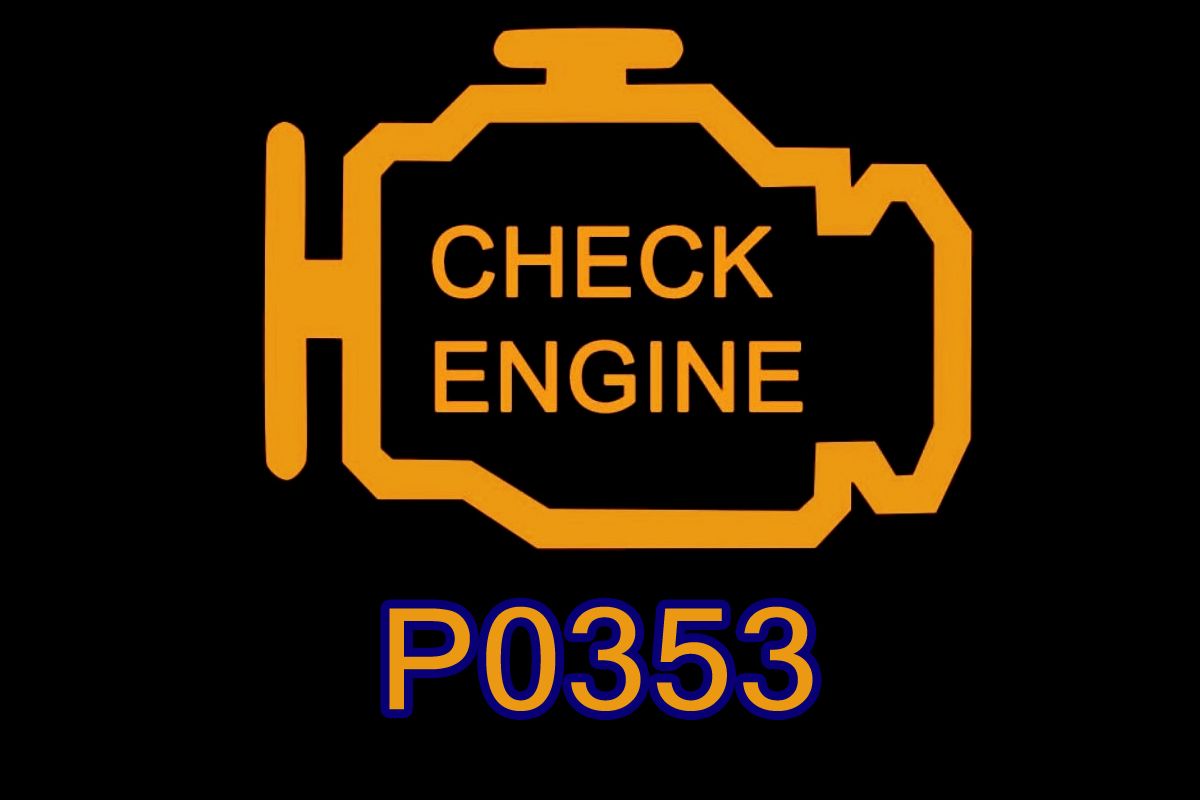
P0353 Ignition Coil "C" Primary/Secondary Circuit Malfunction
The P0353 diagnostic trouble code (DTC) means that the engine control module (ECM/PCM) has detected a malfunction in the primary or secondary ignition circuit of Ignition Coil “C.”
In practical terms, the engine computer is monitoring the electrical operation of one of the ignition coils and has detected that the coil circuit is not behaving as expected.
This code does not automatically mean that the ignition coil itself is defective. The problem can also be caused by the coil connector, wiring, power supply, ground, control signal, spark plug, or even the ECM/PCM ignition driver.
The exact cylinder associated with Ignition Coil “C” is manufacturer-specific. It should not be assumed that Coil C always means cylinder 3. The correct cylinder and coil location should be confirmed using the vehicle's wiring diagram or service information.
What Does P0353 Mean?
Ignition systems have two important electrical sides:
Primary circuit
The primary side is the low-voltage side of the ignition coil. The ECM/PCM controls this circuit to build a magnetic field inside the coil.
Secondary circuit
The secondary side produces the very high voltage required to create the spark at the spark plug.
When the ECM/PCM detects an abnormal electrical condition associated with Coil C, it can store P0353.
The code description uses the term “Primary/Secondary Circuit Malfunction” because the diagnostic strategy does not necessarily identify whether the problem is specifically inside the primary winding, secondary winding, wiring, control circuit, or another part of the ignition system.
Where Is Ignition Coil “C”?
This is one of the most important details when diagnosing P0353.
“C” is an identification used by the diagnostic system, not a universal physical location.
Depending on the engine and manufacturer, Coil C could correspond to a particular cylinder or ignition coil position. On some vehicles, the coil designation may follow cylinder order, while on others the diagnostic naming strategy can differ.
Therefore, replacing the third ignition coil simply because the code says “C” is not a reliable diagnostic procedure.
The vehicle-specific wiring diagram should be used to determine exactly which coil the ECM has identified as Coil C.
What Causes P0353?
There are several possible causes.
Faulty ignition coil
The coil itself can develop an internal electrical fault. A winding can become damaged, or the coil can begin breaking down when subjected to high temperature or high cylinder pressure.
A weak coil may work normally at idle but fail during hard acceleration.
Damaged ignition coil connector
A loose, corroded, contaminated, or damaged connector can interrupt the electrical connection between the coil and the vehicle wiring.
Sometimes the connector appears visually normal but has poor terminal tension.
Broken or damaged wiring
The wiring between the ECM/PCM and Coil C can become damaged by vibration, heat, oil contamination, or rubbing against engine components.
A wire can also break internally while its insulation remains intact.
Power supply problem
Many ignition coils receive a shared ignition power supply. A problem with the power feed can affect one or several coils.
This is why checking only the individual Coil C is sometimes insufficient.
Poor ground or control circuit problem
Depending on the ignition system design, the ECM may control the coil through a dedicated driver circuit. An open circuit, short circuit, poor connection, or damaged control wire can trigger P0353.
Faulty spark plug
A worn, damaged, incorrectly gapped, or contaminated spark plug can increase the electrical demand placed on the ignition coil.
A spark plug problem does not always directly cause P0353, but it can contribute to ignition-coil stress and misfire symptoms.
Oil or water contamination
Oil leaking into the spark plug well can damage coil boots and create insulation problems.
Water intrusion can produce similar symptoms, particularly after engine washing or heavy moisture exposure.
ECM/PCM problem
The engine computer contains electronic drivers that control the ignition coils. A failed driver can cause a coil circuit fault.
However, the ECM should generally be considered after the coil, wiring, power, connectors, and control circuit have been properly tested.
Symptoms of P0353
The symptoms can range from barely noticeable to severe.
Common symptoms include:
-
Check Engine Light
-
Engine misfire
-
Rough idle
-
Engine shaking or vibration
-
Hesitation during acceleration
-
Reduced engine power
-
Poor throttle response
-
Hard starting
-
Extended cranking
-
Engine stalling
-
Increased fuel consumption
-
Poor acceleration
-
Flashing Check Engine Light
-
Reduced performance under load
In some cases, the vehicle may appear to run normally at idle but develop a noticeable misfire when accelerating.
This happens because ignition coils are often placed under greater electrical demand when engine load and cylinder pressure increase.
Why Can the Engine Run Normally at Idle?
This is a common source of confusion.
An ignition coil can be sufficiently strong to produce a spark at idle but unable to produce a reliable spark when the engine is under heavy load.
During acceleration, cylinder pressure increases. The ignition system may require a stronger voltage to create and maintain the spark across the spark plug gap.
A marginal coil, damaged boot, excessive spark plug gap, or insulation problem can therefore remain hidden during a basic idle test.
For this reason, “the engine runs smoothly at idle” does not prove that Coil C is healthy.
P0353 and Engine Misfire Codes
P0353 can appear together with a cylinder-specific misfire code such as P0301, P0302, P0303, P0304, or another P030X code.
These codes provide useful information.
For example, if a vehicle reports an ignition-coil circuit fault together with a cylinder-specific misfire, the technician can investigate whether the affected coil corresponds to that cylinder.
However, the relationship should still be confirmed using the manufacturer's coil identification and wiring information.
A misfire code tells you what the engine is doing.
P0353 tells you that the ECM has detected a problem associated with the electrical operation of Coil C.
Those are related pieces of information, but they are not necessarily the same fault.
How Is P0353 Diagnosed?
A proper diagnosis should begin with the complete diagnostic picture rather than immediately replacing the coil.
1. Scan all stored codes
Check for additional DTCs.
Misfire codes, low-voltage codes, crankshaft/camshaft sensor codes, injector codes, and other ignition-related faults can change the diagnostic direction.
2. Check the freeze-frame data
Look at the engine speed, load, coolant temperature, vehicle speed, and other available parameters when P0353 was stored.
If the code repeatedly occurs during high RPM or heavy acceleration, that can provide an important clue.
3. Identify Coil C correctly
Use vehicle-specific service information to determine which ignition coil is designated as Coil C.
Do not rely solely on the assumption that “C” means the third cylinder.
4. Inspect the coil and connector
Check for:
-
Broken connector locks
-
Loose terminals
-
Corrosion
-
Oil contamination
-
Water intrusion
-
Damaged insulation
-
Burn marks
-
Poor terminal contact
-
Wiring pulled tightly around the connector
The wiring should also be inspected along its entire route.
5. Check the coil power supply
Verify that the coil is receiving the correct power supply under the conditions specified by the manufacturer.
Do not rely on a generic voltage value because ignition systems differ between vehicles.
A voltage measurement should also be performed in a way that can reveal voltage drop or an intermittent connection.
6. Check the control circuit
The ECM's control signal to the ignition coil should be evaluated according to the vehicle's wiring and ignition system design.
An oscilloscope can be particularly useful because an ordinary multimeter may not reveal a fast or intermittent control problem.
7. Test the ignition coil
If the coil is interchangeable with another identical coil, a controlled coil swap can be a useful diagnostic test.
For example, if the suspected Coil C is moved to another cylinder and the misfire follows the coil, the coil becomes a strong suspect.
However, a coil swap should be interpreted together with the stored DTCs and misfire data rather than used as the only test.
8. Inspect the spark plug
Check the spark plug for:
-
Excessive wear
-
Incorrect gap
-
Cracks
-
Carbon deposits
-
Fuel fouling
-
Oil contamination
-
Abnormal electrode wear
A damaged spark plug can make a good ignition coil appear weak.
9. Check for mechanical causes
If the electrical system appears correct but the cylinder continues to misfire, compression, valve operation, camshaft timing, and other mechanical conditions should be investigated.
A misfire is not always caused by the ignition system.
10. Check the ECM last
If the coil, power supply, ground, connector, wiring, and control circuit all test correctly, the ECM ignition driver may need to be investigated.
Replacing an ECM without proving that its external circuits are functioning correctly can be an expensive mistake.
Can P0353 Be Caused by a Bad Spark Plug?
Yes, a spark plug can contribute to the symptoms associated with P0353, although it is important to distinguish a direct circuit fault from an ignition problem that causes secondary symptoms.
A severely worn spark plug requires higher ignition voltage. This can place additional stress on the ignition coil and may expose a marginal coil or insulation problem.
If the spark plug is badly worn, replacing only the ignition coil may not provide a lasting solution.
Can P0353 Be Caused by Wiring?
Absolutely.
Wiring faults are especially important when the ignition coil has already been replaced but P0353 returns.
Possible wiring problems include:
-
Open circuit
-
Short to ground
-
Short to power
-
High resistance
-
Intermittent connection
-
Damaged insulation
-
Loose terminals
-
Corroded terminals
-
Broken wire inside the insulation
An intermittent wire can be particularly difficult to find because the engine may run perfectly during a stationary inspection.
Movement, engine vibration, temperature, and harness position can cause the fault to appear only while driving.
Can P0353 Be an ECM Problem?
It is possible, but it should not be the first conclusion.
The ECM controls the ignition coil through an electronic driver circuit. If the driver fails, the ECM may no longer control Coil C correctly.
Before condemning the ECM, the technician should establish that:
-
The correct coil has been identified
-
The coil itself is functional
-
Power supply is correct
-
Ground is correct where applicable
-
Connector terminals are sound
-
Wiring continuity and isolation are correct
-
The control circuit is not shorted
-
The spark plug and related ignition components are not causing the problem
Only after these checks should an ECM fault become a serious possibility.
Is P0353 Serious?
It can be.
If the engine has an active misfire, continuing to drive can allow unburned fuel to enter the exhaust system. This can cause excessive heat in the catalytic converter and potentially damage it.
A flashing Check Engine Light is especially important. It generally indicates a misfire severe enough that continued driving may damage the emissions system.
If the engine is shaking badly, losing significant power, stalling, or the Check Engine Light is flashing, continued driving should be avoided until the problem is diagnosed.
If the light is steady and the engine is operating normally, the vehicle may still be driveable for a short distance, but the fault should not be ignored.
P0353 vs. a Misfire Code
These two types of codes should not be confused.
P0353 indicates a detected malfunction associated with the primary/secondary circuit of Ignition Coil C.
P030X indicates that the ECM has detected a misfire associated with a particular cylinder.
A vehicle can have both codes at the same time.
This combination can make diagnosis easier because the technician can compare the coil-circuit fault with the cylinder experiencing the misfire.
Why Replacing the Coil Does Not Always Fix P0353
One of the most common diagnostic mistakes is to see P0353 and immediately install a new ignition coil.
Sometimes this works.
Sometimes it does not.
If the actual problem is a damaged wire, loose connector terminal, missing power supply, control-circuit fault, spark plug problem, or ECM driver issue, a new coil will not repair the underlying problem.
This is especially important when the replacement coil works temporarily and the same code returns later.
In that situation, the electrical circuit should be tested rather than repeatedly replacing ignition coils.
A Practical Diagnostic Sequence
A sensible diagnostic path for P0353 is:
P0353 stored → scan all codes → check freeze-frame data → identify Coil C → inspect coil and connector → inspect wiring → verify power and ground → test control signal → evaluate spark plug → test/swap coil if appropriate → check misfire data → inspect mechanical condition if necessary → evaluate ECM driver → repair → clear codes → road test → rescan.
This sequence helps separate a genuine ignition-coil failure from an electrical or mechanical problem that happens to trigger the same diagnostic code.
Final Perspective
P0353 means the ECM/PCM has detected a malfunction associated with the primary/secondary ignition circuit of Ignition Coil C.
The code identifies the circuit being monitored, not necessarily the component that must be replaced.
The ignition coil is certainly one possible cause, but the diagnosis should also consider the connector, wiring, power supply, control signal, spark plug, and ECM driver. The exact identity and cylinder position of Coil C must also be confirmed for the specific vehicle.
When P0353 is accompanied by a strong misfire or a flashing Check Engine Light, the fault should be addressed promptly to prevent secondary damage to the catalytic converter and to restore proper engine operation.