TR
TR EN
EN

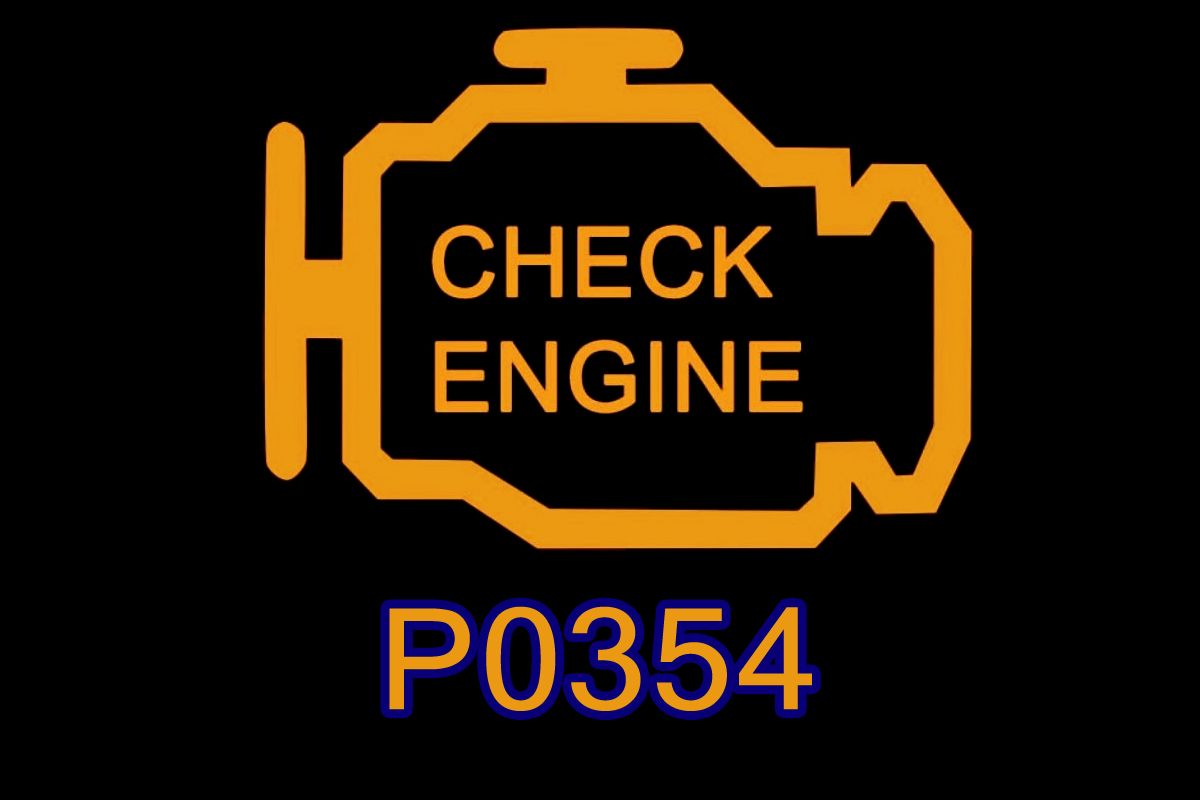
P0354 Ignition Coil "D" Primary/Secondary Circuit Malfunction
P0354 is an OBD-II diagnostic trouble code indicating that the engine control module (ECM/PCM) has detected a malfunction in the primary or secondary ignition circuit associated with ignition coil “D.”
Although the code names an ignition coil, it does not automatically mean that the coil itself is defective. The ECM monitors the electrical behavior of the ignition coil circuit, and a problem anywhere in that circuit can trigger P0354.
The fault may involve the ignition coil, connector, wiring, power supply, control circuit, spark plug, or, less commonly, the ECM's ignition driver.
The letter “D” is manufacturer-dependent. It identifies a particular ignition-coil circuit within the engine's ignition system. It should not automatically be interpreted as a particular cylinder number. The exact coil and cylinder must be confirmed using the manufacturer's wiring diagram or service information.
What does P0354 actually mean?
An ignition coil converts the vehicle's relatively low electrical voltage into the much higher voltage required to create a spark at the spark plug.
The process starts on the primary side of the ignition coil.
The ECM controls the primary circuit, allowing current to build a magnetic field inside the coil. When the ECM switches the circuit, the magnetic field collapses and produces the high voltage used by the secondary ignition circuit.
If the ECM detects electrical behavior that does not correspond to the expected operation of Coil D, it can store P0354.
Depending on the vehicle's ignition architecture, this can mean:
-
An open circuit
-
A short to ground
-
A short to voltage
-
Excessive circuit resistance
-
Incorrect current flow
-
Missing coil power
-
Abnormal control signal
-
Internal ignition-coil failure
Therefore, P0354 is best understood as a circuit diagnosis, not a direct instruction to replace the ignition coil.
What can cause P0354?
A failed ignition coil is one of the most common possibilities, but it is far from the only one.
Possible causes include:
-
Defective ignition coil D
-
Damaged coil wiring
-
Broken control wire
-
Intermittent internal wire break
-
Short to ground
-
Short to battery voltage
-
Excessive resistance in the circuit
-
Loose ignition-coil connector
-
Corroded connector terminals
-
Poor terminal tension
-
Bent or pushed-back connector pins
-
Missing ignition power supply
-
Poor ground where applicable
-
Damaged spark plug
-
Incorrect spark-plug gap
-
Oil contamination around the coil
-
Water intrusion
-
Incorrect or incompatible ignition coil
-
Poor previous wiring repair
-
Failed ECM ignition driver
An intermittent harness problem is particularly easy to overlook. The wiring may look completely normal while an internal break causes the circuit to open when the engine moves, vibrates, or reaches a certain temperature.
What symptoms can P0354 cause?
The symptoms depend on how severe the ignition-circuit problem is.
Common symptoms include:
-
Check Engine Light
-
Engine misfire
-
Rough idle
-
Engine shaking
-
Hesitation
-
Poor acceleration
-
Reduced engine power
-
Difficult starting
-
Long cranking
-
Engine stalling
-
Increased fuel consumption
-
Unburned-fuel smell
-
Intermittent loss of power
In some cases, the engine may appear to run normally under light load.
This is particularly common when a coil or its circuit is only marginal and fails when the ignition system is placed under greater demand.
Why can P0354 appear only during acceleration?
A vehicle that starts easily and idles smoothly can still have a significant ignition problem.
When the engine is under heavy load, cylinder pressure increases. The ignition system then needs to generate sufficient voltage to create a reliable spark across the spark-plug gap.
A weak coil, worn spark plug, damaged insulation, or poor electrical connection may therefore work at idle but fail during acceleration.
A typical pattern can look like:
Normal idle → normal light driving → hard acceleration → misfire → P0354
This is why the conditions under which the code was originally recorded are important.
If the fault appears at a particular RPM, engine temperature, or load, those conditions can provide a major diagnostic clue.
How should P0354 be diagnosed?
The first step is to scan the vehicle for all stored and pending codes.
P0354 should not be considered separately if other diagnostic codes are present.
For example, additional misfire codes, low-voltage codes, injector faults, or engine-position sensor codes may change the diagnostic direction.
Freeze-frame data should also be examined. Engine RPM, engine load, coolant temperature, system voltage, and other recorded parameters can help determine when the ECM detected the fault.
The next step is to identify exactly which physical ignition coil is designated Coil D on that particular engine.
This information should come from the manufacturer's service information rather than assuming that “D” corresponds to cylinder 4.
Inspect the ignition coil and connector
A careful visual inspection can reveal surprisingly common causes of P0354.
The technician should check for:
-
Cracked coil housing
-
Burn marks
-
Evidence of electrical arcing
-
Oil contamination
-
Water intrusion
-
Corroded terminals
-
Loose terminals
-
Damaged connector locks
-
Broken wires
-
Chafed insulation
-
Poor previous repairs
The connector should be checked for proper terminal tension as well as corrosion.
A terminal may look perfectly clean but fail to maintain reliable electrical contact.
If the fault is intermittent, a carefully performed wiggle test while monitoring the relevant circuit or misfire data can help expose a wiring or connector problem.
Check the coil power supply
The ignition coil must receive the correct electrical supply.
A missing or unstable power supply can make a good ignition coil appear defective.
The power circuit should therefore be tested according to the manufacturer's specifications.
A simple voltage measurement is not always enough.
A circuit can show normal voltage when the coil is not operating but experience a significant voltage drop when current flows.
For this reason, voltage-drop testing under load can be more informative than simply checking for battery voltage.
Test the ECM control circuit
The ECM control wire is another critical part of the diagnosis.
On many modern ignition systems, the ECM directly controls the ignition coil or its integrated driver.
The technician may need to check:
-
Control-wire continuity
-
Circuit resistance
-
Short to ground
-
Short to battery voltage
-
Voltage drop
-
Control signal
-
Control waveform during engine operation
An oscilloscope is particularly valuable when diagnosing a difficult P0354 because it allows the actual control signal to be observed rather than relying only on a static resistance measurement.
A wire can pass a basic continuity test while still having a fault that appears only under vibration or electrical load.
Check the spark plug
The spark plug associated with Coil D should also be inspected.
A worn or excessively gapped spark plug can increase the voltage required from the ignition system.
Other possible problems include:
-
Cracked ceramic
-
Carbon fouling
-
Oil fouling
-
Incorrect plug type
-
Excessive electrode wear
-
Incorrect gap
A marginal ignition coil may work normally with a relatively easy-to-fire spark plug but break down when the plug requires higher ignition voltage.
However, a spark-plug problem should not automatically be considered the explanation for P0354. The code specifically concerns the primary/secondary circuit of Coil D, so the electrical circuit still needs to be tested.
Use a coil swap test when appropriate
If the ignition coils are interchangeable, swapping Coil D with another suitable coil can provide useful evidence.
Suppose the vehicle has a misfire associated with the cylinder controlled by Coil D. If the misfire moves after the coils are exchanged, the coil becomes a strong suspect.
If the fault remains at the original location, attention should shift toward:
-
Wiring
-
Connector
-
Power supply
-
Control circuit
-
Spark plug
-
ECM driver
-
Other cylinder-specific conditions
The important point is that the swap is a diagnostic test, not simply a reason to replace the coil.
Could the ECM cause P0354?
Yes, although this is generally less common than a faulty coil, wiring problem, or connector fault.
Many ignition systems use an ECM driver to control the coil's primary circuit. If this driver fails, the coil may not receive the correct control signal.
However, an ECM should not be condemned based on P0354 alone.
Before considering the ECM, the technician should prove that:
-
Coil power is correct
-
Grounds are correct
-
Wiring is intact
-
Control wire is not shorted
-
Connector terminals are sound
-
Coil operation is correct
-
The control waveform is abnormal or missing despite a good external circuit
Only then does an ECM driver fault become a reasonable conclusion.
Can a weak battery cause P0354?
A weak battery or unstable charging voltage can affect ignition-system operation, especially during engine starting.
However, low battery voltage is not the direct meaning of P0354.
If P0354 appears together with multiple voltage, communication, or electrical-system codes, the battery and charging system should be tested.
If P0354 appears by itself, the Coil D circuit should remain the primary diagnostic focus.
What should be replaced for P0354?
The correct repair depends entirely on the test results.
If Coil D has an internal electrical failure, the ignition coil should be replaced.
If the coil is good but the wiring is damaged, the wiring should be repaired.
If the connector has poor terminal tension or corrosion, the connector or terminals should be repaired.
If the spark plug is worn or damaged, it should be replaced according to the manufacturer's specifications.
If the ECM ignition driver is proven to be defective, ECM repair or replacement may be necessary.
There is therefore no single component that should automatically be replaced when P0354 is stored.
P0354 does not automatically mean “bad ignition coil”
This is the most important diagnostic point.
P0354 identifies an abnormal condition involving the Ignition Coil D primary/secondary circuit.
It does not identify the exact failed component.
A professional diagnosis should follow the circuit from the coil back toward the control module:
Ignition coil → connector → power supply → wiring → control signal → spark plug/secondary ignition → ECM driver
The objective is to determine exactly where the expected electrical behavior is lost.
P0354 vs. P0355, P0356 and P0357
These codes belong to the same general ignition-coil circuit family but identify different coil circuits:
-
P0354 – Ignition Coil D
-
P0355 – Ignition Coil E
-
P0356 – Ignition Coil F
-
P0357 – Ignition Coil G
The letter designation does not universally correspond to a cylinder number. The manufacturer's ignition-system layout determines which physical coil is represented by each letter.
Final diagnostic conclusion
P0354 – Ignition Coil “D” Primary/Secondary Circuit Malfunction means the ECM has detected abnormal electrical behavior in the ignition circuit assigned to Coil D.
The ignition coil may be defective, but so may the connector, wiring, power supply, spark plug, or ECM control circuit.
The correct approach is to identify Coil D, inspect the complete circuit, verify power and control signals, evaluate the spark plug, and use waveform or coil-swap testing where appropriate.
Replacing the coil without testing the circuit can easily miss the real problem. The code identifies where the ECM sees the fault, not necessarily which component has failed.