TR
TR EN
EN

What Is Low Engine Compression? Symptoms and Causes
Engine compression is one of the most important factors in the combustion process. During the compression stroke, the piston moves upward and compresses the air or air-fuel mixture inside the cylinder. The resulting pressure and temperature allow the engine to produce combustion efficiently.
When compression is too low, the cylinder may not be able to generate the pressure required for proper combustion. Depending on how low the compression is and whether one or several cylinders are affected, the result can range from a slight roughness to severe misfire, hard starting or complete engine failure to start.
Low compression is not a diagnosis by itself. It is a measurement indicating that something is preventing the cylinder from sealing or compressing the charge correctly.
What Does Engine Compression Mean?
Compression is the pressure created inside a cylinder as the piston moves upward with the valves closed.
For a healthy cylinder, several components must work together:
-
Piston rings
-
Piston
-
Cylinder wall
-
Intake valve
-
Exhaust valve
-
Cylinder head
-
Head gasket
-
Valve train
-
Camshaft
-
Timing chain or timing belt
If the cylinder cannot seal properly, some of the compressed gas escapes.
This reduces compression pressure and can negatively affect combustion.
What Are the Symptoms of Low Compression?
Low compression can produce different symptoms depending on the severity of the problem.
Common symptoms include:
-
Difficult starting
-
Long cranking time
-
Rough idle
-
Engine shaking
-
Misfire
-
Reduced engine power
-
Poor acceleration
-
Increased fuel consumption
-
Uneven engine operation
-
Check Engine Light
-
Blue or white exhaust smoke depending on the underlying fault
-
Increased crankcase pressure
-
Excessive blow-by
-
Poor cold starting
-
Poor hot starting
-
Low compression on one or more cylinders
-
Engine may fail to start in severe cases
Not every engine with low compression will show all of these symptoms.
Difficult or Long Cranking
One of the most noticeable symptoms can be difficult starting.
The starter may rotate the engine normally, but the engine takes longer than usual to start.
This happens because adequate cylinder pressure is necessary for effective combustion.
The problem can be especially noticeable when several cylinders have reduced compression.
Diesel engines are particularly sensitive to compression because they depend on high compression temperatures for ignition.
Rough Idle
A cylinder with significantly lower compression may not contribute the same amount of power as the other cylinders.
At idle, this imbalance can become very noticeable.
The engine may:
-
Shake
-
Vibrate
-
Run unevenly
-
Have unstable RPM
-
Sound as though one cylinder is not working correctly
However, rough idle does not automatically mean low compression.
Ignition faults, fuel injectors, vacuum leaks, throttle problems and sensor faults can produce very similar symptoms.
Misfire
Low compression can cause a cylinder misfire.
The ECU may detect a crankshaft-speed variation and store a misfire code such as:
-
P0300 – Random/Multiple Cylinder Misfire
-
P0301 – Cylinder 1 Misfire
-
P0302 – Cylinder 2 Misfire
-
P0303 – Cylinder 3 Misfire
-
P0304 – Cylinder 4 Misfire
The exact codes depend on the engine.
A misfire code tells you that combustion is abnormal. It does not prove that compression is low.
The cylinder should therefore be tested before concluding that the engine has an internal mechanical problem.
Reduced Engine Power
When one cylinder produces less power than the others, total engine output decreases.
The driver may notice:
-
Weak acceleration
-
Poor hill-climbing performance
-
Sluggish response
-
Reduced high-RPM performance
-
Engine hesitation under load
If several cylinders have low compression, the loss of power can be substantial.
Increased Fuel Consumption
Low compression can reduce combustion efficiency.
The ECU may attempt to compensate for combustion problems through fuel-control adjustments, depending on the engine and the cause.
As a result, fuel consumption can increase.
However, increased fuel consumption has many other possible causes, including:
-
Faulty oxygen sensor
-
MAF sensor problems
-
Injector problems
-
Thermostat problems
-
Low tire pressure
-
Dragging brakes
-
Incorrect fuel mixture
-
Ignition problems
-
Turbocharger faults
Therefore, fuel consumption alone is not evidence of low compression.
Check Engine Light
Low compression itself may not always generate a specific compression-related diagnostic code.
Instead, the ECU may detect the consequences of the problem.
Possible stored codes can include:
-
Misfire codes
-
Camshaft/crankshaft correlation codes
-
Fuel-trim codes
-
Variable valve timing codes
A mechanical compression problem can therefore exist even when the diagnostic scanner does not display an obvious "low compression" message.
Blue Smoke and Low Compression
Blue smoke can sometimes accompany low compression, particularly when worn piston rings or cylinder walls allow engine oil to enter the combustion chamber.
However, blue smoke is more directly associated with oil entering the combustion chamber than with compression loss itself.
Possible causes include:
-
Worn piston rings
-
Worn cylinder walls
-
Damaged pistons
-
Valve stem seals
-
Turbocharger oil leakage
-
PCV system problems
A compression test and leak-down test can help determine whether piston-ring or valve-related problems are involved.
White Smoke and Low Compression
White or light-colored exhaust smoke can occur when combustion is incomplete, particularly on diesel engines.
Low compression can contribute to poor combustion and produce white smoke, especially during cold starting.
However, white smoke can also be caused by:
-
Coolant entering the combustion chamber
-
Faulty injectors
-
Incorrect injection timing
-
Poor glow plug operation
-
Low combustion temperature
-
Fuel-system problems
The smoke color alone cannot identify the cause.
Increased Crankcase Pressure
If piston rings are worn or damaged, combustion gases can escape past the rings into the crankcase.
This is called blow-by.
Excessive blow-by can produce:
-
Increased crankcase pressure
-
Oil leaks
-
Oil consumption
-
Oil mist around the breather system
-
PCV system problems
-
Smoke or vapor from the oil filler area
A compression problem caused by valves or a head gasket does not necessarily produce the same crankcase symptoms.
What Causes Low Engine Compression?
There are several possible causes.
The most important distinction is whether the compression loss comes from:
-
The piston/ring/cylinder area
-
The valves
-
The cylinder head or head gasket
-
Incorrect valve timing
Worn or Damaged Piston Rings
Piston rings are responsible for sealing combustion gases between the piston and cylinder wall.
As the rings wear, more combustion pressure can escape into the crankcase.
This can cause:
-
Low compression
-
Blow-by
-
Oil consumption
-
Blue smoke
-
Reduced engine power
Severely worn rings can cause compression to decrease significantly.
Worn Cylinder Walls
The cylinder wall provides the surface against which the piston rings seal.
Over time, the cylinder can become worn, especially in high-mileage engines or engines that have experienced poor lubrication.
Possible problems include:
-
Excessive cylinder clearance
-
Taper
-
Out-of-round cylinders
-
Scoring
-
Surface damage
Even new piston rings may not properly seal against severely worn cylinders without appropriate machining.
Damaged Piston
A damaged piston can cause a major compression loss.
Possible problems include:
-
Cracked piston
-
Burned piston
-
Broken piston ring lands
-
Hole in piston
-
Severe crown damage
A heavily damaged piston can cause extremely low compression in one cylinder.
In turbocharged engines, severe detonation, abnormal combustion, excessive heat or other mechanical problems can contribute to piston damage.
Burned or Bent Valves
The intake and exhaust valves must seal tightly when closed.
If a valve is burned, bent or damaged, combustion pressure can escape through the valve.
Possible causes include:
-
Excessive valve temperature
-
Incorrect valve clearance
-
Valve-seat damage
-
Overheating
-
Incorrect timing
-
Mechanical contact between piston and valve
A valve that does not seal properly can cause very low compression in one cylinder.
Damaged Valve Seat
The valve must sit correctly against its seat to form a seal.
A damaged valve seat can allow compression to escape even when the valve itself does not appear severely damaged.
This can occur because of:
-
Excessive heat
-
Valve-seat wear
-
Incorrect machining
-
Overheating
-
Mechanical damage
Blown Head Gasket
A damaged head gasket can allow pressure to escape from the cylinder.
Depending on where the gasket fails, compression may leak:
-
Into the cooling system
-
Into an adjacent cylinder
-
Into the oil system
-
Externally
A head-gasket failure between two cylinders can cause low compression in both cylinders.
Possible additional symptoms include:
-
Coolant loss
-
Overheating
-
Bubbles in the cooling system
-
White exhaust smoke
-
Contaminated engine oil
-
Two adjacent cylinders with unusually low compression
However, not every head-gasket failure produces all of these symptoms.
Cracked Cylinder Head
A cracked cylinder head can cause compression loss and may also allow coolant or oil to enter areas where it should not.
Possible symptoms include:
-
Low compression
-
Coolant loss
-
Misfire
-
Overheating
-
White smoke
-
Rough running
A pressure test or specialized inspection may be required to confirm a cylinder-head crack.
Cracked Engine Block
A cracked engine block is less common but can produce serious compression, coolant or oil problems.
This can happen because of:
-
Severe overheating
-
Freezing
-
Mechanical damage
-
Manufacturing defects
-
Extreme combustion pressure
A block problem usually requires extensive engine repair.
Incorrect Valve Timing
Incorrect timing can cause low compression readings even when the piston rings and valves are mechanically healthy.
If the timing chain or belt has jumped, the camshaft may no longer be correctly synchronized with the crankshaft.
The valves may therefore open and close at the wrong time.
Possible causes include:
-
Stretched timing chain
-
Failed timing-chain tensioner
-
Broken timing guide
-
Jumped timing chain
-
Worn timing belt
-
Incorrect timing-belt installation
-
Camshaft timing actuator problem
If multiple cylinders show unexpectedly low compression, incorrect valve timing should be considered.
Timing Belt or Chain Failure
If the timing belt or chain breaks completely, the engine may stop immediately.
On an interference engine, the pistons and valves can collide, potentially bending valves or damaging pistons.
After such a failure, compression may be extremely low on several cylinders.
Trying to repeatedly crank an engine after a suspected timing failure may cause additional damage in some circumstances.
Valve Clearance Problems
Some engines use adjustable mechanical valve clearance, while others use hydraulic lifters or similar systems.
If valve clearance becomes incorrect, a valve may fail to close completely.
That can cause compression loss.
This is particularly important when low compression appears in one cylinder without obvious piston damage.
Carbon Deposits and Valve Problems
Carbon deposits can interfere with valve seating in some engines.
They can prevent a valve from closing completely, allowing pressure to escape.
Carbon buildup can also create other combustion problems, so the actual cause should be confirmed rather than assuming that deposits are responsible.
Low Compression in One Cylinder
A single cylinder with significantly lower compression than the others often points toward a localized mechanical problem.
Possible causes include:
-
Burned valve
-
Bent valve
-
Damaged piston
-
Broken piston ring
-
Worn cylinder
-
Head-gasket failure
-
Valve-seat problem
The difference between cylinders is often more informative than simply comparing one reading with a generic pressure number.
Low Compression in Two Adjacent Cylinders
Two neighboring cylinders with low compression can be an important clue.
Possible causes include:
-
Head-gasket failure between cylinders
-
Cylinder-head damage
-
Timing problems
-
Valve-train problems
A leak-down test can help identify where the compression is escaping.
Low Compression in All Cylinders
If compression is low across nearly every cylinder, the problem may be different.
Possible causes include:
-
Incorrect valve timing
-
Timing chain/belt problem
-
Incorrect compression-test procedure
-
Throttle position during testing on applicable gasoline engines
-
Low cranking speed
-
Battery voltage problems
-
General engine wear
If every cylinder suddenly shows low compression, it is important to verify the test equipment and procedure before assuming that the entire engine is worn out.
How Is Engine Compression Tested?
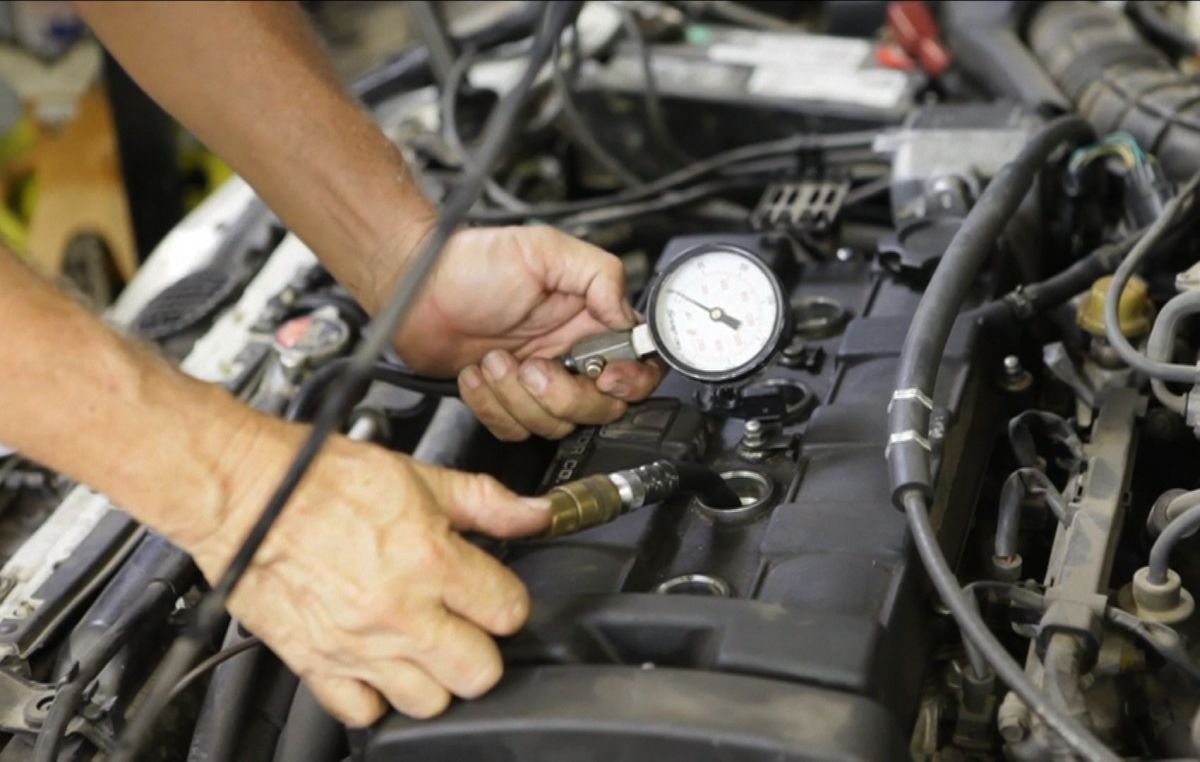
A compression test measures the pressure produced by each cylinder while the engine is cranked.
The basic procedure generally involves:
-
Bringing the engine to an appropriate temperature when specified
-
Disabling fuel and/or ignition according to the manufacturer's procedure
-
Removing the spark plugs on a gasoline engine
-
Installing a compression gauge
-
Cranking the engine
-
Recording the pressure from each cylinder
-
Comparing the results
Diesel engines require equipment designed for their much higher compression pressures, and the testing procedure is different.
The manufacturer's service procedure should always be followed.
Compression Test Results
There is no single compression-pressure number that is correct for every engine.
Compression depends on:
-
Engine design
-
Compression ratio
-
Camshaft profile
-
Valve timing
-
Engine temperature
-
Cranking speed
-
Test equipment
-
Throttle position
-
Altitude
-
Engine condition
Therefore, a value that is normal for one engine can be abnormal for another.
The manufacturer's specifications are the correct reference.
Compression Difference Between Cylinders
The difference between cylinders is often extremely important.
If three cylinders have similar readings and one cylinder is substantially lower, that is a strong indication that further investigation is required.
A relatively even set of readings may be more important than whether the absolute number seems high or low when compared with an unrelated engine.
What Is a Wet Compression Test?
A wet compression test is performed by adding a small amount of engine oil to the cylinder before repeating the compression measurement.
The oil temporarily improves sealing between the piston rings and cylinder wall.
If compression increases significantly, worn piston rings or cylinder-wall wear become stronger suspects.
If compression changes very little, a valve, head gasket or timing-related problem becomes more likely.
The result is not conclusive by itself, but it is a useful diagnostic clue.
What Is a Leak-Down Test?
A leak-down test is often more informative when a compression problem has already been identified.
Instead of measuring how much pressure the cylinder generates during cranking, the technician introduces compressed air into the cylinder and observes where the air escapes.
Air heard from the:
-
Intake → possible intake-valve leakage
-
Exhaust → possible exhaust-valve leakage
-
Oil filler/crankcase → possible piston-ring or cylinder leakage
-
Cooling system → possible head-gasket or cylinder-head/block problem
This makes the leak-down test particularly useful for locating the source of compression loss.
Compression Test vs Leak-Down Test
A compression test answers:
"How much pressure can this cylinder produce?"
A leak-down test answers:
"Where is the cylinder losing pressure?"
For a serious suspected internal-engine problem, using both tests can provide much more useful information than relying on either test alone.
Can Low Compression Cause Engine Misfire?
Yes.
If a cylinder cannot generate sufficient compression, the air-fuel mixture may not burn correctly.
This can produce a persistent or intermittent misfire.
However, the same misfire can also be caused by:
-
Spark plug
-
Ignition coil
-
Fuel injector
-
Fuel pressure
-
Vacuum leak
-
MAF/MAP sensor
-
Electronic throttle
-
Wiring
-
ECU control
This is why replacing ignition or fuel components without testing compression can sometimes lead to unnecessary repairs.
Can Low Compression Cause High Fuel Consumption?
Yes, it can contribute to increased fuel consumption.
An engine with poor combustion efficiency may produce less useful power from the same amount of fuel.
The ECU may also attempt to compensate for some combustion problems.
But high fuel consumption has many possible causes, so compression should be tested when other evidence points toward an internal mechanical problem.
Can Low Compression Cause Oil Consumption?
Yes, particularly when the compression loss is related to piston rings or cylinder-wall wear.
Worn rings can allow oil to enter the combustion chamber while combustion gases pass into the crankcase.
This can create a cycle involving:
-
Low compression
-
Blow-by
-
Oil consumption
-
Blue smoke
-
Reduced engine performance
Valve-related compression loss does not necessarily produce the same oil-consumption pattern.
Can Low Compression Cause Overheating?
Low compression itself does not always cause overheating.
However, the underlying problem can sometimes be associated with excessive heat.
For example:
-
Burned valves
-
Head-gasket failure
-
Abnormal combustion
-
Severe piston damage
may occur alongside overheating or may be caused by excessive engine temperature.
Therefore, overheating and low compression together require careful investigation.
Can Low Compression Cause Hard Starting Only When Cold?
Yes.
Some engines may start relatively easily when warm but become difficult to start when cold if compression is marginal.
This is particularly relevant to diesel engines because cold starting depends heavily on adequate compression temperature.
However, cold-start problems can also result from:
-
Glow plugs
-
Glow plug control module
-
Battery
-
Starter speed
-
Fuel pressure
-
Injectors
-
Coolant temperature sensor
Compression should therefore be confirmed rather than assumed.
Can an Engine Run With Low Compression?
Yes, depending on how severe the compression loss is.
If one cylinder has moderately reduced compression, the engine may continue to run.
It may exhibit:
-
Rough idle
-
Misfire
-
Reduced power
-
Increased fuel consumption
-
Vibration
If compression becomes extremely low or several cylinders lose compression, the engine may become very difficult to start or may not start at all.
Is It Safe to Drive With Low Compression?
Driving with a known compression problem is generally not advisable until the cause has been identified.
A mildly reduced compression reading does not necessarily mean immediate catastrophic failure, but the underlying problem can worsen.
Continued driving can potentially result in:
-
Catalytic-converter damage from misfire
-
Increased oil consumption
-
Engine overheating
-
Further piston or valve damage
-
More severe internal wear
-
Complete engine failure
A severe misfire, flashing Check Engine Light, low oil pressure or overheating should be treated as a reason to stop driving and investigate the vehicle.
Does Low Compression Always Mean the Engine Needs Rebuilding?
No.
This is an important distinction.
Low compression can sometimes be caused by a relatively localized repair such as:
-
Valve problem
-
Valve-seat issue
-
Head-gasket failure
-
Timing problem
Other cases may involve severe piston, ring or cylinder damage and require major engine work.
A compression measurement alone cannot determine whether the engine needs rebuilding.
A leak-down test, timing inspection, borescope examination and other diagnostic procedures may be necessary.
Low Compression in Gasoline vs Diesel Engines
The basic principle is the same, but the consequences differ.
Gasoline engines
Compression is important for efficient combustion, but ignition is normally provided by the spark plug.
Low compression can cause:
-
Misfire
-
Rough running
-
Poor acceleration
-
Hard starting
-
Increased fuel consumption
Diesel engines
Diesel engines rely on compression to generate the temperature required for ignition.
Low compression can therefore be particularly problematic during cold starting.
A diesel engine with low compression may produce:
-
Difficult cold starting
-
White smoke
-
Rough running
-
Misfire-like combustion irregularities
-
Reduced power
-
Increased crankcase blow-by
Can a Compression Problem Be Detected With OBD?
OBD can sometimes provide clues but cannot directly measure cylinder compression.
The ECU can detect the consequences of low compression through:
-
Misfire monitoring
-
Crankshaft-speed variations
-
Fuel-trim abnormalities
-
Camshaft/crankshaft correlation
-
Combustion-related data
However, a scan tool cannot replace a physical compression or leak-down test when an internal mechanical problem is suspected.
What Should Be Checked Before Replacing Engine Parts?
A sensible diagnostic sequence is important.
Start by identifying whether the problem is actually mechanical.
Check:
-
Diagnostic trouble codes
-
Misfire cylinder identification
-
Spark plugs and ignition system
-
Injector operation
-
Fuel pressure
-
Engine timing
-
Compression on all cylinders
-
Wet compression test if appropriate
-
Leak-down test
-
Valve-train condition
-
Borescope inspection when necessary
This approach can prevent unnecessary replacement of expensive components.
Final Consideration
Low engine compression means that one or more cylinders are unable to build or retain the expected pressure.
The most common underlying causes include:
-
Worn piston rings
-
Worn cylinder walls
-
Damaged pistons
-
Burned or bent valves
-
Valve-seat problems
-
Head-gasket failure
-
Cylinder-head damage
-
Incorrect valve timing
-
Timing chain or belt problems
-
Incorrect valve clearance
The most important point is that a low compression reading is a symptom of a mechanical condition, not the diagnosis itself.
A compression test can show that a cylinder is producing less pressure than expected, but a leak-down test is often needed to determine where that pressure is escaping. Comparing all cylinders, checking engine timing and considering the engine manufacturer's specifications are essential before deciding whether the problem is a valve, piston, ring, head gasket or another component.