TR
TR EN
EN

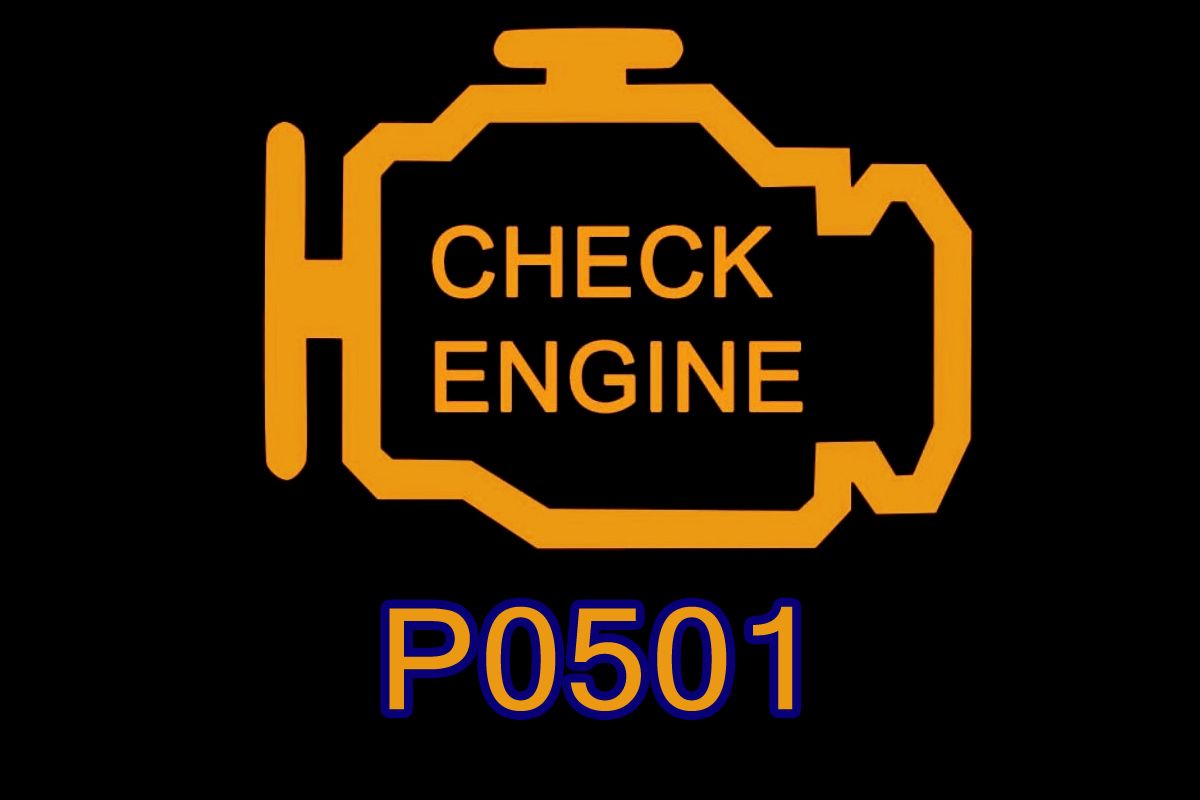
P0501 Vehicle Speed Sensor "A" Range/Performance
The P0501 diagnostic trouble code means that the engine control module (ECM/PCM) has detected a problem with the range or performance of Vehicle Speed Sensor "A".
In practical terms, the control module is receiving vehicle-speed information, but that information does not behave as expected for the vehicle's operating conditions.
The important distinction is that P0501 is not simply a statement that the speed sensor has failed. The sensor may be perfectly functional while the problem is caused by its wiring, tone ring, transmission, ABS system, incorrect wheel-speed information, or communication between control modules.
What Does "Range/Performance" Mean?
The phrase Range/Performance describes how the signal behaves rather than identifying a specific electrical fault.
The ECM knows roughly what vehicle speed should be possible based on other information such as:
-
Engine RPM
-
Transmission gear
-
Throttle position
-
Wheel-speed information
-
Engine load
-
Transmission output speed
If the reported vehicle speed does not agree with what the control module expects, P0501 may be stored.
For example, imagine the vehicle is traveling steadily at 60 km/h. The speed signal suddenly reports 10 km/h, 150 km/h, or another value that is inconsistent with the other available data.
The signal may still exist electrically, but its performance is outside the expected operating range.
This is different from a code such as P0503, where the control module is specifically identifying the signal as intermittent, erratic, or high.
What Is Vehicle Speed Sensor "A"?
Vehicle Speed Sensor "A" is a generic SAE designation. It does not necessarily mean there is a component physically labeled "A" on the vehicle.
On some vehicles, VSS A is a dedicated sensor installed on the transmission or differential.
On many newer vehicles, however, vehicle speed is calculated using ABS wheel-speed sensors. The ABS module can then send vehicle-speed information to other modules over the vehicle's communication network.
As a result, the exact component associated with VSS "A" varies between manufacturers and vehicle platforms.
How Vehicle Speed Information Is Generated
A traditional transmission-mounted speed sensor may monitor the rotation of the transmission output shaft.
As the shaft rotates, the sensor produces a signal corresponding to rotational speed. The control module uses that information to calculate vehicle speed.
Modern vehicles can work differently.
A simplified system may look like this:
Wheel-speed sensors → ABS module → CAN communication → Engine/Transmission/Instrument Cluster
If one wheel-speed signal becomes inaccurate, the ABS module may calculate an incorrect vehicle speed. Other modules can then receive incorrect information even though their own wiring is completely intact.
This is one reason P0501 sometimes requires diagnosis beyond the engine compartment.
Symptoms of P0501
The symptoms depend on the severity and nature of the speed-signal problem.
Possible symptoms include:
-
Check Engine Light
-
Incorrect speedometer reading
-
Speedometer that is too high or too low
-
Speedometer fluctuations
-
Cruise control becoming unavailable
-
Automatic transmission shifting incorrectly
-
Harsh or delayed gear changes
-
Transmission entering fail-safe or limp mode
-
ABS warning light
-
Traction-control warning
-
Stability-control warning
-
Incorrect odometer or trip-distance information
-
Abnormal deceleration fuel-cut behavior
-
Increased fuel consumption
-
Engine idle or deceleration behavior that feels unusual
Some vehicles may store P0501 without producing an obvious drivability symptom.
Common Causes of P0501
Faulty vehicle speed sensor
The sensor can produce an incorrect signal even if it has not completely failed.
A sensor may become inaccurate at particular speeds, temperatures, or operating conditions.
Damaged or contaminated tone ring
Many speed sensors read a toothed wheel, reluctor, magnetic encoder, or similar rotating component.
Damaged teeth, excessive contamination, cracks, or an incorrect sensor gap can distort the signal.
Damaged wiring
A partially broken wire can change the signal quality or cause resistance in the circuit.
Wiring damage may be particularly difficult to identify when the problem only occurs while the vehicle is moving.
Corroded or loose connector
Water, oil, corrosion, or loose terminals can interfere with the speed-sensor signal.
ABS wheel-speed sensor problem
On vehicles that derive vehicle speed from ABS information, a faulty wheel-speed sensor can be the actual cause of P0501.
Wheel bearing or hub problem
On some vehicles, the wheel bearing or hub contains the magnetic encoder used by the wheel-speed sensor. Excessive bearing play or damage to the encoder can therefore affect the speed signal.
Transmission-related problem
If VSS A is transmission-mounted, a problem with the transmission output shaft, reluctor, or related rotating component can affect the sensor signal.
Incorrect tire or wheel size
Significantly different tire circumference can cause a difference between actual vehicle speed and the speed calculated by the control system.
This can be particularly relevant after changing wheel or tire sizes.
Module communication problem
On modern vehicles, vehicle-speed information may travel between modules through CAN communication.
A communication problem can therefore create a speed-related fault without the sensor itself being defective.
P0501 Does Not Necessarily Mean the Speedometer Is Wrong
The speedometer is only one possible user-visible result of a vehicle-speed problem.
The ECM and transmission controller may receive vehicle-speed information independently of what the driver sees on the instrument cluster.
For example, the speedometer may appear normal while the transmission controller receives an abnormal speed value.
Conversely, the speedometer may display an incorrect value because the cluster is receiving bad information from another module.
Therefore, the entire signal path needs to be considered.
How P0501 Should Be Diagnosed
A good diagnosis starts with a complete scan of the vehicle.
Do not look at the engine ECU alone. If the vehicle has separate ABS, transmission, body, or stability-control modules, scan them as well.
Pay particular attention to any codes relating to:
-
Wheel-speed sensors
-
ABS
-
Transmission input/output speed
-
CAN communication
-
Traction control
-
Stability control
These additional codes may identify the source of the problem.
Check freeze-frame data
Look at the conditions under which P0501 was stored.
Vehicle speed, engine RPM, transmission gear, engine load, and other available parameters can help determine whether the reported speed was plausible.
Compare actual speed with scan-tool data
During a controlled road test, monitor the vehicle-speed parameter.
If the vehicle is traveling at a stable speed but the scan tool reports an inconsistent value, the speed-information circuit requires further investigation.
For example, if GPS indicates approximately 80 km/h while the vehicle ECU intermittently reports 40 km/h, that discrepancy is useful diagnostic evidence.
GPS should not be treated as the vehicle's official speed reference, but it can be useful as a general comparison during diagnosis.
Check Wheel-Speed Data
If the vehicle uses ABS wheel-speed information, monitor all available wheel-speed readings.
At a steady speed, the readings should generally be reasonably consistent.
Suppose three wheels report approximately 70 km/h while one wheel repeatedly reports 45 km/h.
That strongly suggests that the problem should be investigated around that wheel:
-
Wheel-speed sensor
-
Wiring
-
Connector
-
Tone ring
-
Magnetic encoder
-
Wheel bearing
-
Hub assembly
In that situation, replacing a transmission speed sensor may accomplish nothing.
Inspect the Sensor and Wiring
A physical inspection should include the sensor itself and its surrounding wiring.
Look for:
-
Broken insulation
-
Chafed wiring
-
Stretched wires
-
Loose connectors
-
Corroded terminals
-
Water intrusion
-
Oil contamination
-
Damaged sensor mounting
-
Incorrect sensor positioning
-
Evidence of previous wiring repairs
Because P0501 is a range/performance code, an intermittent wiring fault is still possible even though the code itself does not specifically say "intermittent."
Check the Signal Electrically
The correct electrical test depends on the type of speed sensor.
Some vehicles use Hall-effect sensors, which produce a digital signal.
Others use variable-reluctance sensors, which generate an AC signal whose characteristics change with rotational speed.
Some modern wheel-speed systems use active sensors with their own electronics.
Therefore, there is no universal VSS voltage, frequency, or resistance specification that applies to every vehicle.
Use the manufacturer's wiring diagram and test specifications for the particular vehicle.
Depending on the system, diagnosis may involve checking:
-
Power supply
-
Ground
-
Signal voltage
-
Signal frequency
-
Signal waveform
-
Continuity
-
Short circuits
-
Sensor output while rotating
-
Communication data
An oscilloscope can be especially useful when the sensor appears to work at low speed but produces an abnormal waveform at higher speed.
Inspect the Tone Ring or Reluctor
A good sensor cannot produce a correct speed signal if the component it is reading is damaged.
Inspect the reluctor or tone ring for:
-
Missing teeth
-
Damaged teeth
-
Cracks
-
Excessive corrosion
-
Metallic debris
-
Incorrect sensor clearance
-
Physical movement
-
Uneven rotation
On wheel-speed systems, also consider the condition of the wheel bearing and magnetic encoder.
A damaged encoder can create a speed signal problem that initially looks like a sensor failure.
Tire Size Can Matter
Vehicle-speed calculations are affected by wheel and tire circumference.
If the vehicle has substantially different tire dimensions from those expected by the manufacturer, the calculated speed may not correspond correctly with the actual road speed.
A small difference may not be enough to trigger a fault, but a significant change can create problems with speed calculation and other systems.
When diagnosing P0501, verify that the vehicle has the correct tire dimensions and that there are no unusual differences between tires.
P0501 and Automatic Transmission Problems
Vehicle speed is a critical input for automatic transmission operation.
The transmission controller uses speed information to determine when and how to shift.
If vehicle speed is reported incorrectly, the transmission may believe that the vehicle is moving faster or slower than it actually is.
This can cause:
-
Early shifting
-
Late shifting
-
Harsh shifting
-
Unexpected downshifts
-
Incorrect torque-converter lockup
-
Fail-safe operation
If P0501 appears together with transmission codes, the speed signal should be investigated before assuming that the transmission itself has a major mechanical failure.
P0501 vs. P0500
These codes are closely related.
P0500 – Vehicle Speed Sensor "A" Malfunction
This is a general malfunction of the vehicle-speed sensor system.
P0501 – Vehicle Speed Sensor "A" Range/Performance
This indicates that the reported speed signal is present but its value or behavior is outside the expected range or performance characteristics.
P0501 therefore often points toward a plausibility or signal-quality problem rather than a simple complete loss of signal.
P0501 vs. P0503
The distinction is also important here.
P0501 indicates a range/performance problem.
P0503 indicates that the VSS A signal is intermittent, erratic, or high.
A vehicle with P0503 may show a speed signal that suddenly disappears or jumps around.
A vehicle with P0501 may have a signal that is continuously present but does not agree with what the control module expects.
There can, of course, be overlap between the two faults depending on the manufacturer's diagnostic strategy.
Can You Drive With P0501?
That depends on how the vehicle behaves.
If the only symptom is a Check Engine Light and the vehicle-speed reading remains normal, the vehicle may still be driveable for a limited period.
However, if the speedometer is inaccurate, the transmission is shifting abnormally, or ABS/traction-control warnings are present, the vehicle should be inspected as soon as possible.
A faulty vehicle-speed signal can affect several safety and drivability systems at once.
Cruise control, stability systems, transmission control, and engine management may all depend on accurate speed information.
What Is the Correct Repair for P0501?
There is no universal repair.
Depending on the diagnosis, the repair may involve:
-
Replacing a faulty vehicle speed sensor
-
Repairing sensor wiring
-
Repairing or replacing a connector
-
Correcting power or ground problems
-
Replacing a damaged tone ring or reluctor
-
Correcting sensor clearance
-
Repairing an ABS wheel-speed sensor circuit
-
Replacing a damaged wheel bearing or hub
-
Correcting an incorrect tire-size configuration
-
Repairing transmission-related components
-
Resolving CAN communication problems
-
Performing required calibration or relearn procedures
The important point is that the sensor should not be replaced simply because P0501 contains the words "Vehicle Speed Sensor."
Final Diagnostic Perspective
P0501 means that Vehicle Speed Sensor "A" is not providing speed information within the range or performance expected by the control module.
The fault can originate from the sensor, but it can just as easily involve wiring, connectors, the reluctor or tone ring, ABS wheel-speed information, wheel bearings, tire configuration, transmission components, or communication between control modules.
The most effective diagnosis is therefore to look at the actual vehicle-speed data, compare it with other speed-related information, and then follow the signal path back toward the source.
A scan tool can tell you that the control module sees an implausible vehicle speed. It cannot, by itself, tell you which component caused that implausible signal.