TR
TR EN
EN

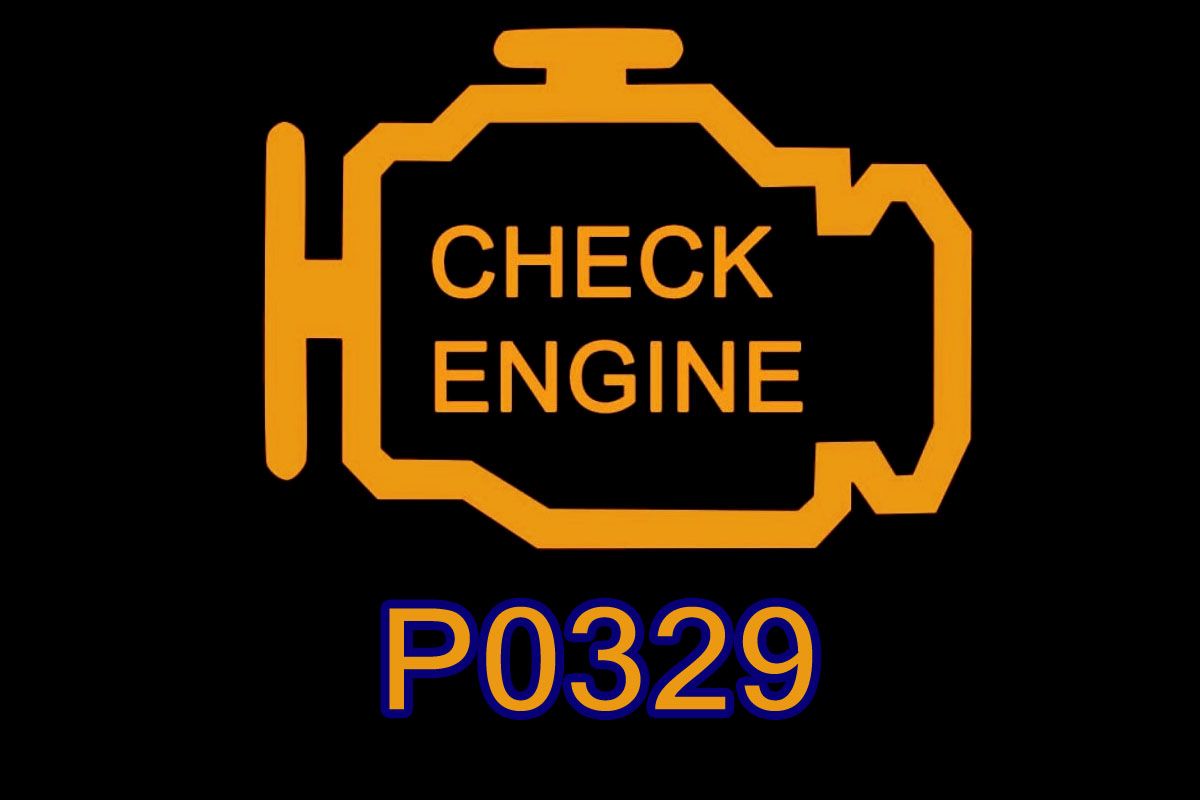
P0329 Knock Sensor 1 Circuit Intermittent (Bank 1 or Single Sensor)
P0329 means the engine control module (ECM/PCM) has detected an intermittent or unstable electrical signal from Knock Sensor 1 on Bank 1, or from the single knock sensor on an engine that uses only one sensor.
The key word in this code is “Intermittent.”
The ECM is not necessarily saying that the knock sensor has completely failed. Instead, the signal is appearing and disappearing, becoming unstable, or behaving abnormally for short periods.
This is why P0329 can sometimes be difficult to diagnose. The vehicle may run perfectly when inspected in the workshop, yet the code returns during acceleration, over rough roads, at a particular engine temperature, or when the engine and wiring are vibrating.
What does P0329 actually mean?
The knock sensor monitors engine vibration and sends information to the ECM. The ECM uses this information to determine whether combustion knock is occurring and to control ignition timing accordingly.
With P0329, the ECM has detected that the knock sensor circuit is not producing a stable signal.
The problem can be caused by the sensor itself, but the wiring and connector are particularly important because intermittent electrical faults frequently occur outside the sensor.
For example, a wire may have an internal break that only opens when the engine moves. A connector terminal may lose contact when vibration occurs. Heat can also change the electrical characteristics of a damaged sensor or harness.
Therefore, P0329 should be approached as an intermittent circuit and signal problem, rather than simply a “bad knock sensor” code.
What is Knock Sensor 1?
Knock Sensor 1 is the first knock sensor identified by the manufacturer's engine-management system.
On an engine with a single knock sensor, the code may be described as:
Knock Sensor 1 Circuit Intermittent (Bank 1 or Single Sensor)
On an engine with multiple sensors, Sensor 1 identifies one particular sensor according to the manufacturer's configuration.
The number does not necessarily correspond to cylinder number 1.
Likewise, the exact physical position of Knock Sensor 1 varies between engines. Manufacturer service information should be used to identify the correct sensor.
What does Bank 1 mean?
Bank 1 is the engine bank containing cylinder No. 1.
This terminology is mainly relevant to engines with multiple cylinder banks, such as V6 and V8 engines.
On an inline engine, there is normally only one cylinder bank, so the same type of knock-sensor fault may simply be associated with the single sensor.
Why is the knock sensor important?
The knock sensor allows the ECM to monitor combustion-related vibration.
When the engine is operating normally, combustion produces a predictable pattern of vibration. Abnormal combustion, particularly detonation, produces a different vibration pattern.
The ECM can use the knock signal to adjust ignition timing.
This becomes particularly important during:
-
Hard acceleration
-
High engine load
-
High cylinder pressure
-
Higher engine temperatures
-
Low-quality fuel conditions
-
Turbocharged operation
-
High-compression engine operation
If the knock signal suddenly disappears or becomes implausible, the ECM may have difficulty determining the correct ignition strategy.
Why is P0329 an intermittent code?
An intermittent fault is different from a permanent open or short circuit.
A permanent electrical failure may cause the ECM to see the same abnormal condition continuously.
An intermittent problem may exist for only a fraction of a second.
For example, imagine a damaged wire inside the insulation.
At rest, the conductor touches correctly and the circuit appears normal.
When the engine accelerates, the engine moves slightly on its mounts. The damaged wire stretches or moves, causing the electrical connection to open briefly.
The ECM sees the knock-sensor signal disappear.
A moment later, the wire reconnects.
The engine continues running, but the ECM has already recorded the abnormal event and can store P0329.
This is why simply measuring continuity with the engine stationary may not always find the problem.
Common causes of P0329
Faulty Knock Sensor 1
The sensor can develop an internal intermittent failure, particularly after long exposure to engine heat and vibration.
Damaged wiring
This is one of the most important possibilities with an intermittent code.
The harness may have:
-
Broken internal conductors
-
Cracked insulation
-
Chafing
-
Heat damage
-
Poor previous repairs
-
Excessive tension
-
Intermittent open circuits
Loose or damaged connector
A connector may look normal but still have a terminal that does not grip the sensor pin correctly.
Vibration can then interrupt the circuit.
Corrosion or moisture
Water or corrosion inside the connector can create unstable electrical contact.
The problem may become worse when humidity or temperature changes.
Poor sensor installation
A knock sensor must be installed correctly against its specified mounting surface.
Incorrect installation can affect the sensor's ability to detect engine vibration correctly.
Incorrect sensor
An aftermarket sensor with different electrical characteristics can potentially create signal problems even if it physically fits the engine.
Excessive engine vibration
Because the knock sensor is designed to respond to vibration, unusual mechanical vibration can complicate signal interpretation.
Possible sources include loose components, exhaust contact, mechanical engine noise or other abnormal vibration.
Electrical interference
Depending on the sensor and wiring design, electrical noise can interfere with the signal.
Damaged shielding, poor harness routing or interference from another circuit may become relevant.
ECM problem
An ECM input problem is possible, but it should be considered only after the external circuit and sensor have been thoroughly tested.
What symptoms can P0329 cause?
P0329 does not always cause obvious drivability problems.
The fault may occur only briefly and then disappear, allowing the engine to operate normally most of the time.
Possible symptoms include:
-
Check Engine Light
-
Engine hesitation
-
Reduced acceleration
-
Reduced engine performance
-
Poor throttle response
-
Reduced fuel economy
-
Retarded ignition timing
-
Engine feeling weak under load
-
Occasional rough operation
Some vehicles may also enter a more conservative ignition strategy when the ECM cannot reliably use the knock sensor signal.
Does P0329 mean the engine is knocking?
No.
This is an important distinction.
P0329 identifies an intermittent knock-sensor circuit/signal problem.
It does not prove that the engine is actually experiencing detonation.
A vehicle can have P0329 because of a broken wire, loose connector or failing sensor while combustion is completely normal.
Conversely, an engine can experience genuine knock without necessarily setting P0329.
The code tells you that the knock-sensing system has experienced an intermittent fault, not that internal engine damage has been diagnosed.
How is P0329 diagnosed?
The best approach is to reproduce or monitor the intermittent fault rather than simply replacing the sensor.
1. Scan for all diagnostic codes
Start by checking stored, pending and manufacturer-specific codes.
Other engine-management codes can provide clues about whether the problem is isolated to the knock sensor or part of a broader electrical issue.
Freeze-frame data is also useful.
Look at the engine conditions when the code was recorded, including:
-
Engine RPM
-
Engine load
-
Coolant temperature
-
Vehicle speed
-
Throttle position
-
Engine operating condition
If P0329 repeatedly appears under heavy acceleration, for example, the wiring and sensor should be investigated under conditions where engine vibration and movement increase.
2. Identify the exact sensor
Confirm the location of Knock Sensor 1 using the manufacturer's wiring diagram and service information.
Do not assume the sensor number from its physical position without verification.
3. Inspect the connector carefully
Look for:
-
Corroded terminals
-
Bent pins
-
Loose terminals
-
Broken locking tabs
-
Moisture
-
Oil contamination
-
Damaged connector housing
Terminal tension is particularly important.
A connector can look perfectly clean while still making unreliable electrical contact.
4. Inspect the entire harness
Follow the wiring from the sensor toward the ECM.
Pay special attention to locations where the harness:
-
Touches the engine
-
Passes near exhaust components
-
Is exposed to high temperatures
-
Bends sharply
-
Has been previously repaired
-
Moves with the engine
Look for evidence of rubbing or stretching.
5. Perform a wiggle test
For an intermittent circuit fault, a controlled wiggle test can be extremely useful.
While monitoring the appropriate circuit or scan data according to the manufacturer's procedure, gently manipulate the harness and connector.
If the signal changes when the harness is moved, the wiring or connector becomes a strong suspect.
Care must be taken around moving belts, fans and hot components.
6. Test the circuit under the correct conditions
Continuity should not be the only test.
A wire can pass a basic continuity test while still failing when subjected to vibration or movement.
Depending on the manufacturer's circuit design, testing may include:
-
Continuity
-
Resistance
-
Voltage
-
Short-to-ground testing
-
Short-to-power testing
-
Signal integrity
-
Shielding or ground checks
The manufacturer's specifications should always be used.
There is no universal knock-sensor voltage or resistance value that applies to every vehicle.
7. Inspect sensor mounting
If the sensor has recently been replaced or removed, verify that it is mounted correctly.
The mounting surface should be clean where specified, and the sensor should be tightened to the manufacturer's specified torque.
Incorrect mounting can affect the sensor's vibration response.
8. Use an oscilloscope when necessary
An oscilloscope can be particularly valuable for P0329 because the problem is intermittent.
A multimeter may show that the circuit is fine when the fault is not occurring.
An oscilloscope can reveal:
-
Signal dropouts
-
Sudden changes in amplitude
-
Electrical noise
-
Intermittent loss of signal
-
Abnormal waveform behavior
The signal can then be correlated with engine RPM, load and operating conditions.
Why an oscilloscope can be better than a multimeter
Suppose the knock sensor signal disappears for only 50 milliseconds.
A conventional multimeter may never show the problem because it is too brief.
An oscilloscope, however, can capture the signal and show exactly when the interruption occurred.
For an intermittent code such as P0329, this can make a significant difference.
The goal is not simply to prove that the sensor produces a signal. The goal is to determine whether the signal remains stable when the engine is operating and the harness is subjected to vibration, heat and movement.
Can a damaged wire cause P0329?
Absolutely.
In fact, wiring should receive serious attention with an intermittent circuit code.
A conductor can be partially broken inside its insulation. Under static conditions it may conduct normally. When the engine moves or the harness vibrates, the conductor can separate momentarily.
The result is exactly the type of fault that can trigger an intermittent code.
This is why replacing the knock sensor without inspecting the harness can result in a repeat failure.
Can a loose connector cause P0329?
Yes.
A connector terminal with poor contact pressure can produce an intermittent signal.
The connector may not be visibly damaged, and simply unplugging and reconnecting it may temporarily restore normal operation.
If the problem later returns with vibration or temperature changes, the connector or terminal may be the actual cause.
Can P0329 be caused by engine vibration?
Potentially.
The knock sensor is specifically designed to detect vibration, so the mechanical condition of the engine matters.
If the engine has an unusual vibration or mechanical noise, the sensor may detect abnormal activity.
However, this should not be the first assumption.
Electrical circuit integrity should be verified before concluding that an unusual mechanical vibration is responsible for the code.
Can bad fuel cause P0329?
Poor-quality fuel can cause genuine combustion knock, but it does not automatically explain an intermittent circuit code.
If the engine is actually knocking, the knock sensor may detect it and the ECM may respond by retarding ignition timing.
That is different from the ECM detecting an intermittent loss or abnormality in the sensor circuit.
Therefore, if P0329 continues to return, the electrical circuit and signal should be investigated rather than simply changing fuel.
Can P0329 affect ignition timing?
Yes.
The ECM relies on knock information when controlling ignition timing.
If the signal becomes unreliable, the ECM may use a protective or fallback strategy depending on the vehicle.
This can result in ignition timing being retarded more than necessary, which may make the engine feel less responsive.
The exact strategy varies by manufacturer and engine.
P0329 vs P0327 and P0328
These codes belong to the same Knock Sensor 1 family but describe different electrical conditions.
P0327 – Knock Sensor 1 Circuit Low Input
The ECM detects a knock-sensor signal below the expected electrical threshold.
P0328 – Knock Sensor 1 Circuit High Input
The ECM detects a signal above the expected electrical threshold.
P0329 – Knock Sensor 1 Circuit Intermittent
The ECM detects an unstable, interrupted or intermittent signal.
That distinction is useful during diagnosis.
If the code is P0327 or P0328, electrical voltage/signal level becomes especially important.
With P0329, the technician should pay particular attention to intermittent connections, wiring movement, vibration, temperature and signal dropouts.
Should the knock sensor be replaced?
Not automatically.
If testing confirms that the sensor itself has an intermittent internal fault, replacement is appropriate.
But if the problem is caused by:
-
Broken wiring
-
Poor terminal tension
-
Corroded connector
-
Incorrect installation
-
Harness movement
-
Electrical interference
a new sensor will not fix the underlying problem.
For this reason, P0329 should be treated as a diagnostic starting point, not a direct parts-replacement instruction.
Can you drive with P0329?
A vehicle may remain driveable if the engine is running normally, but the fault should not be ignored.
If the Check Engine Light is accompanied by severe engine knocking, major power loss, misfires or other abnormal engine behavior, continued driving should be avoided until the cause is identified.
If the vehicle is otherwise operating normally, it can generally be taken to a repair facility for diagnosis, but the intermittent fault should be repaired rather than repeatedly cleared.
Final diagnostic perspective
P0329 – Knock Sensor 1 Circuit Intermittent (Bank 1 or Single Sensor) means the ECM has detected an intermittent problem with the knock-sensor signal.
The most important word is intermittent. The sensor may work normally most of the time and fail only when exposed to engine vibration, heat, harness movement or a particular operating condition.
The diagnosis should therefore concentrate on the sensor, connector, terminal tension, wiring, harness movement, sensor mounting and signal waveform.
A sensor replacement may solve the problem, but it should not be the first conclusion simply because the code mentions the knock sensor. For an intermittent fault, reproducing the failure and capturing the signal while the engine is operating can be far more valuable than performing a simple resistance check with the engine switched off.