TR
TR EN
EN

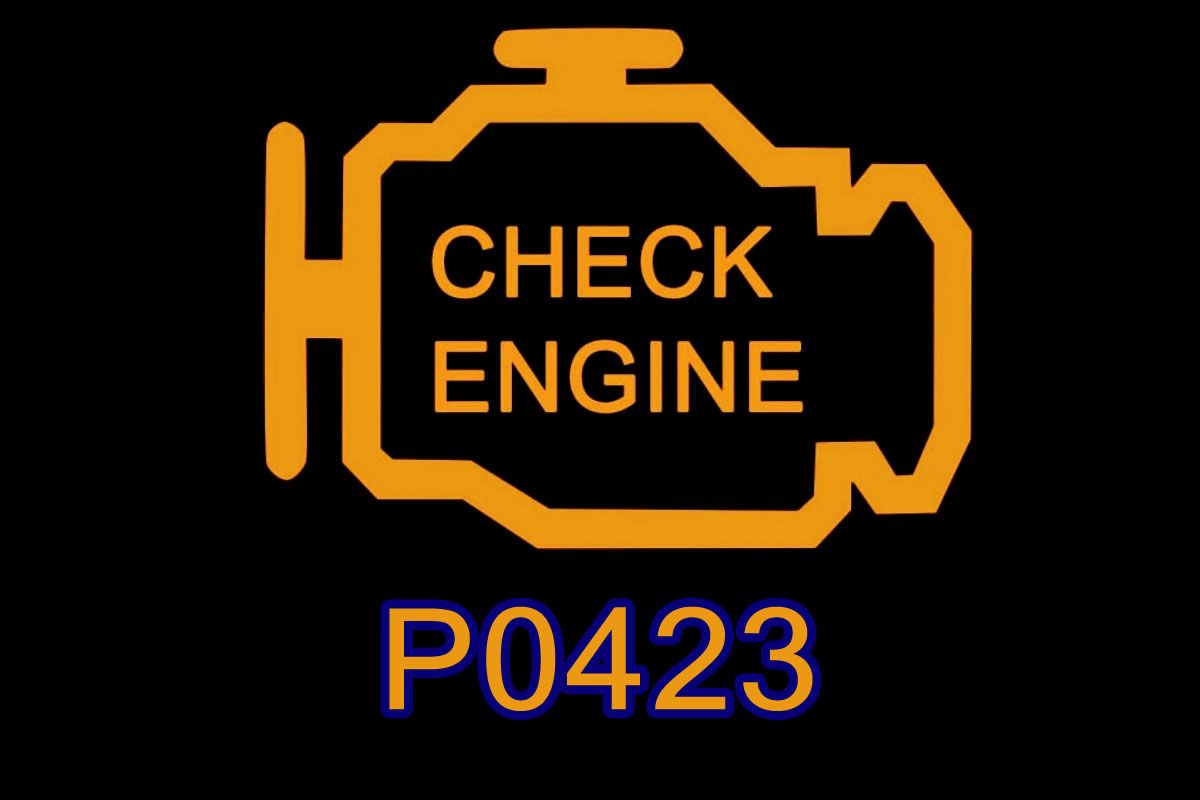
P0423 Heated Catalyst Efficiency Below Threshold (Bank 1)
The P0423 trouble code means the engine control module (ECM/PCM) has determined that the heated catalytic converter on Bank 1 is not achieving the expected efficiency level.
Unlike a catalyst temperature sensor circuit code, P0423 is primarily an emissions-performance code. The ECM is evaluating whether the heated catalyst is working effectively enough to reduce harmful exhaust emissions.
This does not automatically mean the catalytic converter must be replaced.
A weak catalyst is certainly one possibility, but problems with the engine's air-fuel mixture, oxygen sensors, exhaust leaks, ignition system, fuel system, or catalyst heating strategy can also cause the ECM to conclude that catalyst efficiency is below the expected threshold.
What Does “Heated Catalyst” Mean?
A catalytic converter needs to reach a sufficiently high temperature before it can efficiently convert pollutants in the exhaust.
During a cold start, the catalyst is initially cool. Modern emissions systems therefore use strategies designed to heat the catalyst as quickly as possible.
Depending on the vehicle, catalyst heating may be achieved through:
-
Retarded ignition timing
-
Additional fuel during catalyst warm-up
-
Modified air-fuel ratios
-
Increased engine load
-
Secondary air injection
-
An electrically heated catalyst
-
A dedicated catalyst heating element
-
Other manufacturer-specific warm-up strategies
The exact system varies considerably between vehicles.
Therefore, the word “heated” does not necessarily mean that the vehicle has a separate electrical heater physically built into the catalytic converter.
In many vehicles, “heated catalyst” refers to the ECM's catalyst warm-up strategy.
What Does “Efficiency Below Threshold” Mean?
The ECM expects the catalyst to reduce certain exhaust pollutants by a predictable amount.
It monitors the exhaust system using information from sensors, most commonly oxygen sensors.
The basic principle is relatively simple.
Before the catalyst, the exhaust gas contains significant fluctuations in oxygen concentration as the engine adjusts the air-fuel mixture.
A properly functioning catalytic converter changes the composition of the exhaust gas. The downstream oxygen sensor should therefore show behavior consistent with a functioning catalyst.
If the ECM determines that the catalyst is not producing the expected conversion effect, it can set P0423.
The important point is that the ECM is detecting insufficient catalyst performance, not directly measuring the internal condition of the catalyst brick.
What Is Bank 1?
Bank 1 is the engine bank containing cylinder number 1.
On an inline engine, there is normally only one bank, so the catalyst is considered Bank 1.
On a V6 or V8 engine, there are two banks. Bank 1 is the side containing cylinder #1.
The physical location of the Bank 1 catalytic converter depends on the vehicle's engine and exhaust design.
Common Causes of P0423
There are several possible causes, and diagnosing the actual cause is more important than simply replacing the catalyst.
Worn or contaminated catalytic converter
A catalyst can gradually lose its ability to store oxygen and convert pollutants.
Possible reasons include:
-
High mileage
-
Thermal damage
-
Contamination
-
Oil consumption
-
Coolant entering the combustion chamber
-
Prolonged rich operation
-
Repeated misfires
-
Excessive exhaust temperature
When the catalyst's active material becomes degraded, the ECM may detect efficiency below its threshold.
Catalyst damaged by engine misfire
A persistent misfire can send unburned fuel into the catalytic converter.
The fuel can ignite inside the converter and create extremely high temperatures.
This can damage or melt the catalyst substrate.
In this situation, replacing the catalyst without repairing the original misfire can result in another catalyst failure.
Faulty oxygen sensor
The ECM commonly relies on upstream and downstream oxygen-sensor behavior when evaluating catalyst efficiency.
A sensor that responds incorrectly, slowly, or inaccurately can make a healthy catalyst appear inefficient.
Exhaust leak
An exhaust leak near an oxygen sensor can allow outside air to enter the exhaust stream.
That additional oxygen can alter the sensor signal and interfere with catalyst-efficiency calculations.
This is especially important when the leak is located upstream of or close to the downstream sensor.
Fuel mixture problem
A persistent rich or lean condition can affect catalyst operation.
Possible causes include:
-
Faulty fuel injector
-
Incorrect fuel pressure
-
Vacuum leak
-
MAF sensor problem
-
MAP sensor problem
-
Fuel-pressure regulator problem
-
Intake-air measurement error
-
Oxygen-sensor problem
The catalyst cannot operate correctly if the engine continuously supplies it with an abnormal exhaust mixture.
Ignition problems
Worn spark plugs, failing ignition coils, or other ignition faults can cause incomplete combustion.
The resulting unburned fuel can enter the catalytic converter and damage it.
Catalyst heating problem
If the vehicle uses a dedicated electrically heated catalyst, a problem with the heater circuit can prevent the catalyst from reaching the required temperature quickly enough.
Possible problems include:
-
Heater element failure
-
Fuse
-
Relay
-
Wiring
-
Connector
-
Power supply
-
Ground
-
Control module
-
Heater control circuit
In such a vehicle, a heater-related fault may accompany P0423.
Secondary air injection problem
Some vehicles use secondary air injection to accelerate catalyst warm-up.
A faulty air pump, valve, hose, or control system can interfere with catalyst heating and cause efficiency-related problems.
Engine operating temperature problem
An engine that does not reach its intended operating temperature can affect catalyst warm-up and emissions control.
A thermostat stuck open or an inaccurate coolant-temperature sensor can therefore contribute to catalyst-related diagnostic problems.
Oil or coolant contamination
An engine that burns excessive oil or coolant can contaminate the catalyst.
This can gradually reduce catalyst efficiency.
Incorrect catalyst
An aftermarket catalytic converter that does not provide the required oxygen-storage and conversion characteristics can trigger efficiency codes even though it is relatively new.
This is particularly relevant when P0423 appears shortly after catalyst replacement.
Symptoms of P0423
P0423 often produces surprisingly few noticeable driving symptoms.
Possible symptoms include:
-
Check Engine Light
-
Failed emissions inspection
-
Increased emissions
-
Slight reduction in fuel economy
-
Reduced performance in some vehicles
-
Exhaust odor
-
Poor cold-start emissions performance
-
Additional oxygen-sensor or catalyst codes
In many cases, the vehicle can drive almost normally.
This happens because catalyst efficiency is primarily an emissions function. A catalytic converter can lose some of its conversion efficiency without causing an immediate major loss of engine power.
However, severe catalyst damage or restriction can eventually cause noticeable performance problems.
Does P0423 Mean the Catalytic Converter Is Bad?
Not necessarily.
This is one of the most important things to understand about this code.
P0423 means that the ECM has determined that catalyst efficiency is below its expected threshold.
It does not directly inspect the catalyst substrate and announce that the catalyst is physically damaged.
For example, a faulty downstream oxygen sensor can produce data that makes a healthy catalyst appear inefficient.
Likewise, an exhaust leak can introduce oxygen into the exhaust and alter the sensor readings.
An engine that is running excessively rich can also overload or damage the catalyst and cause efficiency to fall.
Therefore, the catalytic converter should not be condemned solely because P0423 is stored.
How the ECM Determines Catalyst Efficiency
The ECM uses sensor data and operating conditions to evaluate catalyst performance.
A simplified example looks like this:
The upstream oxygen sensor sees frequent changes in exhaust oxygen concentration as the engine adjusts the mixture.
The catalytic converter processes the exhaust gases.
The downstream oxygen sensor should generally show a more stabilized behavior when the catalyst is functioning properly.
If the downstream sensor behavior becomes too similar to the upstream sensor under the conditions used by the diagnostic monitor, the ECM may conclude that the catalyst is not storing and processing oxygen as effectively as expected.
This is one reason an oxygen-sensor problem can sometimes look like a catalytic-converter problem.
Modern systems can use considerably more sophisticated calculations than this simplified explanation, including modeled catalyst temperature, fuel-trim information, air-fuel ratio data, and other operating parameters.
P0423 vs P0420
These codes are closely related.
P0420 – Catalyst System Efficiency Below Threshold (Bank 1)
This is the more general catalyst-efficiency code.
P0423 – Heated Catalyst Efficiency Below Threshold (Bank 1)
This specifically concerns the efficiency of the heated catalyst or catalyst warm-up operation on Bank 1.
The exact diagnostic strategy behind P0423 is manufacturer-dependent.
A vehicle may use a dedicated heated catalyst, or the term may relate to a catalyst efficiency monitor performed during the warm-up phase.
P0423 vs P0421
P0421 – Warm Up Catalyst Efficiency Below Threshold (Bank 1)
P0421 focuses on catalyst efficiency during the warm-up period.
P0423 also concerns heated-catalyst efficiency but can be associated with a specific heated-catalyst strategy depending on the vehicle.
The precise distinction between these codes is therefore best determined using the manufacturer's service information.
P0423 vs P0425
These two codes should not be confused.
P0423 concerns catalyst efficiency.
P0425 concerns a catalyst temperature sensor circuit malfunction.
A vehicle can potentially have both faults.
For example, an inaccurate temperature sensor could interfere with catalyst monitoring, while an actual catalyst problem could independently reduce efficiency.
P0423 vs P0429
P0429 – Catalyst Heater Control Circuit (Bank 1)
P0429 points toward a heater control circuit problem.
P0423 points toward insufficient heated-catalyst efficiency.
This distinction is important.
A heater-control circuit problem may prevent the catalyst from heating correctly, but P0429 does not itself prove that the catalyst has low efficiency.
Likewise, P0423 does not necessarily prove that the heater circuit has failed.
Diagnosing P0423 Properly
A good diagnosis should work from the engine and emissions system toward the catalyst rather than immediately installing a new converter.
1. Scan all DTCs
Start by checking every stored and pending code.
Pay particular attention to codes involving:
-
Misfires
-
Fuel mixture
-
Oxygen sensors
-
Air-fuel ratio sensors
-
Catalyst temperature
-
Exhaust leaks
-
Secondary air injection
-
Catalyst heater circuits
If a misfire or fuel-control code is present, that problem should generally be investigated before condemning the catalyst.
2. Check freeze-frame data
Look at the conditions under which P0423 was recorded.
Useful information includes:
-
Engine RPM
-
Engine load
-
Coolant temperature
-
Vehicle speed
-
Fuel trims
-
Oxygen-sensor readings
-
Air-fuel ratio
-
Catalyst temperature, if available
This can reveal whether the monitor failed during cold-start operation, warm cruising, acceleration, or another specific condition.
3. Check for misfires
Misfires are particularly important.
Even if there is no stored misfire code, examine live misfire counters if the vehicle supports them.
A catalyst exposed to repeated unburned fuel can become severely overheated.
Replacing the catalyst without repairing the misfire is likely to result in another failure.
4. Check fuel trims
Look at short-term and long-term fuel trims.
Large positive or negative corrections can indicate an underlying mixture problem.
A catalyst should not be diagnosed in isolation from the engine that feeds it.
5. Inspect for exhaust leaks
Inspect the exhaust system around:
-
Exhaust manifold
-
Manifold gasket
-
Catalytic converter
-
Oxygen-sensor fittings
-
Flex pipe
-
Exhaust joints
Even a relatively small leak in the wrong location can affect oxygen-sensor readings.
6. Evaluate oxygen-sensor operation
Compare the upstream and downstream sensor behavior using live data.
The exact expected waveform depends on the sensor type and vehicle.
A downstream sensor that behaves incorrectly can lead to a false catalyst-efficiency diagnosis.
Do not replace oxygen sensors solely because they appear to fluctuate differently from a generic internet waveform. Manufacturer-specific data and operating conditions matter.
7. Check catalyst temperature
If the vehicle provides catalyst-temperature information, verify that the catalyst reaches the expected operating temperature.
If the catalyst is not heating properly, investigate the cause before replacing it.
8. Check the catalyst heater system if equipped
If the vehicle uses an electrically heated catalyst, inspect:
-
Fuse
-
Relay
-
Wiring
-
Connector
-
Heater element
-
Power supply
-
Ground
-
Control circuit
A dedicated heater can draw substantial current, so testing the circuit under load is more useful than simply checking continuity.
9. Evaluate catalyst efficiency
Once the engine, sensors, exhaust system, and heating strategy have been verified, catalyst performance can be evaluated.
Depending on the vehicle, professional testing may involve:
-
Upstream and downstream oxygen-sensor behavior
-
Air-fuel ratio data
-
Catalyst temperature
-
Oxygen-storage behavior
-
Emissions measurements
-
Manufacturer-specific catalyst tests
The exact test should follow the manufacturer's diagnostic procedure.
Why Fuel and Ignition Problems Matter So Much
The catalytic converter is downstream from the engine, so it depends entirely on the exhaust gas produced by combustion.
If the engine is operating incorrectly, the catalyst can become overloaded.
For example, a leaking injector can produce an excessively rich mixture. A failed ignition coil can create a misfire. A vacuum leak can create a lean condition.
All of these can alter catalyst operation.
This means that a catalyst-efficiency code can sometimes be the consequence of an engine problem rather than the original problem itself.
Could a New Catalytic Converter Still Trigger P0423?
Yes.
A recently replaced catalyst does not automatically eliminate the possibility of P0423.
Possible reasons include:
-
Low-quality aftermarket catalyst
-
Incorrect catalyst specification
-
Wrong application
-
Remaining engine problem
-
Oxygen-sensor problem
-
Exhaust leak
-
Heater-system fault
-
Incorrect installation
-
Catalyst damaged shortly after installation
If P0423 returns soon after catalyst replacement, the diagnosis should move back toward the entire system rather than simply replacing the catalyst again.
Can You Drive With P0423?
If the vehicle runs normally, P0423 is generally not an immediate reason to stop driving.
However, it should be diagnosed rather than ignored indefinitely.
A catalyst that is merely below the emissions-efficiency threshold may not cause immediate drivability problems.
The situation is more serious if there are additional symptoms such as:
-
Flashing Check Engine Light
-
Severe misfire
-
Major loss of power
-
Strong sulfur or fuel smell
-
Excessive exhaust heat
-
Engine stalling
-
Severe hesitation
A severely damaged or melted catalyst can also become restricted, eventually causing significant power loss.
What Repairs Can Fix P0423?
The repair depends entirely on what testing finds.
Possible repairs include:
-
Repairing an exhaust leak
-
Replacing a faulty oxygen sensor
-
Repairing oxygen-sensor wiring
-
Repairing a catalyst heater circuit
-
Replacing a failed catalyst heater component
-
Repairing fuel-system problems
-
Repairing ignition problems
-
Correcting a rich or lean mixture
-
Repairing secondary air injection problems
-
Correcting an engine temperature problem
-
Replacing a contaminated or damaged catalytic converter
-
Installing the correct specification catalyst
The catalyst should generally be the last major component to condemn after the conditions that could cause catalyst failure have been checked.
The Most Important Diagnostic Point
P0423 – Heated Catalyst Efficiency Below Threshold (Bank 1) means the ECM has determined that the Bank 1 heated catalyst is not demonstrating the expected efficiency under the conditions used by its diagnostic monitor.
It is an efficiency-performance code, not a direct catalytic-converter failure confirmation.
A failed catalyst is one possible cause, but oxygen-sensor errors, exhaust leaks, fuel-mixture problems, ignition misfires, catalyst heating problems, secondary-air faults, and other engine-management issues can produce the same result.
The best diagnosis therefore starts with all stored codes, freeze-frame data, misfire checks, fuel trims, oxygen-sensor operation, exhaust leaks, catalyst temperature and heating strategy. Only after these areas have been verified should the catalytic converter itself be considered the primary suspect.