TR
TR EN
EN

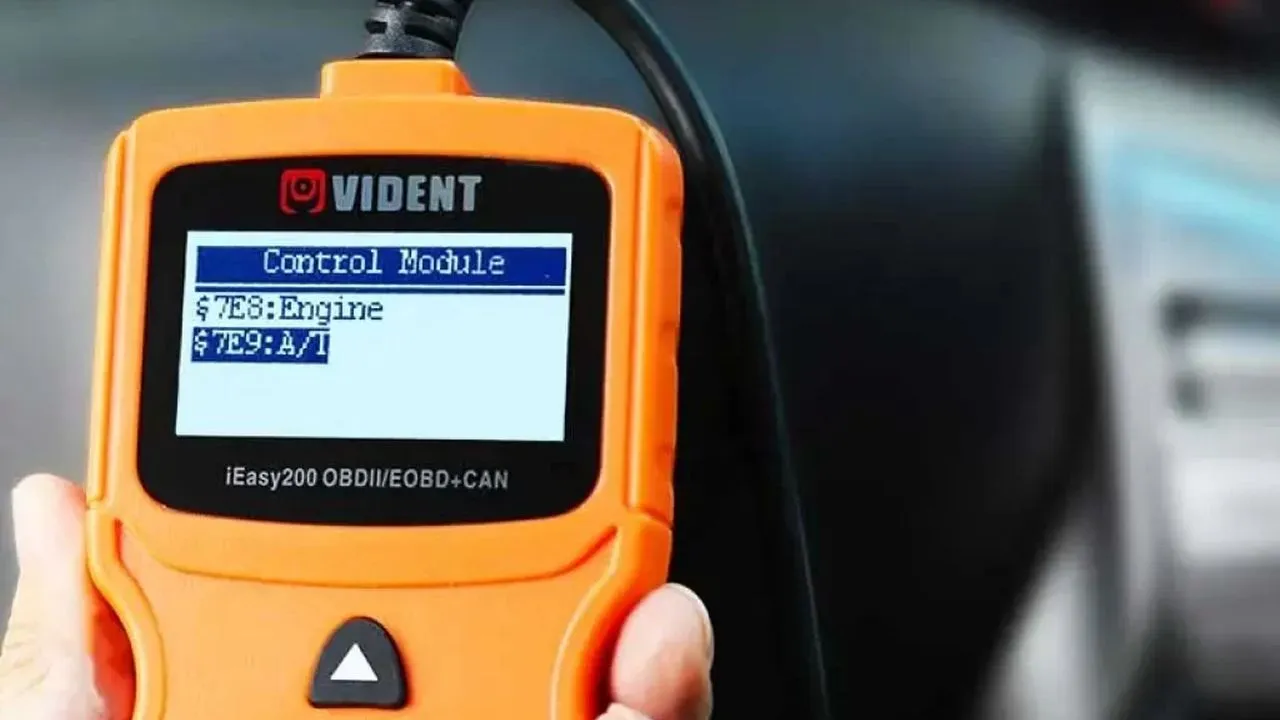
$7E8 and $7E9 Engine Fault Codes: What Do They Mean?
When an OBD-II scanner is connected to a vehicle, you may sometimes see codes such as $7E8 and $7E9 on the screen. Because they look similar to conventional diagnostic trouble codes, many drivers assume that the vehicle has a "$7E8 engine fault" or a "$7E9 engine fault."
This is a common misunderstanding.
$7E8 and $7E9 are generally not engine fault codes. They are hexadecimal communication identifiers used in OBD-II diagnostic communication, particularly over the vehicle's CAN network.
In other words, seeing $7E8 or $7E9 does not, by itself, tell you that a sensor, engine component, ECU, or transmission is defective.
The actual fault information is normally contained in a separate diagnostic trouble code such as P0300, P0171, P0420, P0101, or P2100.
What Is $7E8?
$7E8 is commonly used as an OBD-II CAN response identifier.
In a typical OBD-II CAN communication arrangement, a scan tool sends a diagnostic request to a control module and the module sends a response. One common example is:
$7E0 → $7E8
Here, $7E0 may be used as the request identifier and $7E8 as the corresponding response identifier.
On many vehicles, $7E8 is associated with the engine control module (ECM/PCM) or another powertrain control module.
However, this should not be treated as a universal rule for every vehicle.
The exact CAN addressing and ECU architecture can vary between manufacturers, models, model years, engines, transmissions, and diagnostic protocols.
What Is $7E9?
$7E9 is another hexadecimal CAN identifier that can appear during OBD-II diagnostics.
A common addressing arrangement may look like:
$7E1 → $7E9
In such an arrangement, $7E9 can represent the response from another control module.
Depending on the vehicle architecture, this may be associated with another powertrain-related module, such as a transmission control module or another ECU.
But again, $7E9 does not universally mean "transmission ECU" or any other specific module.
The exact meaning depends on the vehicle and its diagnostic communication structure.
Why Do $7E8 and $7E9 Look Like Fault Codes?
The confusion comes mainly from the way OBD scanners display diagnostic information.
A conventional DTC normally looks like:
P0300
P0171
P0420
P0101
P2100
These are actual diagnostic trouble codes.
By comparison:
$7E8
$7E9
$7EA
$7EB
are hexadecimal communication identifiers.
The $ symbol indicates hexadecimal notation. It does not indicate a special type of engine fault.
Therefore, the two types of information should not be confused.
What Is the Difference Between $7E8 and P0300?
This is one of the most important distinctions when using an OBD-II scanner.
Suppose your scanner displays:
$7E8
and then reports:
P0300 – Random/Multiple Cylinder Misfire Detected
In this situation, $7E8 is not the fault.
It identifies the communication path or response associated with the diagnostic module.
P0300 is the actual diagnostic trouble code.
The same principle applies if the scanner displays:
$7E8 – P0171
In this case:
$7E8 = communication identifier
P0171 = actual diagnostic trouble code
This distinction can prevent unnecessary component replacement.
Does $7E8 Mean the Engine ECU Is Faulty?
No.
Seeing $7E8 does not mean that the engine ECU has failed.
In fact, on many vehicles, seeing $7E8 during a scan simply means that the scanner has received a response from the engine or powertrain control system.
If the ECU were actually experiencing a serious communication problem, you would need to look for other evidence, such as:
-
U-series communication DTCs
-
Failure to communicate with a control module
-
Intermittent loss of ECU communication
-
Multiple systems becoming unavailable
-
CAN network-related symptoms
-
Manufacturer-specific communication faults
A $7E8 identifier by itself is not sufficient evidence of an ECU failure.
Does $7E9 Mean There Is a Transmission Problem?
Not necessarily.
Because $7E9 can be associated with a different powertrain control module in some vehicle configurations, it may sometimes appear during transmission-related diagnostics.
However, $7E9 itself is not a transmission fault code.
For example, if a scanner shows:
$7E9
and then reports:
P0700 – Transmission Control System Malfunction
the actual diagnostic information is P0700, not $7E9.
Further transmission-specific codes may be stored in the transmission control module and should be retrieved before diagnosing the problem.
How OBD-II Communication Uses These Identifiers
Modern vehicles contain numerous electronic control units that communicate over networks such as CAN Bus.
During a diagnostic session, the scan tool communicates with one or more control modules.
A simplified example might be:
Scan Tool → $7E0 → Engine ECU
Then the ECU responds:
Engine ECU → $7E8 → Scan Tool
Another module may use a different pair:
Scan Tool → $7E1 → Control Module
Then:
Control Module → $7E9 → Scan Tool
This is a simplified example intended to illustrate the communication concept.
Real vehicle networks can be significantly more complicated.
What Does the $ Sign Mean?
The $ symbol indicates that the value is being represented in hexadecimal.
For example:
$7E8
is a hexadecimal representation of a numerical CAN identifier.
Hexadecimal notation is widely used in automotive diagnostics, CAN Bus analysis, ECU development, and other low-level electronic systems because it provides a convenient way to represent binary data.
The hexadecimal value is therefore a communication identifier, not a conventional OBD-II DTC.
Are $7E8 and $7E9 the Same as P Codes?
No.
A P-code is a diagnostic trouble code related to the powertrain.
Examples include:
P0101 – Mass Air Flow Sensor Performance
P0171 – System Too Lean
P0300 – Random/Multiple Cylinder Misfire
P0420 – Catalyst System Efficiency Below Threshold
P2100 – Throttle Actuator Control Motor Circuit/Open
By contrast, $7E8 and $7E9 are communication identifiers.
They can appear alongside actual P-codes during a scan, but they serve a different purpose.
Why Does My Scanner Show $7E8 Without a P-Code?
There are several possible reasons.
Some inexpensive OBD-II adapters and smartphone applications expose the underlying CAN communication information rather than presenting only decoded diagnostic information.
The software may therefore display a response such as:
$7E8
without showing a fault code underneath it.
This does not necessarily mean that the vehicle has a problem.
It may simply mean that the scanner received a valid response from the corresponding diagnostic address.
Another possibility is that the vehicle has no stored DTCs in that module.
In other words, a response from an ECU does not automatically mean that the ECU has reported a fault.
Can $7E8 and $7E9 Be Used to Identify an ECU?
They can provide useful clues, but they should not be used as the only method of identifying a control module.
For example, $7E8 is commonly associated with an engine or powertrain response on many OBD-II vehicles.
Likewise, $7E9 may correspond to another diagnostic response.
However, vehicle manufacturers can implement their electronic architectures differently.
For accurate identification, a technician should consider:
-
Vehicle make and model
-
Model year
-
Engine
-
Transmission
-
ECU configuration
-
CAN network architecture
-
Diagnostic protocol
-
Scan tool information
-
ECU identification data
This is especially important on modern vehicles containing multiple CAN networks and numerous control modules.
What Should You Do If You See $7E8 or $7E9?
Do not replace a component simply because one of these identifiers appears on the scanner.
Instead, look at the complete diagnostic report.
First, check for actual DTCs.
Look for codes beginning with P, B, C, or U.
Next, identify the responding module.
Your diagnostic tool may provide an ECU name or module identification.
Then, read the complete fault description.
A code such as P0171 requires a completely different diagnostic approach from P0300 or P2100.
Finally, check live data and other stored or pending codes when appropriate.
A communication identifier alone rarely provides enough information to diagnose an engine problem.
What If $7E8 Appears With an Engine Fault?
This is a more useful situation because the identifier may help explain where the diagnostic response came from.
For example:
$7E8
P0171 – System Too Lean
In this case, the diagnostic focus should be on the P0171 fault.
Possible causes could include:
-
Vacuum leaks
-
Unmetered air entering the engine
-
Fuel delivery problems
-
Injector issues
-
Incorrect air measurement
-
Exhaust leaks affecting oxygen sensor readings
-
Sensor or wiring problems
-
Other vehicle-specific causes
The $7E8 identifier does not identify which of these components has failed.
It simply relates to the diagnostic communication.
What If $7E9 Appears With a Transmission Fault?
The same principle applies.
For example:
$7E9
P0700 – Transmission Control System Malfunction
The technician should investigate the actual transmission-related diagnostic information.
Depending on the vehicle, additional codes may be stored in the transmission control module.
These codes can provide much more specific information about:
-
Shift solenoids
-
Transmission pressure
-
Gear ratio problems
-
Input/output speed sensors
-
Transmission temperature
-
Valve body operation
-
Internal transmission faults
-
Wiring and communication problems
The $7E9 identifier itself does not tell you which component has failed.
Are $7EA and $7EB Related to $7E8 and $7E9?
They can be.
OBD-II CAN networks may use a series of request and response identifiers.
A common arrangement can include relationships such as:
$7E0 → $7E8
$7E1 → $7E9
$7E2 → $7EA
$7E3 → $7EB
These are useful examples of common OBD-II addressing conventions.
However, they should not be interpreted as a universal map for every vehicle.
A particular manufacturer may use a different network structure, additional modules, or different diagnostic addressing.
Can a $7E8 or $7E9 Error Be Cleared?
Technically, it is better to say that you do not normally "clear a $7E8 error" because $7E8 is not itself a DTC.
What can be cleared are actual diagnostic trouble codes stored by the vehicle's control modules.
For example, if the scanner reports:
$7E8 → P0420
then P0420 is the fault code that may be cleared after the underlying problem has been diagnosed and repaired.
If the scanner only displays $7E8 without a DTC, there may be nothing to clear.
What If the Vehicle Has a Communication Problem?
A genuine communication problem requires a different diagnostic approach.
Possible symptoms can include:
-
A control module cannot be accessed
-
Multiple warning lights appear simultaneously
-
Several systems stop communicating
-
Diagnostic communication is intermittent
-
U-series DTCs are stored
-
Vehicle functions become unavailable
-
The scan tool repeatedly loses communication
Possible causes can include wiring faults, connector problems, power or ground issues, CAN network faults, or control-module problems.
In this situation, $7E8 or $7E9 should not be blamed as the cause simply because they appear on the scan tool.
The Most Important Point About $7E8 and $7E9
If you remember only one thing from this article, remember this:
$7E8 and $7E9 are generally communication identifiers, not engine fault codes.
They tell the diagnostic equipment something about where a response is coming from or how the diagnostic communication is addressed.
They do not directly tell you:
-
Which engine component has failed
-
Which sensor is defective
-
Whether the ECU is damaged
-
Whether the transmission has a mechanical problem
-
Whether the vehicle has a stored DTC
For that information, you need the actual diagnostic trouble codes and the associated diagnostic data.
Final Thoughts
Seeing $7E8 or $7E9 on an OBD-II scanner can initially look like a serious engine or transmission fault. In most cases, however, these values are simply part of the vehicle's diagnostic communication system.
$7E8 is commonly associated with an OBD-II response from an engine/powertrain control system, while $7E9 may represent another diagnostic response. The exact mapping is vehicle-dependent.
The real fault is normally represented by a code such as P0300, P0171, P0420, P0700, P2100, or another manufacturer-specific DTC.
Therefore, if your scanner displays $7E8 or $7E9, do not diagnose the vehicle based on that identifier alone. Read the complete diagnostic information, identify the responding module, retrieve the actual DTCs, and then diagnose the underlying system.
That approach is far more reliable than treating a CAN communication identifier as an engine fault code.