TR
TR EN
EN

OBD-II Module Codes: What Are $7EA, $7EB, $7EC and Other Addresses?
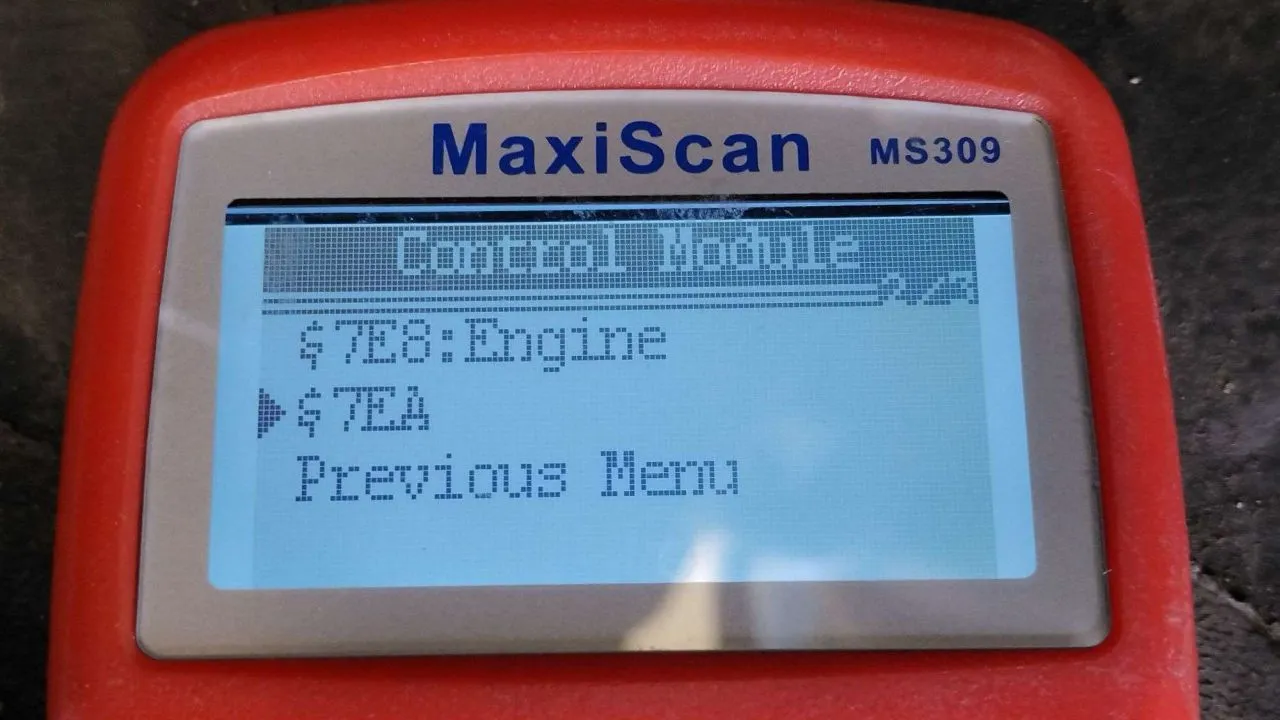
When an OBD-II scanner is connected to a vehicle, you may sometimes see values such as $7E0, $7E1, $7E2, $7E8, $7E9, $7EA, $7EB, or $7EC on the screen.
At first glance, these values can look like diagnostic trouble codes. They are not.
Values such as $7EA and $7EB are generally CAN communication identifiers used to identify electronic control units and their responses during diagnostic communication.
This distinction is important because seeing $7EA on a scan tool does not mean that the vehicle has a "$7EA fault code."
The actual diagnostic trouble code may be something completely different, such as P0300, P0420, P0171, or U0100.
What Does the "$" Symbol Mean?
The dollar sign used in values such as $7EA indicates that the number is being represented in hexadecimal notation.
Hexadecimal, or base-16, is widely used in automotive electronics and diagnostic communication.
The hexadecimal number system uses:
-
0–9
-
A–F
For example:
$7EA
is a hexadecimal value.
The "$" is commonly used by diagnostic tools and technical documentation to indicate that the following value is hexadecimal.
Therefore, $7EA is not the same type of code as P0171 or P0300.
The P-code format identifies a diagnostic trouble code, while $7EA generally identifies a communication address or CAN identifier.
What Is $7EA?
$7EA is commonly seen as a CAN diagnostic response identifier associated with an ECU or another control module.
On many OBD-II vehicles, the range around $7E8–$7EF is used for diagnostic communication with control modules.
A scanner may therefore display:
$7EA
when receiving a response from a particular control module.
The exact module associated with this identifier depends on the vehicle architecture and diagnostic implementation.
This means you should not assume that $7EA always means exactly the same physical module on every vehicle.
What Is $7EB?
$7EB is another diagnostic communication identifier that may be used by an ECU or other control module.
If a vehicle contains several electronic control units, the scan tool may receive responses from different identifiers.
For example, a scan tool could display:
-
$7E8
-
$7E9
-
$7EA
-
$7EB
These values can indicate responses from different ECUs or diagnostic nodes.
However, the exact mapping is vehicle-dependent.
What Is $7EC?
$7EC is another identifier within the diagnostic CAN address range commonly encountered during OBD-II communication.
Depending on the vehicle, it can correspond to another control module responding to the scan tool.
Again, it is important not to interpret $7EC as a fault code.
The scanner may be showing the address from which a diagnostic response originated rather than reporting a malfunction.
$7E0 and $7E8: What Is the Difference?
One of the most useful concepts when understanding these values is the distinction between request IDs and response IDs.
On a typical OBD-II CAN network, a diagnostic tester may send a request using an identifier such as:
$7E0
The corresponding ECU may respond using:
$7E8
This is a simplified example of the relationship between a diagnostic request and response.
Similarly, other control modules may use additional identifiers.
A common pattern is:
$7E0 → $7E8
$7E1 → $7E9
$7E2 → $7EA
$7E3 → $7EB
and so on.
The exact implementation can vary, but this pattern explains why a scanner can display several seemingly strange hexadecimal values during a diagnostic session.
Why Does the Scanner Show $7EA Instead of the ECU Name?
Some inexpensive or generic OBD-II scanners do not have enough vehicle-specific information to translate every CAN identifier into a recognizable module name.
Instead of displaying something like:
Transmission Control Module
the scanner may simply show:
$7EA
The scanner is essentially telling you which diagnostic communication address responded.
A more advanced diagnostic system may translate that information into a specific module name, depending on the vehicle's manufacturer-specific diagnostic information.
Are $7EA, $7EB and $7EC Fault Codes?
No.
This is probably the most important point in understanding these values.
$7EA, $7EB and $7EC are not standard OBD-II diagnostic trouble codes.
A normal OBD-II DTC generally follows a format such as:
-
P0300
-
P0171
-
P0420
-
P0101
-
Bxxxx
-
Cxxxx
-
Uxxxx
The first letter indicates the general system involved.
For example:
P = Powertrain
B = Body
C = Chassis
U = Network/communication
By comparison, $7EA is a hexadecimal communication identifier.
Why Can $7EA Appear Next to a Real Fault Code?
A scanner may display the communication identifier together with the diagnostic information received from the module.
For example, a scan tool might show something conceptually similar to:
ECU Response: $7EA
followed by:
Pxxxx
The first value identifies the communication source, while the second value represents the actual diagnostic trouble code.
Therefore, if your scanner displays $7EA and a P-code together, do not treat $7EA as the fault itself.
The P-code is the information that needs to be interpreted as a diagnostic trouble code.
What Are $7E8, $7E9, $7EA and $7EB Used For?
These identifiers are part of the communication process between the diagnostic tester and vehicle control modules.
Modern vehicles contain many electronic control units, including:
-
Engine Control Module (ECM)
-
Transmission Control Module (TCM)
-
ABS/ESC module
-
Airbag/SRS module
-
Body Control Module (BCM)
-
Instrument cluster
-
Electric power steering module
-
HVAC control module
-
Battery management system
-
Hybrid or electric vehicle control modules
Not all of these necessarily use the standard OBD-II CAN identifiers in the same way.
The diagnostic tool needs a method of addressing the appropriate module and receiving its response.
CAN identifiers provide part of this communication mechanism.
What Is CAN Bus?
CAN stands for Controller Area Network.
It is a communication network that allows electronic control units in a vehicle to exchange information.
Instead of requiring a separate direct connection between every electronic module, CAN allows multiple control units to communicate over a shared network.
For example, information related to:
-
Engine speed
-
Vehicle speed
-
Accelerator position
-
Brake pedal status
-
Transmission position
-
Engine torque
-
Stability control
can be exchanged between different modules when required.
Diagnostic communication also takes place over vehicle networks such as CAN.
How Does OBD-II Communication Work?
When you connect a scan tool to the OBD-II diagnostic connector, the tool communicates with the vehicle.
A simplified sequence looks like this:
Scan tool sends a diagnostic request → vehicle network delivers the request → appropriate control module processes it → module sends a response → scan tool interprets the response.
The hexadecimal identifiers help determine where messages are coming from and where they are going.
The process is much more complex in modern vehicles, especially when diagnostic communication uses protocols such as ISO 15765-4 and higher-level diagnostic protocols.
What Is the Relationship Between $7EA and UDS?
Modern vehicles may use UDS (Unified Diagnostic Services) for more advanced diagnostics.
UDS is standardized under ISO 14229 and provides services that go beyond the basic emissions-related OBD-II functions.
Depending on the vehicle architecture, diagnostic communication may involve different addressing methods and CAN identifiers.
Therefore, seeing $7EA does not necessarily tell you everything about the diagnostic protocol being used.
It only provides part of the communication information.
Can $7EA Tell You Which ECU Is Faulty?
Not by itself.
If a scanner shows $7EA, it may tell you which communication endpoint responded, but that does not automatically mean the corresponding ECU is defective.
For example, an ECU may respond correctly while reporting a sensor or actuator problem elsewhere in the vehicle.
A transmission control module can report a pressure sensor fault without the transmission control module itself being defective.
Similarly, an engine ECU can report a crankshaft position sensor fault without the ECU being the source of the problem.
This distinction is essential for accurate diagnosis.
Why Do Some Scanners Show Multiple $7Ex Addresses?
A vehicle may have several control modules capable of responding to diagnostic requests.
A scanner may therefore display multiple identifiers during an automatic scan.
For example, it might detect responses associated with:
$7E8
$7E9
$7EA
$7EB
This does not necessarily mean that four separate faults exist.
It may simply mean that several diagnostic nodes responded.
The scanner's software determines how these responses are presented to the user.
What Does $7E8 Usually Represent?
On many conventional OBD-II CAN implementations, $7E8 is commonly associated with the response from the engine ECU/ECM, while $7E0 is commonly associated with the corresponding diagnostic request address.
However, this should be treated as a common convention rather than an absolute rule for every vehicle.
Manufacturer-specific architectures can differ.
What Does $7E9 Usually Represent?
$7E9 is commonly associated with a response from another powertrain-related control module.
Depending on the vehicle, this may be associated with a transmission controller or another ECU.
However, the exact module should be confirmed using vehicle-specific diagnostic documentation rather than assuming that $7E9 always represents the transmission.
What Does $7EA Usually Represent?
$7EA is commonly the response identifier corresponding to $7E2 in a conventional sequential addressing scheme.
The physical ECU associated with $7E2/$7EA can vary according to the vehicle architecture.
This is why generic online lists that claim "$7EA always means transmission" or "$7EA always means ABS" should be treated with caution.
The identifier alone is not sufficient to establish the identity of the physical module in every vehicle.
What Does $7EB Usually Represent?
$7EB is commonly associated with the response to the diagnostic request identifier $7E3 in the same type of addressing scheme.
Again, the exact ECU behind this address is not universal.
The vehicle manufacturer's network design and diagnostic implementation determine which module uses the identifier.
What About $7EC and $7ED?
The same concept continues with additional identifiers.
You may encounter:
-
$7EC
-
$7ED
-
$7EE
-
$7EF
These may represent additional diagnostic response addresses.
The more electronic control units a vehicle has, the more complex its diagnostic network can become.
However, the presence of these identifiers does not automatically mean that every corresponding ECU has a fault.
What Is the Difference Between a CAN ID and a DTC?
This distinction makes the subject much easier to understand.
A CAN ID identifies a message or communication endpoint on the network.
A DTC describes a diagnostic condition detected by a vehicle control module.
For example:
$7EA
can identify a diagnostic communication response.
P0193
can describe a fuel rail pressure sensor circuit condition.
They are completely different types of information.
A CAN identifier tells you where or how the diagnostic message is being communicated.
A DTC tells you what problem the control module has detected.
Why Do Generic OBD-II Scanners Cause Confusion?
Basic scanners are designed primarily for standardized emissions-related diagnostics.
They may provide limited information about manufacturer-specific modules.
As a result, the user may see hexadecimal addresses without receiving a clear explanation of which physical ECU they represent.
A professional diagnostic tool can often provide much more information, including:
-
Module identification
-
Manufacturer-specific fault codes
-
Live data
-
Freeze-frame data
-
Communication status
-
Actuator tests
-
Adaptation values
-
Calibration information
-
Network-related faults
The capabilities depend on the diagnostic equipment and vehicle.
Does $7EA Mean There Is a Communication Problem?
Not necessarily.
Simply seeing $7EA does not indicate a communication fault.
A genuine communication problem is normally associated with a diagnostic code or communication behavior indicating that one or more modules cannot communicate correctly.
Network-related DTCs commonly begin with U, although not every communication problem will necessarily produce a generic U-code.
Therefore, the appearance of $7EA by itself should not be interpreted as a CAN bus failure.
What Should You Do If Your Scanner Displays $7EA?
Do not attempt to clear or repair anything solely because you saw $7EA.
Instead, look at the complete diagnostic information provided by the scanner.
Determine:
-
Which module responded
-
Which diagnostic protocol is being used
-
Whether any actual DTCs are stored
-
Whether the DTC is current or historical
-
Whether communication with the module is normal
-
Whether other modules report related faults
If a real DTC is present, diagnose that code according to the vehicle manufacturer's procedures.
Why Are These Addresses Important?
Although $7EA, $7EB and similar values are not fault codes, understanding them can make scan-tool information much easier to interpret.
They provide clues about how the diagnostic tester is communicating with the vehicle's electronic control units.
This becomes increasingly important as vehicles contain more ECUs and more sophisticated network architectures.
A modern vehicle is essentially a distributed computer system on wheels, with numerous modules exchanging data continuously.
Diagnostic communication is therefore more than simply “reading a fault code.”
Final Thoughts
Values such as $7EA, $7EB, $7EC, $7E8 and $7E9 are hexadecimal diagnostic communication identifiers commonly encountered on OBD-II CAN networks.
They should not be confused with diagnostic trouble codes.
A value such as P0300 identifies a diagnostic condition, while a value such as $7EA generally identifies a communication address or response identifier.
The commonly encountered relationships between addresses can look like:
$7E0 → $7E8
$7E1 → $7E9
$7E2 → $7EA
$7E3 → $7EB
but these should be understood as common OBD-II CAN addressing conventions rather than a universal map of every ECU in every vehicle.
Most importantly, $7EA does not mean that a specific component has failed.
If your scanner displays $7EA, $7EB, or another hexadecimal identifier, look for the actual DTC, module information, and diagnostic data associated with it. Correctly separating CAN communication identifiers from diagnostic trouble codes is the first step toward understanding what your OBD-II scanner is actually reporting.