TR
TR EN
EN

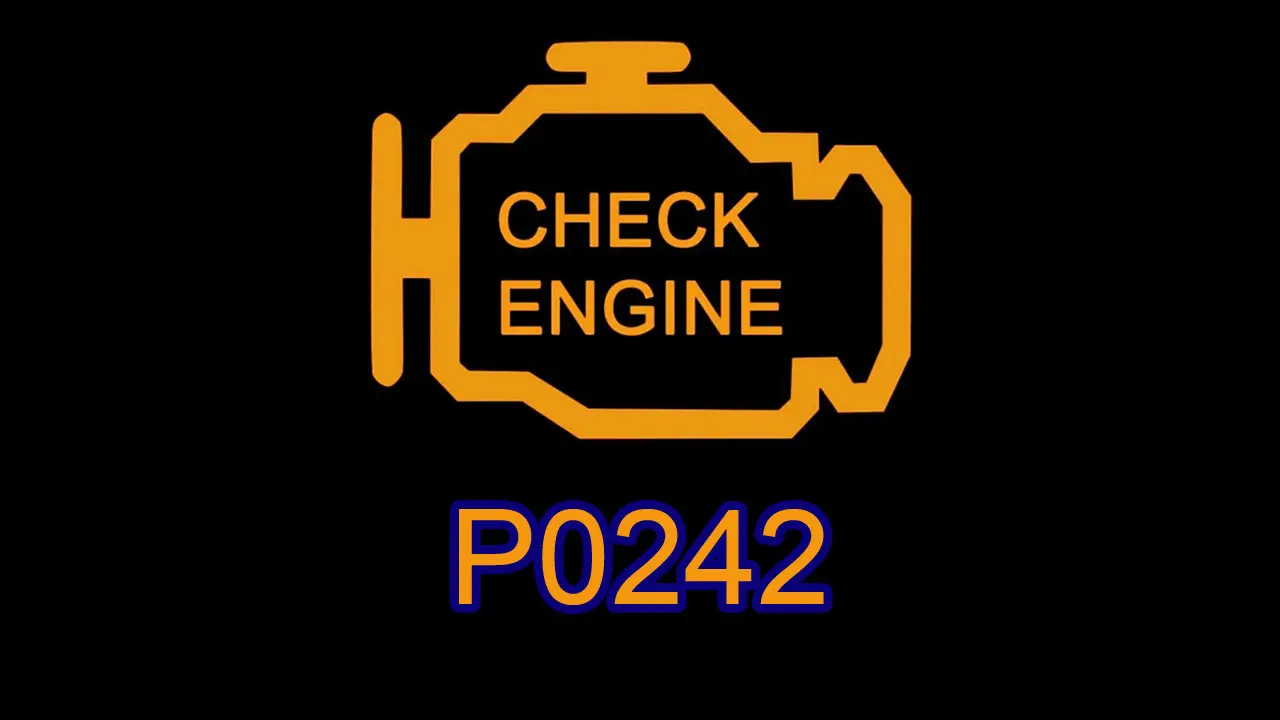
P0242 Turbocharger / Supercharger Boost Sensor "B" Circuit High
The P0242 OBD-II trouble code indicates that the engine control module (ECM/PCM) has detected an abnormally high electrical signal from the Turbocharger/Supercharger Boost Sensor “B” circuit.
This code is important because the word “High” refers to the electrical signal from the sensor circuit, not necessarily to excessive turbocharger boost.
In other words, P0242 does not automatically mean the turbocharger is producing too much boost. The actual problem may be the boost pressure sensor, its wiring, connector, reference voltage, ground circuit, or another electrical fault affecting the sensor signal.
What Does P0242 Mean?
The code can be understood as:
P – Powertrain
02 – Fuel and air metering-related code group
42 – Specific diagnostic code
The important part is:
Turbocharger / Supercharger Boost Sensor “B” Circuit High
The ECM monitors the voltage coming from the boost pressure sensor. When that signal remains above the calibrated range for the operating conditions, the ECM can store P0242.
A simplified sensor circuit usually contains:
ECM → 5-volt reference → boost sensor → sensor ground → signal return to ECM
The sensor converts intake/boost pressure into an electrical signal.
If the ECM receives a signal that is higher than expected, it interprets this as a circuit-high condition.
What Is a Turbocharger Boost Sensor?
A turbocharger boost sensor is generally a pressure sensor that allows the ECM to determine the pressure in the intake or charge-air system.
Depending on the vehicle, it may be called:
-
Boost pressure sensor
-
MAP sensor
-
Intake manifold pressure sensor
-
Charge-air pressure sensor
-
Turbocharger pressure sensor
However, these terms are not necessarily interchangeable on every vehicle.
Some engines use a MAP sensor to measure manifold pressure, while others have additional pressure sensors positioned before or after the intercooler.
The exact location and function of Boost Sensor “B” are manufacturer-specific.
What Does “Circuit High” Mean?
This is one of the most important aspects of P0242.
“Circuit High” refers to an excessively high electrical signal or voltage detected by the ECM.
It does not necessarily mean:
-
Excessive turbo boost
-
High engine RPM
-
High fuel pressure
-
High intake temperature
-
High exhaust pressure
For example, a sensor may normally produce a voltage somewhere within a calibrated range as pressure changes.
If the signal wire becomes shorted to a higher voltage source, the ECM may see an abnormally high signal and set P0242.
Therefore, diagnosing this code requires checking the electrical circuit, not simply looking at turbocharger pressure.
Common Causes of P0242
Several different problems can cause this code.
Faulty boost pressure sensor
The sensor itself may have an internal electrical fault and produce a signal that is higher than expected.
Signal wire shorted to voltage
A damaged harness can allow the sensor signal wire to contact a 5-volt reference or battery-voltage circuit.
This is one of the important possibilities when a circuit-high code is present.
Incorrect 5-volt reference
If the sensor receives an abnormal reference voltage, its output may no longer correspond correctly to actual pressure.
A shared 5-volt reference problem can sometimes affect several sensors at the same time.
Poor sensor ground
A damaged or high-resistance ground circuit can alter the sensor's signal voltage and cause an incorrect reading.
Damaged wiring
The wiring near the turbocharger, intercooler, intake system, or engine can be exposed to:
-
High temperatures
-
Vibration
-
Oil contamination
-
Water
-
Mechanical rubbing
-
Previous repairs
Corroded connector
Moisture or corrosion inside the sensor connector can create abnormal voltage readings.
Loose terminal
A terminal may appear connected while having insufficient contact pressure.
Incorrect sensor
An incorrect replacement sensor can have a different calibration or electrical characteristics.
ECM problem
An ECM internal fault is possible, but it should generally be considered only after the sensor, wiring, reference voltage, ground, and signal circuit have been properly tested.
Symptoms of P0242
The symptoms can vary considerably depending on the vehicle and how the ECM responds to the incorrect boost sensor signal.
Possible symptoms include:
-
Check Engine Light
-
Reduced engine power
-
Poor acceleration
-
Turbocharger performance problems
-
Hesitation
-
Irregular throttle response
-
Limp mode
-
Increased fuel consumption
-
Poor fuel economy
-
Turbocharger control problems
-
Incorrect boost regulation
-
Surging
-
Difficulty maintaining normal engine performance
In some vehicles, the engine may continue to operate relatively normally while the warning light remains illuminated.
In others, the ECM may use a substitute pressure value or limit boost to protect the engine.
Why Does the ECM Care About Boost Pressure?
The ECM needs accurate pressure information to control the engine properly.
On a turbocharged engine, boost pressure affects:
-
Fuel quantity
-
Injection timing
-
Air-fuel mixture
-
Turbocharger control
-
EGR operation
-
Torque calculation
-
Emissions control
-
Engine protection
If the ECM believes the pressure signal is unreliable, it may no longer be able to accurately determine how much air is entering the engine.
This can cause the ECM to use a fallback strategy.
P0242 Does Not Automatically Mean the Turbocharger Is Bad
This distinction is extremely important.
A technician may see a turbocharger-related code and immediately suspect the turbocharger.
But P0242 specifically identifies a boost sensor “B” circuit-high condition.
The turbocharger could be operating perfectly while the sensor circuit is faulty.
For example:
Turbocharger works normally → sensor signal wire shorts to voltage → ECM sees excessively high voltage → P0242
In this situation, replacing the turbocharger would accomplish nothing.
Likewise:
Turbocharger works normally → sensor connector has a wiring fault → ECM receives incorrect signal → P0242
Again, the turbocharger itself is not the cause.
How the Boost Sensor Works
Many modern pressure sensors use a three-wire arrangement:
-
5-volt reference
-
Ground
-
Signal
The ECM supplies a reference voltage to the sensor.
The sensor changes its output according to pressure.
The ECM then interprets that signal as a pressure value.
The exact voltage range varies by sensor and manufacturer, so there is no universal boost sensor voltage specification that applies to every vehicle.
This is why using generic voltage numbers to diagnose every P0242 case can lead to incorrect conclusions.
The manufacturer's wiring diagram and sensor specifications should be used.
How to Diagnose P0242 Correctly
A systematic diagnosis is much more reliable than immediately replacing the sensor.
1. Scan for all fault codes
Start by scanning all available modules.
Look for additional codes involving:
-
MAP sensors
-
MAF sensors
-
5-volt reference
-
Sensor grounds
-
Turbocharger control
-
Engine performance
-
Intake pressure
-
CAN communication
Multiple sensor-related codes can be an important clue.
For example, if several unrelated sensors simultaneously report high or low signals, a shared reference or ground problem becomes much more likely.
2. Check freeze-frame data
Record the conditions under which P0242 was stored.
Important information can include:
-
Engine RPM
-
Vehicle speed
-
Engine load
-
Throttle position
-
Intake pressure
-
Boost pressure
-
Intake air temperature
-
Engine coolant temperature
This can help determine whether the fault occurs at startup, during acceleration, or only under boost.
3. Identify Boost Sensor “B”
Do not assume that “B” means the second sensor physically installed on the vehicle.
Manufacturer terminology varies.
Some vehicles have multiple pressure sensors, while others use a sensor identified as “B” because of the control system's internal naming convention.
The wiring diagram should be used to identify the exact sensor.
Inspect the Sensor Connector
Before performing complicated tests, carefully inspect the connector.
Look for:
-
Corrosion
-
Water intrusion
-
Oil contamination
-
Bent terminals
-
Loose terminals
-
Broken locking mechanism
-
Damaged insulation
-
Pulled wires
Pay particular attention to the terminals inside the connector.
A terminal that has lost its proper tension may make intermittent contact even though the connector appears physically secure.
Inspect the Wiring Harness
Follow the wiring from the sensor toward the ECM.
Look for areas where the harness may have:
-
Rubbed against the engine
-
Contacted the turbocharger
-
Melted against exhaust components
-
Been pinched
-
Been stretched
-
Been repaired incorrectly
-
Become contaminated with oil
Turbocharger-area wiring deserves special attention because of the high temperatures involved.
Check the 5-Volt Reference
If the sensor uses a regulated reference voltage, measure the reference circuit according to the manufacturer's procedure.
If the reference voltage is incorrect, do not automatically condemn the boost sensor.
The same reference circuit may supply other sensors.
A shorted sensor elsewhere in the circuit can sometimes pull a shared reference circuit away from its normal value.
Check the Sensor Ground
A sensor needs a reliable ground reference.
A poor sensor ground can alter the apparent signal voltage.
Ground testing should ideally be performed under the conditions specified by the manufacturer rather than relying only on a static continuity test.
A wire can show continuity with a multimeter and still have excessive resistance when the circuit is operating.
Check the Signal Circuit
The signal wire is particularly important with a circuit-high code.
Determine whether the signal is:
-
Shorted to battery voltage
-
Shorted to the 5-volt reference
-
Open
-
Intermittent
-
Incorrectly grounded
-
Producing an implausible voltage
The actual signal should be compared with manufacturer specifications.
Compare Sensor Reading With Actual Pressure
This is one of the most useful parts of the diagnosis.
If the scan tool reports a boost pressure value, compare it with what would physically be expected under the current operating conditions.
For example, with the engine off and the intake system at atmospheric pressure, the pressure reading should normally be consistent with ambient pressure after accounting for altitude and sensor type.
If the scan tool shows an obviously unrealistic pressure value with the engine off, that is a strong indication that the sensor signal or its interpretation is incorrect.
However, the exact expected value depends on whether the sensor reports absolute pressure, gauge pressure, or another parameter.
Check for a Shared 5-Volt Reference Problem
This is an important diagnostic step that is sometimes overlooked.
Modern vehicles often use a common 5-volt reference circuit for several sensors.
If one sensor or its wiring develops an internal short, it can affect the reference circuit used by other sensors.
Therefore, if P0242 appears together with several seemingly unrelated sensor codes, investigate the shared reference circuit before replacing multiple sensors.
Can Excessive Boost Cause P0242?
Actual excessive boost can contribute to abnormal sensor readings or create other turbocharger-related faults.
However, P0242 specifically describes an electrical high condition in the boost sensor circuit.
Therefore, excessive physical boost should not be assumed to be the primary cause.
If actual boost is high but the sensor circuit voltage is also electrically abnormal, both problems may need to be investigated.
The diagnostic process should determine whether:
the pressure is genuinely high
or
the sensor is falsely reporting high pressure.
Can a Bad Turbocharger Cause P0242?
A mechanically damaged turbocharger can influence boost pressure, but it does not automatically explain a circuit-high sensor fault.
If the turbocharger is mechanically healthy but the boost sensor signal is stuck high, the ECM can still store P0242.
A turbocharger should therefore not be replaced based solely on this code.
Can a Boost Leak Cause P0242?
A boost leak can cause poor turbocharger performance and insufficient boost, but it does not normally explain a genuine electrical circuit-high condition.
A leaking intercooler hose may cause low actual boost.
A shorted boost sensor signal wire may cause P0242.
These are fundamentally different faults, even though both involve the turbocharger system.
Can a MAP Sensor Cause P0242?
On some vehicles, the boost sensor and MAP sensor may be integrated or may perform closely related functions.
On others, they are separate sensors.
Therefore, whether a MAP sensor can be responsible depends on the vehicle's exact system architecture.
If the sensor identified by the manufacturer as Boost Sensor “B” is faulty, it can certainly cause P0242.
But another MAP sensor should not be replaced simply because the generic description mentions boost pressure.
P0242 and Limp Mode
The ECM may enter a reduced-power strategy when it cannot trust boost pressure information.
This is particularly important on turbocharged engines because inaccurate pressure information can cause incorrect boost control.
The ECM may limit:
-
Turbocharger boost
-
Fuel quantity
-
Engine torque
-
Throttle response
The result can feel like a turbocharger failure even when the turbocharger is mechanically sound.
P0242 After Sensor Replacement
If P0242 appears immediately after a boost pressure sensor has been replaced, do not assume that the new sensor is defective.
Check:
-
Correct sensor part number
-
Connector compatibility
-
Terminal arrangement
-
Wiring condition
-
Sensor installation
-
5-volt reference
-
Ground
-
Signal circuit
An incorrectly specified aftermarket sensor can produce a signal that the ECM does not recognize correctly.
A connector that was pulled or wiring that was disturbed during the repair can also create a new fault.
Intermittent P0242
An intermittent P0242 can be more difficult to locate.
The fault may appear only when:
-
Engine vibration increases
-
The wiring moves
-
Engine temperature rises
-
Turbocharger heat increases
-
The connector expands with heat
-
The harness contacts another component
-
Boost pressure increases
In these cases, a visual inspection may show nothing wrong.
A technician may need to monitor the sensor signal while moving the harness or use an oscilloscope to identify brief voltage abnormalities.
Using an Oscilloscope
An oscilloscope can be particularly useful when P0242 is intermittent.
Instead of looking only at a single voltage reading, the technician can observe the signal continuously.
This can reveal:
-
Signal spikes
-
Voltage dropouts
-
Electrical noise
-
Intermittent opens
-
Short-duration high-voltage events
-
Abnormal sensor response
An oscilloscope is not always necessary, but it can save considerable diagnostic time when a conventional multimeter fails to reproduce the problem.
What Should Be Replaced?
There is no universal part replacement for P0242.
Depending on the actual diagnosis, the repair could involve:
-
Boost pressure sensor
-
Wiring harness
-
Connector
-
Electrical terminal
-
Sensor ground circuit
-
5-volt reference circuit
-
Signal circuit
-
ECM, in rare cases
The turbocharger itself should not be the first part replaced simply because P0242 mentions turbocharger/supercharger boost.
Practical Diagnostic Sequence
A professional diagnostic sequence can be summarized as:
P0242 detected → scan all modules → check freeze-frame → identify Boost Sensor “B” → inspect sensor and connector → inspect harness → check 5-volt reference → check sensor ground → check signal voltage → test for short to voltage/ground → compare live pressure data with actual conditions → check shared sensor circuits → inspect turbo/boost system if necessary → diagnose ECM last
This approach separates an electrical sensor problem from a genuine turbocharger problem.
P0242 vs Other Boost Sensor Codes
It is useful to distinguish P0242 from nearby codes.
P0236 – Turbocharger/Supercharger Boost Sensor “A” Circuit Range/Performance
The ECM detects an implausible or incorrect operating range from Boost Sensor “A.”
P0237 – Turbocharger/Supercharger Boost Sensor “A” Circuit Low
The sensor signal is lower than expected.
P0238 – Turbocharger/Supercharger Boost Sensor “A” Circuit High
The sensor signal is higher than expected.
P0240 – Turbocharger/Supercharger Boost Sensor “B” Circuit Range/Performance
The ECM detects an implausible or incorrect range/performance condition from Sensor “B.”
P0241 – Turbocharger/Supercharger Boost Sensor “B” Circuit Low
The sensor signal is lower than expected.
P0242 – Turbocharger/Supercharger Boost Sensor “B” Circuit High
The sensor circuit is producing a signal that is higher than the expected electrical range.
This distinction is important because P0242 is primarily a circuit-high diagnosis, not simply a diagnosis of excessive turbo boost.
Final Diagnosis
P0242 – Turbocharger/Supercharger Boost Sensor “B” Circuit High means the ECM has detected an abnormally high electrical signal in the Boost Sensor “B” circuit.
The most likely areas to investigate are the boost pressure sensor, signal wiring, 5-volt reference, sensor ground, connector, and terminal condition.
A damaged wire shorted to voltage can produce exactly the same code as a defective sensor.
Likewise, a shared 5-volt reference problem can affect several sensors and create multiple fault codes.
The turbocharger should therefore not be condemned based on P0242 alone.
The most reliable diagnosis is to identify the exact Boost Sensor “B” used by the vehicle, inspect its wiring and connector, verify the reference and ground circuits, measure the signal, and compare the reported pressure with actual operating conditions.
P0242 is fundamentally an electrical boost-sensor circuit code. The word “High” describes the sensor signal—not proof that the turbocharger is producing excessive boost.