TR
TR EN
EN

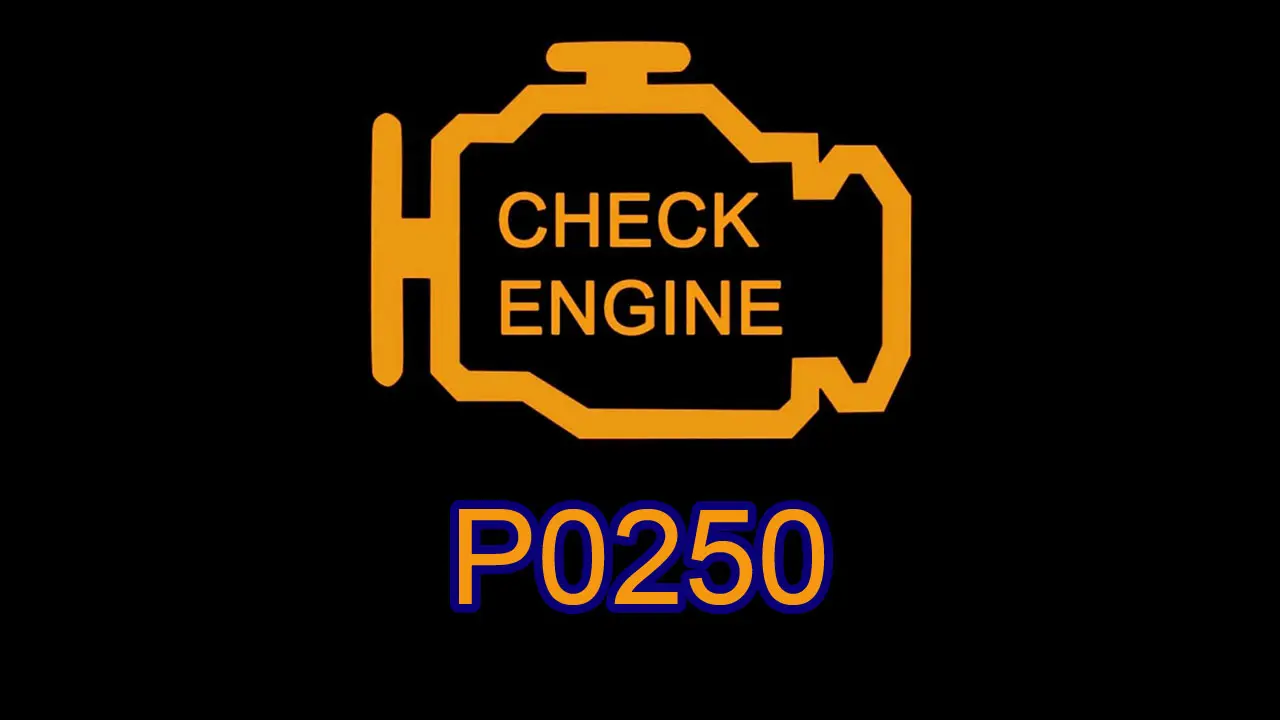
P0250 Turbocharger / Supercharger Wastegate Solenoid "B" Circuit High
P0250 is an OBD-II diagnostic trouble code indicating that the engine control module (ECM) has detected an abnormally high electrical condition in the control circuit for Turbocharger/Supercharger Wastegate Solenoid “B.”
The wastegate control system regulates how much exhaust energy is used to drive the turbocharger. By controlling the wastegate, the engine management system can regulate boost pressure and prevent the turbocharger from producing more boost than intended.
The important word in P0250 is “High.”
In this code, “high” refers primarily to an electrical circuit condition, not necessarily excessive turbocharger boost.
Therefore, P0250 does not automatically mean that the turbocharger is producing too much boost and does not automatically mean that the turbocharger itself has failed.
What Does P0250 Mean?
The ECM controls a wastegate solenoid and monitors its electrical circuit.
When the ECM commands the solenoid to operate, it expects to see a specific electrical response. If the measured voltage or circuit behavior exceeds the manufacturer's calibrated threshold, the ECM can store P0250.
Depending on the vehicle's electrical architecture, the code may be caused by:
-
Excessive voltage on the control circuit
-
Short to battery voltage
-
Incorrect wiring
-
Solenoid internal electrical failure
-
Connector problems
-
Incorrect power supply
-
ECM driver problems
The exact electrical strategy varies between manufacturers.
Some wastegate systems use a solenoid to control vacuum or pressure going to a wastegate actuator. Others use an electronically controlled actuator directly attached to the turbocharger.
Therefore, “Wastegate Solenoid B” is not necessarily the same physical component on every vehicle.
What Is a Wastegate?
A wastegate is a mechanism used to control turbocharger speed and boost pressure.
A turbocharger uses exhaust gases to spin a turbine. The turbine is connected to a compressor wheel, which compresses intake air and sends it into the engine.
More exhaust energy generally means more turbocharger speed and potentially more boost.
The wastegate provides a way to bypass some exhaust flow around the turbine.
When the wastegate opens, part of the exhaust flow bypasses the turbine, reducing the energy available to accelerate the turbocharger.
When it remains closed, more exhaust energy passes through the turbine and the turbocharger can produce more boost.
The ECM therefore uses the wastegate control system to help regulate engine boost.
What Is the Wastegate Solenoid?
On many turbocharged engines, the ECM does not directly move a traditional vacuum-operated wastegate.
Instead, it controls a solenoid.
The solenoid can regulate:
-
Vacuum
-
Boost pressure
-
Actuator pressure
-
Wastegate actuator movement
The exact arrangement depends on the engine.
A typical system may contain:
-
ECM
-
Wastegate control solenoid
-
Vacuum source or pressure source
-
Vacuum hoses
-
Wastegate actuator
-
Wastegate linkage
-
Turbocharger
-
Boost/MAP sensor
Some newer systems use an electronic wastegate actuator rather than a conventional vacuum diaphragm.
This distinction matters when diagnosing P0250 because the fault may involve a solenoid circuit on one vehicle and a more sophisticated electronic actuator system on another.
What Does “Circuit High” Mean?
“Circuit High” is frequently misunderstood.
It does not automatically mean:
-
High turbo boost
-
High intake pressure
-
High exhaust pressure
-
High engine RPM
-
Turbocharger overspeed
It generally means that the ECM has detected an electrical voltage or control condition higher than expected in the relevant circuit.
A common possibility is a control wire that has been unintentionally connected to battery voltage.
However, the precise definition depends on the manufacturer's circuit design.
Common Causes of P0250
Several different faults can produce P0250.
Short to battery voltage
A damaged control wire can contact a battery-voltage source.
This is one of the important possibilities with a circuit-high code.
Faulty wastegate solenoid
The solenoid can develop an internal electrical fault.
Its coil may have abnormal resistance or an internal short that changes the expected circuit behavior.
Damaged wiring
The wiring harness may be:
-
Chafed
-
Melted
-
Broken
-
Pinched
-
Corroded
-
Improperly repaired
Turbocharger wiring is exposed to considerable heat, making harness damage particularly important.
Corroded connector
Moisture or corrosion can alter the electrical characteristics of the circuit.
Loose terminal
A connector terminal may have insufficient contact pressure even though the connector appears properly installed.
Incorrect replacement solenoid
A visually identical solenoid may have different electrical characteristics or control requirements.
Using an incorrect part can produce an electrical fault.
Incorrect power supply
The solenoid may receive incorrect voltage because of a wiring, relay, fuse, or shared power-supply problem.
ECM driver fault
The ECM contains an electronic driver that controls the solenoid.
A damaged driver can cause abnormal voltage on the control circuit, although this should generally be a later diagnostic conclusion rather than the first assumption.
Vacuum or pressure-control problem
A vacuum leak or blocked hose normally does not create a circuit-high code by itself, but it can produce boost-control symptoms at the same time.
Therefore, the electrical fault and mechanical control system should both be evaluated.
Symptoms of P0250
The symptoms depend on how the ECM responds to the wastegate-control fault.
Possible symptoms include:
-
Check Engine Light
-
Reduced engine power
-
Poor acceleration
-
Turbo lag
-
Irregular boost
-
Limp mode
-
Engine hesitation
-
Surging
-
Poor fuel economy
-
Excessive boost
-
Insufficient boost
-
Difficulty maintaining commanded boost
Some vehicles may have very noticeable performance problems, while others may continue driving relatively normally.
Can P0250 Cause High Boost?
It can be associated with a boost-control problem that results in excessive boost, but P0250 itself does not mean that high boost has been measured.
A wastegate that cannot open when required can allow the turbocharger to continue producing more boost than commanded.
However, there is an important distinction between:
P0250 – electrical circuit high
and
actual overboost caused by a mechanically or pneumatically stuck wastegate.
A vehicle can have P0250 because of a wiring fault even when boost pressure itself is normal.
Conversely, a mechanically stuck wastegate can cause excessive boost without necessarily creating P0250.
This is why boost-control diagnosis should include both electrical testing and actual boost measurements.
Can P0250 Cause Low Boost?
Yes, depending on how the ECM responds to the fault.
If the ECM detects a wastegate-control problem, it may enter a protective strategy and reduce turbocharger operation.
This can produce:
-
Low boost
-
Reduced power
-
Slow acceleration
-
Limp mode
A wastegate that is incorrectly held open can also reduce exhaust energy reaching the turbine and therefore reduce boost.
Again, the code does not by itself tell you whether actual boost is too high or too low.
How to Diagnose P0250
The most effective approach is to separate the problem into two areas:
Electrical control circuit
and
Mechanical/pneumatic boost control.
Start with the electrical circuit because P0250 specifically identifies a circuit-high condition.
1. Scan All Diagnostic Trouble Codes
Use a capable scan tool and record all stored and pending codes.
Look for additional codes involving:
-
Boost pressure
-
MAP sensor
-
Turbocharger control
-
Wastegate position
-
MAF
-
Engine voltage
-
ECM communication
Related codes can provide important clues.
2. Check Freeze-Frame Data
Record the operating conditions when P0250 was stored.
Useful information includes:
-
Engine RPM
-
Engine load
-
Vehicle speed
-
Engine temperature
-
MAP pressure
-
Boost pressure
-
Throttle position
-
Battery voltage
If the fault occurs only under acceleration, the wiring harness should be inspected for movement and heat-related problems.
3. Identify Wastegate Solenoid “B”
Do not assume that “B” means the same solenoid on every engine.
Use the manufacturer's service information to determine:
-
Which actuator is “B”
-
Connector pinout
-
Power supply
-
Control wire
-
Ground arrangement
-
Expected voltage
-
Expected resistance
-
Control method
This is especially important on engines with multiple turbochargers or multiple boost-control valves.
4. Inspect the Connector
Disconnect the solenoid and inspect the connector.
Look for:
-
Corrosion
-
Bent pins
-
Loose terminals
-
Water intrusion
-
Oil contamination
-
Broken locking tabs
-
Heat damage
Because turbocharger components operate at high temperatures, connector and wiring damage near the turbo should receive particular attention.
5. Inspect the Wiring
Follow the harness from the wastegate solenoid toward the ECM.
Look for insulation that has:
-
Melted
-
Hardened from heat
-
Chafed against metal
-
Become brittle
-
Been crushed
-
Been repaired incorrectly
Pay special attention to areas close to:
-
Turbocharger housing
-
Exhaust manifold
-
Downpipe
-
Heat shields
-
Engine brackets
A control wire touching battery voltage can produce a circuit-high condition.
6. Check for Short to Voltage
Because P0250 is a circuit-high code, testing the control circuit for an unintended connection to battery voltage is important.
The exact test procedure depends on the manufacturer's circuit design.
The circuit should be isolated correctly before resistance testing to avoid damaging the ECM or obtaining misleading readings.
7. Check Solenoid Resistance
If the manufacturer provides a resistance specification, measure the solenoid coil resistance.
An open circuit or resistance substantially outside the specified range can indicate an internal solenoid problem.
However, resistance testing alone is not enough.
A solenoid can have acceptable resistance but still fail when energized or when hot.
8. Test the Control Signal
A multimeter can provide basic information, but an oscilloscope may be more useful when the system uses PWM control.
The waveform can reveal:
-
Incorrect duty cycle
-
Missing control signal
-
Electrical interference
-
Abnormal switching
-
Voltage spikes
-
Intermittent faults
On difficult intermittent problems, this can help determine whether the ECM is commanding the solenoid correctly.
9. Test the Vacuum or Pressure Side
If the vehicle uses a conventional vacuum-operated wastegate actuator, inspect the hoses.
Look for:
-
Cracks
-
Loose connections
-
Collapsed hoses
-
Incorrect routing
-
Blockages
-
Vacuum leaks
A vacuum problem may not explain the circuit-high code, but it can explain why the wastegate does not respond correctly.
10. Test the Wastegate Actuator
The actuator should move according to manufacturer specifications.
Depending on the system, this may involve applying controlled vacuum or pressure and checking actuator movement.
The actuator should:
-
Move smoothly
-
Begin moving at the specified pressure/vacuum
-
Reach the required travel
-
Hold vacuum/pressure where applicable
A mechanically sticking actuator can create boost-control problems even when the electrical circuit is perfect.
Check the Wastegate Linkage
The wastegate mechanism itself can become mechanically restricted.
Possible problems include:
-
Carbon buildup
-
Rust
-
Corrosion
-
Bent linkage
-
Seized pivot
-
Mechanical wear
A wastegate that is physically stuck cannot respond correctly even if the ECM and solenoid are functioning perfectly.
Compare Commanded and Actual Boost
This is one of the most useful tests when diagnosing turbocharger control problems.
Use live data to compare:
Commanded boost
with
Actual boost
during different operating conditions.
If the ECM requests a certain boost level but actual boost remains significantly different, determine whether the cause is:
-
Wastegate control
-
Solenoid
-
Actuator
-
Vacuum system
-
Boost leak
-
MAP sensor
-
Turbocharger
-
Exhaust restriction
-
Intake restriction
Do not assume that the turbocharger itself is defective.
P0250 Does Not Automatically Mean Turbocharger Failure
This is a critical point.
The turbocharger can be mechanically healthy while P0250 is caused by a damaged electrical wire.
For example, a control wire may melt against the exhaust manifold and become connected to battery voltage.
The ECM then detects the abnormal electrical condition and stores P0250.
Replacing the turbocharger would not repair that problem.
Likewise, a turbocharger can have mechanical problems without producing P0250.
The code should therefore be treated as a wastegate-control circuit fault, not as a direct turbocharger-failure code.
Can a MAP Sensor Cause P0250?
A MAP or boost-pressure sensor can cause boost-control problems and may trigger other related codes.
However, a sensor problem does not automatically explain a genuine circuit-high condition in the wastegate solenoid circuit.
If the ECM specifically detects excessive voltage in the solenoid circuit, the solenoid wiring and ECM driver should be tested directly.
If P0250 is accompanied by MAP/boost sensor codes, both systems should be investigated.
Can a Boost Leak Cause P0250?
A boost leak can cause:
-
Low boost
-
Poor acceleration
-
Turbocharger overwork
-
Hissing sounds
-
Poor engine performance
But a conventional boost leak does not normally create a wastegate-solenoid circuit-high condition.
Therefore, a boost leak may be a separate problem or a contributing factor to poor boost control rather than the direct cause of P0250.
Can a Vacuum Leak Cause P0250?
On vacuum-operated wastegate systems, a vacuum leak can prevent proper actuator operation.
However, the electrical code itself still requires electrical diagnosis.
A vacuum leak and an electrical circuit fault can occur simultaneously, so both sides of the system should be tested when symptoms point in both directions.
P0250 on Twin-Turbo Engines
The letter “B” becomes particularly important on engines with multiple turbochargers or multiple boost-control actuators.
Depending on the manufacturer's terminology, “B” may identify:
-
The second wastegate solenoid
-
A specific turbocharger
-
A particular control circuit
-
One of several boost-control valves
It should not automatically be interpreted as “the turbo on the passenger side” or “the second turbo.”
Always use the manufacturer's wiring diagram and component identification.
Common Diagnostic Mistakes
Replacing the turbocharger immediately
P0250 is an electrical control-circuit code. A turbocharger replacement may be completely unnecessary.
Assuming “high” means high boost
The code refers to an electrical circuit condition.
Replacing the wastegate solenoid without testing the wiring
A shorted control wire can cause the same code with a perfectly good solenoid.
Ignoring heat damage
Turbocharger wiring is exposed to extreme temperatures and should be inspected carefully.
Testing only with a multimeter
Intermittent PWM-control problems may require oscilloscope testing.
Ignoring the mechanical wastegate
Electrical operation does not guarantee that the wastegate linkage and actuator can physically move.
Ignoring boost measurements
Actual boost should be compared with commanded boost when diagnosing the complete control system.
Replacing the ECM too early
The ECM should be considered only after the external circuit and actuator have been properly verified.
P0250 vs P0243, P0244, P0245 and P0246
The P024x and P0250 codes are closely related to turbocharger/supercharger wastegate control.
P0243 generally refers to Wastegate Solenoid “A” Circuit Malfunction.
P0244 generally refers to Wastegate Solenoid “A” Range/Performance.
P0245 generally refers to Wastegate Solenoid “A” Circuit Low.
P0246 generally refers to Wastegate Solenoid “A” Circuit High.
P0250 refers to Wastegate Solenoid “B” Circuit High.
The exact component designation remains manufacturer-dependent.
The important distinction is that P0250 specifically points toward the “B” wastegate-control circuit and an electrical high condition.
A Practical Diagnostic Order
A logical diagnostic sequence for P0250 is:
-
Scan all modules and record every DTC.
-
Save freeze-frame data.
-
Identify the exact Wastegate Solenoid “B.”
-
Determine the system's electrical and actuator architecture.
-
Inspect the connector.
-
Inspect the harness, especially near hot turbocharger components.
-
Check power and ground.
-
Test the control circuit for shorts to voltage and ground.
-
Measure solenoid resistance according to manufacturer specifications.
-
Check the ECM control signal.
-
Use an oscilloscope if the fault is intermittent or PWM-related.
-
Inspect vacuum or pressure-control hoses.
-
Test wastegate actuator movement.
-
Inspect the wastegate linkage for mechanical sticking.
-
Compare commanded and actual boost.
-
Check MAP/boost sensor data.
-
Evaluate the turbocharger only after the control system has been verified.
-
Consider an ECM driver fault as a later-stage diagnosis.
Final Diagnosis
P0250 – Turbocharger/Supercharger Wastegate Solenoid “B” Circuit High means that the ECM has detected an abnormally high electrical condition in the control circuit for Wastegate Solenoid “B.”
The problem may be caused by a short to battery voltage, damaged wiring, connector problems, a defective wastegate solenoid, incorrect power supply, or an ECM driver fault.
At the same time, the complete boost-control system should be evaluated because a faulty actuator, vacuum system, or mechanically stuck wastegate can create similar drivability symptoms.
Most importantly, P0250 does not automatically mean high boost and does not automatically mean the turbocharger has failed.
The correct diagnosis is to test the electrical circuit first, then verify the solenoid and actuator, and finally compare commanded versus actual boost pressure. This approach prevents an electrical wiring problem from being incorrectly diagnosed as an expensive turbocharger failure.