TR
TR EN
EN

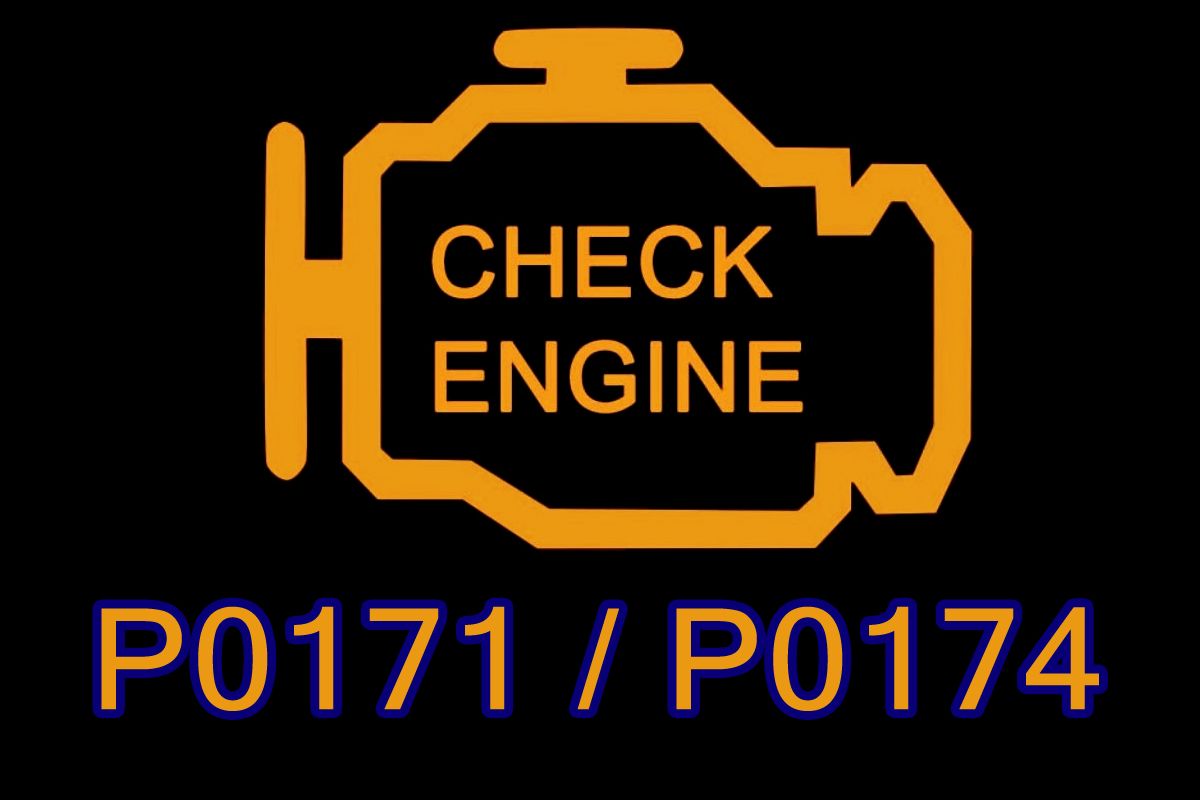
P0171 and P0174 Trouble Codes – Lean Mixture Problem
P0171 and P0174 are OBD-II trouble codes related to a lean air-fuel mixture. When these two codes appear together, the engine control module (ECM) has determined that the fuel mixture is too lean on both Bank 1 and Bank 2.
A lean mixture means that, according to the engine management system, there is either too much air or not enough fuel for the current operating conditions.
However, that does not automatically mean the engine has a fuel shortage.
A faulty MAF sensor, vacuum leak, low fuel pressure, restricted injectors, an EVAP problem, an exhaust leak, or incorrect oxygen sensor feedback can all contribute to P0171 and P0174.
The fact that both codes appear together is particularly important because it can point toward a common problem affecting the entire engine.
What Do P0171 and P0174 Mean?
The two codes identify the affected cylinder banks:
P0171 – System Too Lean (Bank 1)
The ECM detects a lean condition on Bank 1, the cylinder bank containing cylinder number 1.
P0174 – System Too Lean (Bank 2)
The ECM detects a lean condition on Bank 2, the opposite cylinder bank on an engine with two cylinder banks.
These codes do not identify a specific failed component.
They tell you that the ECM has had to make an excessive fuel correction to maintain the desired air-fuel mixture.
What Is a Lean Mixture?
For proper combustion, an engine needs an appropriate amount of air and fuel.
If there is more air than expected or less fuel than required, the mixture becomes lean.
The ECM normally attempts to correct this by increasing fuel delivery.
If the condition is small, the ECM may compensate without storing a fault code.
If the correction becomes excessive or remains outside the calibrated range for a sufficient period, P0171 and/or P0174 may be stored.
This means the vehicle can sometimes continue running relatively normally even though these codes are already present.
The ECM may have been compensating for the problem for some time.
Why Are Both Codes Appearing Together?
This is one of the most important aspects of diagnosing P0171 and P0174.
If only P0171 is present, a Bank 1-specific problem becomes more likely.
If only P0174 is present, Bank 2-specific causes deserve more attention.
But when P0171 and P0174 appear together, the problem may be something that affects both cylinder banks.
Possible common causes include:
-
MAF sensor under-reporting airflow
-
Low fuel pressure
-
Insufficient fuel volume
-
Restricted fuel supply
-
Large intake leak
-
PCV system problem
-
EVAP system problem
-
Fuel contamination
-
Common sensor reference or ground problem
-
Incorrect engine-load calculation
This does not completely eliminate bank-specific problems, but it changes where the diagnosis should begin.
Fuel Trim Is the Key to Understanding the Problem
Fuel trims are extremely useful when P0171 and P0174 occur together.
The two main fuel-trim values are:
-
Short-Term Fuel Trim (STFT)
-
Long-Term Fuel Trim (LTFT)
When the ECM detects a lean mixture, it generally adds fuel.
As a result, fuel trims normally move in the positive direction.
If the engine requires significant additional fuel on both banks, the scan tool may show positive fuel-trim values on Bank 1 and Bank 2.
The important thing is not simply to see a positive number.
The technician should observe how the fuel trims behave under different operating conditions.
Fuel Trim Behavior Can Point Toward the Cause
Suppose both banks have high positive fuel trims at idle.
Then, as engine speed increases, the fuel trims move closer to normal.
That pattern makes an intake or vacuum leak more suspicious.
Why?
At idle, a relatively small amount of unmetered air can represent a significant percentage of the total air entering the engine.
At higher engine speed, the engine consumes much more air, so the same leak represents a smaller percentage of total airflow.
Now consider a different situation.
The fuel trims are relatively normal at idle but become strongly positive during acceleration.
That pattern can make a fuel-delivery problem more suspicious.
Possible causes include:
-
Weak fuel pump
-
Restricted fuel filter
-
Low fuel pressure
-
Insufficient fuel volume
-
Fuel-pressure control problem
These patterns are not absolute rules, but they are extremely useful diagnostic clues.
Vacuum and Intake Leaks
A vacuum leak is one of the first things that should be considered when P0171 and P0174 occur together.
Air entering the intake system after the MAF sensor may not be properly measured.
The ECM therefore calculates fuel delivery based on less air than the engine is actually receiving.
The result can be a lean mixture.
Potential leak locations include:
-
Intake manifold gasket
-
Vacuum hoses
-
PCV hoses
-
Brake booster hose
-
Intake ducting
-
Throttle-body gasket
-
EVAP hoses
-
Intake manifold cracks
-
Vacuum fittings
A large leak can sometimes be heard as a hissing sound.
Small leaks may be almost impossible to detect without a smoke test.
A Smoke Test Can Save a Lot of Time
If fuel-trim data strongly suggests an unmetered-air problem, a smoke test can be much more useful than replacing sensors.
Smoke introduced into the intake system can reveal leaks around:
-
Intake manifold
-
Vacuum hoses
-
PCV system
-
Throttle body
-
Seals
-
Hoses and connections
If both banks are showing a lean condition, a significant intake leak becomes particularly interesting.
However, not every P0171/P0174 combination is caused by a vacuum leak.
The fuel system still needs to be evaluated.
MAF Sensor Problems
The Mass Air Flow sensor is another major suspect when both banks are lean.
The ECM uses the MAF signal to estimate the amount of air entering the engine.
If the sensor under-reports airflow, the ECM may calculate that less fuel is necessary than the engine actually requires.
The resulting mixture can become lean.
A contaminated MAF sensor can produce inaccurate readings.
But the presence of P0171 and P0174 does not prove that the MAF sensor is faulty.
Its readings should be compared with:
-
Engine RPM
-
Engine load
-
Throttle position
-
MAP data
-
Fuel trims
-
Intake-air temperature
-
Actual engine behavior
A MAF reading that does not make sense relative to the other parameters is much stronger evidence than the trouble code alone.
Fuel Pressure Problems
If both banks are lean, insufficient fuel delivery should be investigated carefully.
Possible causes include:
-
Weak fuel pump
-
Restricted fuel filter
-
Low fuel pressure
-
Fuel-pressure regulator problem
-
Fuel-pressure control valve problem
-
Restricted fuel line
-
Poor electrical supply to the fuel pump
-
Low fuel volume
-
Fuel contamination
The important point is that fuel pressure must be measured rather than assumed.
A fuel pump may produce adequate pressure at idle but fail to provide sufficient fuel volume when the engine is under load.
That is why checking fuel pressure only at idle may not be enough.
Fuel Pump Electrical Supply
A fuel pump can also have an electrical problem without the pump itself being mechanically defective.
Possible causes include:
-
Corroded connector
-
Weak ground
-
Damaged wiring
-
Relay problem
-
Voltage drop
-
Poor power supply
If fuel pressure is below specification, check whether the pump is receiving the correct electrical supply under the relevant operating conditions.
Replacing the pump without checking its power and ground circuits can result in an unnecessary repair.
Fuel Filter Restriction
A restricted fuel filter can limit fuel flow.
At idle, the engine's fuel demand is relatively low, so the problem may not be obvious.
During acceleration, however, fuel demand increases significantly.
If the fuel system cannot maintain adequate pressure or volume, the mixture can become lean and fuel trims can rise.
This is one reason a vehicle may appear to run normally at idle but lose power under load.
Fuel Injectors
Restricted injectors can also contribute to a lean mixture.
If several injectors have reduced flow, the entire engine can be affected.
Possible causes include:
-
Contaminated fuel
-
Injector deposits
-
Restricted injector nozzles
-
Incorrect injector flow
-
Electrical problems
-
Connector problems
If only one cylinder is affected, a cylinder-specific misfire may be more noticeable.
If multiple cylinders are affected, fuel-trim codes such as P0171 and P0174 can become more likely.
Injector resistance alone is not sufficient to prove that an injector is healthy.
Flow, balance, leakage, electrical operation, and cylinder contribution may need to be evaluated.
Low Fuel Pressure vs MAF Problem
These two problems can sometimes produce very similar scan-tool information.
Both can cause positive fuel trims.
The difference often becomes clearer when the vehicle is tested under different loads.
With a fuel-delivery problem, fuel trims may become increasingly positive as fuel demand rises.
With an airflow-measurement problem, the MAF data may appear implausible compared with engine speed and load.
This is why looking at only the fuel-trim numbers is not enough.
PCV System Problems
The Positive Crankcase Ventilation system can introduce unmetered air into the intake if a hose, valve, diaphragm, or related component is damaged.
A PCV problem can affect the entire engine and therefore may contribute to both P0171 and P0174.
Inspect:
-
PCV valve
-
PCV hoses
-
Diaphragm where applicable
-
Hose connections
-
Valve-cover connections
-
Intake connections
If the codes appeared after work was performed around the intake or valve cover, recently disturbed components deserve particular attention.
EVAP Purge Valve
The EVAP purge system controls fuel vapors from the fuel tank.
A purge valve that does not close properly can allow air and fuel vapors into the intake at the wrong time.
Depending on the vehicle, this can influence fuel trims and create drivability problems.
The EVAP system becomes especially interesting if:
-
The problem occurs at idle
-
The problem started after refueling
-
EVAP-related codes are also present
-
Fuel trims change significantly when purge operation changes
Exhaust Leaks
An exhaust leak near an upstream oxygen or air-fuel ratio sensor can introduce outside air into the exhaust stream.
The sensor may then detect additional oxygen and report a lean condition.
The ECM responds by adding fuel.
This can create positive fuel trims even if the engine's actual fuel delivery is not the original problem.
Inspect the area around:
-
Exhaust manifold
-
Manifold gasket
-
Upstream oxygen sensor
-
Air-fuel ratio sensor
-
Exhaust flanges
-
Cracks near the cylinder head
A small exhaust leak can sometimes be difficult to hear.
Oxygen and Air-Fuel Ratio Sensors
A faulty oxygen sensor or air-fuel ratio sensor can falsely indicate a lean condition.
The ECM then attempts to compensate by adding fuel.
This can result in P0171 and P0174.
However, replacing both sensors simply because both banks have lean codes is not a proper diagnosis.
Sensor behavior must be evaluated according to the type of sensor installed.
A conventional narrowband oxygen sensor and a modern wideband air-fuel ratio sensor use different operating principles and should not be diagnosed using the same generic voltage assumptions.
Engine Coolant Temperature Sensor
The coolant temperature sensor affects fuel calculations.
If the ECM receives an incorrect temperature signal, fuel control can be affected.
For example, an incorrect temperature reading can alter the amount of enrichment or fuel correction applied by the ECM.
When diagnosing persistent fuel-trim problems, check coolant temperature data.
After the vehicle has been sitting long enough to become completely cold, the reported coolant temperature should generally be reasonably close to ambient temperature.
Then monitor the temperature as the engine warms.
Air Filter and Intake Restriction
A severely restricted air intake can affect engine operation.
Check:
-
Air filter
-
Airbox
-
Intake duct
-
Intake snorkel
-
Throttle-body area
However, a dirty air filter should not automatically be blamed for P0171 and P0174.
The ECM generally uses airflow and other information to calculate engine load and fueling.
A moderate filter restriction does not automatically create a classic lean condition.
What If P0171 and P0174 Appear With P0300?
If P0171 and P0174 appear together with P0300, the situation deserves more attention.
P0300 indicates random or multiple-cylinder misfires.
A lean mixture can cause misfires.
At the same time, a misfire can affect oxygen-sensor readings and make fuel-control data more difficult to interpret.
The technician therefore needs to determine whether:
The lean condition caused the misfire
or
The misfire is contributing to the apparent lean condition.
Looking at freeze-frame data and the sequence in which the codes were generated can help.
What If P0171 and P0174 Appear Only Under Acceleration?
This is an important clue.
If fuel trims are close to normal at idle and light cruise but become strongly positive during acceleration, the fuel system should be investigated carefully.
Under acceleration, fuel demand increases.
Possible causes include:
-
Weak fuel pump
-
Restricted fuel filter
-
Fuel pressure drop
-
Insufficient fuel volume
-
Fuel-pressure control problem
-
Injector flow limitation
Fuel pressure should be observed under the conditions where the problem actually occurs.
What If the Codes Appear Only at Idle?
If both codes appear primarily at idle and fuel trims improve significantly as engine speed rises, an intake-air problem becomes more suspicious.
Potential causes include:
-
Vacuum leak
-
Intake manifold gasket leak
-
PCV problem
-
Brake booster leak
-
EVAP purge valve issue
-
Intake manifold crack
A smoke test can be especially useful in this situation.
Diagnosing P0171 and P0174 Step by Step
A practical diagnostic sequence can prevent unnecessary parts replacement.
First, scan the vehicle completely.
Check stored and pending codes in addition to P0171 and P0174.
Pay attention to:
-
Misfire codes
-
MAF/MAP codes
-
Fuel-pressure codes
-
EVAP codes
-
Oxygen/A/F sensor codes
-
Temperature sensor codes
Next, examine freeze-frame data.
Determine the engine speed, load, coolant temperature, vehicle speed, and fuel trims when the codes were stored.
Then examine STFT and LTFT.
Compare Bank 1 and Bank 2.
Check the values at idle, cruise, and under acceleration.
Inspect for unmetered air.
Check the intake system, PCV system, vacuum hoses, brake booster line, EVAP plumbing, and intake manifold.
Perform a smoke test when necessary.
Check MAF and MAP plausibility.
The readings should make sense in relation to engine speed, load, and throttle position.
Verify fuel pressure and volume.
Compare actual measurements with manufacturer specifications.
If the pressure falls under load, investigate the fuel supply system.
Check fuel pump voltage and ground.
A voltage-drop problem can reduce pump performance.
Evaluate injectors if necessary.
Check flow, balance, leakage, and electrical operation according to the vehicle's system.
Evaluate oxygen/A/F sensor feedback.
Make sure the sensors are actually reporting the combustion condition correctly.
Check the EVAP purge system and PCV system.
Both can introduce unwanted airflow into the intake.
Consider wiring and common grounds.
If several sensors show unusual values, investigate shared power, reference, and ground circuits.
Why Both Banks Being Lean Is So Useful
The combination of P0171 and P0174 can actually make diagnosis easier.
If one bank is lean and the other is normal, look for something specific to that bank.
If both banks are lean by a similar amount, look for something affecting the whole engine.
This makes the following possibilities particularly important:
Common air measurement problem
MAF sensor or related airflow calculation.
Common fuel delivery problem
Fuel pressure, fuel pump, filter, fuel supply, or fuel-pressure control.
Common unmetered-air problem
Large intake leak, PCV issue, or another source of unmeasured air.
Common sensor or electrical problem
Shared reference voltage, ground, wiring, or sensor feedback.
Can P0171 and P0174 Be Caused by a Bad Fuel Pump?
Yes, but the codes do not prove that the fuel pump is defective.
A weak pump can cause insufficient fuel pressure or volume, particularly under load.
However, the same codes can be caused by a vacuum leak, MAF problem, injector restriction, or sensor issue.
Fuel pressure and volume should be tested before replacing the pump.
Can a Vacuum Leak Cause Both Codes?
Yes.
A sufficiently large intake leak can affect the entire engine and cause both Bank 1 and Bank 2 to run lean.
If fuel trims are especially high at idle and improve as engine speed increases, this possibility becomes more convincing.
Can a Dirty MAF Cause Both Codes?
Yes.
Because the MAF sensor provides information used for the overall engine airflow calculation, an inaccurate reading can affect both cylinder banks.
But again, the MAF should be tested rather than replaced simply because P0171 and P0174 are present.
Can P0171 and P0174 Damage the Engine?
A mild, temporary lean condition does not necessarily cause immediate engine damage.
A severe or prolonged lean condition, however, should not be ignored.
Possible consequences include:
-
Rough running
-
Misfires
-
Increased combustion temperatures
-
Poor acceleration
-
Increased emissions
-
Catalyst damage
-
Reduced engine performance
-
Potential engine damage in severe cases
If the engine is misfiring severely or the check engine light is flashing, continued driving should be avoided until the problem is diagnosed.
P0171/P0174 vs P0172/P0175
These codes represent opposite mixture conditions.
P0171 – System Too Lean, Bank 1
P0174 – System Too Lean, Bank 2
P0172 – System Too Rich, Bank 1
P0175 – System Too Rich, Bank 2
The lean codes generally indicate that the ECM is adding fuel to compensate.
The rich codes generally indicate that the ECM is removing fuel.
If a vehicle produces both lean and rich codes at different times, an intermittent sensor, wiring issue, fuel-pressure problem, EVAP fault, or changing operating condition should be considered.
A Practical Example
Imagine a V6 vehicle arrives with both P0171 and P0174.
The engine has a slightly unstable idle.
The scan tool shows significant positive fuel trims on both banks at idle.
As engine speed increases, the fuel trims move closer to normal.
Fuel pressure remains within specification.
The MAF reading appears reasonable.
In this case, immediately replacing the fuel pump or injectors would make little sense.
The fuel-trim pattern points more strongly toward an unmetered-air problem.
A smoke test then reveals a significant leak in the intake system.
After the leak is repaired, the fuel trims return toward normal and the codes no longer return.
Another Diagnostic Example
Now consider a different vehicle.
P0171 and P0174 are stored.
At idle, fuel trims are only slightly positive.
During acceleration, both banks become strongly positive.
The engine loses power under heavy load.
Fuel pressure drops below specification during acceleration.
This pattern points much more strongly toward a fuel-delivery problem.
The next step would be to determine why fuel pressure or volume is insufficient rather than replacing oxygen sensors.
Final Diagnosis
P0171 and P0174 – System Too Lean (Bank 1 and Bank 2) indicate that the ECM is having to add an excessive amount of fuel to compensate for a lean condition affecting both cylinder banks.
When both codes appear together, common engine-wide causes deserve particular attention.
The main possibilities include:
-
Vacuum or intake leaks
-
MAF sensor measurement problems
-
Low fuel pressure
-
Insufficient fuel volume
-
Restricted fuel filter
-
Weak fuel pump
-
Fuel injector restriction
-
PCV system problems
-
EVAP purge problems
-
Oxygen/A/F sensor errors
-
Exhaust leaks
-
Coolant temperature sensor errors
-
Wiring, reference-voltage, or ground problems
The most valuable diagnostic information usually comes from fuel-trim behavior under different operating conditions.
If the trims are high at idle and improve with RPM, investigate unmetered air.
If the trims become worse under load, investigate fuel delivery.
If both banks behave similarly, look for a common cause.
Most importantly, P0171 and P0174 are not “replace the MAF” or “replace the fuel pump” codes. They are indications that the ECM is struggling to maintain the correct mixture. The actual fault must be identified by combining fuel trims, live data, physical inspection, smoke testing, fuel-pressure testing, and targeted sensor and electrical checks.