TR
TR EN
EN

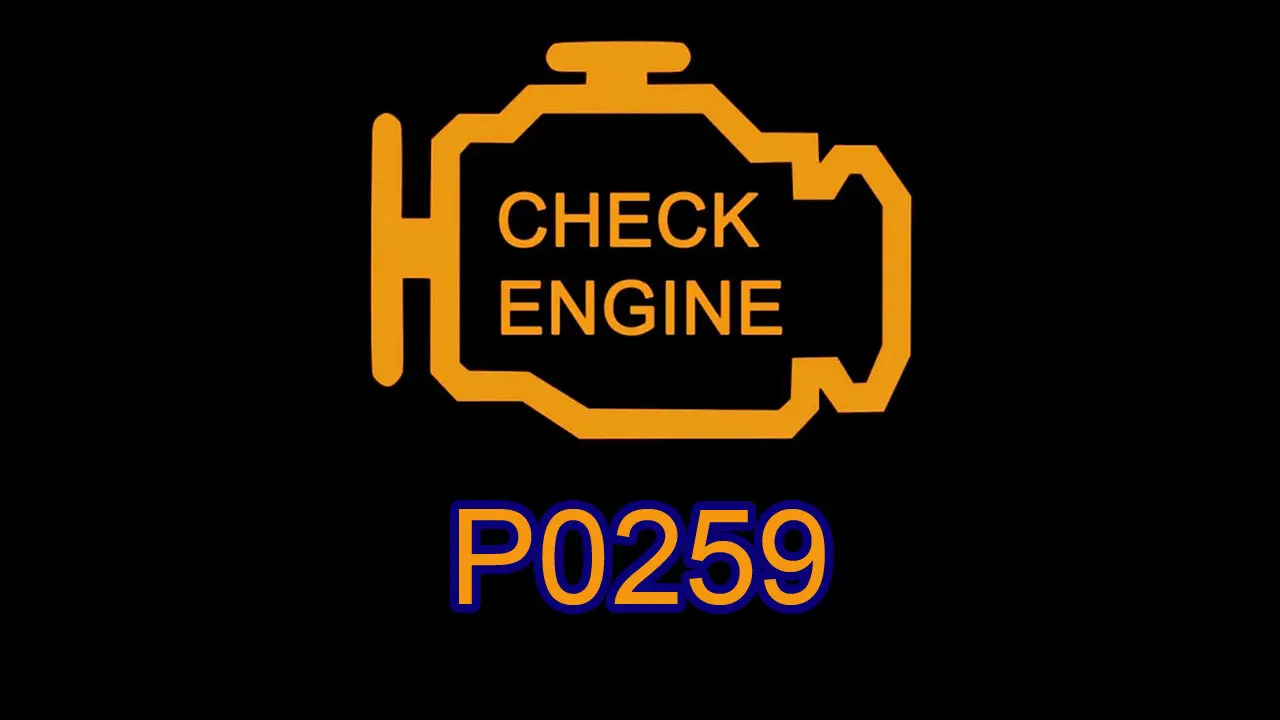
P0259 Injection Pump Fuel Metering Control "B" Circuit High (Cam/Rotor/Injector)
P0259 is an OBD-II diagnostic trouble code that indicates the engine control module (ECM/PCM) has detected an abnormally high electrical condition in the fuel metering control “B” circuit of the injection pump.
This code is primarily associated with electronically controlled diesel fuel-injection systems. Depending on the injection system, the control circuit may involve components related to the injection pump, pump cam or rotor mechanism, or injector/fuel-metering assembly.
The phrase “Circuit High” refers to an electrical signal or circuit condition, not automatically to high fuel pressure or excessive fuel delivery.
P0259 therefore does not mean that the injection pump must be replaced. A wiring problem, connector fault, metering-control component, power supply issue, or ECM driver problem can produce the same code.
What Does P0259 Mean?
Older diesel injection systems could mechanically control fuel quantity using mechanical governors, pumps, and linkages.
Modern electronically controlled systems use sensors and actuators to allow the ECM to control fuel quantity much more precisely.
The ECM may monitor the fuel metering system through feedback from sensors and the electrical response of the control circuit.
When the ECM detects that the “B” fuel metering control circuit is electrically higher than the expected range, it can store P0259.
The exact component represented by “B” is manufacturer-specific.
Depending on the vehicle, the circuit can be associated with a fuel metering actuator, injection pump control mechanism, pump cam/rotor-related assembly, or another electronically controlled portion of the fuel injection system.
For this reason, “B” should not automatically be interpreted as a particular injector or a specific pump component without consulting the vehicle's wiring diagram and service information.
What Does “Circuit High” Mean?
“High” in P0259 describes an electrical condition.
It does not necessarily mean:
-
Excessive fuel pressure
-
Too much diesel fuel
-
High injection pressure
-
Injection pump producing too much fuel
-
Injector stuck open
-
Engine running too rich
-
Excessive engine RPM
The ECM has detected a voltage, current, or electrical response that is higher than the expected range for that particular control circuit.
For example, a control wire may be unintentionally connected to a power source, an actuator may have an internal electrical problem, or the control circuit may not be responding as expected.
The exact electrical interpretation depends on the injection system.
Why Is the Fuel Metering Control Important?
The fuel metering system determines how much fuel is made available for injection.
The ECM must continuously adjust fuel quantity according to conditions such as:
-
Engine speed
-
Accelerator position
-
Engine load
-
Fuel pressure
-
Coolant temperature
-
Intake air conditions
-
Requested torque
-
Emissions requirements
On electronically controlled diesel engines, incorrect fuel metering can affect both engine performance and fuel pressure.
If the metering system does not respond correctly, the ECM may have difficulty maintaining the requested fuel quantity or pressure.
Common Causes of P0259
Fuel metering control actuator problem
The metering-control actuator itself may have an internal electrical or mechanical problem.
Depending on the injection system, this component may be mounted directly on or integrated into the injection pump.
It may become contaminated, stick mechanically, develop an internal electrical fault, or fail to respond correctly to ECM commands.
Injection pump problem
A mechanical or electrical problem within the injection pump can interfere with fuel metering.
Possible causes include:
-
Internal pump wear
-
Mechanical sticking
-
Damaged internal components
-
Contamination
-
Incorrect pump operation
-
Electrical actuator failure
However, P0259 does not by itself prove that the pump is mechanically damaged.
Damaged wiring
The wiring between the ECM and fuel-metering system can be damaged by heat, vibration, oil, moisture, or contact with other engine components.
Possible problems include:
-
Short to battery voltage
-
Damaged insulation
-
Incorrect previous repair
-
Chafed wiring
-
Broken conductors
-
High-resistance connections
-
Intermittent wiring faults
A short to a power supply is particularly relevant when diagnosing a genuine circuit-high condition.
Connector problems
Fuel-metering components often operate in a hot and mechanically demanding environment.
Connector problems can include:
-
Corrosion
-
Loose terminals
-
Bent pins
-
Poor terminal tension
-
Water contamination
-
Oil contamination
-
Damaged locking mechanisms
A poor connection can cause unstable or abnormal electrical feedback.
Power supply problem
The fuel-metering control circuit may depend on a dedicated or shared power supply.
A problem involving a fuse, relay, power feed, ground, or shared circuit can affect the electrical behavior of the system.
Fuel contamination
Diesel fuel containing water, dirt, or other contamination can interfere with the operation of precision fuel-system components.
Contaminated fuel can cause mechanical sticking or abnormal operation of metering components and injection-pump mechanisms.
Fuel pressure problem
Although “Circuit High” is an electrical description, a fuel-system pressure problem can coexist with a metering-control fault.
A restriction, pressure regulator problem, pump problem, or sensor fault may cause the ECM to see fuel-system behavior that does not correspond to its commands.
The electrical circuit should still be tested rather than assuming the fuel pressure itself is the meaning of “High.”
ECM driver problem
The ECM controls electronically operated fuel-system components through internal driver circuits.
A failed driver can potentially produce an abnormal electrical condition.
However, the ECM should generally be considered only after the wiring, connectors, power supply, actuator, and related fuel-system components have been properly tested.
Symptoms of P0259
The symptoms can vary considerably depending on the injection system and how severely the metering circuit is affected.
Possible symptoms include:
-
Check Engine Light
-
Difficult starting
-
Extended cranking
-
Rough idle
-
Engine hesitation
-
Poor acceleration
-
Reduced engine power
-
Engine stalling
-
Unstable engine speed
-
Poor fuel economy
-
Limited engine performance
-
Reduced or limp-home mode
-
In severe cases, an engine that will not start
Some vehicles may enter a protective operating mode because the ECM cannot reliably control fuel delivery.
Why Can P0259 Cause a No-Start Condition?
A diesel engine needs the correct amount of fuel at the correct pressure and at the correct time.
If the fuel metering system is unable to respond correctly, the injection system may not generate or regulate fuel delivery as required for starting.
If the ECM detects a serious control problem, it may also limit fuel delivery as a protective strategy.
Therefore, P0259 can sometimes be associated with extended cranking or a complete no-start condition.
However, a no-start diesel engine should not be diagnosed from P0259 alone. Fuel pressure, engine speed signals, immobilizer status, injector operation, and other related parameters should also be checked.
How Is P0259 Diagnosed?
A systematic diagnosis is important because injection-pump components can be expensive.
1. Scan all DTCs
Start by scanning the vehicle for all active, pending, and stored codes.
Pay particular attention to codes related to:
-
Fuel pressure
-
Injection pump
-
Fuel metering
-
Rail pressure
-
Crankshaft position
-
Camshaft position
-
Injector control
-
ECM power supply
-
Battery voltage
Other codes may provide the clue that P0259 is part of a larger fuel-system problem.
2. Check freeze-frame data
Freeze-frame information can show the conditions under which P0259 was recorded.
Useful parameters may include:
-
Engine RPM
-
Engine load
-
Coolant temperature
-
Fuel pressure
-
Rail pressure
-
Accelerator position
-
Battery voltage
-
Vehicle speed
This can help determine whether the problem occurs during starting, idle, acceleration, or high engine load.
3. Identify exactly what “B” means
This step is essential.
The technician should consult the vehicle-specific wiring diagram and service information to determine exactly which component and circuit the manufacturer calls Fuel Metering Control “B.”
The label cannot safely be assigned to the same physical component on every diesel engine.
4. Inspect the connector
Inspect the relevant injection-pump or fuel-metering connector carefully.
Look for:
-
Corrosion
-
Loose pins
-
Bent terminals
-
Water intrusion
-
Oil contamination
-
Damaged locks
-
Poor terminal tension
5. Inspect the wiring
Follow the wiring between the ECM and the fuel-metering control system.
Look for wires that are:
-
Chafed
-
Melted
-
Pinched
-
Broken
-
Shorted to another circuit
-
Shorted to battery voltage
-
Repaired incorrectly
Because these components are often close to the engine and injection pump, heat and vibration should receive particular attention.
6. Check power and ground circuits
Verify the relevant power supplies and grounds according to the manufacturer's procedure.
A voltage-drop test can be useful when a connection appears normal but cannot carry the required current under operating conditions.
Do not rely only on a static continuity check.
7. Test the metering-control circuit
The control circuit should be checked for the electrical condition specified by the manufacturer.
Depending on the system, testing may include:
-
Voltage
-
Resistance
-
Current
-
Duty cycle
-
Control signal
-
Feedback signal
-
Oscilloscope waveform
There is no universal resistance or voltage value for every injection pump.
8. Compare commanded and actual fuel-system values
If the scan tool provides live data, compare the ECM's requested fuel-metering value with the actual response.
On common-rail systems, rail pressure and fuel-pressure control data can be particularly useful.
If the ECM commands one response but the system consistently produces another, the technician can determine whether the problem is electrical, mechanical, or related to another fuel-system component.
9. Check the fuel system
The fuel supply should also be evaluated.
Check for:
-
Restricted fuel filter
-
Air entering the fuel system
-
Water contamination
-
Incorrect fuel
-
Fuel supply restriction
-
Low-pressure pump problems
-
Pressure-control problems
An injection-pump control fault should not be diagnosed without considering the condition of the fuel reaching the pump.
10. Test the injection pump or metering actuator
If the wiring and electrical controls are correct, the metering actuator and injection pump may require more advanced testing.
Depending on the system, this may involve actuator testing, pump pressure testing, bench testing, or manufacturer-specific diagnostic procedures.
11. Consider the ECM last
If the complete circuit and component checks pass, the ECM control driver may need to be investigated.
Replacing the ECM simply because P0259 is present is not a reliable diagnostic approach.
P0259 vs P0258
These two codes concern the same general fuel metering control system but indicate different electrical conditions.
P0258 – Injection Pump Fuel Metering Control “B” Circuit Low
The ECM detects an abnormally low electrical condition in the specified “B” control circuit.
P0259 – Injection Pump Fuel Metering Control “B” Circuit High
The ECM detects an abnormally high electrical condition in that circuit.
Both codes require the actual circuit to be tested.
Neither one automatically means that the injection pump needs to be replaced.
P0259 vs P0257
These codes should also be distinguished.
P0257 generally refers to an Injection Pump Fuel Metering Control “B” range/performance problem.
This means the ECM is concerned that the control system's response is outside the expected operating range or is not performing as commanded.
P0259, on the other hand, specifically indicates an electrical high condition in the circuit.
A range/performance code can therefore involve response or plausibility, while a circuit-high code points more directly toward an abnormal electrical condition.
Can P0259 Damage the Injection Pump?
The code itself does not necessarily indicate that the pump is being damaged.
However, if the underlying problem involves incorrect fuel metering, inadequate lubrication from contaminated fuel, excessive pressure, or another genuine fuel-system malfunction, continued operation may cause additional problems.
A vehicle that is experiencing severe power loss, stalling, hard starting, or abnormal engine operation should be diagnosed promptly.
Can You Drive With P0259?
It depends on the symptoms.
If the vehicle runs normally and the code is intermittent, it may be possible to drive it a short distance to a repair facility.
However, driving should be minimized if the vehicle has:
-
Severe power loss
-
Engine stalling
-
Difficult starting
-
Unstable engine operation
-
Limp mode
-
Severe hesitation
-
A no-start condition
-
Additional fuel-pressure or injection-system codes
An engine that stalls unexpectedly can also create a significant safety hazard, particularly in traffic.
Repairing P0259
There is no single repair that applies to every vehicle with P0259.
Depending on the actual cause, the repair may involve:
-
Repairing damaged wiring
-
Replacing a damaged connector
-
Correcting a short to power
-
Repairing a poor ground
-
Replacing the fuel-metering actuator
-
Cleaning or correcting fuel contamination
-
Replacing a restricted fuel filter
-
Repairing the fuel-pressure system
-
Repairing or replacing the injection pump
-
Correcting an installation or wiring problem
-
Repairing the ECM driver in cases where it has been properly confirmed
The injection pump should not be replaced simply because P0259 is stored.
The Key Point About P0259
P0259 – Injection Pump Fuel Metering Control “B” Circuit High indicates that the ECM has detected an abnormally high electrical condition in the specified fuel-metering control circuit.
The word “High” describes the electrical circuit, not automatically high diesel pressure or excessive fuel delivery.
The correct diagnosis starts by identifying exactly what the manufacturer defines as fuel metering control “B,” then inspecting its connector and wiring, checking power and ground circuits, evaluating the control signal, and comparing commanded and actual fuel-system behavior.
Only after the electrical circuit and related components have been tested should the injection pump or ECM be considered for replacement.