TR
TR EN
EN

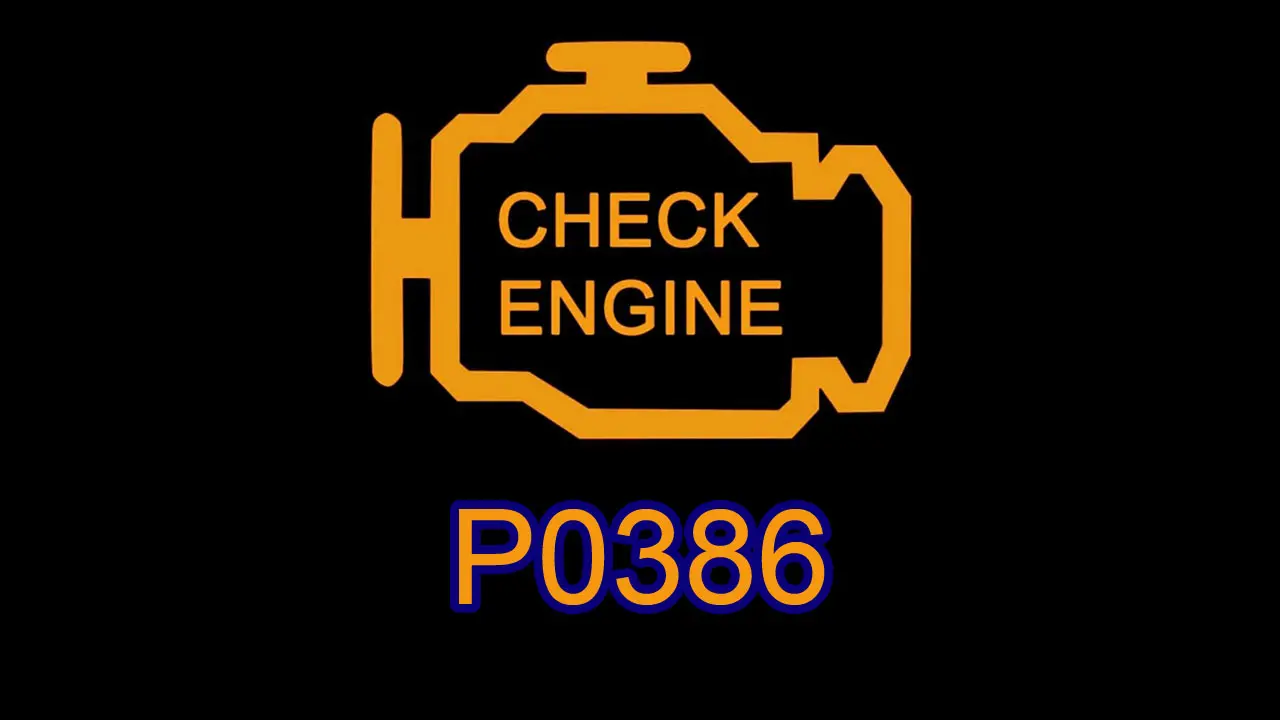
P0386 Crankshaft Position Sensor "B" Circuit Range/Performance
P0386 is an OBD-II diagnostic trouble code indicating that the engine control module (ECM/PCM) has detected a problem with the range or performance of the Crankshaft Position Sensor “B” circuit.
Unlike a “circuit high” or “circuit low” code, P0386 does not necessarily mean that the sensor signal is simply too high or too low electrically. The signal may be present, but the ECM considers its frequency, timing, waveform, consistency, or relationship to engine operation to be outside the expected range.
This makes P0386 particularly interesting diagnostically because the sensor can appear to be functioning during a basic voltage test while still producing a signal that the ECM considers implausible.
What Does Crankshaft Position Sensor “B” Do?
The crankshaft position sensor provides the ECM with information about the crankshaft's position and rotational speed.
The ECM uses this information for:
-
Engine RPM calculation
-
Ignition timing
-
Fuel injection timing
-
Engine synchronization
-
Misfire detection
-
Variable valve timing strategies
-
Starting and cranking control
The crankshaft signal is one of the most important inputs in engine management. If the ECM cannot accurately determine crankshaft position, it cannot reliably coordinate ignition and fuel injection.
The exact meaning of Sensor “B” is manufacturer-specific. Not every engine uses the same crankshaft sensing architecture, so the correct sensor must be identified from the vehicle's service information rather than assuming that every P0386 application uses an identical component.
What Does “Range/Performance” Mean?
This is the key to understanding P0386.
The ECM is receiving a crankshaft-related signal, but something about that signal does not behave as expected.
For example, the signal could have:
-
An abnormal waveform
-
Incorrect pulse spacing
-
Missing or inconsistent pulses
-
An unexpected frequency
-
Signal instability at certain RPMs
-
Incorrect amplitude
-
An abnormal relationship to the camshaft signal
-
A problem that appears only during starting, acceleration, or high engine speed
In other words, P0386 does not necessarily mean “no signal.”
The ECM may be seeing a signal but determining that it does not accurately represent what the crankshaft should be doing.
Common Causes of P0386
A number of different problems can produce this code.
Failing crankshaft position sensor
The sensor may work normally at one temperature or RPM and become unreliable under different conditions.
Heat-related sensor failures are particularly difficult because the vehicle may pass a cold test but develop the fault after the engine reaches operating temperature.
Damaged or contaminated reluctor
The crankshaft position sensor reads a reluctor, tone wheel, trigger wheel, or similar target.
If the target is damaged, bent, contaminated, incorrectly installed, or physically displaced, the sensor may generate an abnormal signal.
Incorrect sensor air gap
The distance between the sensor and the reluctor is important on many systems.
An excessive or inconsistent gap can weaken or distort the signal.
Damaged wiring
The harness can be damaged by:
-
Engine movement
-
Vibration
-
Heat
-
Oil contamination
-
Chafing
-
Previous repairs
An intermittent wiring fault can change with engine movement, making P0386 difficult to reproduce.
Poor connector contact
Loose terminals, corrosion, water intrusion, or poor terminal tension can create a signal problem without an obvious visual indication.
Electrical interference
A crankshaft signal is particularly sensitive to electrical noise on some systems. Poor shielding, damaged wiring, incorrect routing, or interference from another electrical component can distort the signal.
Sensor power or ground problem
On active sensor systems, an unstable supply voltage or poor ground can affect signal quality.
Mechanical timing problem
A stretched timing chain, incorrect timing installation, damaged timing components, or another mechanical problem can alter the relationship between crankshaft and camshaft signals.
However, P0386 alone does not prove that the timing chain is defective.
VVT problem
On engines using variable valve timing, incorrect camshaft positioning can create synchronization or performance problems that may appear alongside crankshaft-related codes.
Again, the presence of P0386 does not automatically mean the VVT system is responsible.
Symptoms You May Experience
The symptoms depend on how severe the signal problem is.
Possible symptoms include:
-
Check Engine Light
-
Difficult starting
-
Extended cranking
-
Intermittent no-start
-
Engine stalling
-
Rough idle
-
Hesitation
-
Poor acceleration
-
Misfires
-
Unstable RPM readings
-
Reduced engine performance
-
Increased fuel consumption
In some cases, the vehicle may appear to drive normally even though P0386 is stored.
This can happen when the signal remains usable most of the time and only becomes implausible under particular conditions, such as high engine temperature or high RPM.
How P0386 Should Be Diagnosed
The best diagnosis begins by finding out when the ECM decided the crankshaft signal was outside its expected range.
Scan all modules and check for additional codes involving:
-
Camshaft position
-
Crankshaft position
-
Cam/crank correlation
-
VVT
-
Engine synchronization
-
Misfire
-
Low system voltage
Freeze-frame information can also be valuable.
For example, if P0386 consistently appears at 4,000 RPM, that points the diagnosis in a different direction than a fault that appears only during hot starting.
Inspect the Sensor and Wiring
Before replacing anything, inspect the crankshaft sensor and its wiring.
Look for:
-
Oil contamination
-
Metal particles on the sensor where applicable
-
Damaged connector
-
Corroded terminals
-
Loose terminals
-
Broken insulation
-
Harness rubbing
-
Heat damage
-
Previous wiring repairs
A wiggle test can sometimes reproduce an intermittent problem while monitoring the crankshaft signal or scan-tool data.
However, simply seeing the engine continue to run while moving the harness does not completely eliminate a wiring fault. Some faults occur only at a particular temperature, vibration level, or engine speed.
Check the Actual Signal
A basic multimeter test may not be sufficient for P0386.
Because this is a range/performance code, the shape and timing of the signal can be more important than simply confirming that voltage exists.
An oscilloscope can reveal:
-
Missing pulses
-
Irregular pulse spacing
-
Distorted waveform
-
Excessive electrical noise
-
Weak signal
-
Incorrect amplitude
-
Signal dropouts
-
Abnormal behavior at higher RPM
This can be especially useful when the sensor passes a static resistance or voltage test but the fault continues to return.
Hall-Effect and Variable-Reluctance Sensors
The correct testing method depends on the sensor design.
A Hall-effect crankshaft sensor normally uses an electrical supply and produces a digital switching signal.
A variable-reluctance sensor generates an AC signal as the reluctor passes the sensor.
These two systems behave differently, so there is no universal resistance or voltage value that proves a crankshaft sensor is good or bad.
Testing should follow the manufacturer's specifications for that particular engine.
Could the Sensor Be Bad Even If It Tests Normally?
Yes.
This is one of the reasons P0386 can be frustrating.
A sensor may pass a resistance or static voltage test but fail when:
-
The engine becomes hot
-
RPM increases
-
Engine vibration increases
-
The sensor is exposed to oil or contamination
-
The reluctor reaches a particular position
An oscilloscope or suitable live-data monitoring may reveal a problem that a stationary multimeter test cannot.
Could the Reluctor Cause P0386?
Yes, and it should not be overlooked.
The crankshaft position sensor does not measure the crankshaft directly. It reads a physical target attached to or associated with the crankshaft.
If that target has:
-
A damaged tooth
-
A missing or incorrectly positioned section
-
Excessive runout
-
Mechanical damage
-
Incorrect installation
-
Contamination
the resulting signal can be outside the ECM's expected pattern.
This can produce a range/performance problem even though the electrical wiring and sensor itself are healthy.
Could a Timing Chain Cause P0386?
A mechanical timing problem can contribute to crankshaft/camshaft synchronization faults, but P0386 alone is not sufficient evidence to condemn the timing chain.
If the vehicle also has camshaft correlation codes or the oscilloscope shows an incorrect relationship between the crankshaft and camshaft signals, mechanical timing becomes much more suspicious.
The important diagnostic distinction is:
A bad electrical signal points toward the sensor, wiring, connector, power/ground, or trigger system.
A good electrical signal with incorrect mechanical synchronization points toward timing components, VVT, or another mechanical issue.
P0386 vs P0388
These two codes are easy to confuse because they both involve Crankshaft Position Sensor “B.”
P0386 – Range/Performance
The ECM is receiving a signal but considers its behavior, timing, waveform, or relationship to engine operation abnormal.
P0388 – Circuit High Input
The ECM is detecting an electrical input that is higher than the expected range.
Therefore, P0386 generally requires more attention to signal quality and plausibility, while P0388 puts greater emphasis on an electrical high-input condition.
P0386 vs P0387
P0387 indicates a low input condition from Crankshaft Position Sensor B, whereas P0386 indicates a range/performance problem.
With P0387, the diagnostic process may focus more directly on why the signal voltage is abnormally low.
With P0386, the signal can be electrically present yet still fail the ECM's expected performance criteria.
Is P0386 Always Caused by the Crankshaft Sensor?
No.
Replacing the sensor immediately is one of the easiest mistakes to make with this code.
If the real problem is a damaged reluctor, poor connector contact, excessive sensor clearance, wiring interference, mechanical timing, or a VVT-related synchronization problem, a new sensor may change nothing.
The correct approach is to determine why the ECM considers the crankshaft signal implausible.
Repairing P0386
The appropriate repair depends on the test results.
Possible repairs include:
-
Replacing a proven faulty crankshaft position sensor
-
Repairing damaged wiring
-
Repairing connector terminals
-
Restoring sensor power or ground
-
Correcting sensor installation or air gap
-
Repairing a damaged reluctor or trigger wheel
-
Correcting mechanical timing
-
Repairing a VVT-related problem
-
Addressing electrical interference
-
Diagnosing the ECM only after the external circuit has been verified
After the repair, the code should be cleared and the vehicle tested under the conditions that originally triggered the fault.
Final Diagnostic Point
P0386 means the ECM has detected a range or performance problem with the Crankshaft Position Sensor “B” circuit.
The signal does not necessarily have to disappear completely. It may be present but have an abnormal waveform, timing, frequency, amplitude, or relationship to the engine's actual position.
For that reason, P0386 is best diagnosed by looking at the entire signal path—sensor, wiring, connector, trigger target, power and ground, and mechanical synchronization—rather than simply installing a new crankshaft position sensor.