TR
TR EN
EN

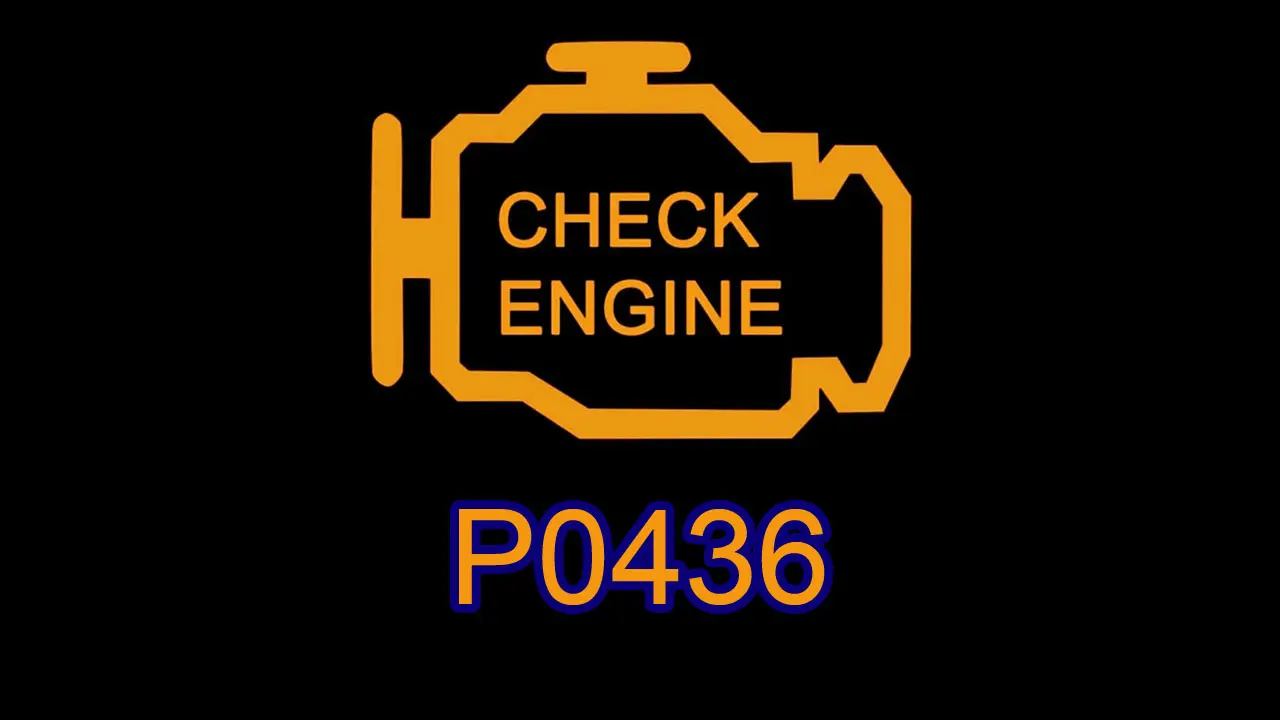
P0436 Catalyst Temperature Sensor Circuit Range/Performance (Bank 2, Sensor 1)
P0436 means the engine control module (ECM/PCM) has detected that the catalyst temperature sensor signal on Bank 2, Sensor 1 is outside the expected range or is not behaving as expected.
This is a range/performance code, which makes it different from a simple circuit-high or circuit-low fault.
The sensor may still be producing a valid electrical signal. The problem is that the ECM does not consider the reported temperature or the way that temperature changes over time to be plausible.
This distinction is important because P0436 does not automatically mean that the catalyst temperature sensor has failed.
The fault can be caused by the sensor itself, wiring, connector problems, an incorrect sensor, a physical exhaust-temperature problem, or another engine condition that makes the temperature behavior inconsistent with what the ECM expects.
What Does Bank 2, Sensor 1 Mean?
Bank 2 generally identifies the cylinder bank that does not contain cylinder #1 on an engine with multiple cylinder banks.
Sensor 1 generally refers to the sensor positioned upstream of the main catalyst monitoring point.
However, the exact location and terminology can vary by manufacturer.
Some vehicles have multiple catalysts and multiple temperature sensors, so the physical location of Bank 2 Sensor 1 should always be confirmed using the vehicle's service information.
What Does “Range/Performance” Mean?
The phrase Range/Performance is particularly important in P0436.
It generally means the ECM can see a sensor signal, but the signal is not behaving in a way that makes sense for the current operating conditions.
For example, the sensor may:
-
Report a temperature that is implausible
-
Change too slowly
-
Change too quickly
-
Remain almost fixed
-
React incorrectly to engine load
-
Disagree significantly with another relevant temperature sensor
-
Show a temperature that does not correspond to the engine's operating condition
This is different from a circuit-high code such as P0438.
With P0438, the ECM is primarily concerned that the electrical signal is too high.
With P0436, the signal may be electrically present and within a general voltage range, but its value or behavior does not make sense.
Does P0436 Mean the Catalyst Is Too Hot?
No.
P0436 does not automatically mean excessive catalytic-converter temperature.
The ECM could be seeing an implausible sensor signal even though the actual catalyst temperature is normal.
For example, a temperature sensor may have developed an internal drift problem. Its signal may remain within the expected electrical range but report a temperature that does not correspond correctly to actual exhaust conditions.
Likewise, excessive resistance in a connector or wiring connection can alter the sensor signal enough to produce a plausibility problem.
Only after the sensor circuit has been verified should you conclude that the exhaust system itself is producing abnormal temperatures.
How Catalyst Temperature Monitoring Works
Catalyst temperature is important because the catalytic converter must operate within a suitable temperature range.
The ECM can use temperature information to monitor and manage:
-
Catalyst warm-up
-
Emissions control
-
Catalyst protection
-
Fuel strategy
-
Exhaust-system temperature
-
Catalyst efficiency monitoring
-
Regeneration strategies on certain diesel applications
The exact strategy depends on the engine and emissions system.
A catalyst temperature sensor can therefore provide important information even though it does not directly control fuel injection or ignition.
Common Causes of P0436
Catalyst temperature sensor deterioration
A sensor can develop an incorrect temperature response without completely losing its electrical signal.
This is a classic situation where a range/performance code can appear even though the sensor is not electrically open or shorted.
Incorrect sensor
A replacement sensor with the wrong electrical characteristics can physically fit while producing an incorrect temperature signal.
This is especially important when aftermarket components have been installed.
Wiring resistance
A damaged wire may not be completely open.
Instead, corrosion, internal conductor damage or a poor connection can introduce additional resistance into the circuit.
The circuit can therefore appear electrically functional while the reported temperature is inaccurate.
Loose or corroded connector
A connector with poor terminal tension or corrosion can alter the sensor signal intermittently or continuously.
Heat-damaged wiring
Temperature sensors are located close to extremely hot exhaust components.
Harness insulation can melt, harden, crack or become brittle.
Previous exhaust repairs can also leave wiring routed too close to the exhaust.
Poor sensor ground or reference
Depending on the sensor design, abnormal reference or ground conditions can affect the reported temperature.
Actual abnormal exhaust temperature
The sensor may be working correctly while the engine is genuinely producing unusual exhaust temperatures.
Possible causes include:
-
Misfire
-
Rich mixture
-
Excessive unburned fuel
-
Injector problems
-
Ignition faults
-
Fuel-control problems
-
Incorrect engine timing
-
Exhaust restriction
-
Turbocharger-related problems
-
Other emissions-control faults
Why Misfires Matter
A misfire is particularly important when investigating catalyst temperature.
If fuel enters the exhaust without being properly burned inside the cylinder, combustion can occur in the exhaust system or catalytic converter.
This can cause extremely high catalyst temperatures.
Therefore, if P0436 appears together with misfire codes, the misfire should not be ignored.
The temperature sensor may simply be accurately reporting an abnormal physical condition.
In that situation, replacing the temperature sensor would not solve the underlying problem.
Symptoms of P0436
The symptoms depend on the reason the sensor signal is considered implausible.
Possible symptoms include:
-
Check Engine Light
-
Poor fuel economy
-
Reduced engine performance
-
Increased emissions
-
Catalyst protection strategies
-
Abnormal exhaust behavior
-
Limp mode on some vehicles
-
DPF/regeneration problems on certain diesel applications
However, it is also possible to have no noticeable drivability symptoms.
If the ECM only detects the problem during a specific emissions monitor, the driver may notice nothing except the Check Engine Light.
Diagnosing P0436 Correctly
P0436 should be approached as a plausibility and performance problem, rather than immediately assuming that the sensor has failed.
Start with a complete scan
Check for all stored and pending codes.
Look particularly for:
-
Misfire codes
-
Fuel-trim codes
-
Oxygen-sensor codes
-
Catalyst-related codes
-
Other exhaust-temperature codes
-
Injector or ignition faults
-
Turbocharger-related codes
Another code may explain why the catalyst temperature behavior has become abnormal.
Check the freeze-frame data
Record the conditions under which P0436 was detected.
Pay attention to:
-
Engine coolant temperature
-
Engine RPM
-
Engine load
-
Vehicle speed
-
Fuel-system status
-
Other available temperature readings
This can help determine whether the problem occurs during cold start, acceleration, cruising, high load or another specific operating condition.
Check the Sensor Reading With a Cold Engine
This is one of the most useful tests.
If the vehicle has been sitting long enough for the exhaust system to cool to ambient temperature, the catalyst temperature reading should be physically plausible.
It should not immediately show an extreme temperature that makes no sense for a cold engine.
An implausible cold-start reading points toward:
-
Sensor drift or failure
-
Wiring resistance
-
Connector problems
-
Incorrect sensor
-
Reference/ground problems
-
Circuit-related issues
A normal cold-start reading does not completely eliminate the sensor, but it gives you a useful baseline.
Watch How the Temperature Changes
A range/performance fault is often revealed by how the sensor behaves, not just by one voltage measurement.
Monitor the catalyst temperature sensor with a scan tool while:
-
The engine warms up
-
RPM changes
-
Engine load changes
-
The vehicle accelerates
-
Exhaust temperature increases
The reading should respond in a manner consistent with the vehicle's operating conditions.
A sensor that remains frozen at one value or responds in an obviously implausible way deserves further testing.
Compare Bank 2 With Bank 1
If the engine has comparable temperature sensors on both banks, comparing their behavior can provide valuable information.
However, the two banks should not be expected to have exactly identical temperatures under every condition.
Instead, look for obvious inconsistencies.
For example, if both banks are operating under similar load but Bank 1 temperature responds normally while Bank 2 Sensor 1 remains fixed or behaves completely differently, the Bank 2 sensor circuit becomes a strong suspect.
Test the Electrical Circuit
Once the live-data behavior is understood, test the sensor circuit according to the manufacturer's wiring diagram.
Depending on the sensor architecture, this may include:
-
Reference voltage
-
Ground
-
Signal voltage
-
Resistance
-
Continuity
-
Short to ground
-
Short to voltage
-
Voltage drop
-
Connector terminal condition
There is no universal catalyst-temperature-sensor resistance value.
The correct test procedure depends on the sensor technology and the manufacturer's specifications.
Inspect the Wiring Near the Exhaust
This deserves special attention.
Look for:
-
Melted insulation
-
Brittle wiring
-
Chafing
-
Broken conductors
-
Exhaust contact
-
Incorrect harness routing
-
Corroded connectors
-
Previous repair work
-
Loose terminals
A wire can be damaged internally while looking acceptable from the outside.
This is why a simple visual inspection is not always sufficient.
Check for a Genuine Exhaust Temperature Problem
If the sensor and its electrical circuit test correctly, the next question is whether the engine is actually producing abnormal exhaust temperatures.
Investigate:
-
Misfires
-
Fuel mixture
-
Injector operation
-
Ignition system
-
Fuel pressure
-
Air-fuel control
-
Engine timing
-
Exhaust restriction
-
Turbocharger operation
If the sensor accurately reports a temperature that is genuinely abnormal, the sensor itself may be completely innocent.
Can a Bad Catalytic Converter Cause P0436?
It can be related, but P0436 does not prove that the catalytic converter is defective.
A damaged or restricted catalyst can alter exhaust conditions and temperature.
However, a sensor problem, wiring problem, engine misfire, fuel-control problem or another exhaust fault can produce the same diagnostic code.
Replacing the catalytic converter solely because P0436 is stored is therefore not justified.
Can an Oxygen Sensor Cause P0436?
The oxygen sensor and catalyst temperature sensor are separate components, but they are part of the same emissions-control system.
An oxygen-sensor problem can influence fuel control.
If fuel mixture becomes excessively rich or combustion becomes abnormal, exhaust temperature can change.
Therefore, oxygen-sensor and fuel-trim codes should be considered if they are present.
But a normal oxygen-sensor system does not rule out a catalyst temperature sensor problem.
Can an Exhaust Leak Cause P0436?
An exhaust leak can influence exhaust-system measurements and emissions behavior.
However, an exhaust leak does not automatically explain a range/performance fault in the catalyst temperature sensor.
The sensor circuit should still be tested directly.
If the sensor's electrical characteristics are incorrect, fixing an exhaust leak alone will not necessarily resolve P0436.
P0436 vs P0438
These codes are closely related but describe different diagnostic situations.
P0436 – Range/Performance
The ECM sees a temperature signal but considers its value or behavior implausible.
P0438 – Circuit High
The ECM detects an electrically high signal from the catalyst temperature sensor circuit.
This distinction matters during diagnosis.
P0438 generally pushes the investigation toward the sensor circuit, signal voltage, open-circuit conditions and shorts to voltage.
P0436 requires a broader investigation into both electrical plausibility and actual temperature behavior.
Can P0436 Cause Limp Mode?
It can, depending on the vehicle.
If catalyst temperature information is considered important for emissions protection or exhaust-system management, the ECM may modify engine operation when the signal becomes implausible.
Possible responses include:
-
Reduced engine torque
-
Modified fuel strategy
-
Disabled emissions functions
-
Reduced regeneration capability
-
Limp-home operation
Other vehicles may simply illuminate the Check Engine Light.
P0436 on Diesel Engines
On some diesel engines, exhaust temperature information is closely connected with DPF regeneration and exhaust-temperature management.
An incorrect catalyst temperature signal can interfere with the ECM's ability to determine whether regeneration conditions are suitable.
However, P0436 should not automatically be diagnosed as a DPF fault.
The actual function of Bank 2 Sensor 1 depends on the vehicle's exhaust architecture.
What Should Be Replaced for P0436?
There is no single part that should automatically be replaced.
Depending on the diagnosis, the repair may involve:
-
Catalyst temperature sensor
-
Wiring repair
-
Connector or terminal repair
-
Harness repair
-
Incorrectly installed sensor
-
Repair of an exhaust problem
-
Fuel-system repair
-
Ignition-system repair
-
Injector repair
-
Exhaust restriction repair
-
Another underlying engine problem
The catalytic converter should not be replaced simply because P0436 is stored.
Final Diagnostic Summary
P0436 means the ECM/PCM has detected an implausible range or performance from the Catalyst Temperature Sensor circuit on Bank 2, Sensor 1.
The sensor may still be producing an electrical signal. The problem is that the ECM does not believe the signal's value or behavior matches the operating conditions.
The correct diagnostic path is to:
-
Confirm the exact Bank 2 Sensor 1 location
-
Scan all modules and check related codes
-
Examine freeze-frame data
-
Check the sensor reading with the engine cold
-
Monitor temperature behavior during warm-up and load changes
-
Compare with other relevant temperature sensors
-
Inspect heat-damaged wiring and connectors
-
Test the sensor circuit according to the manufacturer's specifications
-
Investigate genuine excessive exhaust temperature if the sensor and circuit are healthy
The key difference from P0438 is that P0436 is not simply saying “the electrical signal is too high.” It is saying that the sensor's reported temperature or its response is not behaving within the expected range or performance pattern.
That is why P0436 should be diagnosed by looking at sensor behavior, electrical integrity, and actual engine/exhaust conditions together, rather than replacing the temperature sensor or catalytic converter based on the code alone.