TR
TR EN
EN

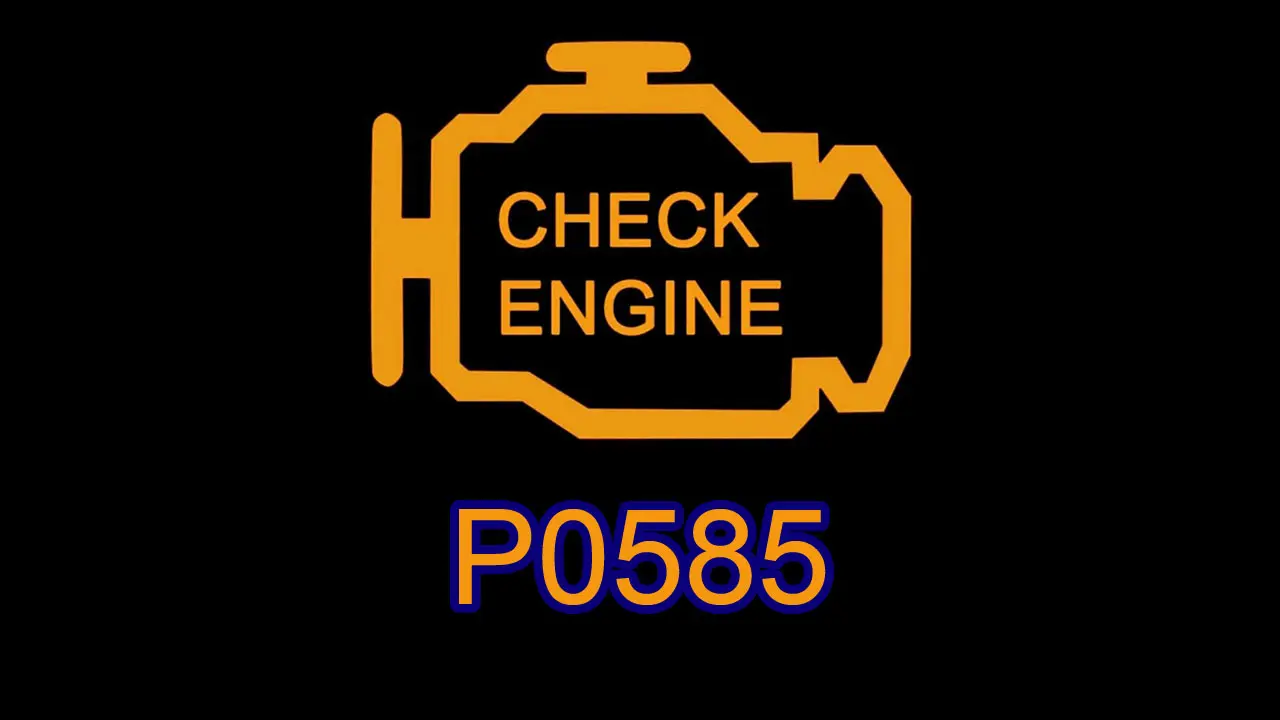
P0585 Cruise Control Multi-Function Input A/B Correlation
P0585 is an OBD-II diagnostic trouble code indicating a correlation problem between the Cruise Control Multi-Function Input "A" and Input "B" circuits.
In simple terms, the vehicle's control module receives signals from two cruise-control input circuits, but the signals do not agree with each other in the way the control module expects.
This is different from a simple "circuit low" or "circuit high" fault. The problem here is primarily about whether two related input signals make sense together.
For example, if the driver presses a particular cruise-control button, the control module expects Input A and Input B to produce a specific combination of electrical signals. If one circuit indicates one command while the other indicates an incompatible command, P0585 may be stored.
What Does P0585 Mean?
The code can be broken down as follows:
-
P – Powertrain-related diagnostic trouble code
-
05 – Cruise-control and related speed-control functions
-
85 – Specific fault identifier
-
Cruise Control Multi-Function Input A/B – Two input circuits associated with the cruise-control multifunction controls
-
Correlation – The control module detects that the two signals do not correspond as expected
The word "correlation" is the most important part of this DTC.
The control module is not simply asking whether Input A works or whether Input B works. It is comparing the two inputs and checking whether their relationship is plausible.
How Does Cruise Control Multi-Function Input A/B Work?
Cruise-control systems can have several driver-operated functions, including:
-
ON/OFF
-
SET
-
SET-
-
RESUME
-
RES+
-
CANCEL
-
COAST
-
ACCEL
-
Speed limiter functions on some vehicles
Depending on the vehicle, these controls may use two separate input circuits.
The control module monitors the signals from these circuits and determines which button or command the driver has selected.
Some systems use:
-
Separate switch circuits
-
Resistor-based switch networks
-
Voltage-divider circuits
-
Steering-wheel control modules
-
Body-control modules
-
Digital communication networks
The exact architecture varies significantly between manufacturers.
What Does "A/B Correlation" Mean?
Imagine that the control module expects two signals to work together.
Under normal conditions:
Input A = expected state
Input B = corresponding state
The module knows that this particular combination represents a valid cruise-control command.
If the vehicle instead produces:
Input A = SET
Input B = an impossible or conflicting state
the module can determine that the two signals do not correlate.
This can trigger P0585.
The problem therefore does not necessarily mean that either circuit is completely dead.
One circuit can be functioning, while the other is producing the wrong signal.
Common Causes of P0585
There are several possible causes.
1. Faulty cruise-control multifunction switch
The switch assembly can develop worn, contaminated or damaged contacts.
Because multiple buttons may be integrated into one switch assembly, a single internal fault can affect the relationship between Inputs A and B.
2. Damaged wiring
A damaged wire can alter one of the input signals.
Possible problems include:
-
Broken wire
-
Partially broken wire
-
Chafed insulation
-
Short to ground
-
Short to voltage
-
High resistance
3. Faulty clock spring
If the cruise-control buttons are mounted on the steering wheel, the signals usually have to pass through the clock spring.
A damaged clock spring can interfere with one or more steering-wheel control circuits.
4. Loose connector
A connector that is not fully seated can cause intermittent or unstable input signals.
5. Corroded terminals
Corrosion can increase resistance or cause poor electrical contact.
This can change the voltage seen by the control module.
6. Faulty resistor network
Some multifunction switch systems use different resistance values to identify button presses.
If a resistor inside the switch fails, the module may interpret the combination of Input A and Input B incorrectly.
7. Reference-voltage problem
If one or both input circuits depend on a reference voltage, an abnormal reference supply can cause incorrect signal interpretation.
8. Ground problem
A poor ground can affect one or more switch circuits and cause unexpected voltage readings.
9. Steering-wheel control module problem
Some vehicles use a dedicated steering-wheel or body-control module to interpret button signals.
A fault in that module can produce a correlation problem.
10. Communication problem
On newer vehicles, steering-wheel controls may communicate digitally with another module.
A communication problem can therefore produce symptoms that appear to be a switch-circuit problem.
11. Aftermarket electrical modifications
Incorrectly installed:
-
Cruise-control systems
-
Steering wheels
-
Multimedia systems
-
Steering-wheel adapters
-
Alarm systems
-
Remote-start systems
can interfere with the factory input circuits.
12. Control-module fault
The PCM, ECM, BCM or another control module could theoretically misinterpret the signals.
However, a module should not be condemned until the external circuits have been properly tested.
Symptoms of P0585
The most obvious symptom is usually a problem with cruise control.
Possible symptoms include:
-
Cruise control does not work
-
Cruise control cannot be activated
-
SET function does not work
-
RESUME function does not work
-
CANCEL does not operate correctly
-
Cruise control works intermittently
-
Some steering-wheel buttons do not work
-
Cruise-control indicator does not illuminate
-
Speed limiter functions incorrectly
-
Check Engine Light comes on
The engine may otherwise operate completely normally.
Can P0585 Disable Cruise Control?
Yes.
The control module must be able to distinguish the driver's commands reliably.
If Inputs A and B disagree, the module may disable cruise control.
This is a safety strategy.
The system should not continue controlling vehicle speed if it cannot reliably determine the driver's input.
Can P0585 Affect Engine Performance?
Usually, P0585 does not directly indicate an engine mechanical problem.
You would not normally expect it to cause:
-
Engine misfire
-
Low engine oil pressure
-
Overheating
-
Fuel-pressure problems
-
Mechanical engine damage
The most common consequence is the loss of cruise-control functionality.
However, other DTCs stored at the same time should always be checked because they may point to a broader electrical or communication problem.
Is P0585 Serious?
P0585 is generally a moderate electrical fault.
It is usually not an immediate threat to the engine.
However, cruise control is a driver-assistance function, and reliable command and disengagement are important.
Until the problem is repaired, the safest approach is to avoid relying on cruise control.
Can You Drive With P0585?
In many cases, yes.
If the vehicle:
-
Starts normally
-
Drives normally
-
Brakes normally
-
Steers normally
-
Has no serious warning lights
it can often be driven without using cruise control.
However, additional symptoms should be taken seriously.
If P0585 occurs together with:
-
Airbag warning light
-
Horn failure
-
Multiple steering-wheel controls failing
-
ABS/ESC warnings
-
Communication faults
-
Major electrical problems
the vehicle should be diagnosed promptly.
How to Diagnose P0585
A good diagnosis should concentrate on comparing the two input circuits.
1. Scan all modules
Start by checking all stored and pending DTCs.
Look for:
-
P0585
-
Other cruise-control codes
-
Steering-wheel control codes
-
Communication codes
-
Voltage-related codes
-
Body-control module codes
If several codes appear together, they may reveal the common cause.
2. Test all cruise-control buttons
Check every available function:
-
ON/OFF
-
SET
-
RES
-
CANCEL
-
ACCEL
-
COAST
Note exactly which buttons work and which do not.
A single malfunctioning button can provide an important clue.
3. Check the steering-wheel controls
Test other controls mounted on the steering wheel.
If the horn, audio controls and cruise buttons are all affected, inspect the clock spring and steering-wheel wiring.
4. Inspect the connectors
Check for:
-
Corrosion
-
Bent pins
-
Loose terminals
-
Water intrusion
-
Broken locks
-
Damaged wires
5. Inspect the wiring
Follow both Input A and Input B circuits using the vehicle's wiring diagram.
Check for:
-
Open circuits
-
Shorts
-
High resistance
-
Chafing
-
Pinched wiring
-
Previous repairs
Do not assume that visually intact wiring is electrically perfect.
Compare Input A and Input B
This is the most important part of diagnosing P0585.
If the scan tool provides live data for the cruise-control multifunction inputs, observe both signals while operating the buttons.
The goal is to determine whether:
Input A changes correctly but Input B does not
or:
Input B changes correctly but Input A does not
or:
Both inputs change, but their combination is incorrect
This information can dramatically narrow the diagnosis.
For example, if Input A behaves perfectly while Input B remains fixed, Input B's wiring or switch circuit becomes more suspicious.
If both signals change but the control module reports an invalid combination, the switch or resistor network may be producing the wrong relationship.
Testing a Resistor-Based Cruise-Control Switch
Some vehicles identify different buttons by using different resistance values.
A simplified example might look like this:
-
No button pressed → high reference value
-
SET → resistance value A
-
RESUME → resistance value B
-
CANCEL → resistance value C
A second circuit may provide another corresponding signal.
The module compares the two circuits.
If one resistor changes value because of an internal switch fault, the resulting combination may no longer match any valid command.
This can trigger P0585.
The actual resistance values are vehicle-specific and must be obtained from the manufacturer's service information.
Testing With a Multimeter
A multimeter can be useful for checking:
-
Reference voltage
-
Signal voltage
-
Ground
-
Resistance
-
Continuity
-
Voltage drop
The technician should test both circuits according to the vehicle's wiring diagram.
It is particularly important not to disconnect or probe airbag-related circuits incorrectly while working around the steering wheel.
Why the Clock Spring Matters
The clock spring is a common area of interest when steering-wheel-mounted controls malfunction.
The steering wheel rotates while the vehicle's main wiring remains stationary.
The clock spring maintains electrical connections between the two.
If part of the clock spring fails, some functions may stop working while others continue to operate.
For example:
-
Cruise buttons fail
-
Horn still works
or:
-
Cruise buttons work intermittently
-
Horn also becomes intermittent
The exact combination depends on the internal circuit arrangement.
P0585 and Airbag Problems
P0585 itself does not mean that the airbag is faulty.
However, the cruise-control buttons and airbag system may physically share the steering-wheel/clock-spring assembly.
If P0585 appears together with an airbag warning light, the steering-wheel wiring and clock spring should be investigated carefully.
The airbag system requires proper safety procedures when diagnosing or removing components.
P0585 and Aftermarket Steering Wheels
An aftermarket steering wheel or incorrectly installed steering-wheel controls can cause P0585.
The same is true for aftermarket cruise-control installations.
If the code appeared after:
-
Steering-wheel replacement
-
Cruise-control retrofit
-
Audio-system installation
-
Steering-wheel control adapter installation
the modified wiring should be checked before replacing factory components.
P0585 vs P0584
These codes are related to cruise-control multifunction inputs but represent different problems.
P0584 – Cruise Control Multi-Function Input "A" Circuit High
This indicates that the control module detects a high electrical condition on the designated Input A circuit.
P0585 – Cruise Control Multi-Function Input A/B Correlation
This indicates that the relationship between the two input circuits is incorrect.
Therefore, P0585 is not simply an "Input A high" fault. It is a comparison or plausibility problem between two inputs.
P0585 vs P0586
P0585 concerns the correlation between Cruise Control Multi-Function Inputs A and B.
P0586 concerns the Cruise Control Vent Control Circuit/Open.
These are different circuits.
P0585 points toward the multifunction input system, while P0586 concerns the circuit controlling the cruise-control vent function.
P0585 vs P0589
P0585 – Cruise Control Multi-Function Input A/B Correlation
The module detects that Inputs A and B do not correspond as expected.
P0589 – Cruise Control Multi-Function Input "B" Circuit
This is a more general fault associated with the designated Input B circuit.
If both codes are present, Input B deserves particular attention because an abnormal B signal could be the reason the A/B combination fails its correlation check.
Related Cruise-Control Codes
Other codes that may appear in the same diagnostic area include:
-
P0564 – Cruise Control Multi-Function Input "A" Circuit
-
P0565 – Cruise Control On Signal
-
P0566 – Cruise Control Off Signal
-
P0567 – Cruise Control Resume Signal
-
P0568 – Cruise Control Set Signal
-
P0569 – Cruise Control Coast Signal
-
P0570 – Cruise Control Accel Signal
-
P0571 – Brake Switch "A" Circuit
-
P0584 – Cruise Control Multi-Function Input "A" Circuit High
-
P0585 – Cruise Control Multi-Function Input A/B Correlation
-
P0586 – Cruise Control Vent Control Circuit/Open
-
P0587 – Cruise Control Vent Control Circuit Low
-
P0588 – Cruise Control Vent Control Circuit High
-
P0589 – Cruise Control Multi-Function Input "B" Circuit
-
P0590 – Cruise Control Multi-Function Input "B" Circuit
When several of these codes are stored together, it is important to determine whether they share a common wiring, power, ground or module problem.
Common Diagnostic Mistakes
One of the biggest mistakes is assuming that P0585 automatically means the cruise-control switch is defective.
The switch is only one possibility.
Other common mistakes include:
-
Replacing the switch without testing Input A and B
-
Ignoring the clock spring
-
Not checking connectors
-
Not checking reference voltage
-
Ignoring ground problems
-
Failing to inspect steering-wheel wiring
-
Not checking live data
-
Ignoring other stored DTCs
-
Replacing the control module too early
-
Using generic resistance values
-
Clearing the code without confirming the repair
The word "correlation" should encourage the technician to compare the two signals rather than testing only one circuit.
How Do You Fix P0585?
The correct repair depends on the cause.
Possible repairs include:
-
Replacing the faulty multifunction cruise-control switch
-
Repairing damaged wiring
-
Repairing or replacing electrical connectors
-
Repairing a poor ground
-
Correcting a reference-voltage problem
-
Replacing a damaged clock spring
-
Repairing a resistor network
-
Correcting aftermarket wiring
-
Repairing a steering-wheel control module
-
Repairing a communication problem
-
Reprogramming or replacing a control module when properly diagnosed
The correct component should be replaced only after the circuit has been tested.
Can You Clear P0585?
Yes.
A compatible OBD-II diagnostic scanner can normally clear the stored fault code.
However, clearing the code does not fix the underlying correlation problem.
If the two input signals remain inconsistent, the control module will detect the fault again.
After completing the repair:
-
Clear the DTC.
-
Check Input A and Input B live data.
-
Test every cruise-control button.
-
Verify the signals correspond correctly.
-
Test the cruise-control system.
-
Road-test the vehicle safely.
-
Scan the vehicle again.
-
Confirm that P0585 does not return.
Final Thoughts on P0585
P0585 – Cruise Control Multi-Function Input A/B Correlation indicates that the control module has detected an inconsistency between two cruise-control multifunction input signals.
The important word is "correlation." The problem is not necessarily that one circuit is completely open or shorted. Instead, the module is seeing a combination of signals that does not match the expected relationship.
The most important areas to investigate are the multifunction cruise-control switch, resistor network, steering-wheel wiring, clock spring, connectors, reference voltage and control modules.
If P0585 appears by itself and the vehicle drives normally, the main consequence is usually the loss of cruise-control functionality. A systematic comparison of Input A and Input B is the most effective way to locate the fault and avoid unnecessary replacement of expensive components.