TR
TR EN
EN

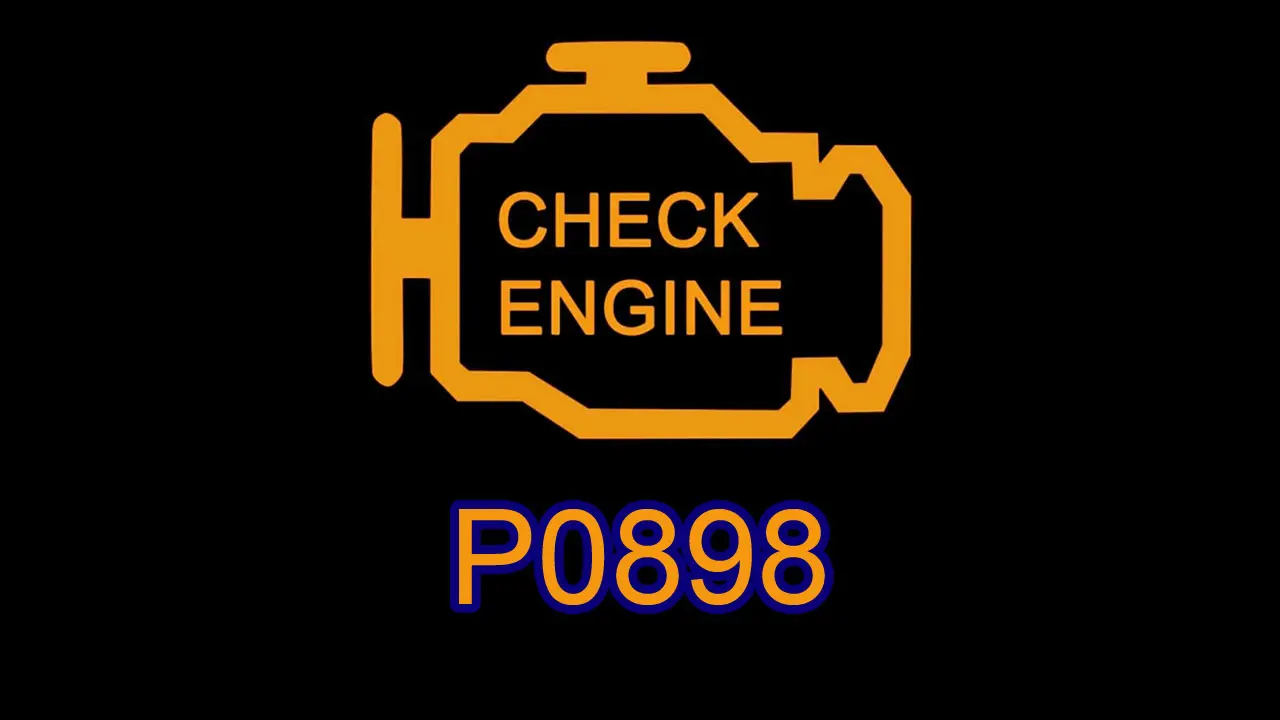
P0898 Transmission Control System MIL Request Circuit Low
The P0898 trouble code is an OBD-II diagnostic trouble code related to the transmission control system MIL request circuit.
P0898 – Transmission Control System MIL Request Circuit Low
This code means that the transmission control module (TCM) has detected a lower-than-expected voltage or signal in the circuit used to request the Malfunction Indicator Lamp (MIL).
The MIL is commonly known as the Check Engine Light. When the TCM detects a transmission-related fault that requires the warning lamp to be illuminated, it communicates this request to the engine control module (ECM/PCM) or another vehicle control module.
If the electrical signal associated with this request is lower than the expected value, the TCM may store P0898.
Possible causes include:
-
Short to ground
-
Damaged MIL request wiring
-
Open or high-resistance circuit
-
Faulty electrical connector
-
Corroded connector terminals
-
Loose connector pins
-
Poor TCM ground
-
Poor ECM/PCM ground
-
TCM fault
-
ECM/PCM fault
-
CAN communication problem
-
Low battery voltage
-
Charging-system problem
-
Incorrect module programming
-
Software fault
-
Previous wiring repair
The exact operation of the MIL request circuit varies between vehicle manufacturers. On many modern vehicles, this information may be transmitted through the CAN communication network rather than through a dedicated wire.
What Does P0898 Mean?
P0898 – Transmission Control System MIL Request Circuit Low
The transmission control module monitors the transmission and stores fault codes when it detects problems.
If a transmission fault requires the Check Engine Light to be switched on, the TCM sends an MIL request.
A simplified sequence is:
Transmission fault → TCM → MIL request → ECM/PCM → Check Engine Light
With P0898, the TCM has detected that the relevant MIL request signal is lower than the expected value.
This is primarily an electrical or communication-related code.
It does not automatically mean that there is internal mechanical damage inside the transmission.
What Does “Circuit Low” Mean?
The word “Low” refers to an electrical voltage or signal below the expected range.
It does not mean:
-
Low transmission fluid
-
Low transmission pressure
-
Low transmission temperature
-
Low engine RPM
-
Low gear
A possible electrical fault is:
MIL request circuit → Short to ground → Signal voltage drops → TCM detects low signal → P0898
However, a short to ground is not the only possible cause.
A poor connection, damaged wiring, module ground problem or communication fault can also result in an abnormal low signal.
What Is the MIL Request Circuit?
MIL stands for Malfunction Indicator Lamp.
The MIL is the warning light generally identified as the:
Check Engine Light
The TCM can request that the MIL be illuminated when it detects a transmission problem that meets the manufacturer's criteria.
Depending on the vehicle, this request can be transmitted through:
-
Dedicated electrical wiring
-
CAN bus communication
-
Other network communication
Older systems may use a dedicated MIL request circuit, while newer vehicles frequently use network communication between control modules.
Symptoms of P0898
P0898 may cause few noticeable symptoms if the transmission itself is functioning normally.
Possible symptoms include:
-
Check Engine Light
-
Transmission warning light
-
Transmission warning message
-
Stored transmission codes
-
Limp mode
-
Harsh shifting
-
Delayed gear changes
-
Incorrect gear indication
-
Reduced transmission performance
-
Multiple communication-related trouble codes
In some cases, the only visible symptom may be the Check Engine Light.
If other transmission codes are stored, those codes may identify the actual problem that caused the MIL request.
Common Causes of P0898
Short to ground
A wire associated with the MIL request circuit may contact ground.
This can pull the signal voltage below the expected level.
Damaged wiring
The wiring harness can become damaged because of:
-
Heat
-
Vibration
-
Chafing
-
Moisture
-
Corrosion
-
Previous repairs
High-resistance connection
A damaged wire or corroded terminal can cause an abnormal voltage condition.
Corroded connector
Moisture or corrosion can interfere with communication between the TCM and other modules.
Loose connector terminal
A terminal that does not make proper contact can produce an intermittent or low signal.
Poor TCM ground
A weak ground connection can affect the electrical signals generated or monitored by the TCM.
Poor ECM/PCM ground
The ECM/PCM may also be involved in processing the MIL request.
A poor ground can cause abnormal circuit behavior.
CAN communication fault
On modern vehicles, the MIL request may travel over the CAN network.
Problems with:
-
CAN High
-
CAN Low
-
CAN wiring
-
Network termination
-
Module power
-
Module ground
can produce communication-related faults.
Low battery voltage
Weak battery voltage can cause control modules to behave abnormally.
Charging-system problem
An alternator or voltage-regulation problem can cause unstable module operation.
TCM fault
The TCM may have an internal problem affecting the MIL request or its communication with other modules.
ECM/PCM fault
The engine control module may incorrectly interpret or process the MIL request.
Software or programming problem
Incorrect or corrupted software can cause abnormal communication or MIL-request behavior.
Is P0898 a Transmission Problem?
P0898 does not necessarily indicate an internal transmission problem.
It specifically concerns the MIL request from the transmission control system.
The TCM may have generated the MIL request because another transmission fault was detected.
For example:
Transmission sensor fault → TCM detects fault → TCM requests MIL → P0898
Therefore, other stored transmission codes are extremely important.
P0898 should not automatically lead to transmission replacement.
Is P0898 a Serious Code?
The seriousness of P0898 depends on the other faults present.
If P0898 is the only code and the vehicle drives normally, the problem may be limited to:
-
Wiring
-
Communication
-
Power or ground
-
Module software
-
MIL request circuitry
However, if P0898 is accompanied by serious transmission codes, harsh shifting, limp mode or loss of drive, the underlying problem may be more significant.
Can You Drive With P0898?
If the vehicle drives normally and P0898 is the only stored code, it may be possible to drive carefully to a repair facility.
However, the fault should still be diagnosed.
Avoid driving if you experience:
-
Severe shifting
-
Loss of gears
-
Transmission stuck in one gear
-
Transmission stuck in Neutral
-
Limp mode
-
Loss of drive
-
Unpredictable gear selection
In those situations, the underlying transmission problem should be addressed immediately.
P0898 vs. P0899
These codes represent opposite electrical conditions.
P0898 – Transmission Control System MIL Request Circuit Low
The TCM detects a lower-than-expected signal.
P0899 – Transmission Control System MIL Request Circuit High
The TCM detects a higher-than-expected signal.
In simple terms:
P0898 → MIL request circuit signal too low
P0899 → MIL request circuit signal too high
P0898 vs. P0897
P0897 – Transmission Fluid Deteriorated
This code concerns the condition of the transmission fluid.
P0898 – Transmission Control System MIL Request Circuit Low
This code concerns the electrical or communication path used by the transmission control system to request the MIL.
These are different fault categories.
How to Diagnose P0898
A proper diagnosis should first determine whether the vehicle uses a dedicated MIL request circuit or network communication.
1. Scan all control modules
Use a professional diagnostic scanner to check:
-
TCM
-
ECM/PCM
-
ABS module
-
Body control module
-
Other networked modules
Record all stored and pending codes.
Do not diagnose P0898 using the TCM alone.
2. Check for other transmission codes
Look for additional codes stored in the TCM.
If another transmission fault caused the MIL request, that problem should be diagnosed first.
3. Check freeze-frame data
Review:
-
Battery voltage
-
Engine RPM
-
Vehicle speed
-
Transmission temperature
-
Selected gear
-
Module communication status
This can help identify when the fault occurred.
4. Check battery and charging voltage
Verify:
-
Battery condition
-
Charging voltage
-
Main grounds
-
TCM power supply
-
ECM/PCM power supply
Low system voltage can cause multiple control-module problems.
5. Inspect TCM connectors
Check for:
-
Corrosion
-
Bent pins
-
Loose terminals
-
Moisture
-
Oil contamination
-
Damaged connector locks
6. Inspect the MIL request circuit
If the vehicle uses a dedicated circuit, inspect the wiring for:
-
Short to ground
-
Open circuit
-
High resistance
-
Damaged insulation
-
Incorrect previous repairs
7. Check ECM/PCM connections
Inspect the engine control module's connectors, power supply and grounds.
The ECM/PCM may receive and process the MIL request.
8. Check CAN communication
If the MIL request is transmitted through CAN communication, check:
-
CAN High
-
CAN Low
-
Short to ground
-
Short to power
-
Open CAN wiring
-
Network termination
-
Communication errors
An oscilloscope can be useful when diagnosing difficult CAN network faults.
9. Check module grounds
Verify the TCM and ECM/PCM ground circuits.
A poor ground can cause abnormal signal levels and communication errors.
10. Monitor live data
Use the diagnostic scanner to observe:
-
MIL request status
-
TCM communication
-
ECM/PCM communication
-
Network status
-
Transmission fault status
11. Check module programming
If the electrical circuits and communication network are correct, verify that the TCM and ECM/PCM have the correct software and calibration.
12. Evaluate the TCM
If the wiring, connectors, power, ground and communication network are all functioning correctly, the TCM may require further testing.
Why P0898 Can Be Misdiagnosed
P0898 can be misleading because it may be a secondary code.
For example:
Transmission pressure sensor fault → TCM detects fault → TCM requests MIL → P0898
Replacing the TCM in this situation would not solve the original problem.
Another possibility is:
CAN communication problem → TCM cannot communicate correctly → MIL request error → P0898
Therefore, all stored codes and communication faults should be analyzed together.
P0898 After Transmission Repair
If P0898 appears after transmission repair, inspect:
-
TCM connectors
-
Transmission wiring
-
CAN wiring
-
Mechatronic connectors
-
Battery connections
-
Ground connections
Make sure that no connector was left loose or incorrectly installed.
P0898 After TCM Replacement
If P0898 appears after replacing the TCM, verify:
-
Correct TCM part number
-
Correct software
-
Proper programming
-
Vehicle configuration
-
CAN communication
-
Power supply
-
Ground connections
-
Required adaptation procedures
A replacement TCM may require programming or configuration before it can communicate correctly with the vehicle.
P0898 After Battery Replacement
If P0898 appears after battery replacement or electrical work, check:
-
Battery terminals
-
Battery voltage
-
Main grounds
-
TCM power
-
ECM/PCM power
-
Stored communication codes
A voltage interruption can sometimes result in temporary communication-related faults.
Can P0898 Damage the Transmission?
P0898 itself does not normally cause mechanical transmission damage.
It is primarily an electrical or communication-related fault.
However, the underlying transmission fault that caused the MIL request may be serious.
For this reason, the code should not be ignored simply because the vehicle still drives normally.
Common Diagnostic Mistakes With P0898
Common mistakes include:
-
Replacing the TCM immediately
-
Assuming the transmission is mechanically damaged
-
Ignoring other transmission codes
-
Not checking CAN communication
-
Ignoring module grounds
-
Not checking battery voltage
-
Replacing the ECM/PCM without testing
-
Ignoring damaged wiring
-
Failing to inspect connectors
-
Assuming the Check Engine Light itself is faulty
-
Ignoring software and programming issues
What Is the Correct Repair for P0898?
The correct repair depends on the confirmed cause.
Possible repairs include:
-
Repairing a short to ground
-
Repairing damaged wiring
-
Repairing CAN communication wiring
-
Repairing high-resistance connections
-
Replacing damaged connector terminals
-
Cleaning or replacing corroded connectors
-
Repairing TCM power or ground connections
-
Repairing ECM/PCM connections
-
Correcting network communication problems
-
Updating TCM software
-
Correctly programming the TCM
-
Repairing or replacing the TCM if confirmed faulty
-
Repairing or replacing the ECM/PCM if confirmed faulty
-
Repairing the underlying transmission fault that triggered the MIL request
After the repair, clear the diagnostic codes and perform a complete system test.
Final Thoughts on P0898
P0898 – Transmission Control System MIL Request Circuit Low indicates that the transmission control system has detected a lower-than-expected electrical signal in the circuit or communication path used to request the Malfunction Indicator Lamp.
The most important areas to investigate are the TCM, ECM/PCM, wiring, connectors, power supply, grounds and CAN communication network.
It is also important to understand that P0898 may not be the original transmission fault. The TCM may have requested the Check Engine Light because another transmission problem was detected.
Therefore, the correct diagnostic approach is to scan all control modules, identify all stored codes, inspect the relevant wiring and connectors, verify power and ground, check CAN communication where applicable, and only then evaluate the TCM or ECM/PCM.
P0898 does not automatically mean that the transmission, TCM or ECM/PCM needs to be replaced. A wiring problem, short to ground, poor connector, weak ground, communication fault, software issue or another transmission fault can be responsible.