TR
TR EN
EN

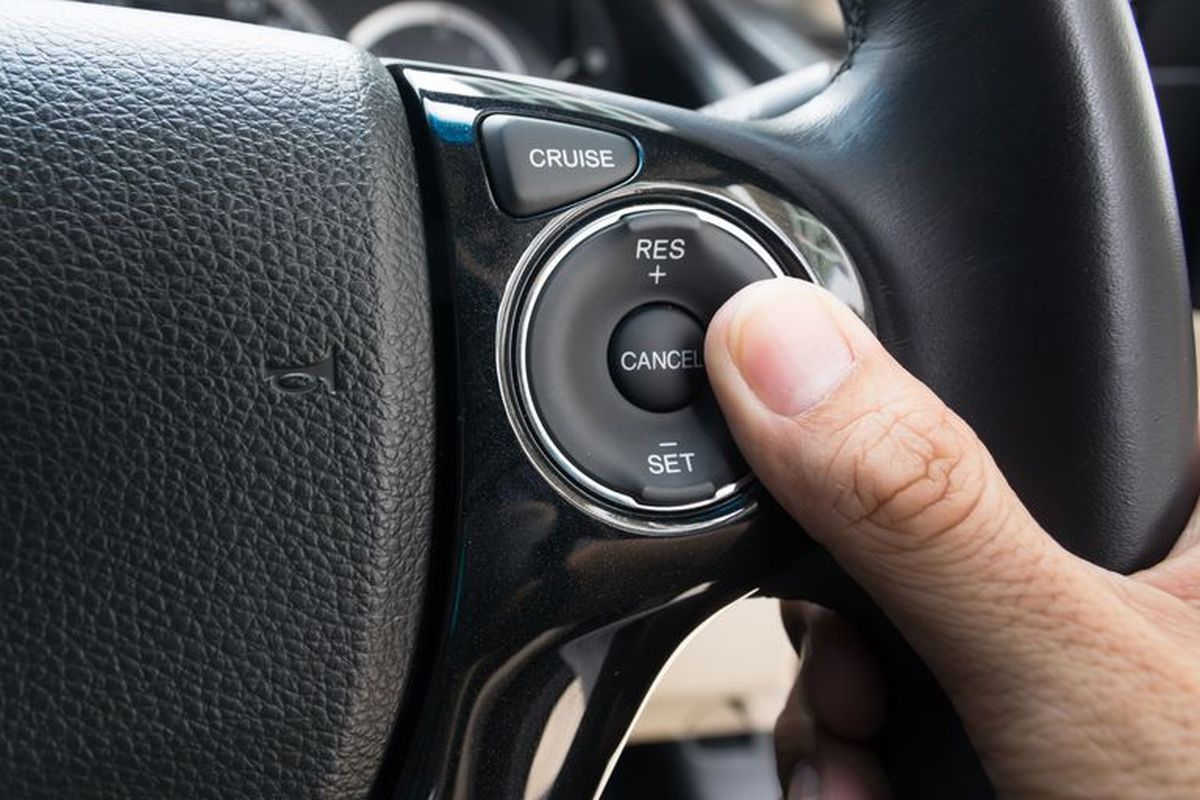
What Is Cruise Control? How Does It Work?
Cruise control is a driver-assistance system that allows a vehicle to maintain a selected speed automatically without requiring the driver to continuously press the accelerator pedal.
It is especially useful on highways and long-distance roads because it reduces the need to keep the accelerator pedal depressed for extended periods.
The driver selects a desired speed, activates the cruise control system, and the vehicle's electronic control systems continuously adjust engine torque or throttle control to maintain that speed.
Modern vehicles can use much more advanced versions of this technology. Adaptive Cruise Control (ACC) can also monitor the traffic ahead and automatically adjust the vehicle's speed to maintain a safe following distance.
What Is the Purpose of Cruise Control?
The primary purpose of cruise control is to maintain a relatively constant vehicle speed.
Without cruise control, the driver must continuously adjust accelerator pedal pressure to compensate for:
-
Small changes in road gradient
-
Wind resistance
-
Vehicle load
-
Changes in rolling resistance
-
Minor speed variations
Cruise control performs these adjustments automatically.
It can make long highway journeys more comfortable and can also help the driver avoid unintentionally exceeding a selected speed.
How Does Cruise Control Work?
A conventional cruise control system uses electronic signals and vehicle-speed information to control engine output.
The basic operating process is:
The driver accelerates to the desired speed.
For example, the vehicle may be accelerated to 100 km/h.
The driver activates cruise control.
The system stores the current vehicle speed as the target speed.
The driver releases the accelerator pedal.
The cruise control system takes over the task of maintaining the selected speed.
The vehicle speed is continuously monitored.
Wheel-speed sensors, transmission information, or other vehicle-speed signals provide the control system with current speed information.
The control system adjusts engine torque.
If the vehicle slows down, the system requests additional engine torque.
If the vehicle becomes faster than the target speed, the system reduces the requested torque.
This process happens continuously while cruise control is active.
What Components Does Cruise Control Use?
Cruise control is not normally a single component. It is a function created by several vehicle systems working together.
Depending on the vehicle, the system may use:
-
Cruise control switches
-
Steering-wheel controls
-
Accelerator pedal position sensors
-
Electronic throttle control
-
Engine ECU
-
Transmission control module
-
ABS or wheel-speed sensors
-
Brake pedal switch
-
Clutch pedal switch on manual transmissions
-
Vehicle-speed signals
-
CAN-Bus communication
-
Instrument cluster
-
Cruise control indicator
Modern vehicles often integrate these components through the vehicle's electronic network.
What Happens When You Press the Cruise Control Button?
The exact buttons vary between vehicles, but conventional cruise control commonly includes functions such as:
-
ON
-
OFF
-
SET
-
RES or RESUME
-
-
or ACCEL
-
-
− or COAST
-
CANCEL
The driver first activates the system and then selects a target speed.
Once the speed has been stored, the vehicle attempts to maintain that speed automatically.
What Does the SET Button Do?
The SET function generally stores the vehicle's current speed as the cruise-control target.
For example, if the vehicle is traveling at 90 km/h when SET is pressed, the system may attempt to maintain approximately 90 km/h.
The exact behavior differs between manufacturers.
What Does RES or RESUME Do?
The RES or RESUME function allows the system to return to a previously stored cruise-control speed after the system has been temporarily canceled.
For example, if cruise control was set to 100 km/h and the driver presses the brake, the system may cancel active speed control while retaining the previous target speed.
Pressing RESUME can then command the vehicle to return to the stored speed, provided the system's operating conditions are satisfied.
How Does Cruise Control Control the Throttle?
In older vehicles, cruise control could use a mechanical actuator connected to the throttle.
Modern vehicles generally use electronic throttle control.
The accelerator pedal does not directly open the throttle plate through a mechanical cable. Instead, accelerator pedal position sensors send electrical signals to the engine ECU.
The ECU then controls the electronic throttle actuator according to the driver's request and other operating conditions.
When cruise control is active, the ECU can control engine torque without requiring the driver to press the accelerator pedal.
Does Cruise Control Keep the Throttle at One Fixed Position?
No.
Cruise control does not simply move the throttle to one fixed position and leave it there.
The required throttle opening changes constantly.
For example, when the vehicle begins climbing a hill, more engine torque may be required to maintain the selected speed.
When the vehicle reaches level ground again, the required torque decreases.
The control system continuously compares actual vehicle speed with the target speed and adjusts engine torque accordingly.
How Does Cruise Control Work on Uphill Roads?
When the vehicle begins climbing a hill, gravity increases the load on the vehicle.
If no additional torque is provided, the vehicle speed will decrease.
The cruise control system detects this reduction in speed and requests more engine torque.
Depending on the vehicle, the ECU may increase throttle opening and the transmission may also select a lower gear.
The exact strategy depends on the engine and transmission.
What Happens When Driving Downhill?
A conventional cruise control system may reduce engine torque when the vehicle begins exceeding the target speed.
However, conventional cruise control is not necessarily capable of maintaining the exact selected speed on every steep downhill section.
Some vehicles can use engine braking and automatic transmission downshifts to help control speed.
Modern systems may also integrate braking control.
This is one of the major differences between basic cruise control and more advanced adaptive systems.
What Is Adaptive Cruise Control?
Adaptive Cruise Control, or ACC, is an advanced form of cruise control.
Instead of maintaining only a selected speed, ACC can also monitor vehicles ahead.
The system may use:
-
Radar
-
Cameras
-
Ultrasonic sensors in some applications
-
Vehicle-speed information
-
Electronic braking systems
If the road ahead is clear, ACC can maintain the driver's selected speed.
If a slower vehicle enters the lane, the system can reduce speed to maintain a programmed following distance.
When the road becomes clear again, the system can accelerate back toward the selected speed.
What Is the Difference Between Cruise Control and Adaptive Cruise Control?
Conventional cruise control primarily controls the vehicle's speed according to a selected target.
Adaptive Cruise Control adds traffic monitoring and following-distance control.
For example, with conventional cruise control set to 100 km/h, the vehicle generally attempts to remain at 100 km/h regardless of whether a slower vehicle is ahead.
With ACC, the system can detect the slower vehicle and reduce speed automatically.
The vehicle may then accelerate again when the lane ahead is clear.
Does Cruise Control Control the Brakes?
Basic cruise control generally does not continuously control the brakes.
Its primary function is engine torque control.
Adaptive Cruise Control, however, can integrate with the vehicle's electronic braking system to reduce speed when necessary.
The capabilities vary considerably between vehicles.
Some ACC systems can bring the vehicle to a complete stop in traffic, while others operate only above a certain minimum speed.
Why Does Cruise Control Cancel When You Press the Brake?
This is an important safety feature.
When the driver presses the brake pedal, the system normally interprets this as an indication that the driver wants to regain direct control of vehicle speed.
The cruise control system therefore cancels or temporarily suspends active speed control.
The brake pedal switch is consequently an important part of the system.
A faulty brake-light switch can sometimes cause cruise control to stop working even though the braking system itself appears normal.
Does Cruise Control Cancel When You Press the Clutch?
On vehicles with manual transmissions, cruise control commonly cancels when the clutch pedal is pressed.
This prevents the system from continuing to request engine torque while the drivetrain is disconnected.
A clutch-pedal switch or position sensor can therefore affect cruise control operation.
Can a Faulty Accelerator Pedal Affect Cruise Control?
Yes.
Modern accelerator pedals usually contain one or more position sensors.
The ECU uses these signals to determine driver demand.
If the pedal-position signal is implausible or inconsistent, the ECU may disable cruise control as a safety measure.
However, a cruise-control system can sometimes operate even when there is a problem affecting the normal accelerator-pedal input, depending on the exact fault and system architecture.
Why Does Cruise Control Stop Working?
Cruise control can be disabled for many reasons.
Common causes include:
-
Faulty brake-light switch
-
Faulty clutch switch
-
Accelerator pedal sensor problems
-
Electronic throttle problems
-
Wheel-speed sensor faults
-
ABS faults
-
Engine ECU faults
-
Transmission faults
-
Steering-wheel switch problems
-
Damaged wiring
-
CAN-Bus communication problems
-
Blown fuses
-
Low system voltage
-
Engine management faults
-
Active diagnostic trouble codes
The system may intentionally disable itself when another vehicle system reports a fault.
Can an Engine Fault Disable Cruise Control?
Yes.
Cruise control depends on information and control functions from several vehicle systems.
If the engine ECU detects a fault that could affect torque control or safe vehicle operation, it may deactivate cruise control.
For example, faults involving:
-
Electronic throttle control
-
Accelerator pedal position
-
Engine torque calculation
-
Engine speed
-
Transmission control
-
Vehicle speed
can potentially prevent cruise control from operating.
This does not necessarily mean that the cruise control system itself is defective.
Can ABS Problems Affect Cruise Control?
Yes.
Cruise control needs reliable vehicle-speed information.
Modern vehicles commonly obtain speed information through the ABS and wheel-speed sensor system or through data shared between the ABS module and other control units.
If an ABS or wheel-speed sensor fault causes unreliable speed information, cruise control may be disabled.
This is one reason why cruise control problems should not always be diagnosed by inspecting the cruise-control switches alone.
Does Cruise Control Improve Fuel Economy?
It can, depending on the road and driving conditions.
On relatively flat highways, cruise control can help maintain a steady speed and avoid unnecessary acceleration and deceleration.
However, cruise control is not automatically more economical in every situation.
On hilly roads, a driver may sometimes achieve better fuel economy by allowing small speed variations instead of forcing the vehicle to maintain exactly the same speed.
Modern adaptive systems can use more sophisticated control strategies, but fuel consumption still depends on road conditions, vehicle weight, speed, traffic, engine efficiency, and driving style.
Is Cruise Control Safe?
Cruise control can be useful when used correctly, but it does not replace driver attention.
The driver remains responsible for:
-
Monitoring traffic
-
Steering
-
Recognizing hazards
-
Adjusting speed when necessary
-
Maintaining a safe following distance
-
Taking control when road conditions change
Cruise control is generally most appropriate on roads where traffic flow and conditions are predictable.
It should be used carefully in heavy traffic, poor visibility, severe weather, slippery conditions, sharp curves, or roads with rapidly changing conditions.
Can Cruise Control Be Used in Rain or Snow?
It is generally advisable to exercise caution.
On wet, icy, or snowy roads, tire grip can change rapidly.
If the vehicle loses traction, maintaining a constant target speed may not be appropriate.
The correct use depends on the vehicle manufacturer's recommendations and the road conditions.
Adaptive systems with traction and stability integration can offer more assistance, but they do not eliminate the physical limitations of tire grip.
Can Cruise Control Be Installed Later?
In some vehicles, factory-style cruise control can be added.
However, whether this is possible depends on the vehicle's electronic architecture.
A retrofit may require:
-
Steering-wheel switches
-
Appropriate wiring
-
Compatible control modules
-
Software activation
-
ECU configuration
-
Brake or clutch switches
-
Instrument-cluster coding
Some vehicles are already equipped with the necessary hardware and only require software activation.
Others require additional components.
A proper retrofit should use components and software compatible with the vehicle rather than simply installing a universal switch.
What Is the Difference Between Cruise Control and a Speed Limiter?
These systems perform different functions.
Cruise control attempts to maintain a selected vehicle speed automatically.
A speed limiter generally allows the driver to accelerate normally but prevents the vehicle from exceeding a programmed maximum speed, subject to the system's design and operating conditions.
For example, with a 100 km/h limiter activated, the driver may continue controlling the accelerator, but the system can restrict engine torque when the selected limit is reached.
Why Does Cruise Control Sometimes Change Speed Slightly?
A small amount of speed variation can be normal.
The system continuously reacts to changing conditions.
Factors such as:
-
Road gradient
-
Wind
-
Vehicle load
-
Gear changes
-
Engine response
-
Transmission behavior
can cause small fluctuations.
On a steep hill, for example, the vehicle may temporarily lose some speed before the control system increases engine torque.
The behavior depends on the calibration of the cruise-control system.
Can Cruise Control Cause Engine Problems?
Normally, cruise control does not damage the engine when the vehicle is operating correctly.
The system is designed to operate within the engine and transmission's normal control limits.
However, a pre-existing engine, throttle, transmission, or electrical problem may cause cruise control to deactivate.
If cruise control repeatedly cancels or the Check Engine Light appears simultaneously, the vehicle should be diagnosed rather than repeatedly resetting the system.
What Should Be Checked If Cruise Control Does Not Work?
A diagnostic approach should begin with the simplest possibilities.
Check whether:
-
Brake lights operate correctly
-
The brake pedal switch is functioning
-
The clutch switch operates correctly, if equipped
-
Cruise-control switches respond
-
ABS warning lights are present
-
Check Engine Light is illuminated
-
Vehicle-speed information is correct
-
Battery voltage is normal
-
Fuses are intact
A diagnostic scan should then be performed if necessary.
The technician can check stored fault codes and live data from the engine, ABS, transmission, and other relevant modules.
Final Thoughts
Cruise control is an electronic system that automatically maintains a driver's selected vehicle speed by continuously adjusting engine torque.
Traditional cruise control primarily focuses on maintaining speed, while Adaptive Cruise Control can additionally monitor traffic ahead and adjust speed according to the surrounding vehicles.
Although the system can make long-distance driving more comfortable, it does not replace the driver. The driver must continue to monitor the road and be ready to take control whenever conditions require it.
Modern cruise control is therefore best understood not as a device that simply "holds the gas pedal," but as a coordinated electronic control function involving the engine ECU, throttle system, vehicle-speed information, transmission, braking system, switches, and communication networks.