TR
TR EN
EN

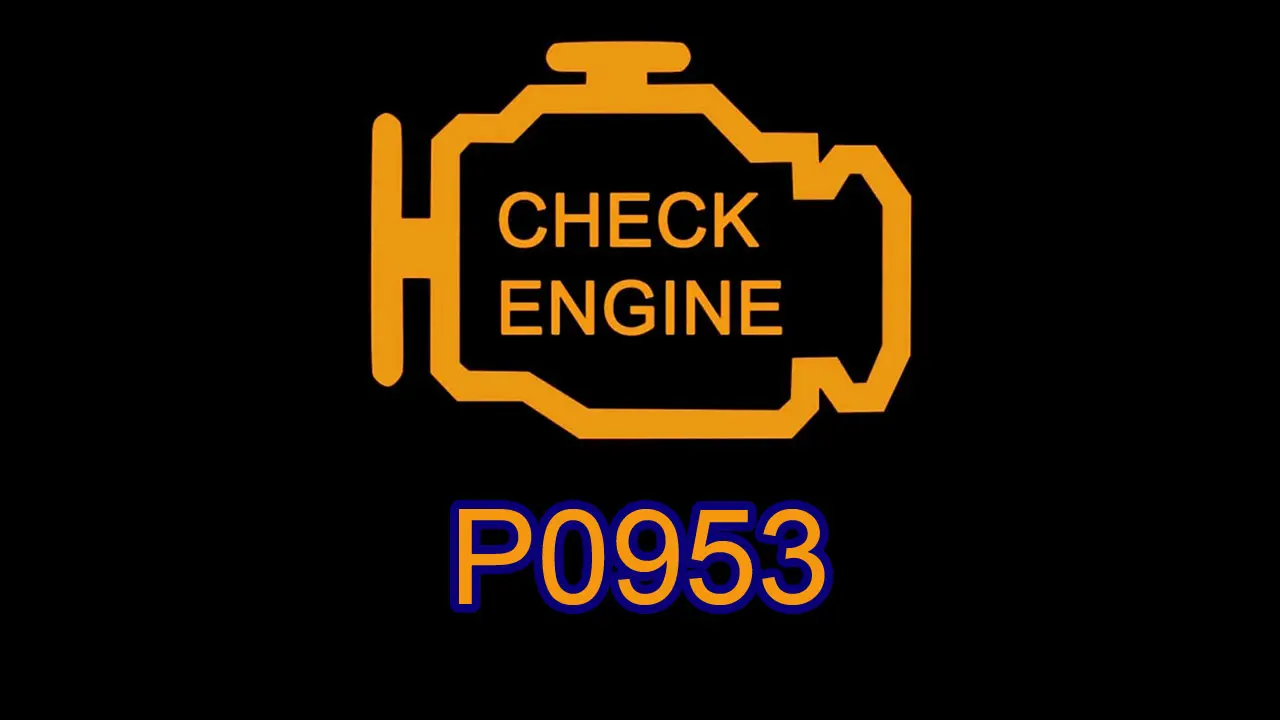
P0953 Auto Shift Manual Control Circuit High
The P0953 trouble code is an OBD-II diagnostic trouble code related to the electronic system that controls the automatic/manual shifting function of an automatic transmission.
P0953 – Auto Shift Manual Control Circuit High
This code means that the transmission control module (TCM) or powertrain control module (PCM) has detected an electrical signal that is higher than the expected value in the automatic/manual shift control circuit.
In simple terms, the vehicle's transmission computer is receiving a manual-shift control signal that is too high or otherwise outside the expected electrical state.
The fault can be caused by a manual-mode switch, gear selector, paddle shifter, wiring, connector, short to voltage, or a problem with one of the electronic modules involved in transmission control.
P0953 does not automatically mean that the transmission itself is mechanically damaged.
What Does P0953 Mean?
P0953 – Auto Shift Manual Control Circuit High
Many automatic transmissions allow the driver to manually request gear changes.
Depending on the vehicle, manual control can be provided through:
-
Gear selector
-
“+” and “–” selector positions
-
Manual-mode button
-
Steering-wheel paddle shifters
-
Electronic shift switches
The control module monitors these inputs.
A simplified system looks like this:
Driver input → Manual control switch → Wiring → Control module → TCM → Transmission
When the TCM detects a signal that is higher than the expected electrical level, it may store P0953.
What Does “Circuit High” Mean?
The word “High” refers to the electrical signal, not transmission pressure.
P0953 does not mean:
-
High transmission fluid pressure
-
High engine RPM
-
High transmission temperature
-
Too much transmission fluid
It means the voltage or electrical state detected in the manual control circuit is higher than the value the control module expects.
A common cause of a circuit-high condition is a short to voltage, but other electrical faults can also produce the code.
What Is Auto Shift Manual Control?
Auto shift manual control allows the driver to request individual gear changes while the vehicle continues using an electronically controlled automatic transmission.
A typical system works like this:
“+” → Upshift
“–” → Downshift
The TCM continues to control the transmission and can prevent a requested shift if operating conditions do not permit it.
The electrical architecture differs considerably between vehicles.
Some systems use dedicated switches.
Others use resistor-based circuits or electronic communication between several control modules.
Does P0953 Mean the Gear Selector Is Faulty?
Not necessarily.
A faulty selector is only one possibility.
Other potential causes include:
-
Short to voltage
-
Damaged wiring
-
Faulty manual-mode switch
-
Faulty paddle shifter
-
Corroded connector
-
Loose terminal
-
Damaged terminal
-
Clock spring problem
-
Shift-control module fault
-
Communication problem
-
TCM fault
The circuit should be tested before replacing the gear selector.
Symptoms of P0953
Symptoms vary depending on the vehicle.
Possible symptoms include:
-
Check Engine Light
-
Transmission warning light
-
Manual mode not working
-
Manual mode activating incorrectly
-
Paddle shifters not responding
-
Upshift command ignored
-
Downshift command ignored
-
Transmission remaining in automatic mode
-
Incorrect manual-shift behavior
-
Limited gear selection
-
Transmission entering limp mode
Some vehicles may continue to drive normally in automatic mode.
In these cases, the only obvious symptom may be that the manual-shifting function does not operate correctly.
Common Causes of P0953
Short to voltage
A short to a power supply is one of the most important possibilities with a circuit-high code.
If the manual-control signal wire contacts a voltage source, the TCM may see a signal that is higher than expected.
Possible sources include:
-
Battery voltage
-
Ignition voltage
-
Another powered circuit
The exact circuit must be identified from the vehicle's wiring diagram.
Faulty manual-mode switch
A switch can develop an internal electrical fault that causes the signal to remain high or change incorrectly.
Possible problems include:
-
Internal short
-
Worn contacts
-
Incorrect resistance
-
Contamination
-
Physical damage
Faulty gear selector
If the manual-control function is integrated into the gear selector, an internal selector fault can generate an abnormal signal.
Possible problems include:
-
Internal switch failure
-
Position sensor fault
-
Internal wiring damage
-
Mechanical wear
Faulty paddle shifter
A stuck or internally shorted paddle switch can cause a constant or abnormal manual-shift command.
This can be particularly noticeable if:
-
Upshift commands remain active
-
Downshift commands remain active
-
One paddle works while the other does not
Damaged wiring
Wiring problems can cause a circuit-high condition.
Look for:
-
Insulation damage
-
Wires touching a power supply
-
Incorrect previous repairs
-
Melted insulation
-
Pinched wires
-
Damaged harness sections
Corroded or damaged connectors
Connectors can develop electrical problems because of:
-
Moisture
-
Corrosion
-
Contamination
-
Physical damage
A damaged terminal can change the electrical characteristics of the circuit.
Clock spring problem
If manual gear changes are controlled by steering-wheel paddles, the clock spring can be part of the electrical path.
A clock spring problem can cause abnormal paddle-shifter signals.
If several steering-wheel controls are also affected, this area should be investigated.
Shift-control module fault
Some vehicles use a separate module to interpret selector or manual-shift commands.
A fault in this module can result in an incorrect signal being sent to the TCM.
Communication problem
On modern vehicles, the manual-shift request may be transmitted electronically between modules.
A communication problem can result in an incorrect command being interpreted by the TCM.
TCM fault
A faulty TCM is possible but should generally be considered only after the external circuit and input devices have been tested.
Can Low Transmission Fluid Cause P0953?
Low transmission fluid does not normally cause P0953 directly.
Low fluid can cause:
-
Transmission slipping
-
Delayed engagement
-
Harsh shifting
-
Hydraulic pressure problems
But P0953 is an electrical circuit-high code.
The fluid level should still be checked when transmission symptoms are present, but low fluid should not be assumed to be the cause of P0953.
Can Dirty Transmission Fluid Cause P0953?
Dirty transmission fluid can cause:
-
Valve-body problems
-
Solenoid sticking
-
Poor shifting
-
Hydraulic pressure issues
However, contaminated transmission fluid does not normally cause an electrical signal to become too high in the manual-control circuit.
The electrical system should be investigated first.
P0953 vs. P0952
These two codes identify opposite electrical conditions in the same general circuit family.
P0952 – Auto Shift Manual Control Circuit Low
The control module detects a signal lower than expected.
P0953 – Auto Shift Manual Control Circuit High
The control module detects a signal higher than expected.
This distinction can significantly narrow the diagnostic direction.
With P0953, technicians should pay particular attention to short-to-voltage conditions and switches or circuits that are incorrectly held in a high state.
P0953 vs. P0954 and P0955
The neighboring codes provide additional context.
P0953 – Auto Shift Manual Control Circuit High
The signal is higher than expected.
P0954 – Auto Shift Manual Control Circuit Intermittent
The signal or circuit operation is intermittent.
P0955 – Auto Shift Manual Mode Circuit Malfunction
A general malfunction has been detected in the manual-mode circuit.
P0953 is therefore more specific about the electrical condition than P0955.
P0953 vs. P0956, P0957, P0958 and P0959
The codes in this group can be summarized as follows:
P0953 – Auto Shift Manual Control Circuit High
The manual-control circuit signal is higher than expected.
P0954 – Auto Shift Manual Control Circuit Intermittent
The manual-control circuit operates intermittently.
P0955 – Auto Shift Manual Mode Circuit Malfunction
A general malfunction has been detected.
P0956 – Auto Shift Manual Mode Circuit Range/Performance
The signal or operation is outside the expected range.
P0957 – Auto Shift Manual Mode Circuit Low
The signal is lower than expected.
P0958 – Auto Shift Manual Mode Circuit High
The signal is higher than expected.
P0959 – Auto Shift Manual Mode Circuit Intermittent
The manual-mode circuit is intermittent.
The exact circuit being monitored can differ between vehicle manufacturers.
How Serious Is P0953?
P0953 is usually not an immediate indication of catastrophic internal transmission failure.
If the transmission continues to operate normally in automatic mode, the problem may be limited to manual-shift functionality.
However, it should not be ignored if the vehicle develops additional transmission symptoms.
Pay particular attention to:
-
Harsh shifting
-
Unexpected gear selection
-
Transmission slipping
-
Limp mode
-
Loss of Drive
-
Loss of Reverse
These symptoms require more urgent diagnosis.
Can You Drive With P0953?
If the vehicle operates normally in automatic mode, it may be possible to drive it carefully to a repair facility.
However, the manual-shift function should not be relied upon until the fault has been repaired.
Driving should be minimized if:
-
The transmission enters limp mode
-
Shifting becomes severe
-
The transmission slips
-
Drive or Reverse is lost
-
Gears are selected unexpectedly
How to Diagnose P0953
A proper diagnosis should determine why the manual-control signal is higher than expected.
1. Scan all control modules
Use a professional diagnostic scanner to check:
-
TCM
-
PCM
-
Body-control module
-
Gear-selector module
-
Steering-wheel control module
Look for additional diagnostic codes.
Related codes may identify a shared electrical or communication problem.
2. Check freeze-frame data
Review the operating conditions when P0953 was stored.
Useful information can include:
-
Vehicle speed
-
Engine RPM
-
Selected gear
-
Transmission temperature
-
Selector position
-
Manual-mode status
-
Shift request
3. Monitor live data
Observe:
-
Manual mode ON/OFF
-
Selector position
-
Upshift request
-
Downshift request
-
Paddle status
-
Shift request
-
Transmission operating mode
Operate the selector or paddles while monitoring the scan-tool data.
The displayed status should correspond to the actual driver's input.
4. Measure the circuit voltage
The relevant circuit should be tested according to the manufacturer's specifications.
Do not assume that every manual-mode circuit uses the same voltage.
Some systems may use:
-
Dedicated switch circuits
-
Resistor-based inputs
-
Reference-voltage circuits
-
Electronic communication
The manufacturer's wiring diagram and service information should be followed.
5. Check for a short to voltage
Because P0953 is a circuit-high code, check whether the signal wire is unintentionally connected to a power supply.
Inspect for:
-
Battery voltage contact
-
Ignition-voltage contact
-
Damaged insulation
-
Incorrect wiring repairs
6. Test the manual-mode switch
Check the switch for:
-
Correct resistance
-
Correct continuity
-
Proper voltage behavior
-
Correct signal changes
The signal should change according to the manufacturer's specifications when the switch is operated.
7. Inspect the gear selector
Check:
-
Selector connector
-
Wiring
-
Terminals
-
Internal switch
-
Position signals
-
Manual-mode input
8. Test paddle shifters
If equipped, verify that:
-
Upshift command is recognized
-
Downshift command is recognized
-
Neither command remains permanently active
A stuck switch can produce a constant abnormal signal.
9. Inspect the wiring harness
Look for:
-
Chafed wires
-
Melted insulation
-
Pinched wiring
-
Shorted wires
-
Poor previous repairs
-
Harness damage near brackets
10. Inspect connectors
Check for:
-
Corrosion
-
Bent pins
-
Loose terminals
-
Backed-out terminals
-
Water intrusion
-
Damaged connector locks
11. Check the clock spring when applicable
If paddle shifters are located on the steering wheel, inspect the clock spring and related wiring.
This is especially important if other steering-wheel controls have also stopped working.
12. Check module communication
If the manual-shift request passes through another electronic module, verify that the information reaches the TCM correctly.
A communication problem can sometimes appear similar to a switch fault.
13. Evaluate the TCM last
If the switch, selector, wiring, connectors and communication network all test correctly, the TCM can then be evaluated.
A TCM should not be replaced simply because P0953 is stored.
Why P0953 Can Be Difficult to Diagnose
A circuit-high code may appear straightforward, but the exact cause can be difficult to locate.
The signal may be high because of:
-
A short to voltage
-
A faulty switch
-
Incorrect resistance
-
Wiring damage
-
Connector damage
-
Module fault
The circuit design also varies between vehicles.
For this reason, the manufacturer's wiring diagram is extremely important.
P0953 After Steering Wheel Repair
If P0953 appeared after steering-wheel work, inspect:
-
Paddle-shifter wiring
-
Paddle connectors
-
Clock spring
-
Steering-wheel connectors
-
Related harnesses
If other steering-wheel controls developed problems at the same time, the clock spring or steering-wheel wiring should receive particular attention.
P0953 After Gear Selector Repair
If the code appeared after gear-selector work, inspect the selector circuit first.
Check:
-
Connector seating
-
Wiring
-
Terminals
-
Selector switches
-
Manual-mode signal
-
Selector position signals
A damaged or incorrectly connected wire can create a circuit-high condition.
P0953 After Transmission Repair
If P0953 appeared after transmission repair or replacement, inspect any electrical connectors and wiring disturbed during the work.
However, because the code concerns the manual control circuit, the gear selector and manual-mode input system should also be checked.
P0953 alone does not prove that the transmission has an internal mechanical problem.
Can P0953 Cause Limp Mode?
Yes, it can on some vehicles.
If the TCM receives an implausible manual-control signal, it may disable manual mode or enter a protective operating strategy.
Possible results include:
-
Manual mode disabled
-
Limited gear selection
-
Fixed gear operation
-
Transmission warning light
-
Reduced transmission functionality
The exact response depends on the vehicle.
Can P0953 Damage the Transmission?
P0953 itself does not normally cause direct mechanical transmission damage.
It primarily identifies an abnormal electrical signal in the manual-control circuit.
However, if the transmission begins operating with incorrect shift requests or enters an abnormal control strategy, shifting behavior can be affected.
If the transmission slips, shifts violently or loses gear engagement, the vehicle should be diagnosed promptly.
Common Diagnostic Mistakes With P0953
One common mistake is immediately blaming the transmission.
P0953 does not automatically mean that the transmission needs to be rebuilt or replaced.
Another mistake is replacing the gear selector without checking the circuit.
A short to voltage can produce the same code.
Another mistake is interpreting “Circuit High” as high transmission fluid pressure.
It does not mean that.
“High” refers to the electrical signal detected by the control module.
Another mistake is ignoring paddle shifters and the clock spring on vehicles equipped with steering-wheel manual controls.
What Is the Correct Repair for P0953?
The correct repair depends on the confirmed cause.
Possible repairs include:
-
Replacing the manual-mode switch
-
Replacing the gear selector
-
Replacing a faulty paddle shifter
-
Repairing a short to voltage
-
Repairing damaged wiring
-
Replacing damaged terminals
-
Repairing or replacing connectors
-
Repairing clock spring wiring when applicable
-
Repairing a shift-control module
-
Correcting communication problems
-
Repairing or replacing the TCM when it is conclusively diagnosed as faulty
After the repair, the manual-control circuit should be tested again to ensure that its electrical signal is within the manufacturer's specified range.
Final Thoughts on P0953
P0953 – Auto Shift Manual Control Circuit High indicates that the transmission control system has detected an electrical signal higher than expected in the automatic/manual shift control circuit.
The code does not automatically indicate internal transmission failure.
The most important areas to investigate are the manual-mode switch, gear selector, paddle shifters, wiring, connectors, terminals, clock spring and related electronic control modules.
Because this is a circuit-high code, particular attention should be given to short-to-voltage conditions and switches or wiring that are incorrectly maintaining a high electrical signal.
A proper diagnosis should include scan-tool live data, electrical testing, wiring inspection and connector checks before expensive components such as the gear selector or TCM are replaced.
P0953 should primarily be approached as an electrical shift-control problem. Finding the source of the excessive or incorrect signal can prevent unnecessary replacement of the transmission or other expensive components.
:::