TR
TR EN
EN

What Is the ABS System? Why Does the ABS Warning Light Come On?
ABS, short for Anti-lock Braking System, is one of the most important active safety systems in modern vehicles. Its main purpose is to prevent the wheels from locking during hard braking and to help the driver maintain steering control while braking.
When a conventional braking system is used during an emergency stop, excessive brake pressure can cause one or more wheels to stop rotating while the vehicle is still moving. A locked wheel has much less ability to respond to steering input.
ABS continuously monitors wheel speed and automatically adjusts brake pressure when it detects that a wheel is approaching lock-up.
How Does the ABS System Work?
The ABS system consists of several components that work together.
Wheel speed sensors
Each wheel speed sensor monitors the rotational speed of the wheel. The ABS control unit compares the signals from the sensors and looks for abnormal changes in wheel speed.
ABS control module
The ABS control module processes information from the wheel speed sensors and determines whether a wheel is approaching a lock-up condition.
ABS hydraulic control unit
The hydraulic unit controls brake pressure to individual wheels. It can increase, decrease, or maintain hydraulic pressure depending on the conditions detected by the ABS module.
Brake system
The brake pedal, master cylinder, brake fluid, calipers or wheel cylinders, and brake pads or shoes all work together with the ABS system.
During hard braking, ABS can adjust brake pressure many times in a very short period.
What Happens When ABS Activates?
When ABS activates, the driver may feel rapid pulsations through the brake pedal. A clicking, buzzing, or mechanical operating noise may also be heard from the ABS hydraulic unit.
This is normally expected when ABS is actively preventing wheel lock.
For example, if you suddenly brake on a wet or slippery road, one wheel may begin slowing down much faster than the others. The ABS system detects this condition and temporarily reduces brake pressure to that wheel. It then increases the pressure again when the wheel begins rotating normally.
If ABS activates during emergency braking, the driver should generally continue pressing the brake pedal firmly rather than releasing it because of the vibration.
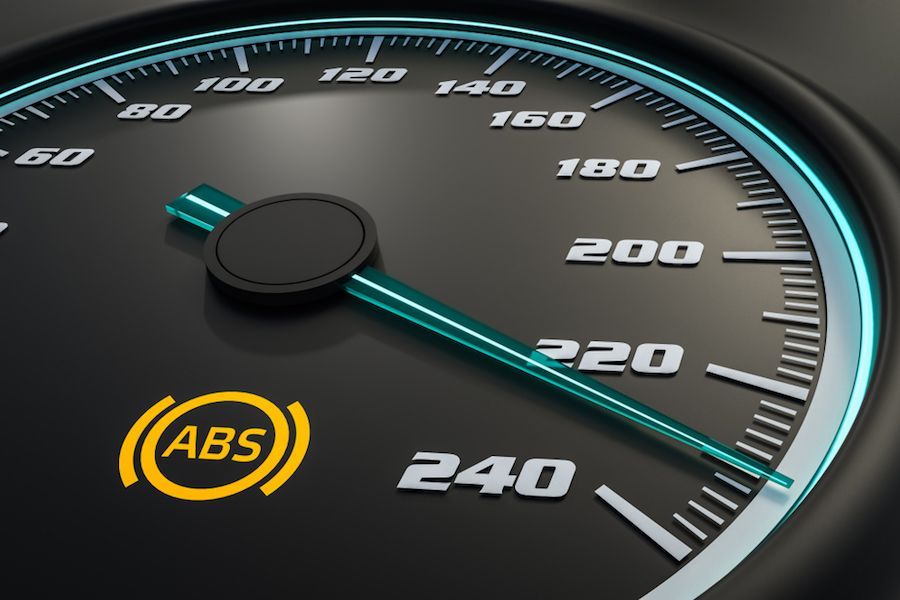
Why Does the ABS Warning Light Come On?
The ABS warning light can illuminate for many different reasons. In most cases, it means that the ABS control system has detected a fault and has disabled some or all of its ABS functions.
The most common causes include:
-
Faulty wheel speed sensor
-
Damaged sensor wiring
-
Loose or corroded electrical connector
-
Damaged ABS sensor ring or tone ring
-
Excessive wheel bearing play
-
ABS hydraulic unit malfunction
-
ABS control module fault
-
Low battery voltage
-
Charging system problems
-
Low brake fluid level
-
Damaged wheel speed sensor mounting
-
Incorrect tire size or significant tire-size differences
-
Problems with steering angle or other related sensors
-
Communication problems between electronic control modules
-
ABS fuse or power supply problems
A warning light does not automatically mean that the ABS sensor itself needs to be replaced.
Faulty Wheel Speed Sensor
One of the most common causes of an ABS warning light is a problem with a wheel speed sensor.
The sensor provides the ABS module with information about wheel rotation. If the signal is missing, intermittent, implausible, or different from the other wheels, the control module may detect a fault.
A damaged sensor can cause:
-
ABS warning light
-
Traction control warning light
-
Electronic stability control warning light
-
Speedometer problems on some vehicles
-
Traction control malfunction
-
Stability control malfunction
-
Stored ABS fault codes
The sensor itself is not always the problem. Its wiring and connector should also be inspected.
Damaged ABS Sensor Wiring
ABS sensors are located close to the wheels, where they are exposed to water, dirt, road salt, stones, heat, suspension movement, and mechanical damage.
The wiring can become stretched, rubbed against a component, broken internally, or damaged near the connector.
An intermittent wiring problem can be particularly difficult to diagnose because the ABS light may disappear and return depending on wheel movement or suspension travel.
Dirty or Damaged ABS Sensor
Depending on the sensor design, contamination around the sensor or its mounting area can affect the quality of the signal.
Metal particles, dirt, corrosion, or damage around the sensor and magnetic encoder can cause an incorrect wheel-speed signal.
However, simply cleaning the sensor is not always the solution. The complete sensor, wiring, bearing, encoder ring, and mounting area should be inspected.
Wheel Bearing Problems Can Trigger the ABS Light
A worn wheel bearing can also cause ABS-related problems.
Some modern wheel bearings incorporate a magnetic encoder or tone ring that works with the wheel speed sensor. If the bearing develops excessive play or the encoder is damaged, the sensor signal may become inaccurate.
As a result, replacing the ABS sensor alone may not solve the problem.
If an ABS fault occurs together with a humming or rumbling noise that changes with vehicle speed, the wheel bearing should also be inspected.
Low Battery Voltage and ABS Faults
Modern ABS systems are sensitive to electrical voltage.
A weak battery, poor battery connection, damaged ground cable, alternator problem, or voltage drop during engine starting can cause various electronic modules to record temporary faults.
This is particularly important if the ABS light appeared after:
-
A weak or discharged battery
-
Battery replacement
-
Jump-starting
-
Difficulty starting the engine
-
Alternator or charging-system work
In such situations, the stored ABS code should be checked before replacing expensive components.
Low Brake Fluid and the ABS Warning Light
A low brake fluid level can trigger a brake warning light and, depending on the vehicle, may be associated with other warning messages.
Brake fluid can become low because of worn brake pads, a leak, or another brake-system problem.
Low brake fluid should never be ignored.
If the brake fluid level is significantly below the recommended level, the braking system should be inspected rather than simply adding fluid and continuing to drive.
Can the ABS Light Come On After Changing Tires?
Yes.
Tire replacement or wheel-related work can sometimes expose an existing ABS problem or create conditions that affect the wheel speed signal.
For example:
-
A damaged sensor wire may be disturbed during wheel removal.
-
A sensor may be incorrectly positioned.
-
A sensor connector may not be fully connected.
-
An incorrect tire size may affect wheel-speed calculations.
-
A damaged wheel bearing may become noticeable after wheel service.
If the ABS light appears immediately after tire, brake, bearing, or suspension work, those areas should be inspected first.
Can ABS and Traction Control Lights Come On Together?
Yes.
ABS, traction control, and electronic stability control systems often share wheel speed information.
If one wheel speed sensor stops providing a reliable signal, the vehicle may disable several related systems.
The driver may therefore see multiple warning lights at the same time, such as:
-
ABS
-
Traction control
-
ESC/ESP
-
Brake warning
-
Hill-start assist
-
Tire pressure warning on some vehicles
Seeing several warning lights does not necessarily mean that all of these systems have failed independently. One faulty sensor or communication problem can affect several systems.
Is It Safe to Drive With the ABS Light On?
It depends on what other warning lights and symptoms are present.
If the ABS warning light remains illuminated, the conventional braking system may still operate normally, but the anti-lock function may be unavailable.
This means that during hard braking, the wheels may be more likely to lock.
If the red brake warning light is also illuminated, the situation should be treated more seriously, particularly if the brake pedal feels abnormal, the brake fluid is low, or braking performance has changed.
A vehicle with an ABS warning light should be diagnosed as soon as reasonably possible, especially before driving in heavy rain, snow, ice, or other slippery conditions.
Does ABS Always Reduce Braking Distance?
Not necessarily.
ABS is primarily designed to prevent wheel lock and help maintain steering control during hard braking.
On a dry road, ABS can help the vehicle achieve effective braking while maintaining control. On loose surfaces such as deep gravel or certain types of snow, a locked wheel can sometimes produce a shorter stopping distance.
However, that does not make disabling ABS desirable for normal road driving because maintaining the ability to steer during emergency braking is extremely important.
How Is an ABS Fault Diagnosed?
Proper diagnosis should begin with an ABS-capable diagnostic scanner.
A basic engine-code scanner may not be able to access the ABS control module.
A technician should check:
ABS fault codes
The stored diagnostic trouble code can identify which circuit, sensor, or system has been detected as abnormal.
Live wheel-speed data
The technician can monitor all wheel speeds while driving or rotating the wheels. If one wheel shows an implausible signal, the problem can be narrowed down.
Sensor wiring
The wiring and connectors should be inspected for corrosion, broken wires, loose terminals, and physical damage.
Sensor and encoder
The sensor, tone ring, magnetic encoder, and mounting position should be checked.
Wheel bearing
Bearing play and encoder condition should be inspected when appropriate.
Power and ground
The ABS module requires stable electrical power and ground. Voltage drops can cause misleading fault codes.
Hydraulic unit
If the sensors and electrical circuits are working correctly, the ABS hydraulic unit and its valves may need further testing.
Does an ABS Fault Code Mean the ABS Sensor Must Be Replaced?
No.
This is an important point in ABS diagnosis.
A code related to a particular wheel does not automatically prove that the sensor itself has failed.
The problem could be caused by:
-
Sensor wiring
-
Connector
-
Wheel bearing
-
Encoder ring
-
Sensor mounting
-
Power supply
-
Ground
-
ABS module
-
Mechanical damage
-
Incorrect installation
Replacing parts based only on the fault code can lead to unnecessary repairs.
Can the ABS Light Turn Off by Itself?
Sometimes.
If the problem is intermittent, the ABS light may disappear after restarting the vehicle or after the signal returns to normal.
However, this does not necessarily mean the problem has been repaired.
The ABS module may still have a stored fault code or diagnostic history. An intermittent wheel speed signal, wiring problem, or voltage issue can return later.
If the warning light repeatedly appears and disappears, the stored codes and live data should be checked rather than simply clearing the fault memory.
ABS Maintenance
ABS does not normally require frequent maintenance like engine oil, but the system should be inspected whenever related components are serviced.
Important points include:
-
Keep the brake system properly maintained.
-
Use the correct brake fluid.
-
Inspect wheel speed sensor wiring during brake and suspension work.
-
Repair wheel bearing problems promptly.
-
Avoid damaging ABS sensors during wheel removal.
-
Keep tires at the correct pressure.
-
Use compatible tire sizes.
-
Check warning lights promptly.
-
Scan the ABS module when an ABS warning appears.
What Should You Do When the ABS Light Comes On?
The first step is not to replace the ABS sensor immediately.
Instead, the vehicle should be scanned with equipment capable of communicating with the ABS module. The exact fault code should then be interpreted together with live wheel-speed data and a physical inspection.
An ABS warning light can be caused by something as relatively simple as a damaged wire or weak battery voltage, but it can also indicate a problem with the hydraulic unit or another important braking component.
Because ABS is directly related to vehicle control during emergency braking, ignoring the warning for a long period is not recommended.
The most important point is that the ABS warning light is a symptom, not a diagnosis. Finding the actual cause requires checking the sensor signal, wiring, wheel bearing, electrical supply, hydraulic system, and ABS control module rather than replacing parts based solely on the warning light.