TR
TR EN
EN

What Are Toe, Camber, and Caster? How Is Wheel Alignment Performed?
Wheel alignment is one of the most important adjustments affecting a vehicle's handling, steering response, tire wear, and driving stability. When the wheels are not positioned according to the manufacturer's specifications, the vehicle may pull to one side, the steering wheel may sit crooked, or the tires may wear unevenly.
Three important alignment angles are toe, camber, and caster. Understanding these angles makes it easier to understand what a wheel alignment actually does and why it is sometimes necessary after suspension or steering repairs.
What Is Toe?
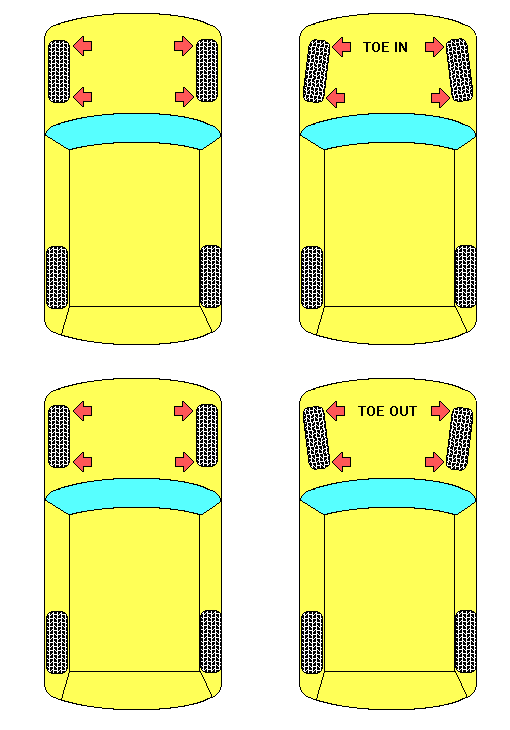
Toe describes the direction in which the wheels point when viewed from above.
If the front edges of two wheels are slightly closer together than the rear edges, the wheels have toe-in.
If the front edges are farther apart than the rear edges, the wheels have toe-out.
The correct toe setting is determined by the vehicle manufacturer and can vary depending on the suspension design.
Incorrect toe is one of the most common causes of uneven tire wear.
Excessive toe-in can cause the tires to scrub against the road surface, while excessive toe-out can produce similar tire wear and handling problems.
Possible symptoms of incorrect toe include:
-
Uneven tire wear
-
Steering wheel not centered
-
Vehicle wandering
-
Poor straight-line stability
-
Increased tire noise
-
Reduced tire life
What Is Camber?
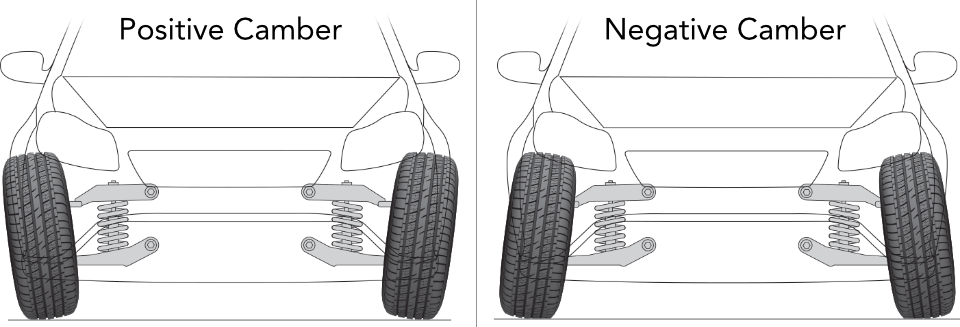
Camber is the inward or outward tilt of the wheel when viewed from the front of the vehicle.
If the top of the wheel leans toward the vehicle, it has negative camber.
If the top of the wheel leans away from the vehicle, it has positive camber.
A small amount of camber is normal and is intentionally specified by the vehicle manufacturer.
However, excessive camber can cause uneven tire wear.
For example, excessive negative camber can cause increased wear toward the inside edge of the tire.
Camber can be affected by:
-
Damaged suspension components
-
Worn suspension parts
-
Bent control arms
-
Incorrect ride height
-
Accident damage
-
Incorrectly installed components
-
Changes to the suspension
On some vehicles, camber is adjustable. On others, it is not directly adjustable without replacing or correcting the relevant suspension components.
What Is Caster?
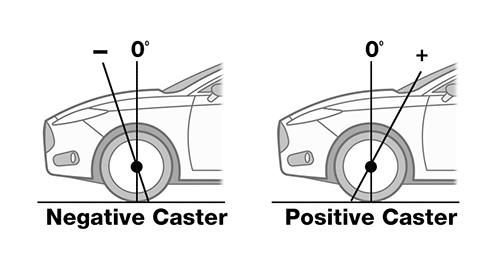
Caster refers to the forward or backward angle of the steering axis when viewed from the side of the vehicle.
Caster has a major influence on steering stability and the vehicle's ability to return the steering wheel toward the center after a turn.
A properly set caster angle contributes to:
-
Straight-line stability
-
Steering feel
-
Steering wheel self-centering
-
High-speed stability
-
Predictable cornering
Unlike toe and camber, caster is not usually visible by simply looking at the wheel.
A significant difference in caster between the left and right sides can cause the vehicle to pull toward one side.
Caster can be affected by damaged suspension components, accident damage, incorrect suspension geometry, or changes in ride height.
Toe vs. Camber vs. Caster
These three angles affect different aspects of wheel geometry.
Toe controls the direction the wheels point when viewed from above.
Camber controls the inward or outward tilt of the wheels when viewed from the front.
Caster controls the steering-axis angle when viewed from the side.
All three work together. A vehicle can have correct toe but incorrect camber, or correct camber but incorrect caster.
This is why a proper four-wheel alignment checks the complete geometry rather than simply adjusting one angle.
What Is Wheel Alignment?
Wheel alignment, commonly called rot ayarı or rot ayarı yapılması, is the process of measuring the wheel and suspension geometry and adjusting the angles to the manufacturer's specifications.
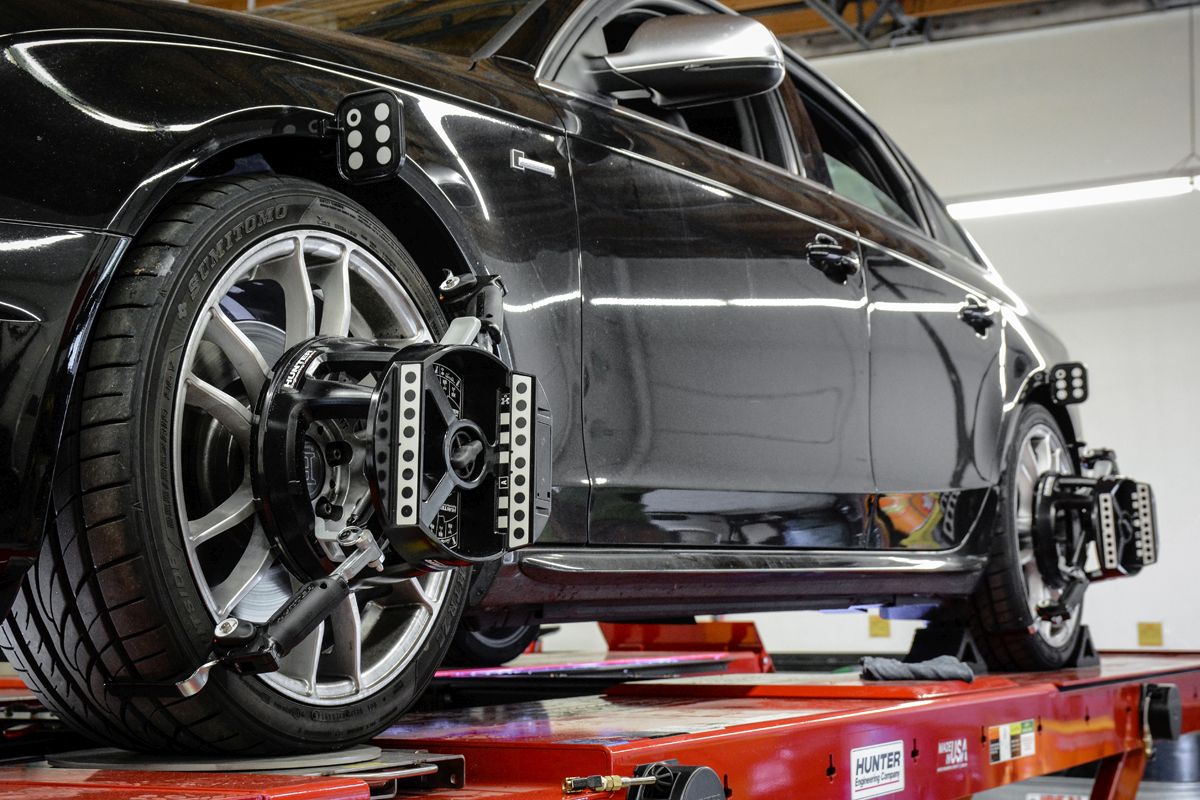
A modern alignment machine uses sensors or targets attached to the wheels. The machine measures the position and angles of the wheels and compares them with the specified values.
Depending on the vehicle, the technician may check:
-
Front toe
-
Rear toe
-
Front camber
-
Rear camber
-
Front caster
-
Thrust angle
-
Steering wheel position
The exact parameters that can be adjusted depend on the vehicle's suspension design.
What Is Wheel Balancing?
Wheel alignment and wheel balancing are two different procedures, although they are often performed at the same workshop.
Wheel balancing deals with the distribution of weight around the wheel and tire assembly.
If the assembly is not properly balanced, the vehicle may develop vibration at certain speeds.
Balancing is performed using a wheel balancing machine. The machine rotates the wheel and tire assembly and detects areas where additional weight is required.
Small balancing weights are then installed on the wheel to correct the imbalance.
What Is the Difference Between Alignment and Balancing?
The easiest way to understand the difference is:
Wheel alignment: Corrects the position and geometry of the wheels.
Wheel balancing: Corrects weight distribution in the wheel and tire assembly.
A vehicle can have perfect wheel alignment but still vibrate because a wheel is out of balance.
Likewise, the wheels can be perfectly balanced while the vehicle pulls to one side because the alignment is incorrect.
How Is Wheel Alignment Performed?
A professional alignment generally follows several steps.
1. Tire and Suspension Inspection
Before making any adjustments, the technician should inspect the tires, steering system, and suspension.
Worn or damaged components should be repaired first.
Important components include:
-
Tie rods and tie-rod ends
-
Ball joints
-
Control arms
-
Bushings
-
Wheel bearings
-
Steering components
-
Shock absorbers and struts
-
Springs
Performing an alignment while suspension components are excessively worn can produce inaccurate or short-lived results.
2. Check Tire Pressure
Tire pressures should be adjusted to the manufacturer's recommended values.
Incorrect tire pressure can affect measurements and handling.
3. Position the Vehicle on the Alignment Rack
The vehicle is placed on an alignment lift or alignment rack.
The wheels must be positioned correctly, and the vehicle should be prepared according to the alignment machine manufacturer's procedure.
4. Attach the Alignment Sensors
Sensors or measurement targets are attached to the wheels.
The alignment machine then measures the relationship between the wheels and the vehicle's geometric centerline.
5. Perform the Initial Measurement
The machine displays the measured values and compares them with the manufacturer's specifications.
The technician can see whether each angle is within the specified range.
For example, the machine may show that the front toe is outside the recommended range while the camber remains within specification.
6. Adjust the Alignment
The technician adjusts the components that are designed to provide alignment adjustment.
Toe is commonly adjusted through the steering tie rods.
Camber and caster adjustment methods vary considerably between vehicles. Some vehicles use eccentric bolts, adjustable control arms, shims, or other mechanisms.
On some vehicles, certain angles may not have factory adjustment.
7. Center the Steering Wheel
The steering wheel should be correctly centered while the front toe is adjusted.
An alignment that produces correct numerical values but leaves the steering wheel noticeably off-center is not an ideal result.
8. Perform a Final Measurement
After adjustments are completed, the alignment machine performs another measurement.
The technician verifies that the relevant angles are within the manufacturer's specifications.
Why Does a Car Pull to One Side?
A vehicle pulling to one side does not automatically mean that the wheel alignment is incorrect.
Possible causes include:
-
Incorrect toe
-
Unequal camber
-
Unequal caster
-
Incorrect tire pressure
-
Tire construction differences
-
Uneven tire wear
-
Worn suspension components
-
Brake caliper sticking
-
Road surface slope
For this reason, a proper diagnosis should consider the tires, brakes, steering, and suspension as well as alignment values.
Why Does the Steering Wheel Become Crooked?
A crooked steering wheel while driving straight can be caused by incorrect front toe adjustment or an incorrectly centered steering system.
It can also occur after:
-
Suspension repairs
-
Steering component replacement
-
Tie-rod replacement
-
Accident damage
-
Incorrect alignment procedures
The steering wheel should be centered as part of the alignment process rather than simply being repositioned on the steering shaft to hide an alignment problem.
What Causes Uneven Tire Wear?
Uneven tire wear is one of the most common reasons to inspect wheel alignment.
Different wear patterns can provide useful clues.
Inside Edge Wear
May be associated with excessive negative camber or incorrect toe, although suspension wear and other factors can also contribute.
Outside Edge Wear
Can be associated with excessive positive camber or other alignment and tire-related problems.
Feathered Tread
A feathered or sawtooth-like tread pattern is often associated with incorrect toe or other alignment problems.
However, tire wear should not be diagnosed from appearance alone. Tire pressure, suspension condition, tire rotation, driving style, and road conditions can also affect wear.
When Should Wheel Alignment Be Performed?
Wheel alignment should be checked when there are signs of incorrect geometry or after certain suspension repairs.
Common situations include:
-
Vehicle pulls to one side
-
Steering wheel is off-center
-
Tires wear unevenly
-
Vehicle feels unstable
-
Steering response has changed
-
Suspension components have been replaced
-
Steering components have been replaced
-
The vehicle has hit a large pothole
-
The vehicle has hit a curb
-
The vehicle has been involved in an accident
Some manufacturers also recommend checking alignment periodically as part of maintenance.
Is Wheel Alignment Necessary After Changing Tires?
Replacing tires alone does not necessarily mean that an alignment is required.
However, installing new tires provides a good opportunity to check the alignment, especially if the previous tires showed uneven wear.
If the underlying alignment problem is not corrected, new tires can begin wearing unevenly as well.
Can Incorrect Alignment Increase Fuel Consumption?
Yes, although the effect depends on the severity of the problem.
When the wheels are incorrectly aligned, the tires can experience increased rolling resistance and scrub against the road surface.
This can contribute to:
-
Increased tire wear
-
Increased rolling resistance
-
Reduced fuel efficiency
-
Less predictable handling
However, tire pressure, tire type, vehicle load, driving style, and mechanical condition can have a much larger effect on fuel consumption.
Why Is Correct Wheel Alignment Important?
Correct wheel geometry helps the vehicle maintain predictable contact with the road.
Proper alignment can improve:
-
Straight-line stability
-
Steering response
-
Tire life
-
Driving comfort
-
Steering wheel centering
-
Cornering behavior
The important point is that alignment should not simply mean setting every value to zero. The correct values are determined by the vehicle manufacturer, and some angles are intentionally specified as positive or negative.
A professional alignment should therefore be based on the manufacturer's specifications for that specific vehicle, followed by a final check to confirm that the steering and wheel geometry are within the appropriate range.