TR
TR EN
EN

What Is an Exhaust Emission Test and How Is It Performed?
An exhaust emission test is a measurement performed to determine the amount of pollutants released by a vehicle's exhaust system. The test evaluates whether the vehicle's emissions remain within the limits established for its engine type, fuel system, and applicable regulations.
Exhaust gases contain substances produced during the combustion process. Some of these gases are relatively harmless, while others can contribute to air pollution and have negative effects on human health.
Emission testing is therefore important not only for environmental protection but also for identifying certain engine and exhaust system problems.
What Is Measured During an Emission Test?
The gases measured depend on the type of vehicle and the emission testing procedure being used.
For gasoline engines, the test may evaluate gases such as:
-
Carbon monoxide (CO)
-
Carbon dioxide (CO₂)
-
Hydrocarbons (HC)
-
Oxygen (O₂)
-
Nitrogen oxides (NOx) in systems where applicable
For diesel vehicles, particulate emissions and smoke opacity may also be important depending on the applicable test procedure.
The measured values can provide useful information about combustion efficiency, air-fuel mixture, and the condition of the vehicle's emission-control system.
Why Is Exhaust Emission Testing Important?
An emission test can determine whether a vehicle is producing excessive levels of pollutants.
High emissions can be associated with problems such as:
-
Incorrect air-fuel mixture
-
Faulty oxygen sensor
-
Worn spark plugs
-
Ignition problems
-
Dirty or malfunctioning injectors
-
Faulty catalytic converter
-
EGR system problems
-
EVAP system faults
-
Diesel particulate filter problems
-
Air intake leaks
-
Engine misfires
For this reason, an emission test can sometimes provide useful diagnostic information even when the vehicle does not have an obvious drivability problem.
How Is an Exhaust Emission Test Performed?
The exact procedure depends on the vehicle and the regulations applicable in the country or region.
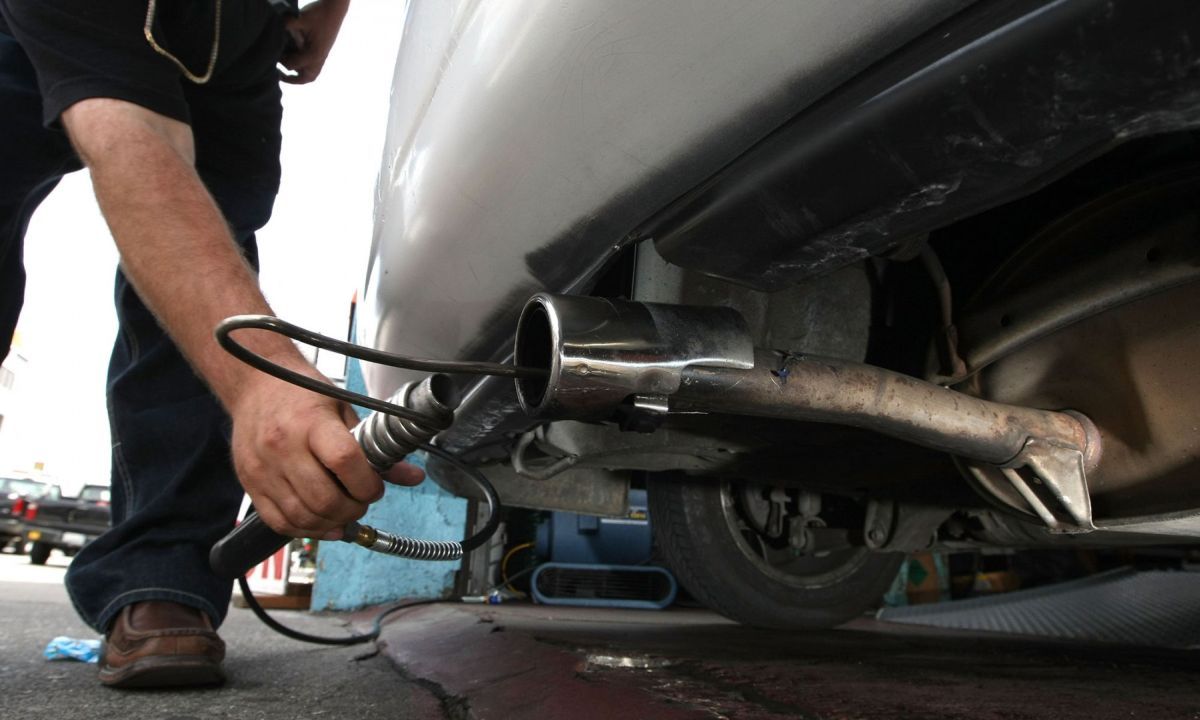
In a typical test, the vehicle is first identified and its basic condition is checked. The testing equipment is then connected to the vehicle's exhaust system or positioned to sample the exhaust gases.
The engine may be brought to its required operating temperature before measurements are taken.
For a gasoline vehicle, an emission analyzer can sample the exhaust gases and measure their concentrations.
For some vehicles, measurements may be performed while the engine is idling and/or at a specified engine speed.
What Is an Exhaust Gas Analyzer?
An exhaust gas analyzer is a device designed to measure the concentration of different gases in the exhaust.
Depending on the equipment, it can measure parameters such as CO, CO₂, HC and O₂.
The analyzer takes a sample of exhaust gas and processes it to determine the concentration of each measured component.
Modern equipment can provide the results almost immediately, allowing the technician to determine whether the vehicle is within the applicable limits.
How Is a Diesel Vehicle Tested?
Diesel emission testing can differ from gasoline vehicle testing.
Depending on the applicable procedure, diesel vehicles may be evaluated using smoke opacity or other particulate-related measurements.
Older diesel engines may produce visible black smoke when combustion is incomplete or when the engine receives too much fuel relative to the available air.
Possible causes include:
-
Dirty air filter
-
Faulty injectors
-
Turbocharger problems
-
EGR malfunction
-
Air intake restrictions
-
Excessive fuel delivery
-
Poor combustion
Modern diesel vehicles equipped with systems such as a Diesel Particulate Filter (DPF) are subject to additional emission-control requirements.
Why Does the Engine Need to Be at Operating Temperature?
Engine temperature can significantly affect exhaust emissions.
A cold engine does not operate in exactly the same way as an engine that has reached its normal operating temperature. Fuel mixture, ignition strategy, catalytic converter temperature, and emissions-control systems can all behave differently during warm-up.
For this reason, emission testing procedures commonly require the vehicle to reach an appropriate operating condition before final measurements are taken.
A vehicle that has not reached the required temperature may produce emission values that do not represent its normal operating condition.
What Does High CO Mean?
Carbon monoxide (CO) is produced when fuel does not burn completely.
A high CO reading can be associated with a mixture that is too rich, meaning there is too much fuel relative to the available oxygen.
Possible causes include:
-
Faulty oxygen sensor
-
Injector problems
-
Incorrect fuel pressure
-
Air intake measurement problems
-
Engine control problems
-
Ignition faults
The exact cause should be diagnosed using additional measurements rather than assuming that the oxygen sensor is automatically defective.
What Does High HC Mean?
Hydrocarbons (HC) represent unburned or partially burned fuel in the exhaust.
High HC emissions can indicate incomplete combustion.
Possible causes include:
-
Engine misfire
-
Worn spark plugs
-
Ignition coil problems
-
Injector faults
-
Low compression
-
Incorrect ignition timing
-
Vacuum or air intake problems
A misfiring engine can produce significantly increased HC emissions because some of the fuel entering the cylinder is not burned correctly.
What Does High CO₂ Indicate?
Carbon dioxide is a normal product of fuel combustion.
Unlike CO and HC, a high CO₂ concentration is not automatically an indication of a malfunction.
CO₂ measurements are often considered together with other exhaust gas readings because the relationship between CO₂, CO, O₂, and HC can provide information about combustion quality.
What Does High O₂ Mean?
Oxygen in the exhaust can provide information about the combustion process and possible air entering the exhaust stream.
A high O₂ reading may be associated with:
-
Lean combustion
-
Misfire
-
Exhaust leaks
-
Air entering the exhaust system
-
Certain fuel or ignition problems
An exhaust leak before the oxygen sensor or near the sampling point can sometimes influence measured values, so the entire exhaust system should be considered during diagnosis.
Can a Vehicle Fail an Emission Test Because of the Catalytic Converter?
Yes.
The catalytic converter is responsible for converting harmful exhaust gases into less harmful compounds.
A damaged, contaminated, overheated, or inefficient catalytic converter may no longer reduce emissions effectively.
Possible symptoms of a catalytic converter problem include:
-
High HC emissions
-
High CO emissions
-
Increased exhaust odor
-
Check engine light
-
Reduced engine performance in severe cases
However, replacing the catalytic converter without determining why it failed can result in the new converter developing the same problem.
For example, a persistent engine misfire can overheat and damage a catalytic converter.
Can a Check Engine Light Affect the Emission Test?
It can.
The check engine light may indicate an emissions-related fault, particularly on vehicles equipped with OBD systems.
Fault codes can be related to:
-
Oxygen sensors
-
Catalytic converter efficiency
-
EVAP system
-
EGR system
-
Misfires
-
Fuel mixture
-
Fuel system
-
Other emissions-control components
Depending on the applicable testing rules, an illuminated malfunction indicator lamp or certain stored diagnostic faults can affect the result.
Therefore, clearing fault codes immediately before an emission test is not a proper repair strategy. The underlying problem should be diagnosed and corrected.
How Does OBD Affect Emission Testing?
Modern vehicles use On-Board Diagnostics (OBD) to monitor many engine and emission-control components.
During an OBD-based inspection, a diagnostic device can communicate with the vehicle's ECU and check information such as:
-
Diagnostic trouble codes
-
Malfunction indicator status
-
Readiness monitors
-
Emission-related system status
Readiness monitors are particularly important because they indicate whether the vehicle has completed the self-tests required by its diagnostic system.
If diagnostic codes have recently been cleared or the battery has been disconnected, some readiness monitors may show as incomplete.
What Should Be Checked Before an Emission Test?
If a vehicle has a known emission problem, the problem should be diagnosed before the test.
Useful checks include:
-
Engine oil level
-
Coolant level
-
Air filter condition
-
Spark plugs
-
Ignition system
-
Fuel system
-
Oxygen sensors
-
Catalytic converter
-
EGR system
-
EVAP system
-
Exhaust leaks
-
OBD fault codes
The engine should also be in normal operating condition.
Can Poor Maintenance Increase Exhaust Emissions?
Yes.
A poorly maintained engine can produce significantly more pollutants than a properly maintained one.
For example, worn spark plugs can cause incomplete combustion, while a restricted air filter can affect the amount of air available to the engine.
Likewise, incorrect fuel delivery, vacuum leaks, malfunctioning sensors, and neglected emission-control components can increase emissions.
Regular maintenance therefore has an environmental benefit as well as a mechanical one.
What Happens If a Vehicle Does Not Pass the Emission Test?
If the measured emissions exceed the applicable limits, the vehicle may fail the inspection or emission-control check depending on the local regulations.
The next step should not simply be replacing random parts.
The measured values should be analyzed to determine the likely cause. Diagnostic trouble codes, live sensor data, fuel trims, ignition performance, exhaust condition, and other relevant parameters may need to be checked.
Once the underlying fault is repaired, the vehicle can be tested again according to the applicable procedure.
Exhaust Emissions Can Reveal Engine Problems
An emission test is more than an environmental measurement. The results can also provide valuable clues about the condition of the engine and its emission-control systems.
A vehicle with high CO, HC, or other abnormal emission values may have a problem that is not yet obvious during normal driving.
For this reason, emission measurements, OBD diagnostics, and proper mechanical inspection can work together to identify faults before they develop into more serious engine or exhaust-system problems.