TR
TR EN
EN

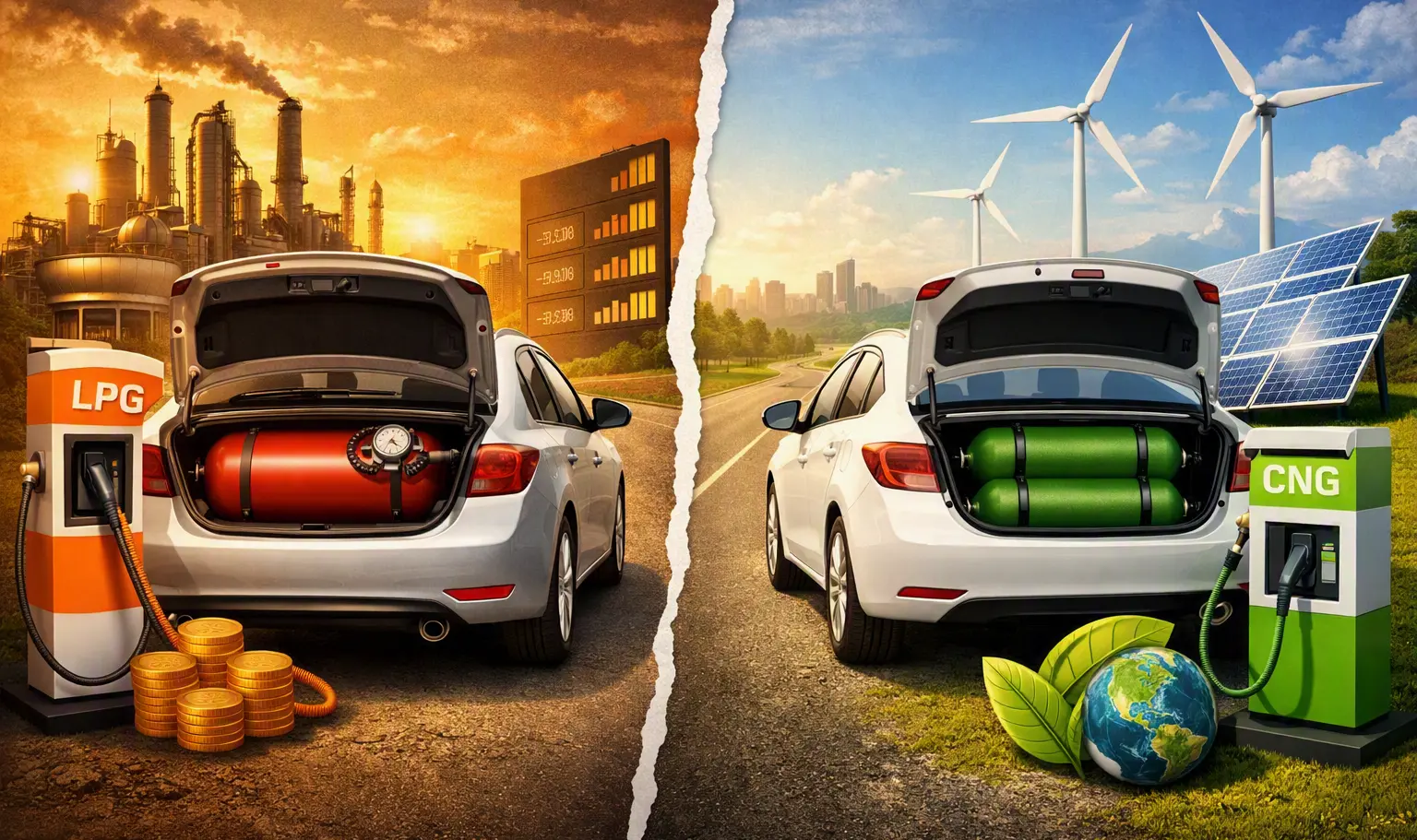
LPG vs. CNG: Which Fuel Is More Advantageous?
LPG and CNG are both widely used as alternatives to gasoline and diesel, especially in vehicles designed to reduce fuel costs and emissions. At first glance, they may seem similar because both are gaseous fuels and both can be used in internal combustion engines.
However, they are quite different in terms of storage, fuel economy, infrastructure, tank size, vehicle range, performance, safety, and availability.
For a passenger car owner, the better choice depends heavily on where the vehicle is used and how easily the fuel can be obtained.
LPG and CNG Are Not the Same Type of Fuel
LPG, or Liquefied Petroleum Gas, is mainly composed of propane and butane. It is stored in the vehicle as a liquid under pressure.
CNG, or Compressed Natural Gas, consists primarily of methane. Unlike LPG, it is stored as a compressed gas at very high pressure.
This difference affects almost everything else about the vehicle.
LPG can be stored in relatively compact tanks because it becomes liquid under pressure. CNG requires much larger and stronger high-pressure cylinders because the gas remains gaseous during storage.
That is one of the biggest practical differences between the two systems.
Which One Is Cheaper to Run?
Fuel price alone does not tell the whole story.
CNG can be very economical where natural gas is inexpensive and CNG stations are readily available. LPG can also provide a substantial reduction in fuel cost compared with gasoline, particularly in countries with a well-developed LPG market.
The actual running cost depends on:
-
Fuel price
-
Vehicle consumption
-
Engine efficiency
-
Local taxation
-
Fuel availability
-
Driving conditions
-
Conversion quality
A CNG vehicle can have excellent fuel economy, but if CNG is difficult to find in your area, the theoretical fuel-cost advantage may not be very useful.
For many private-car owners, LPG is the more practical economical fuel because of its wider availability and easier refueling.
LPG Usually Has the Infrastructure Advantage
This is one of LPG's strongest points.
LPG has been used in passenger cars for decades in many countries. As a result, there are established LPG filling stations, conversion specialists, spare parts and maintenance networks in many markets.
CNG infrastructure is more limited in many countries.
This can be a major problem for people who frequently travel long distances.
An LPG driver may be able to find several LPG stations during a journey, while a CNG driver may have to plan the route around the availability of CNG.
For daily commuting in a city with plenty of CNG stations, this may not matter much. For long-distance travel, it can make a major difference.
Which Fuel Provides Better Range?
This is where CNG has a significant disadvantage in many passenger cars.
Because CNG is stored as a compressed gas, a relatively large tank volume is required to store a useful amount of energy.
CNG cylinders are therefore often large and heavy.
LPG tanks can store more fuel energy in a relatively compact space because the fuel is stored in liquid form.
This makes LPG easier to package into a normal passenger car.
A toroidal LPG tank can also be installed in the spare-wheel well, reducing the impact on luggage space.
CNG cylinders generally require considerably more physical space.
What About the Weight of the System?
CNG systems can be relatively heavy because the cylinders must withstand very high internal pressure.
The tank has to be extremely strong, which means that the storage system can add significant weight to the vehicle.
LPG tanks are also heavy, particularly larger steel tanks, but the overall packaging is often easier for passenger cars.
For a vehicle where luggage space and weight are important, LPG generally has the more convenient packaging solution.
Which Fuel Is Better for Performance?
Neither fuel automatically makes an engine more powerful.
Both LPG and CNG have different combustion characteristics from gasoline, and the final result depends heavily on engine design and calibration.
A properly calibrated LPG system can provide performance very close to gasoline under normal driving conditions.
CNG can also provide good performance, but the fuel's characteristics and lower energy density by volume mean that the system must be properly calibrated to deliver satisfactory performance.
Turbocharged engines can be particularly sensitive to fuel-system calibration.
Poorly adjusted LPG or CNG systems can cause:
-
Hesitation
-
Loss of power
-
Rough idle
-
Increased fuel consumption
-
Misfires
-
Check-engine warnings
The quality of the conversion is often more important than the simple choice between LPG and CNG.
LPG Has an Important Advantage for Existing Gasoline Cars
LPG is particularly attractive for people who already own a gasoline-powered vehicle.
There is a large aftermarket industry for LPG conversion systems, including systems designed for modern multipoint injection and direct-injection engines.
CNG conversions are also possible, but the vehicle-specific installation requirements and packaging challenges can make them less attractive for a typical private passenger car.
For someone looking at an existing gasoline vehicle and asking, “Which alternative fuel can I realistically convert it to?”, LPG will often be the easier option.
CNG Can Be Attractive for Factory-Built Vehicles
CNG becomes more interesting when the vehicle is designed for it from the beginning.
Factory-built CNG vehicles can integrate:
-
High-pressure cylinders
-
Fuel lines
-
Pressure regulators
-
Injectors
-
Engine calibration
-
Safety systems
into the vehicle architecture.
This can produce a much better result than attempting to retrofit a system into a vehicle that was never designed to accommodate large CNG cylinders.
This is one reason CNG has traditionally been more attractive in fleets, buses, commercial vehicles and some factory-produced passenger cars.
Which One Is Better for the Environment?
Both fuels can reduce certain emissions compared with conventional gasoline or diesel operation, but the comparison is not simply “LPG is clean and CNG is cleaner.”
CNG is primarily methane and can produce relatively low carbon dioxide emissions per unit of energy because methane has a favorable hydrogen-to-carbon ratio.
However, methane itself is a powerful greenhouse gas. Any leakage during production, transportation, storage or distribution can affect the overall climate benefit.
LPG generally produces lower greenhouse-gas emissions than gasoline on a fuel-energy basis, but its environmental advantage depends on the fuel source, vehicle efficiency and operating conditions.
Modern emissions systems have also made the differences between fuels more complicated than they were in older vehicles.
Which One Is Safer?
Both LPG and CNG systems can be safe when properly designed, approved, installed and maintained.
The two fuels behave differently when released.
CNG is lighter than air. If released outdoors, it tends to rise and disperse.
LPG is heavier than air. A leak can accumulate near the ground or in low areas if ventilation is poor.
This difference is particularly important in enclosed spaces.
For both fuels, the most important safety factors are:
-
Approved components
-
Correct installation
-
Proper tank mounting
-
Correct fuel lines
-
Functional shut-off systems
-
Regular inspection
-
Undamaged tanks
-
Qualified maintenance
A poorly installed system can be dangerous regardless of whether it uses LPG or CNG.
What About Refueling?
LPG refueling is generally straightforward and similar in duration to conventional fuel refueling.
CNG refueling can take longer depending on the station equipment and filling pressure.
There are also different types of CNG filling systems, including fast-fill and time-fill systems. This makes refueling experience more dependent on the infrastructure available.
For private motorists who want the simplest refueling experience, LPG generally has the advantage.
CNG Has a Strong Position in Fleets
CNG can make more sense for vehicles that return to a fixed location regularly.
Buses, taxis, delivery fleets and commercial vehicles can benefit because a company can install or access dedicated CNG infrastructure.
A fleet operator can plan fuel consumption and refueling much more easily than an individual driver traveling between different cities.
This changes the economics significantly.
For a private driver, fuel availability may be the deciding factor.
For a fleet operator, fuel cost and predictable centralized refueling may make CNG much more attractive.
LPG Tanks Are Easier to Package in Passenger Cars
One of LPG's biggest practical advantages is tank design.
A toroidal LPG tank can often replace the spare wheel or be positioned in a relatively compact area.
CNG cylinders generally need more space and have less freedom in terms of shape because of the pressure they must withstand.
This can affect:
-
Trunk capacity
-
Ground clearance
-
Vehicle weight
-
Tank placement
-
Number of cylinders
-
Available driving range
For a normal family car, LPG usually integrates more easily.
Maintenance Is Important for Both
Neither LPG nor CNG should be considered a “fit and forget” fuel system.
LPG systems may require attention to:
-
LPG filters
-
Injectors
-
Regulator
-
Pressure and temperature sensors
-
Multivalve
-
Fuel lines
-
Electrical connections
-
LPG ECU calibration
CNG systems have their own maintenance requirements, including:
-
High-pressure lines
-
Pressure regulators
-
Injectors
-
Valves
-
Pressure sensors
-
Cylinders
-
Safety components
CNG cylinders deserve particular attention because they operate at very high pressure.
Their inspection and service requirements must be followed according to the applicable regulations and cylinder certification.
Which Fuel Is Better for Cold Weather?
Both systems can work well in cold conditions when properly designed.
LPG systems use a regulator/vaporizer to convert liquid LPG into gas before it reaches the engine. The vaporization process is therefore closely connected to the engine's cooling system.
CNG is already gaseous, so it does not require the same vaporization process.
However, pressure regulation, fuel quality, temperature and calibration still affect CNG operation.
A properly maintained modern system should not normally have major cold-start problems simply because the vehicle uses LPG or CNG.
LPG vs. CNG for Long-Distance Driving
For long-distance private-car use, LPG usually has the practical advantage.
The reason is simple:
availability and packaging.
Even if CNG offers an attractive fuel cost in a particular market, limited station coverage can make long trips inconvenient.
LPG generally provides a more predictable refueling network in countries where LPG is widely used.
CNG becomes much more attractive when the driver knows exactly where CNG stations are located along the route.
So, Which One Should You Choose?
There is no universal winner.
LPG is generally the better choice for:
-
Private passenger cars
-
Existing gasoline vehicles
-
Drivers who want an aftermarket conversion
-
People who need a wide refueling network
-
Drivers who want relatively compact fuel storage
-
Long-distance road travel
-
Vehicles where trunk space matters
CNG can be the better choice for:
-
Fleet vehicles
-
Buses and commercial vehicles
-
Vehicles with factory-designed CNG systems
-
Drivers living in areas with extensive CNG infrastructure
-
Users who can refuel at a dedicated or convenient CNG station
-
Applications where centralized refueling is possible
The Most Important Question Is Not LPG or CNG
Before choosing either fuel, it is better to ask:
Which fuel is actually practical for my vehicle and where I drive it?
A fuel that is theoretically cheaper is not necessarily the better option if the nearest filling station is far away.
Likewise, a fuel with excellent emissions characteristics may not be practical if the conversion requires sacrificing too much luggage space or if qualified service is unavailable.
For most private gasoline passenger cars in markets with a mature LPG network, LPG remains the more practical alternative fuel.
CNG becomes increasingly attractive when the vehicle is factory-designed for it and the local infrastructure is strong enough to make regular refueling convenient.