TR
TR EN
EN

What Is a CVT Transmission? How Does It Work?
A CVT (Continuously Variable Transmission) is an automatic transmission that can continuously change its transmission ratio instead of using a fixed number of gears such as 6-speed, 8-speed, or 10-speed automatic transmissions.
The main characteristic of a CVT is that it does not have conventional fixed gear steps. Instead, it continuously adjusts the relationship between engine speed and wheel speed according to driving conditions.
This allows the engine to operate closer to its most efficient or most effective RPM range.
How Does a CVT Transmission Work?
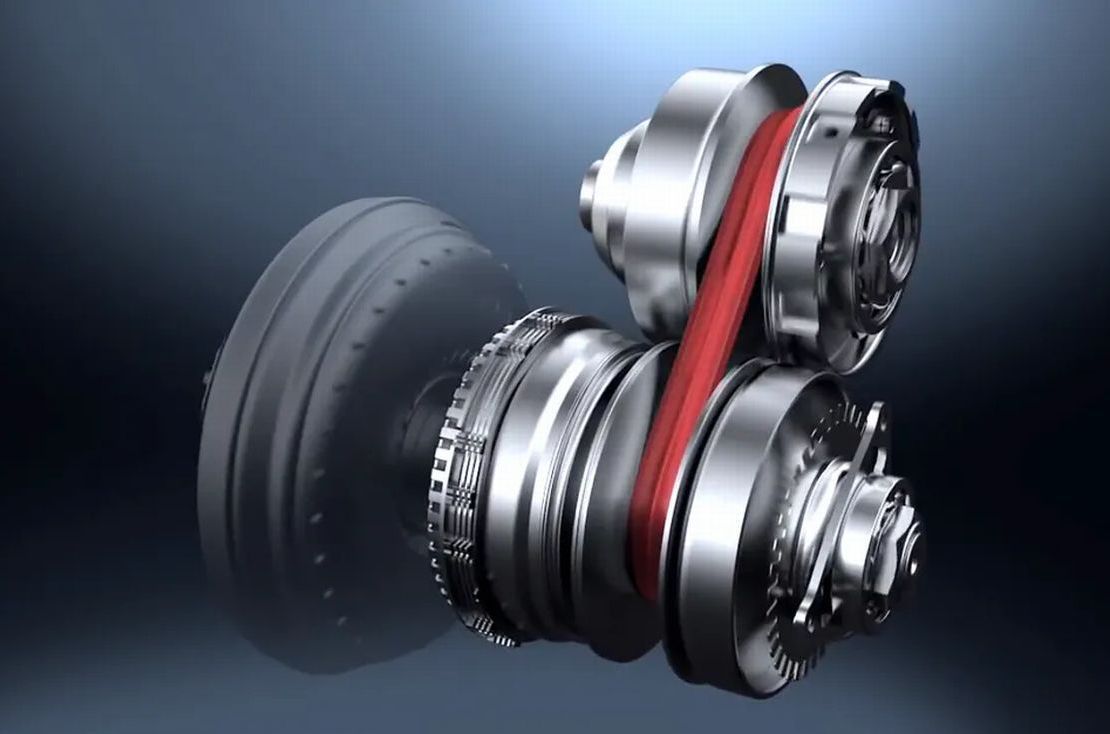
The operating principle of a traditional CVT is based mainly on two variable-diameter pulleys and a flexible steel belt or chain.
The two pulleys are:
-
Primary pulley: Connected to the engine through the transmission input.
-
Secondary pulley: Connected to the differential and ultimately the drive wheels.
The belt or chain transfers power from one pulley to the other.
Each pulley consists of two conical faces that can move closer together or farther apart.
When the ECU or hydraulic control system changes the position of these pulley halves, the effective diameter at which the belt runs changes.
This continuously changes the transmission ratio.
How Does the CVT Change Its Ratio?

Think of the two pulleys as variable-sized gears.
When the engine needs more pulling power, the transmission can make the primary pulley effectively smaller and the secondary pulley effectively larger.
This creates a low transmission ratio, similar to using a low gear in a conventional automatic transmission.
When the vehicle reaches higher speeds, the pulley diameters are adjusted in the opposite direction.
The primary pulley becomes effectively larger while the secondary pulley becomes effectively smaller.
This creates a higher transmission ratio, allowing the vehicle to travel faster while keeping engine speed relatively low.
The important difference is that this transition happens continuously rather than through individual gear changes.
Why Doesn't a CVT Have Fixed Gears?
A conventional automatic transmission uses separate gear sets to create ratios such as:
1st gear
2nd gear
3rd gear
4th gear
5th gear
6th gear
A CVT does not need these fixed steps.
Instead, it can select almost any ratio within its available operating range.
For example, rather than changing directly from one fixed ratio to another, the transmission can gradually move through the required ratios.
This is why CVT-equipped vehicles can feel very different from conventional automatic transmissions.
What Happens During Acceleration?
One of the most noticeable characteristics of a CVT can be seen during hard acceleration.
When the driver presses the accelerator, the CVT may immediately raise the engine speed to an RPM where the engine can produce strong torque or power.
The transmission then continuously changes its ratio while keeping the engine around that RPM.
As a result, the engine speed may remain relatively constant while the vehicle continues to accelerate.
This produces the characteristic "engine drone" or "rubber-band" feeling that some drivers notice with CVT transmissions.
Modern CVTs often use software programming to simulate conventional gear changes and make this behavior feel more familiar.
What Is the Purpose of the CVT Belt or Chain?
The belt or chain is one of the most important components inside a CVT.
It transfers torque between the two variable pulleys.
Unlike a simple rubber belt, the steel belts and chains used in modern CVTs are specially designed to withstand substantial loads.
Depending on the transmission design, power can be transmitted through:
-
A steel push belt
-
A chain-type system
-
Other specialized flexible drive elements
The belt and pulley surfaces must maintain the correct clamping force. If the belt slips, serious transmission damage can occur.
How Are the CVT Pulleys Controlled?
The pulley positions are controlled through a combination of hydraulic pressure, electronic solenoids, sensors, and transmission-control software.
The transmission control system monitors information such as:
-
Vehicle speed
-
Engine RPM
-
Accelerator-pedal position
-
Engine torque
-
Transmission temperature
-
Pulley speed
-
Hydraulic pressure
-
Selected driving mode
-
Brake-pedal status
Based on this information, the transmission control module determines the appropriate ratio.
Hydraulic pressure then moves the pulley halves to change the effective pulley diameters.
What Is the Role of CVT Transmission Fluid?
CVT fluid is extremely important because it performs several functions simultaneously.
It provides:
-
Lubrication
-
Cooling
-
Hydraulic pressure
-
Friction control
-
Protection of the belt and pulley surfaces
CVT transmissions are particularly sensitive to the characteristics of their fluid.
Using the wrong transmission fluid can cause changes in friction characteristics and may lead to:
-
Belt slip
-
Shudder
-
Abnormal noise
-
Poor ratio control
-
Accelerated wear
For this reason, the manufacturer's specified CVT fluid should be used.
Is CVT Fluid the Same as Automatic Transmission Fluid?
Not necessarily.
A CVT generally requires a specific fluid formulated for its belt/chain and pulley system.
Although both conventional automatic transmissions and CVTs use transmission fluid, their friction and lubrication requirements can be different.
Using conventional ATF in a CVT when the manufacturer specifies dedicated CVT fluid can cause serious problems.
The correct fluid specification should always be confirmed for the particular transmission.
What Are the Advantages of a CVT?
CVTs offer several potential advantages.
Smooth acceleration
Because there are no conventional gear changes, acceleration can be very smooth.
Good fuel efficiency
The transmission can keep the engine operating in an efficient RPM range, particularly during steady driving.
Continuous ratio adjustment
The transmission can select a ratio more precisely than a conventional transmission with a limited number of fixed gears.
Reduced shift shock
Since there are no traditional gear changes, the driver does not normally feel conventional upshifts and downshifts.
Efficient urban driving
A CVT can continuously adjust the ratio during frequent acceleration and deceleration, which can be beneficial in city traffic.
What Are the Disadvantages of a CVT?
CVTs also have limitations.
Some drivers dislike the engine behavior during hard acceleration because the engine RPM can rise quickly and remain high while road speed continues to increase.
Other possible disadvantages include:
-
Sensitivity to fluid condition
-
Belt or chain wear
-
Pulley wear
-
Expensive repairs
-
Shudder or vibration when problems develop
-
Heat sensitivity in some applications
-
Limited tolerance for excessive torque in certain CVT designs
However, CVT reliability varies greatly between transmission models. It is not accurate to assume that every CVT is unreliable.
Why Does a CVT Sometimes Feel Like It Is Slipping?
A properly operating CVT should not continuously slip.
The sensation of slipping can sometimes be a normal characteristic of CVT operation because the engine and transmission are intentionally allowed to operate at different speeds while the ratio changes.
However, actual belt slip is a fault condition.
Possible causes include:
-
Incorrect or degraded fluid
-
Low fluid level
-
Excessive belt or pulley wear
-
Hydraulic pressure problems
-
Faulty pressure-control solenoid
-
Internal transmission damage
-
Control-system problems
If the engine RPM rises sharply without a corresponding increase in vehicle speed, the transmission should be inspected.
What Causes CVT Shudder?
A CVT shudder is usually felt as a vibration or judder during acceleration, low-speed driving, or when the transmission is changing ratio.
Potential causes include:
-
Degraded CVT fluid
-
Incorrect fluid
-
Belt or pulley wear
-
Hydraulic pressure problems
-
Valve-body problems
-
Transmission-control problems
-
Excessive internal wear
A shudder does not automatically mean the entire transmission needs to be replaced.
Proper diagnosis should determine whether the problem is related to fluid, control pressure, software, or mechanical components.
What Are the Symptoms of CVT Failure?
A failing CVT can produce several warning signs.
Common symptoms include:
-
Delayed acceleration
-
Engine RPM rising without normal acceleration
-
Shuddering during acceleration
-
Jerking or vibration
-
Whining or humming noises
-
Transmission overheating
-
Loss of drive
-
Difficulty moving from a stop
-
Transmission warning light
-
Check Engine Light
-
Limp mode
-
Abnormal engine RPM behavior
-
Difficulty maintaining a consistent transmission ratio
Not every symptom means the CVT itself is mechanically damaged. Electronic, sensor, fluid, and hydraulic problems can create similar symptoms.
Why Does a CVT Overheat?
Heat is one of the major concerns for any continuously variable transmission.
During heavy operation, the CVT fluid must lubricate and cool the internal components while also maintaining the hydraulic pressure necessary to clamp the belt or chain.
Excessive heat can result from:
-
Heavy towing
-
Continuous uphill driving
-
Aggressive acceleration
-
Insufficient transmission cooling
-
Low fluid level
-
Incorrect fluid
-
Internal mechanical problems
-
Restricted transmission cooler
Excessive fluid temperature can accelerate fluid degradation and internal wear.
Many modern vehicles therefore have temperature sensors and protective strategies that can reduce transmission performance when the CVT becomes too hot.
Does a CVT Have Reverse Gear?
Yes.
Although the forward driving ratios are continuously variable, the transmission still needs a mechanism to provide reverse rotation.
Many CVTs use a planetary gearset and associated clutch mechanism to provide reverse operation.
Therefore, "CVT has no gears" does not mean that the transmission contains no gears or gearsets at all. The continuously variable portion of the transmission is based on the variable pulley system, while other mechanical components may still be used for reverse and other functions.
What Is a CVT With a Torque Converter?
Not every CVT uses exactly the same launch mechanism.
Some CVTs use a torque converter to connect the engine to the transmission during initial movement, while other designs use different clutch arrangements.
A torque converter can provide smooth vehicle launch and allow the engine to remain running while the vehicle is stationary.
The exact configuration depends on the manufacturer and transmission design.
What Is a CVT With a Launch Clutch?
Some CVTs use a starting clutch instead of a conventional torque converter.
The clutch gradually connects engine power to the transmission as the vehicle begins moving.
This design can reduce mechanical complexity in certain applications, but it introduces another component that must be correctly controlled.
Problems with the launch clutch can produce symptoms such as:
-
Judder when moving away
-
Shaking at low speeds
-
Delayed engagement
-
Harsh engagement
What Is an e-CVT?
An e-CVT used in many hybrid vehicles is fundamentally different from a conventional belt-and-pulley CVT.
A hybrid e-CVT can use an electrically controlled power-split system involving:
-
Planetary gearsets
-
Electric motor-generators
-
Internal combustion engine
-
Hybrid battery
-
Power electronics
Toyota's hybrid system is a well-known example of a power-split transmission that is commonly described as an e-CVT.
It does not use the same steel belt-and-variable-pulley mechanism found in many conventional CVTs.
This distinction is important because the term "CVT" can refer to significantly different transmission technologies.
How Long Does a CVT Last?
There is no universal CVT lifespan.
Service life depends on:
-
Transmission design
-
Vehicle weight
-
Engine torque
-
Driving style
-
Fluid maintenance
-
Operating temperature
-
Towing
-
Road conditions
-
Manufacturing quality
A well-maintained CVT can provide many years of service, while a transmission exposed to excessive heat, incorrect fluid, heavy loads, or neglected maintenance may develop problems much earlier.
The manufacturer's maintenance recommendations are therefore more important than a single mileage figure.
Does a CVT Need an Oil Change?
The answer depends on the manufacturer and transmission.
Some manufacturers specify regular CVT fluid replacement, while others describe the fluid as long-life under normal conditions.
Even when a manufacturer does not specify a frequent replacement interval, the condition and level of the fluid remain important.
If a CVT requires fluid replacement, the correct procedure and fluid specification should be followed carefully.
A CVT should not be serviced using generic assumptions based on conventional automatic transmissions.
Is a CVT Good for Long-Distance Driving?
A CVT can be very comfortable on long journeys.
At steady highway speeds, the transmission can select a relatively high ratio and keep engine RPM low.
This can contribute to:
-
Quiet cruising
-
Smooth acceleration
-
Good fuel economy
-
Reduced unnecessary gear changes
The experience depends on the specific vehicle, engine, CVT calibration, and road conditions.
Is a CVT Good for City Driving?
CVTs can work particularly well in urban environments because they continuously adjust the transmission ratio as traffic speed changes.
Instead of repeatedly shifting through multiple fixed gears, the CVT can smoothly move between ratios.
This can make stop-and-go driving comfortable.
However, frequent low-speed acceleration and heavy traffic can also generate considerable heat, making proper transmission cooling and fluid condition important.
Can a CVT Be Repaired?
Yes, depending on the failure.
Some CVT problems can be repaired by addressing:
-
Fluid problems
-
Solenoids
-
Sensors
-
Valve-body issues
-
Cooling-system problems
-
Control-system faults
-
Software or calibration issues
More severe mechanical failures may require replacement or rebuilding of components such as:
-
Belt or chain
-
Pulleys
-
Bearings
-
Clutches
-
Planetary components
In some cases, replacing the complete transmission may be more practical than rebuilding it.
Final Thoughts
A CVT (Continuously Variable Transmission) is an automatic transmission designed to provide continuously variable transmission ratios instead of relying on a fixed number of conventional gears.
Its main components in a traditional belt-type design are the primary pulley, secondary pulley, and steel belt or chain. By changing the effective diameter of the pulleys, the transmission can continuously adjust the ratio according to engine load, vehicle speed, and driver demand.
The main advantages of a CVT are smooth operation, efficient engine-speed management, and potentially good fuel economy. Its disadvantages can include sensitivity to fluid condition, heat, internal wear, and a driving feel that some drivers find unusual.
It is also important to remember that not all CVTs use the same technology. A conventional belt-driven CVT and a hybrid e-CVT can have very different internal designs and operating principles.
When properly maintained and operated within its design limits, a CVT can be an efficient, comfortable, and durable transmission.