TR
TR EN
EN

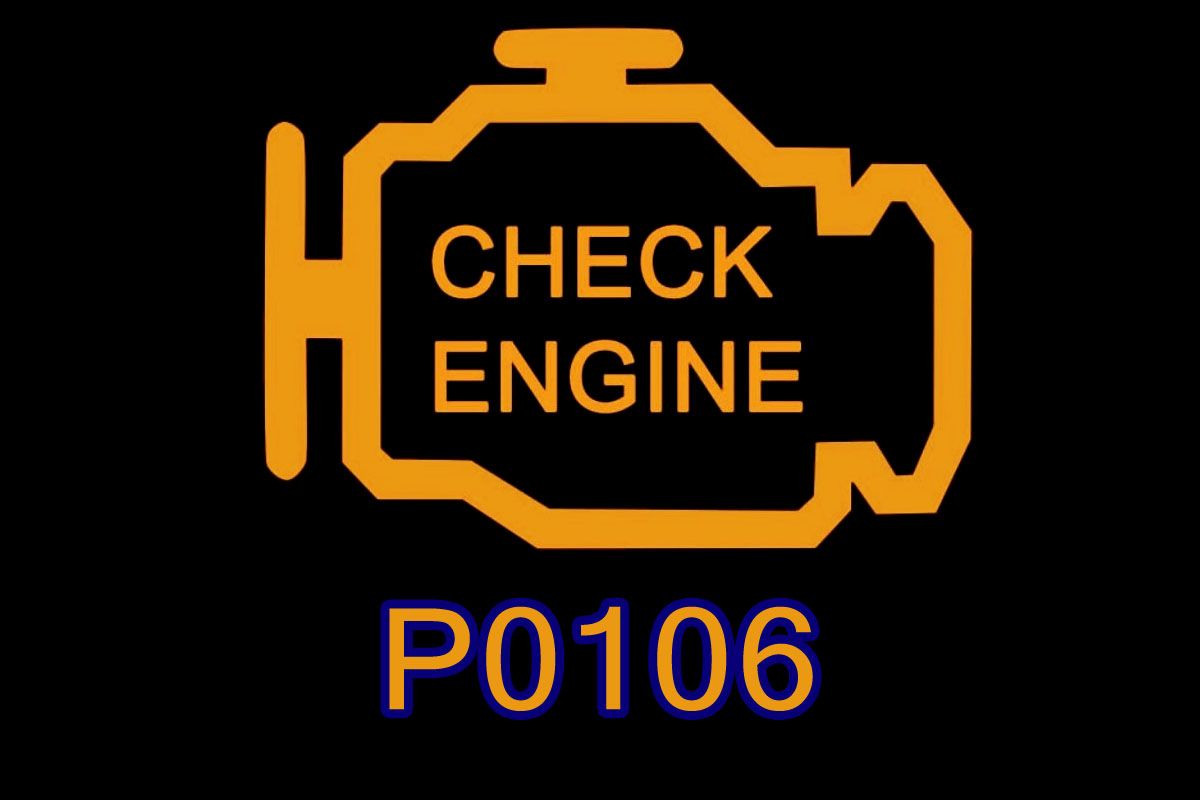
P0106 MAP / BARO Sensor Circuit Range/Performance Problem
P0106 is set when the engine control module (ECM/PCM) determines that the MAP/BARO sensor signal is not behaving within the expected range for the engine's current operating conditions.
Unlike a code that simply identifies a high or low electrical input, P0106 is mainly about plausibility. The signal may be electrically present, but the value reported by the sensor does not make sense when the ECU compares it with engine speed, throttle position, airflow and other information.
Why the MAP signal is important
The MAP sensor measures pressure in the intake manifold.
The ECU uses this information to estimate engine load and make decisions about:
-
Fuel injection
-
Ignition timing
-
Idle control
-
EGR operation
-
Turbocharger control on applicable engines
-
Emissions management
The sensor therefore needs to respond predictably as engine conditions change.
If the throttle opens, for example, manifold pressure should change accordingly. If the ECU sees a MAP value that does not correspond to what the engine is doing, it can set P0106.
What does “Range/Performance” mean?
This wording can be confusing.
It does not necessarily mean that the MAP sensor voltage is simply too high or too low.
Instead, the ECU is essentially asking:
“Does this pressure reading make sense right now?”
If the answer is no, P0106 may be stored.
For example, the ECU may see:
-
A MAP value that does not correspond to throttle position
-
A pressure reading inconsistent with engine RPM
-
An implausible change in manifold pressure
-
A MAP reading that disagrees significantly with other airflow information
-
A sensor response that is too slow or otherwise abnormal
The sensor can therefore produce a voltage that is technically within its electrical range and still trigger P0106.
MAP sensor behavior in a naturally aspirated engine
On a naturally aspirated engine, manifold pressure changes considerably depending on throttle position and engine load.
At idle, the throttle is mostly closed and manifold pressure is substantially below atmospheric pressure.
When the throttle opens, more air enters the engine and manifold pressure rises.
During wide-open throttle, manifold pressure can approach atmospheric pressure, depending on engine speed and operating conditions.
The MAP signal should follow these changes in a predictable way.
If the engine is idling normally but the MAP value suddenly indicates a high-load condition, there is a discrepancy that the ECU may recognize as a range/performance problem.
Turbocharged engines require a different interpretation
Turbocharged engines can operate with manifold pressure above atmospheric pressure.
The MAP sensor must therefore be capable of measuring the pressure range required by that engine.
A MAP sensor with the wrong specification, a pressure leak, incorrect sensor installation or a boost-control problem can create readings that do not agree with the ECU's expectations.
On turbocharged vehicles, boost-related problems should therefore be considered when investigating P0106.
Common causes of P0106
There is no single component responsible for this code.
Possible causes include:
Faulty MAP sensor
The sensor may have become inaccurate, contaminated or internally damaged.
Blocked MAP pressure port
Oil deposits, carbon or other contamination can interfere with the pressure reaching the sensing element.
Vacuum or intake leak
An unexpected air leak can alter manifold pressure and cause the MAP reading to disagree with the ECU's expected values.
Damaged MAP wiring
A damaged signal, power or ground circuit can distort the sensor output.
Poor connector contact
Corrosion, loose terminals or moisture can cause unreliable sensor operation.
Incorrect sensor installation
A sensor that is not properly seated or uses an incorrect seal can experience pressure-related problems.
Exhaust restriction
A restricted exhaust can affect engine breathing and create unusual manifold-pressure behavior.
Throttle-body problem
A throttle that does not open or close as expected can produce MAP values inconsistent with commanded throttle position.
EGR problem
An EGR valve that remains open when it should be closed can significantly alter intake pressure and airflow.
Incorrect MAF information
On engines equipped with both MAP and MAF sensors, discrepancies between the two can contribute to plausibility faults.
Engine mechanical problem
Valve timing, compression or other mechanical problems can change the pressure behavior of the intake manifold.
The easiest place to start: live data
P0106 is often best approached using a scan tool.
Instead of immediately removing the MAP sensor, observe the pressure reading while changing engine operating conditions.
Watch what happens when:
-
The engine is switched on
-
The engine idles
-
The throttle is opened slightly
-
The throttle is opened quickly
-
The engine is held at higher RPM
-
The throttle is released
The MAP value should change in a way that corresponds to what the engine is actually doing.
A sudden, implausible jump is a useful clue.
Check MAP with the engine off
With the ignition on and engine not running, the pressure inside the intake manifold should generally be close to atmospheric pressure.
This provides a useful reference point.
If the MAP reading is already highly implausible before the engine starts, attention should move toward:
-
MAP sensor
-
Sensor wiring
-
Power supply
-
Ground
-
Incorrect sensor calibration
-
Wrong sensor application
Atmospheric pressure changes with altitude and weather, so the comparison does not need to be exact.
Watch the signal during acceleration
When the throttle is opened, manifold pressure should respond.
A MAP sensor that remains almost unchanged despite significant throttle changes deserves investigation.
Likewise, a signal that suddenly jumps to an implausible value can indicate an electrical or sensor problem.
A scan tool's refresh rate should also be considered. Very rapid changes may not be displayed perfectly.
Compare MAP with throttle position
Throttle position is particularly useful for plausibility testing.
For example, if the throttle position indicates a relatively closed throttle but the MAP reading indicates extremely high manifold pressure, the two pieces of information may not agree.
Possible explanations include:
-
MAP sensor fault
-
Wiring problem
-
Throttle problem
-
Vacuum leak
-
Engine operating abnormality
The important point is that the ECU does not evaluate the MAP sensor completely in isolation.
Compare MAP and MAF when available
Vehicles equipped with both sensors provide another diagnostic opportunity.
The MAF measures the amount of air entering the engine, while the MAP sensor measures intake pressure.
Their values are related to engine load but are not interchangeable.
If the MAP reading indicates one operating condition while MAF and throttle data indicate something completely different, the discrepancy can help identify the problem.
This does not automatically mean either sensor is defective.
Inspect the MAP sensor itself
Remove and inspect the sensor according to the manufacturer's procedure.
Look for contamination around the pressure port.
Common contaminants include:
-
Oil
-
Dirt
-
Carbon deposits
-
Moisture
If the pressure passage is blocked, the sensor may not accurately detect changes in manifold pressure.
Avoid using aggressive cleaning chemicals on the sensor unless the manufacturer specifically permits cleaning. The sensing element is delicate.
Check the electrical side
A MAP sensor generally requires an electrical supply, a ground/return and a signal circuit, although the exact configuration varies.
Check:
-
Sensor supply voltage
-
Ground/return quality
-
Signal voltage
-
Connector condition
-
Wiring continuity
-
Signal-wire resistance
-
Possible shorts
The manufacturer's wiring diagram and specifications should be used for these tests.
A good power supply does not guarantee a good sensor signal
It is possible to have:
-
Correct power
-
Correct ground
-
Intact wiring
and still have a defective MAP sensor.
The internal sensing element may produce an incorrect output even though the basic electrical circuits appear healthy.
Conversely, a perfectly good MAP sensor can report incorrectly at the ECU because of a damaged signal wire.
Testing the complete circuit is therefore more reliable than replacing the sensor based solely on the code.
Vacuum leaks can complicate diagnosis
A vacuum leak can change manifold pressure and therefore change the MAP reading.
Look at:
-
Vacuum hoses
-
Intake manifold gasket
-
Throttle-body gasket
-
PCV system
-
Brake-booster hose
-
Intake ducting
A smoke test can be useful when a vacuum or intake leak is suspected.
The presence of a vacuum leak does not automatically mean the MAP sensor is faulty.
EGR problems can affect MAP
If the engine is equipped with EGR, an EGR valve that does not operate correctly can alter intake pressure and airflow.
An EGR valve stuck open can produce:
-
Rough idle
-
Poor acceleration
-
Stalling
-
Unusual MAP readings
If P0106 appears together with EGR-related symptoms or codes, the EGR system deserves attention.
Throttle body problems
The throttle plate has a direct influence on manifold pressure.
A malfunctioning electronic throttle can therefore create a situation in which the MAP value and commanded throttle position do not agree.
Possible problems include:
-
Dirty throttle body
-
Sticking throttle plate
-
Throttle actuator fault
-
Throttle-position sensor problem
-
Wiring fault
If throttle-related DTCs are also present, they should be investigated.
Mechanical engine problems
Not every P0106 is caused by an electronic sensor.
Engine mechanical problems can change the pressure pattern inside the intake manifold.
Possible causes include:
-
Incorrect valve timing
-
Valve-train problems
-
Low compression
-
Valve leakage
-
Camshaft timing problems
If the MAP signal appears physically plausible electrically but the engine's pressure behavior is abnormal, mechanical testing may be necessary.
Can a dirty air filter cause P0106?
A severely restricted air filter can affect engine airflow, but it is not one of the first things to blame for P0106.
The filter should certainly be inspected during a general diagnosis, but a MAP range/performance code requires examination of the sensor signal and the engine's actual pressure behavior.
Can a bad MAP sensor cause poor fuel economy?
Yes.
The ECU uses MAP information to calculate engine load and control several aspects of engine operation.
If the sensor consistently reports an incorrect pressure, the ECU may make incorrect fuel and ignition decisions.
Possible consequences include:
-
Increased fuel consumption
-
Poor acceleration
-
Rough idle
-
Hesitation
-
Reduced performance
The severity depends on how far the MAP information has deviated from reality.
Is P0106 serious?
P0106 is usually not an indication of immediate catastrophic engine damage.
However, the engine may not operate correctly if the ECU cannot reliably determine engine load.
More serious symptoms can include:
-
Engine stalling
-
Significant loss of power
-
Severe hesitation
-
Poor throttle response
If the vehicle becomes unpredictable during acceleration or repeatedly stalls, it should be diagnosed promptly.
When should the MAP sensor be replaced?
The sensor should not be replaced solely because P0106 is stored.
Replacement becomes reasonable when testing shows that:
-
The sensor has the correct power supply
-
The ground/return is correct
-
The wiring is intact
-
The connector is good
-
The intake pressure is behaving normally
-
The sensor's output is inaccurate or implausible
If the MAP sensor produces the correct signal but the ECU receives something different, the wiring or ECU-side circuit needs to be investigated.
Clearing the code is not the repair
After the underlying problem has been corrected, clear the DTC and perform a road test.
Monitor the MAP value during:
-
Idle
-
Acceleration
-
Cruising
-
Deceleration
-
Different engine loads
The goal is to confirm that the sensor continues to respond plausibly and that P0106 does not return.
Final takeaway
P0106 means the ECU considers the MAP/BARO sensor signal implausible for the engine's current operating conditions.
The sensor may be faulty, but the real cause can also be a vacuum leak, throttle problem, wiring fault, blocked pressure passage, EGR issue, MAF/MAP discrepancy, exhaust restriction or even an engine mechanical problem.
The most valuable diagnostic clue is the relationship between MAP pressure and what the engine is actually doing.
If the MAP reading follows changes in throttle and engine load logically, the sensor is probably providing useful information. If the reading does not make physical or electrical sense, the sensor and its complete circuit should be investigated.