TR
TR EN
EN

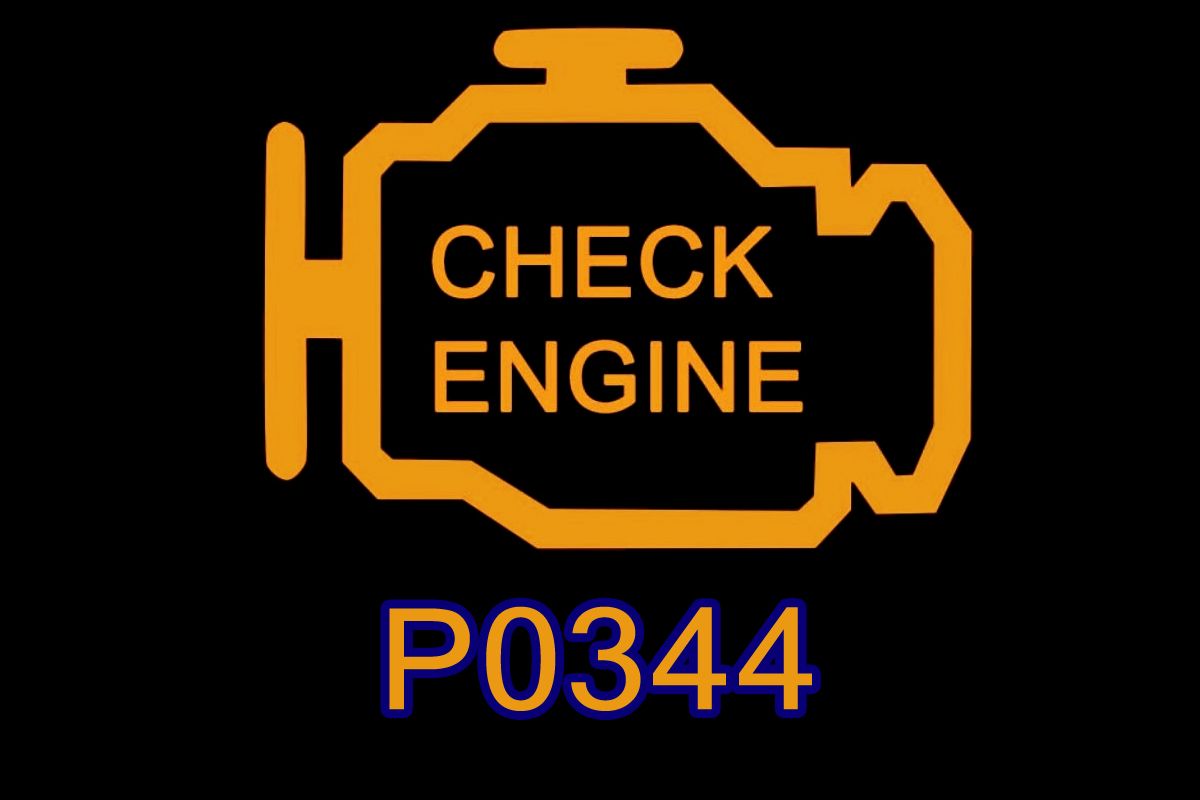
P0344 Camshaft Position Sensor "A" Circuit Intermittent (Bank 1)
The P0344 diagnostic trouble code (DTC) means that the engine control module (ECM/PCM) has detected an intermittent signal from Camshaft Position Sensor “A” on Bank 1.
In practical terms, the ECM expects a stable and predictable camshaft position signal, but the signal is occasionally disappearing, becoming unstable, or behaving differently from what the engine computer expects.
The word “intermittent” is the key to understanding this code. The sensor may work perfectly for several minutes or several hundred kilometers and then briefly lose its signal. The problem may appear only when the engine is hot, during acceleration, at a particular RPM, or when engine vibration causes movement in the wiring harness.
P0344 does not automatically mean that the camshaft position sensor is defective. The sensor, connector, wiring, power supply, ground, camshaft trigger, VVT system, mechanical timing, or in rare cases the ECM can all be involved.
What Does P0344 Mean?
The camshaft position sensor tells the ECM where the camshaft is in its rotational cycle.
The ECM uses this information together with crankshaft position information to control and monitor several engine functions, including:
-
Fuel injection timing
-
Ignition timing
-
Camshaft/crankshaft synchronization
-
Variable valve timing (VVT)
-
Misfire detection
-
Engine starting
-
Camshaft position control
When the signal from Camshaft Position Sensor A, Bank 1 becomes unreliable or disappears intermittently, the ECM can store P0344.
The code does not necessarily mean that the signal is completely absent. Even a brief interruption can be enough for the ECM to recognize an intermittent fault.
What Does “Intermittent” Mean?
An intermittent signal is one that is sometimes correct and sometimes incorrect.
For example, a vehicle might:
-
Start normally
-
Idle normally
-
Drive normally for several minutes
-
Suddenly hesitate
-
Trigger the Check Engine Light
-
Continue running
-
Then operate normally again after restarting
The problem may also be temperature-dependent.
A camshaft sensor can work correctly when cold and begin producing an unstable signal after the engine compartment becomes hot.
Likewise, a damaged wire may maintain electrical contact while the vehicle is stationary but lose contact when the engine moves during acceleration.
What Is Camshaft Position Sensor “A”?
Sensor A is a manufacturer-specific designation.
Many modern engines have more than one camshaft position sensor. For example, an engine with separate intake and exhaust camshafts may use different sensors for each camshaft.
Sensor A may represent the intake camshaft on some engines, but this is not a universal rule.
The exact sensor should therefore be identified using the vehicle's service information or wiring diagram.
What Does Bank 1 Mean?
Bank 1 is the cylinder bank containing cylinder number 1.
On engines with two cylinder banks, such as V6 and V8 engines, this distinction is important because there is also a Bank 2.
The physical location of Bank 1 depends on the engine design.
On an inline engine, there is normally only one cylinder bank, so it is generally considered Bank 1.
Common Causes of P0344
There are several possible causes, and intermittent faults often require more careful diagnosis than permanent circuit failures.
Failing camshaft position sensor
The sensor may have an internal electronic fault that causes its signal to drop out occasionally.
Heat can be particularly important. Some sensors function normally when cold but fail as their internal electronics heat up.
Damaged wiring
The wiring between the sensor and ECM can become:
-
Chafed
-
Melted
-
Broken internally
-
Stretched
-
Corroded
-
Shorted
-
Intermittently open
An internally broken conductor can look perfectly normal from the outside.
Loose or damaged connector
A connector that is not securely locked can lose contact when the engine vibrates.
Corrosion, moisture, oil contamination, or weak terminal tension can also produce intermittent signal problems.
Poor sensor power supply
If the sensor depends on an external power supply, an unstable or interrupted supply can cause the signal to disappear.
Poor sensor ground
A weak or unstable ground can also interfere with sensor operation.
Ground connections should be tested rather than assumed to be good.
Incorrect sensor installation
A sensor that is not properly seated or secured may have an incorrect relationship with its trigger target.
On systems where air gap is critical, an incorrect gap can affect the signal.
Damaged camshaft trigger or reluctor
The camshaft position sensor detects a physical reference feature associated with the camshaft.
Depending on the engine, this may be a reluctor, trigger wheel, tone wheel, or another timing reference.
If this component is damaged, loose, contaminated, or incorrectly positioned, the sensor signal may become unstable.
Variable valve timing problem
A VVT actuator, solenoid, camshaft phaser, oil-control problem, or related fault can affect actual camshaft position.
This can create synchronization problems and symptoms that may initially look like a sensor fault.
Mechanical timing problem
A stretched timing chain, worn timing component, damaged tensioner, incorrectly installed timing system, or failed camshaft phaser can alter camshaft timing.
This possibility becomes particularly important when the sensor's electrical signal appears clean but the camshaft is not synchronized correctly.
Electrical interference
Ignition systems, motors, alternators, damaged wiring, or poor harness routing can sometimes introduce electrical interference into a sensitive position-sensor circuit.
This is not the first thing to assume, but it can be relevant when a waveform shows unexplained noise.
Low system voltage
A weak battery or charging-system problem can affect electronic systems on some vehicles.
However, low system voltage should not automatically be blamed for P0344 without supporting evidence.
ECM/PCM fault
A fault inside the ECM is possible but comparatively uncommon.
The ECM should generally be considered only after the sensor, connector, wiring, power, ground, and mechanical systems have been properly tested.
Symptoms of P0344
Because the signal is intermittent, symptoms can also come and go.
Possible symptoms include:
-
Check Engine Light
-
Hard starting
-
Extended cranking
-
Intermittent no-start
-
Rough idle
-
Engine hesitation
-
Poor acceleration
-
Reduced engine power
-
Engine misfire
-
Engine stalling
-
Unstable RPM
-
Poor fuel economy
-
Reduced throttle response
-
VVT-related performance problems
-
Limp mode on some vehicles
Some vehicles may continue driving almost normally despite storing P0344.
Others can experience significant drivability problems if the signal drops out at an important point in the engine's operating cycle.
Can P0344 Cause a No-Start?
Yes.
The camshaft position signal is important for engine synchronization.
During cranking, the ECM uses camshaft and crankshaft information to determine the engine's position and timing.
If the camshaft signal becomes unreliable, some engine management systems may have difficulty establishing synchronization.
The result can be:
-
Extended cranking
-
Difficult starting
-
Intermittent no-start
-
Starting and immediately stalling
The exact behavior depends on the engine and its control strategy. Some systems can continue operating using alternative synchronization methods if the camshaft signal is lost.
Can P0344 Cause a Misfire?
Yes.
An intermittent camshaft signal can affect the ECM's ability to correctly synchronize injection, ignition, and VVT operation.
This can lead to unstable combustion and misfire symptoms.
If P0344 appears together with a P030X misfire code, the two should be diagnosed together.
A misfire code identifies the cylinder experiencing combustion problems, while P0344 identifies an intermittent camshaft position signal problem.
Neither code alone necessarily identifies the root cause.
Why Does the Problem Often Appear While Driving?
Intermittent camshaft sensor faults can be strongly affected by operating conditions.
The problem may occur when:
Engine temperature increases
Electronic components and wiring can behave differently at high temperature.
Engine vibration increases
A loose connector or internally broken wire may lose contact when the engine moves.
RPM increases
A marginal sensor or trigger can produce an unstable signal at higher rotational speeds.
Engine load increases
Acceleration can change engine movement, vibration, electrical load, and VVT operation.
The harness moves
A damaged wire may open only when it is bent or pulled in a particular direction.
This is why an engine that runs perfectly while stationary does not necessarily eliminate P0344.
How Is P0344 Diagnosed?
The goal is to determine why the signal is intermittent.
Simply replacing the sensor is not always enough.
1. Scan all DTCs
Read stored and pending codes before clearing anything.
Look for:
-
Other camshaft codes
-
Crankshaft position codes
-
VVT codes
-
Timing codes
-
Misfire codes
-
Low-voltage codes
Additional codes can reveal whether the problem is isolated to Sensor A or part of a broader synchronization problem.
2. Check freeze-frame data
Review the conditions under which P0344 was recorded.
Useful information includes:
-
Engine RPM
-
Engine load
-
Coolant temperature
-
Vehicle speed
-
Throttle position
-
System voltage
If the fault consistently occurs at a particular temperature or RPM, those conditions can be reproduced during diagnosis.
3. Identify Sensor A and Bank 1
Confirm the exact sensor using vehicle-specific service information.
Do not assume Sensor A is the intake sensor without checking the manufacturer's terminology.
4. Inspect the sensor
Check for:
-
Physical damage
-
Oil contamination
-
Debris
-
Incorrect installation
-
Loose mounting
-
Damage around the sensor connector
The sensor should be correctly positioned and secured.
5. Inspect the connector
Look for:
-
Corroded terminals
-
Bent pins
-
Loose terminals
-
Poor terminal tension
-
Moisture
-
Oil contamination
-
Broken locking mechanism
A connector can look visually fine while still having an electrical contact problem.
6. Inspect the wiring
Follow the wiring from the sensor toward the ECM.
Look for:
-
Chafing
-
Melted insulation
-
Previous repairs
-
Broken conductors
-
Poor routing
-
Contact with hot components
-
Excessive harness tension
Pay particular attention to areas where the harness moves with the engine.
7. Verify power and ground
If the sensor uses an external power supply, verify the correct voltage under the manufacturer's specified conditions.
Ground integrity should also be checked.
There is no universal voltage or resistance specification that applies to every camshaft sensor because different sensor technologies use different electrical designs.
8. Monitor the signal
For an intermittent fault, signal monitoring is often much more useful than simply checking resistance.
An oscilloscope can reveal:
-
Signal dropouts
-
Missing pulses
-
Electrical noise
-
Distorted waveform
-
Irregular transitions
-
Problems occurring at particular RPM
A multimeter may show a normal reading even when a brief signal interruption is occurring.
9. Reproduce the fault
If possible, reproduce the operating conditions that triggered P0344.
Temperature, RPM, vibration, and harness movement can all be relevant.
This is particularly important because the vehicle may behave perfectly when the technician first starts testing it.
10. Check the camshaft trigger
If the electrical circuit appears correct, inspect the mechanical target that the sensor reads.
A damaged or incorrectly positioned trigger can cause the sensor waveform to become abnormal.
11. Compare camshaft and crankshaft signals
The camshaft signal should be evaluated in relation to the crankshaft signal.
An oscilloscope comparison can reveal whether the synchronization relationship remains correct.
This is especially useful when the sensor's electrical output appears normal but the engine computer continues to report camshaft-related problems.
12. Check VVT operation
If the engine uses variable valve timing, check commanded versus actual camshaft position and investigate relevant VVT components.
Possible causes include:
-
VVT solenoid problems
-
Camshaft phaser problems
-
Oil-flow restrictions
-
Incorrect oil level
-
Oil contamination
-
Insufficient oil pressure
13. Inspect mechanical timing if necessary
If the electrical signal is good but synchronization is incorrect, investigate the timing chain, belt, gears, tensioner, and related components.
A mechanical timing problem can cause camshaft position errors even when the sensor itself is functioning correctly.
Can a Bad Connector Cause P0344?
Yes.
A connector problem is particularly relevant because P0344 describes an intermittent signal.
The connection may be perfect under one condition and fail for a fraction of a second when:
-
The engine vibrates
-
The harness moves
-
Temperature changes
-
Moisture enters the connector
-
Terminals lose tension
That brief interruption can be enough for the ECM to store the code.
Can a Broken Wire Cause P0344?
Yes, and an internally broken wire can be difficult to detect.
The conductor may be fractured inside its insulation while the exterior still looks intact.
The wire can maintain contact when stationary and lose contact when the harness moves.
This is why intermittent wiring faults may require:
-
Harness movement testing
-
Signal monitoring
-
Voltage-drop testing
-
Careful visual inspection
-
Oscilloscope testing
A basic continuity test performed while the harness is completely stationary may not reveal the problem.
Can VVT Cause P0344?
VVT can contribute to camshaft-related problems, but the distinction between electrical signal interruption and camshaft position error is important.
If the actual sensor signal is dropping out electrically, the sensor circuit should be investigated first.
If the electrical signal remains clean but the actual camshaft position is changing incorrectly, the VVT system becomes a stronger suspect.
Relevant components can include the VVT solenoid, camshaft phaser, oil passages, oil pressure, and associated mechanical components.
Can a Timing Chain Cause P0344?
A timing chain problem can contribute to camshaft synchronization problems, but it does not automatically explain an intermittent electrical circuit code.
If the sensor waveform itself is repeatedly disappearing or becoming electrically unstable, the sensor and circuit deserve close attention.
If the waveform is clean but the camshaft-to-crankshaft relationship is incorrect, mechanical timing becomes much more likely.
A stretched chain, failed tensioner, damaged timing component, or incorrect timing installation can alter that relationship.
Is P0344 Serious?
P0344 should not be ignored.
If the engine currently runs normally and the Check Engine Light is steady, the vehicle may be driven cautiously to a repair facility.
However, the problem becomes more urgent if there is:
-
Engine stalling
-
Severe hesitation
-
Hard starting
-
Intermittent no-start
-
Major power loss
-
Severe misfire
-
Unstable engine operation
An intermittent engine stall can create a safety hazard, particularly when driving in traffic.
P0344 vs. P0341, P0342 and P0343
P0344 belongs to a group of Camshaft Position Sensor A, Bank 1 codes.
P0340 – Camshaft Position Sensor “A” Circuit
P0341 – Camshaft Position Sensor “A” Circuit Range/Performance
P0342 – Camshaft Position Sensor “A” Circuit Low Input
P0343 – Camshaft Position Sensor “A” Circuit High Input
P0344 – Camshaft Position Sensor “A” Circuit Intermittent
The distinction is important.
P0341 focuses on signal range or performance.
P0342 indicates a lower-than-expected electrical input.
P0343 indicates a higher-than-expected electrical input.
P0344 indicates that the signal is intermittent or unstable.
Therefore, a loose connector or broken wire can be particularly relevant when P0344 is present.
Why Replacing the Sensor May Not Fix P0344
Replacing the camshaft position sensor may solve the problem if the sensor has an internal intermittent failure.
But it will not repair:
-
A loose connector
-
Corroded terminals
-
Broken wiring
-
Poor ground
-
Unstable power supply
-
Damaged trigger
-
VVT malfunction
-
Mechanical timing problems
-
An ECM fault
If a new sensor is installed and P0344 returns, the electrical circuit and synchronization system should be investigated rather than repeatedly replacing sensors.
A Practical Diagnostic Sequence
A sensible diagnostic path for P0344 is:
P0344 → scan all codes → check freeze-frame data → identify Sensor A/Bank 1 → inspect sensor → inspect connector → inspect wiring → verify power and ground → monitor signal waveform → reproduce the intermittent fault → inspect trigger mechanism → compare cam/crank synchronization → evaluate VVT → inspect mechanical timing if necessary → repair → clear codes → road test → rescan.
This approach is especially valuable for intermittent faults because the problem may disappear temporarily after the vehicle is restarted.
Final Perspective
P0344 means the ECM/PCM has detected an intermittent signal problem involving Camshaft Position Sensor A on Bank 1.
The sensor may be failing, but the code does not prove that it is the defective component.
A loose connector, weak terminal contact, damaged wiring, unstable power or ground, trigger-wheel problem, VVT malfunction, or mechanical timing issue can all produce camshaft-related symptoms.
The best diagnosis focuses on why the signal is intermittent. Monitoring the sensor waveform while reproducing the conditions that trigger the fault can be much more revealing than simply measuring the sensor or replacing it immediately.
If P0344 is accompanied by engine stalling, hard starting, severe hesitation, or significant power loss, the problem should be addressed promptly because an unreliable camshaft signal can interfere with engine synchronization and normal engine operation.