TR
TR EN
EN

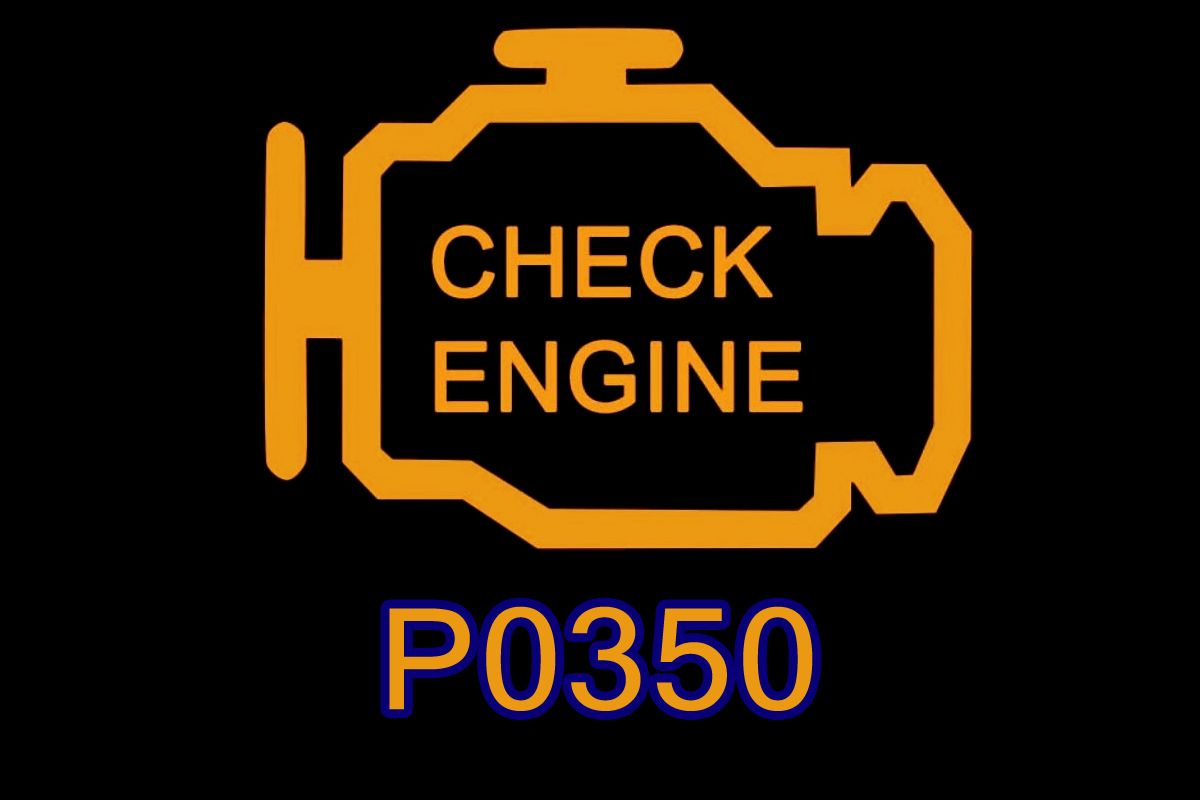
P0350 Ignition Coil Primary/Secondary Circuit Malfunction
P0350 is an OBD-II diagnostic trouble code indicating that the engine control module (ECM/PCM) has detected a malfunction in the ignition coil primary/secondary circuit.
Unlike P0351, P0352, P0353, and the other coil-specific codes, P0350 is a general ignition-coil circuit code. It does not identify a particular coil by letter or cylinder.
This distinction is important because P0350 can be caused by a problem affecting the ignition system as a whole, a shared power or control circuit, or a fault that the ECM cannot associate with only one individual coil.
Most importantly, P0350 does not automatically mean that all ignition coils are defective.
What does P0350 actually mean?
An ignition coil has a low-voltage primary circuit and a high-voltage secondary circuit.
The ECM controls the primary side to build a magnetic field inside the coil. When the primary current is interrupted, the magnetic field collapses and generates the high voltage necessary to fire the spark plug.
The ECM monitors this process in various ways depending on the vehicle.
If the electrical behavior of the ignition system is outside the expected parameters, P0350 may be stored.
The fault can involve:
-
Coil power supply
-
Primary control circuit
-
Coil ground, depending on system design
-
Wiring
-
Connectors
-
One or more ignition coils
-
Ignition-control electronics
-
ECM driver circuitry
The exact monitoring strategy differs considerably between manufacturers.
P0350 is different from the coil-specific P0351–P0362 codes
This is one of the most useful ways to understand P0350.
Codes such as:
-
P0351 – Ignition Coil A
-
P0352 – Ignition Coil B
-
P0353 – Ignition Coil C
-
P0354 – Ignition Coil D
-
P0355 – Ignition Coil E
-
P0356 – Ignition Coil F
-
P0357 – Ignition Coil G
-
P0358 – Ignition Coil H
identify a particular ignition-coil circuit.
P0350, on the other hand, is the general ignition-coil primary/secondary circuit malfunction code.
If a vehicle has P0350 together with one or more coil-specific codes, those additional codes become extremely important because they can help identify where the actual electrical problem is located.
What can cause P0350?
There is no single cause that applies to every vehicle.
Possible causes include:
-
Faulty ignition coil
-
Multiple failing ignition coils
-
Shared ignition-coil power supply problem
-
Damaged ignition wiring
-
Open circuit
-
Short to ground
-
Short to battery voltage
-
Excessive circuit resistance
-
Loose connector
-
Corroded terminals
-
Poor terminal tension
-
Damaged coil connector
-
Poor engine or electrical ground
-
Blown fuse
-
Faulty ignition relay
-
Incorrect ignition coils
-
Damaged spark plugs
-
Electrical interference
-
ECM ignition-driver problem
-
ECM power or ground problem
-
Incorrect previous wiring repair
A shared power supply fault deserves particular attention when several ignition coils are affected simultaneously.
For example, if several coil-specific codes appear together, replacing the coils individually may completely miss the real problem if the coils are all losing their common power supply.
What symptoms can P0350 cause?
The symptoms depend on the type and severity of the ignition fault.
Possible symptoms include:
-
Check Engine Light
-
Engine misfire
-
Rough idle
-
Engine shaking
-
Hesitation
-
Poor acceleration
-
Reduced engine power
-
Difficult starting
-
Long cranking
-
Engine stalling
-
Increased fuel consumption
-
Unburned-fuel smell
-
Intermittent loss of power
In some cases, the vehicle may continue running relatively normally despite storing P0350.
This can happen when the fault is intermittent or occurs only under specific engine-load or temperature conditions.
Why can an ignition problem appear only under load?
Ignition systems face greater demands when the engine is producing high torque.
During acceleration, cylinder pressure rises, making it more difficult for the spark to jump across the spark-plug gap.
A weak coil or marginal electrical connection may therefore operate normally at idle but fail under heavy acceleration.
The same applies to a worn spark plug.
This can produce a pattern such as:
Smooth idle → normal light driving → hard acceleration → misfire → P0350
Consequently, the fact that the engine starts and idles normally does not prove that the ignition system is healthy.
How should P0350 be diagnosed?
The first step is to scan the vehicle for all stored and pending codes.
This is especially important with P0350 because the code itself is general.
If the scan reveals P0351, P0352, P0353, or another coil-specific code at the same time, the diagnostic direction becomes much clearer.
Freeze-frame data should also be examined.
Engine RPM, engine load, coolant temperature, battery voltage, and other parameters can help establish whether the fault occurred during starting, idle, acceleration, or high-load operation.
Look for patterns in the ignition-coil codes
The pattern of the codes can provide an important clue.
If only one coil-specific code appears, a problem with that individual coil circuit becomes more likely.
If several coil circuits report faults simultaneously, the technician should investigate shared electrical components before replacing multiple coils.
For example:
-
Common ignition power supply
-
Fuse
-
Ignition relay
-
Shared ground
-
Harness
-
Common connector
-
ECM power supply
-
ECM ground
This is one of the biggest differences between diagnosing a general P0350 and diagnosing a single coil-specific code.
Inspect the ignition system physically
The coils, connectors, and visible wiring should be inspected carefully.
Look for:
-
Cracked coil housings
-
Burn marks
-
Signs of electrical arcing
-
Oil contamination
-
Water intrusion
-
Corrosion
-
Loose terminals
-
Damaged connector locks
-
Chafed wiring
-
Broken wires
-
Poor previous repairs
If the vehicle uses multiple individual ignition coils, all affected circuits should be examined rather than immediately replacing every coil.
An intermittent harness fault can be particularly difficult to locate because the wiring may look normal while losing electrical contact due to vibration or engine movement.
Check the shared power supply
This is especially important when multiple coil circuits are affected.
The technician should determine how the particular ignition system supplies power to the coils.
Depending on the vehicle, several coils may share a common ignition-switched power supply.
A problem with a fuse, relay, wiring junction, connector, or power distribution point could therefore affect multiple coils at the same time.
The supply should be tested under load, not merely checked for voltage with the engine switched off.
Voltage-drop testing can reveal resistance in a power connection that a basic voltage check might miss.
Check the control circuits
The ECM must also be able to control the ignition coils correctly.
Depending on the ignition architecture, each coil may have its own control wire, or the system may use an integrated ignition driver.
The technician may need to check:
-
Control-wire continuity
-
Circuit resistance
-
Short to ground
-
Short to voltage
-
Voltage drop
-
Control signal
-
Ignition-control waveform
An oscilloscope is particularly useful when an electrical fault cannot be identified with a basic multimeter.
The waveform can show whether the ECM is actually producing the expected control signal.
Check the spark plugs
Spark plugs should also be considered during the diagnosis.
A worn or incorrectly gapped plug can increase the voltage required to create a spark.
Possible problems include:
-
Excessive electrode gap
-
Cracked insulator
-
Carbon fouling
-
Oil fouling
-
Incorrect plug type
-
Excessive electrode wear
However, a bad spark plug does not automatically explain a P0350.
P0350 is fundamentally an ignition-coil primary/secondary circuit code, so the electrical operation of the coil circuit still needs to be verified.
Could several bad coils cause P0350?
Yes, but it should not be the first assumption.
Ignition coils can fail individually, particularly on high-mileage engines or engines exposed to excessive heat, oil contamination, or moisture.
However, if several coils suddenly report problems at the same time, it is more logical to investigate a common electrical cause first.
A simultaneous failure of multiple coils is possible, but a shared power, ground, wiring, relay, or ECM-related problem may be a much better explanation.
Could a weak battery cause P0350?
A weak battery or unstable system voltage can affect ignition operation, especially during starting.
However, low battery voltage is not the direct definition of P0350.
If P0350 appears together with several low-voltage, communication, or electrical-system codes, the battery and charging system should be tested.
Battery voltage, alternator output, main grounds, and power connections should be checked before assuming that multiple ignition components have failed.
Could the ECM cause P0350?
Yes, although ECM failure is generally not the first thing to suspect.
The ECM or an integrated ignition driver may be responsible for controlling the coil primary circuits.
An internal driver failure can prevent the ignition coils from receiving the correct control signal.
However, the ECM should only become a serious suspect after the external circuits have been proven good.
The technician should verify:
-
Coil power supply
-
Grounds
-
Wiring
-
Connectors
-
Control circuits
-
Relevant waveforms
-
ECM power and ground
Replacing or programming an ECM simply because P0350 is present is not a sound diagnostic strategy.
What should be replaced?
The correct repair depends on the test results.
If a particular ignition coil is proven defective, that coil should be replaced.
If several coils are good but their common power supply is missing, the fuse, relay, wiring, connector, or power-distribution fault should be repaired.
If a connector has damaged or loose terminals, the terminals or connector should be repaired.
If the spark plugs are worn or damaged, they should be replaced according to the manufacturer's specifications.
If an ECM ignition driver is conclusively proven defective, ECM repair or replacement may be necessary.
There is therefore no universal “replace this part” solution for P0350.
P0350 does not mean all ignition coils should be replaced
This is the most important diagnostic point.
Because P0350 is a general code, replacing every ignition coil without further testing can be an expensive mistake.
The technician should first determine whether the fault is:
Individual coil → shared power supply → wiring/connector → control circuit → spark plug/secondary ignition → ECM
The code tells you that the ECM has detected a problem in the ignition-coil system. It does not tell you exactly which component has failed.
P0350 vs. P0351
The distinction is straightforward but important.
P0350 is the general Ignition Coil Primary/Secondary Circuit Malfunction code.
P0351 identifies a malfunction specifically associated with Ignition Coil A.
If P0350 appears together with P0351, the Coil A circuit deserves particular attention.
If P0350 appears with several coil-specific codes, however, a common electrical problem should be investigated before replacing individual coils.
Final diagnostic conclusion
P0350 – Ignition Coil Primary/Secondary Circuit Malfunction indicates that the ECM has detected abnormal electrical behavior in the ignition-coil system but does not identify one specific coil.
The most important diagnostic clue is often what other codes are stored at the same time.
A single coil code may point toward an individual circuit. Multiple coil codes may point toward a shared power supply, ground, wiring, relay, or control problem.
The correct approach is therefore to scan all codes, examine the operating conditions, identify the ignition-system architecture, check shared power and grounds, inspect the individual coil circuits, verify control signals, and only then determine which component actually needs repair or replacement.
P0350 is a code where understanding the circuit architecture is often more valuable than simply replacing ignition coils.