TR
TR EN
EN

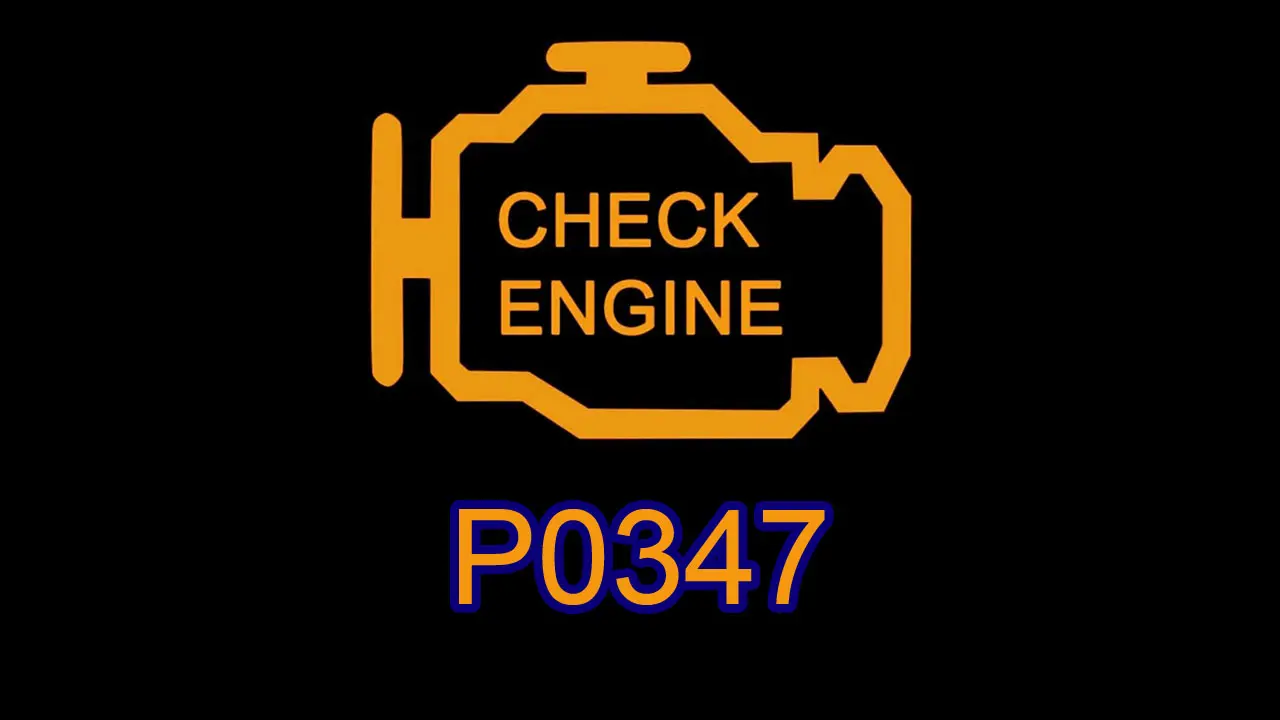
P0347 Camshaft Position Sensor "A" Circuit Low Input (Bank 2)
The P0347 diagnostic trouble code (DTC) means that the engine control module (ECM/PCM) has detected a lower-than-expected electrical signal from Camshaft Position Sensor “A” on Bank 2.
The important word here is “Low.” It refers primarily to the electrical signal being received by the ECM, not necessarily to low camshaft speed, low engine temperature, low oil pressure, or a physically “low” camshaft position.
P0347 does not automatically mean that the camshaft position sensor has failed. A shorted signal wire, poor power supply, wiring damage, connector problem, incorrect sensor installation, damaged trigger mechanism, VVT problem, or mechanical timing issue can also produce this code.
The exact location of Sensor A and Bank 2 depends on the engine and manufacturer. Sensor A should not automatically be assumed to be the intake camshaft, and Bank 2 should not be identified by guesswork.
What Does P0347 Mean?
The camshaft position sensor provides the ECM with information about the rotational position of the camshaft.
The engine computer uses this information to determine the correct relationship between the camshaft and crankshaft. This information is important for:
-
Fuel injection timing
-
Ignition timing
-
Engine synchronization
-
Variable valve timing (VVT)
-
Misfire detection
-
Engine starting
-
Camshaft position control
When the ECM sees a signal from Camshaft Position Sensor A, Bank 2 that is below the expected electrical range, it can store P0347.
The code therefore tells us what the ECM is seeing electrically. It does not identify the failed component by itself.
What Does “Low Input” Mean?
Low input means the ECM is receiving a signal lower than the expected electrical level.
This distinction is important because a low electrical signal does not necessarily mean that the camshaft itself is turning slowly.
For example, the following can produce a low sensor signal:
-
Signal wire shorted to ground
-
Missing or unstable sensor power
-
Poor sensor ground
-
Damaged sensor
-
Corroded connector
-
High resistance in the circuit
-
Incorrect sensor installation
-
Damaged trigger/reluctor
-
Electrical interference
Therefore, diagnosing P0347 by simply replacing the sensor can lead to an unnecessary repair.
What Is Camshaft Position Sensor “A”?
The designation “A” is manufacturer-specific.
On many engines there are multiple camshaft position sensors because the engine may have separate intake and exhaust camshafts or multiple cylinder banks.
Sensor A may represent the intake camshaft on one engine, while another manufacturer may use a different designation.
For this reason, the exact location of Sensor A should always be confirmed using the vehicle's wiring diagram or service documentation.
What Does Bank 2 Mean?
On engines with two cylinder banks, Bank 2 is the bank that does not contain cylinder number 1.
This terminology is commonly used on V6, V8, and other multi-bank engines.
The physical location of Bank 2 depends on the specific engine design.
On an inline engine with only one cylinder bank, Bank 2 normally does not exist in the conventional sense. Manufacturer-specific diagnostic strategies can differ, so the vehicle-specific information remains the final reference.
Common Causes of P0347
There are several possible causes of a low camshaft position sensor signal.
Faulty camshaft position sensor
The sensor itself may have an internal fault that causes its output to remain below the expected level.
Heat, age, vibration, contamination, or internal electronic failure can affect sensor operation.
Short to ground
A signal wire that is shorted to ground can pull the sensor signal down.
This is one of the important possibilities when diagnosing a genuine low-input code.
The exact circuit behavior depends on whether the sensor is Hall-effect, variable reluctance, or another design.
Damaged wiring
The sensor harness may be:
-
Broken
-
Chafed
-
Melted
-
Crushed
-
Corroded
-
Internally damaged
-
Contaminated with oil
-
Intermittently connected
Wiring near the cylinder head can be particularly vulnerable to heat and vibration.
Poor connector connection
A loose or corroded connector can introduce resistance or interrupt the electrical circuit.
Bent terminals or insufficient terminal tension can also cause signal problems.
Missing sensor power
Some camshaft sensors require a dedicated supply voltage.
If that supply is missing or significantly lower than specified, the sensor may not generate the expected signal.
Poor sensor ground
A bad ground connection can alter the sensor's electrical output.
Ground integrity should therefore be tested rather than assumed to be good simply because the sensor is physically connected.
Incorrect sensor installation
A sensor that is not installed correctly may not maintain the required relationship with its trigger target.
An incorrect air gap or improperly seated sensor can affect the signal.
Damaged camshaft trigger or reluctor
The camshaft sensor reads a physical target associated with the camshaft.
Depending on the engine, this can be a reluctor, trigger wheel, tone wheel, timing component, or another reference feature.
If the target is damaged, loose, contaminated, or incorrectly positioned, the sensor signal can become abnormal.
Variable valve timing problem
A VVT actuator, camshaft phaser, oil-control solenoid, oil-pressure problem, or related mechanical issue can cause camshaft position to differ from the expected value.
This can produce synchronization problems that may appear alongside camshaft sensor codes.
Mechanical timing problem
A stretched timing chain, damaged timing component, incorrect timing installation, or similar mechanical problem can affect the relationship between the camshaft and crankshaft.
This should be considered when the electrical circuit tests correctly but the synchronization is incorrect.
ECM/PCM problem
The ECM itself can have an internal fault affecting sensor signal interpretation.
However, an ECM problem should generally be considered only after the sensor, wiring, power, ground, connectors, and mechanical system have been properly checked.
Symptoms of P0347
P0347 can produce very different symptoms depending on how low the signal is and how the engine control system reacts to the missing or incorrect camshaft information.
Possible symptoms include:
-
Check Engine Light
-
Hard starting
-
Extended cranking
-
Intermittent no-start
-
Rough idle
-
Engine hesitation
-
Poor acceleration
-
Reduced engine power
-
Engine misfire
-
Engine stalling
-
Unstable RPM
-
Poor fuel economy
-
Reduced throttle response
-
VVT-related performance problems
-
Limp mode on some vehicles
Some vehicles may continue running relatively normally with P0347 stored.
Others may have significant starting and drivability problems if the camshaft signal becomes unreliable.
Can P0347 Cause a No-Start?
Yes.
The camshaft signal can be important during engine cranking because the ECM uses it to establish the relationship between camshaft and crankshaft position.
If the signal is too low or effectively unavailable, some engine management systems may have difficulty determining the correct synchronization.
This can result in:
-
Long cranking
-
Difficult starting
-
Intermittent no-start
-
Starting and stalling
However, not every engine reacts in exactly the same way. Some systems can continue operating using alternative synchronization strategies.
Can P0347 Cause a Misfire?
It can.
Incorrect camshaft information can affect injection timing, ignition timing, variable valve timing, and synchronization.
This can result in unstable combustion and misfire symptoms.
If P0347 appears together with a P030X cylinder misfire code, the complete set of codes should be analyzed rather than assuming the misfire is caused solely by the camshaft sensor.
Why Does the Engine Sometimes Run Normally?
A low-input fault does not always mean that the signal is completely absent all the time.
The signal may be low enough to trigger P0347 under certain operating conditions while remaining usable under others.
For example, the problem may become more noticeable when:
-
The engine is hot
-
RPM changes
-
Engine vibration increases
-
The sensor reaches a particular temperature
-
Electrical load changes
-
The harness moves
-
Moisture enters the connector
This can explain why the vehicle may appear to run normally immediately after starting but develop symptoms later.
How Is P0347 Diagnosed?
A proper diagnosis should determine why the signal is low rather than assuming the sensor has failed.
1. Scan all DTCs
Begin by reading every stored and pending code.
Look for additional:
-
Camshaft sensor codes
-
Crankshaft sensor codes
-
Synchronization codes
-
VVT codes
-
Misfire codes
-
Low-voltage codes
A group of related codes can provide much more information than P0347 alone.
2. Check freeze-frame data
Look at the conditions under which the ECM stored the code.
Useful information includes:
-
Engine RPM
-
Engine load
-
Coolant temperature
-
Vehicle speed
-
Throttle position
-
System voltage
If P0347 consistently occurs at a particular temperature or RPM, reproducing those conditions can make diagnosis much easier.
3. Identify Sensor A and Bank 2
Confirm the exact sensor using the vehicle-specific wiring diagram.
Do not assume Sensor A is intake, or that Bank 2 is on a particular side of the engine without confirmation.
4. Inspect the sensor and connector
Look for:
-
Corrosion
-
Bent terminals
-
Loose terminals
-
Broken connector locks
-
Oil contamination
-
Water intrusion
-
Damaged sensor housing
-
Incorrect installation
A connector problem is particularly worth investigating because a poor connection can alter the signal seen by the ECM.
5. Check the sensor power supply
If the sensor requires an external power supply, verify it according to the manufacturer's specifications.
There is no universal camshaft sensor voltage that applies to every vehicle.
Different sensor technologies require different testing procedures.
6. Check the ground
Verify ground integrity under the manufacturer's specified test conditions.
A poor ground can cause the sensor output to appear lower than expected.
Voltage-drop testing can be useful for identifying high-resistance connections that a simple continuity test may miss.
7. Check the signal circuit
Inspect the signal wire for:
-
Short to ground
-
Open circuit
-
Excessive resistance
-
Damaged insulation
-
Poor terminal contact
The exact testing method depends on the sensor design.
A Hall-effect sensor and a variable-reluctance sensor cannot be diagnosed using identical electrical procedures.
8. Monitor the signal with an oscilloscope
An oscilloscope can provide a much clearer picture of what is happening.
It can reveal:
-
Low signal amplitude
-
Missing transitions
-
Distorted waveform
-
Electrical noise
-
Incorrect pulse pattern
-
Signal dropout
-
Problems that occur only at certain RPM
This can be especially useful when a multimeter shows a seemingly acceptable result but P0347 continues to return.
9. Inspect the trigger mechanism
If power, ground, wiring, and the sensor itself appear correct, the camshaft trigger should be examined.
A damaged or incorrectly positioned trigger can prevent the sensor from producing the expected waveform.
10. Check camshaft/crankshaft synchronization
Compare the camshaft signal with the crankshaft signal.
A correct electrical waveform does not necessarily mean that the mechanical timing is correct.
If the signals have an incorrect relationship, mechanical timing or VVT may need further investigation.
11. Check the VVT system
If the engine uses variable valve timing, investigate:
-
VVT solenoids
-
Camshaft phasers
-
Oil supply
-
Oil-control passages
-
Commanded camshaft position
-
Actual camshaft position
-
Related DTCs
VVT problems can create camshaft-position discrepancies even when the sensor circuit itself is functioning correctly.
12. Inspect mechanical timing
If the electrical tests are good but cam/crank synchronization is incorrect, inspect the timing chain, belt, gears, phasers, and associated components.
This is particularly important on engines with known timing-chain or VVT issues.
Can a Bad Connector Cause P0347?
Yes.
A connector can create a low signal without the sensor itself being defective.
Possible causes include:
-
Corrosion
-
Moisture
-
Loose terminal
-
Weak terminal tension
-
Damaged locking mechanism
-
Contamination
Because the camshaft sensor signal can be relatively sensitive, even a poor electrical connection can interfere with the signal reaching the ECM.
Can a Short to Ground Cause P0347?
Yes.
A short to ground on the signal circuit is one of the classic electrical possibilities for a low-input diagnostic code.
The signal wire may be contacting:
-
Engine ground
-
Another grounded wire
-
Damaged wiring
-
A metal component
However, the exact circuit behavior depends on the sensor's electrical design.
This is why the wiring diagram should be consulted before performing resistance or continuity tests.
Can Low Oil Pressure Cause P0347?
Low oil pressure is not normally the direct meaning of “low input” in P0347.
“Low input” refers to the electrical signal being received by the ECM.
However, low oil pressure can potentially contribute to a camshaft/VVT problem on engines where camshaft position is controlled hydraulically.
If the engine has VVT and there are corresponding timing or camshaft-position symptoms, oil pressure and oil-control systems may need to be investigated.
Can a Timing Chain Problem Cause P0347?
A timing problem can contribute to camshaft-related faults, but it should not automatically be blamed when P0347 appears.
If the electrical signal from Sensor A is genuinely too low, the first diagnostic direction should include the sensor's power, ground, signal circuit, connector, and waveform.
If those are correct but the camshaft and crankshaft signals are not synchronized properly, mechanical timing becomes much more significant.
A stretched timing chain, damaged timing component, incorrect installation, or failed camshaft phaser can all alter synchronization.
Is P0347 Serious?
P0347 can range from a minor drivability issue to a problem that prevents the engine from operating correctly.
If the engine is running normally and the Check Engine Light is steady, it may be possible to drive cautiously to a repair facility.
However, the situation becomes more urgent if the vehicle develops:
-
Severe engine misfire
-
Engine stalling
-
Hard starting
-
Intermittent no-start
-
Major power loss
-
Severe hesitation
Unexpected engine stalling can create a safety risk, especially in traffic.
P0347 vs. Other Camshaft Sensor Codes
The P0347 code belongs to a group of Bank 2 Sensor A camshaft-position codes.
P0345 – Camshaft Position Sensor “A” Circuit, Bank 2
P0346 – Camshaft Position Sensor “A” Circuit Range/Performance, Bank 2
P0347 – Camshaft Position Sensor “A” Circuit Low Input, Bank 2
P0348 – Camshaft Position Sensor “A” Circuit High Input, Bank 2
P0349 – Camshaft Position Sensor “A” Circuit Intermittent, Bank 2
The distinction between these codes is important.
P0345 is a general circuit malfunction.
P0346 indicates that the signal or its behavior is outside the expected range or performance.
P0347 indicates that the electrical input is lower than expected.
P0348 indicates that the electrical input is higher than expected.
P0349 indicates an intermittent or unstable signal.
These codes can have overlapping causes, but the diagnostic direction changes according to what the ECM is actually detecting.
Why Replacing the Sensor May Not Fix P0347
A new camshaft position sensor will not repair a shorted signal wire, poor connector contact, missing power supply, bad ground, damaged trigger, VVT malfunction, or mechanical timing problem.
This is why replacing the sensor based solely on the code can sometimes result in the same P0347 returning immediately.
A more reliable approach is to determine whether the problem is located in the:
sensor → power supply → ground → signal circuit → connector → trigger mechanism → synchronization → VVT/mechanical timing
chain.
A Practical Diagnostic Sequence
A logical diagnostic path for P0347 is:
P0347 → scan all codes → check freeze-frame → identify Sensor A/Bank 2 → inspect sensor and connector → verify power → verify ground → test signal circuit → check for short to ground → monitor waveform → inspect trigger mechanism → check cam/crank synchronization → evaluate VVT → inspect mechanical timing if necessary → repair → clear codes → road test → rescan.
This approach is much more reliable than simply replacing the camshaft sensor and hoping the code disappears.
Final Perspective
P0347 means the ECM/PCM is detecting a camshaft position Sensor A signal on Bank 2 that is lower than expected.
The word “low” describes the electrical input, not necessarily the physical position or speed of the camshaft.
A defective sensor is certainly possible, but the diagnosis should also consider the sensor's power and ground, signal wiring, connector condition, shorts to ground, sensor installation, trigger mechanism, VVT operation, and mechanical timing.
If the vehicle has hard starting, stalling, severe hesitation, or significant power loss along with P0347, the problem deserves prompt attention because an unreliable camshaft signal can interfere with engine synchronization and normal engine operation.