TR
TR EN
EN

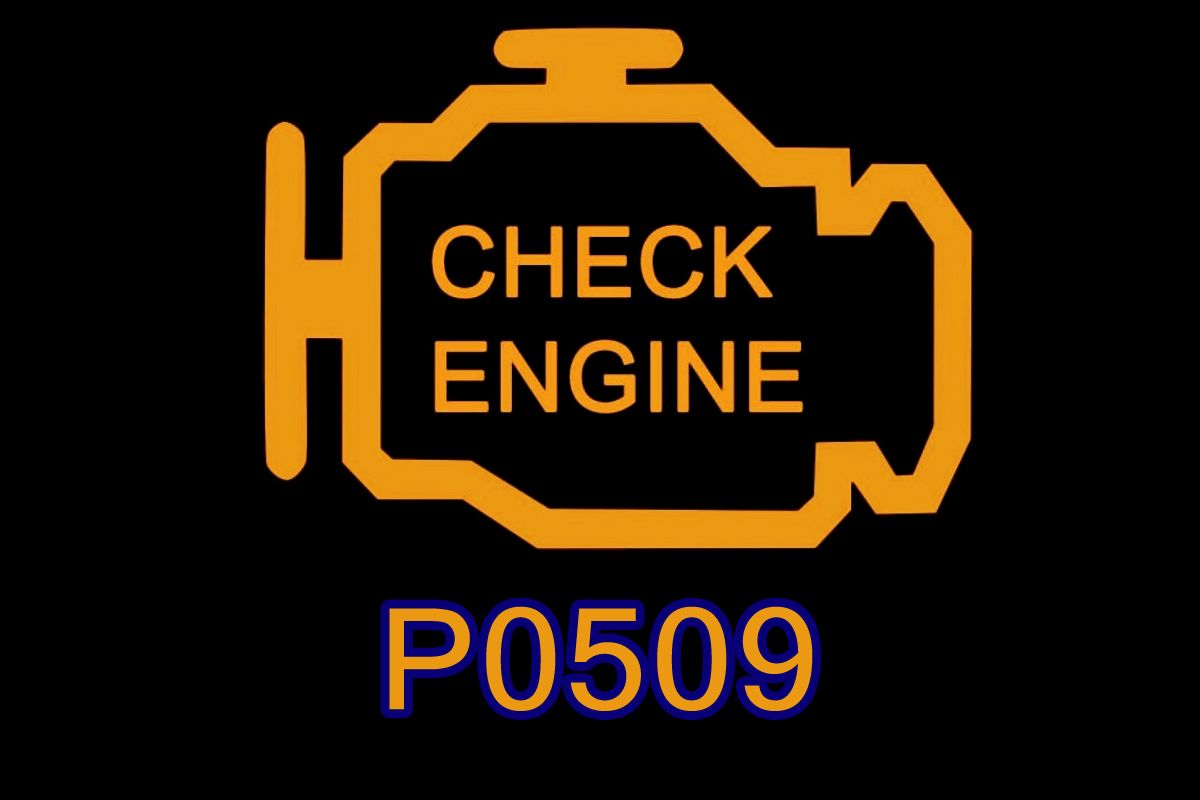
P0509 Idle Air Control (IAC) System Circuit High
The P0509 Idle Air Control (IAC) System Circuit High trouble code means the engine control module has detected an electrical signal in the idle air control system that is higher than the expected value.
The important word here is “High.” It generally refers to the electrical signal or voltage detected by the control module, not simply a high engine idle speed.
P0509 therefore should not automatically be interpreted as “the engine is idling too high” or “the IAC valve must be replaced.” The fault may be caused by the IAC valve, wiring, connector, power supply, control circuit, or, on vehicles without a separate IAC valve, the electronic throttle body that controls idle airflow.
What Is the Idle Air Control System?
At idle, the accelerator pedal is released, but the engine still needs a controlled amount of air to continue running.
On vehicles equipped with a traditional throttle body, a dedicated Idle Air Control valve (IAC valve) controls air flowing around the closed throttle plate.
The ECU continually adjusts this airflow to maintain the desired idle speed.
For example, when the A/C compressor engages, the alternator is heavily loaded, the cooling fan switches on, or an automatic transmission is placed into Drive, engine load changes.
The ECU responds by adjusting idle airflow.
The basic process is:
ECU calculates required idle speed → commands idle airflow → IAC system responds → engine RPM is stabilized
If the electrical signal from the IAC system is higher than the ECU expects, P0509 can be stored.
Modern Vehicles May Use the Electronic Throttle Body
Not every vehicle with an idle-air-control fault has a separate IAC valve.
Many modern gasoline engines use an electronic throttle body to regulate idle airflow.
In these systems, the throttle plate is controlled electronically and performs much of the function that an older IAC valve performed.
This means that diagnosing P0509 requires first determining how that particular engine controls idle air.
Replacing an IAC valve that the vehicle does not even have is obviously not going to solve the problem.
What Does “Circuit High” Mean?
P0509 is an electrical circuit code.
The High designation generally means the control module has detected a voltage or electrical signal above its expected range.
This can occur because of:
-
A short to power
-
Incorrect electrical resistance
-
An open circuit, depending on the system design
-
A faulty actuator
-
Incorrect control-signal feedback
-
Wiring damage
-
Connector problems
-
A power or ground fault
The exact interpretation depends on the electrical design of the vehicle.
Therefore, a high circuit code should not be diagnosed simply by looking at engine RPM.
An engine can have normal idle speed while P0509 is present.
Common Causes of P0509
Short to battery voltage
A control or signal wire may have contacted a power source, causing the ECU to see a higher-than-expected voltage.
Damaged wiring
Wiring may be chafed, melted, pinched, or incorrectly repaired.
The problem can be particularly difficult to find when the wire is damaged internally but the insulation still looks normal.
Faulty IAC valve
If the vehicle uses a separate IAC valve, an internal electrical failure can alter the expected control signal.
The valve can also become mechanically stuck, although a mechanical problem by itself does not necessarily explain a circuit-high code.
Faulty electronic throttle body
On vehicles using electronic throttle control for idle regulation, a throttle actuator or throttle-position feedback problem can produce an idle-control circuit fault.
Poor connector contact
Loose terminals, corrosion, moisture, bent pins, or damaged connector locks can affect the electrical signal.
Power or ground problem
An actuator cannot operate correctly without a stable electrical supply and ground.
A poor ground can produce unusual voltage readings and misleading symptoms.
Incorrect wiring repair
A previous repair that connected the wrong wires or used an incorrect circuit can cause the ECU to see an abnormal signal.
Throttle-body or IAC contamination
Carbon deposits can cause the actuator to stick or alter airflow. This can create idle-control problems, although contamination should be distinguished from a genuine electrical high-signal fault.
ECU fault
A control-module failure is possible but should normally be considered only after the external circuit and actuator have been tested.
Symptoms of P0509
The symptoms depend on the vehicle and the way its idle-control system is designed.
Possible symptoms include:
-
Check Engine Light
-
High idle speed
-
Low idle speed
-
Fluctuating RPM
-
Rough idle
-
Engine stalling
-
Difficulty maintaining idle
-
Engine speed remaining high after releasing the accelerator
-
Stalling when A/C is switched on
-
Poor idle during electrical loads
-
Difficult starting
-
Throttle-control warnings on some vehicles
Some vehicles may have almost no noticeable symptoms even though P0509 is stored.
P0509 Does Not Automatically Mean High RPM
This is an important distinction.
The code says:
Idle Air Control System Circuit High
It does not say:
Engine Idle Speed Too High
The ECU may be seeing an abnormally high electrical signal even while the engine is idling at the correct RPM.
Conversely, an engine that is physically idling too high does not necessarily have P0509.
A vacuum leak, for example, can cause high idle speed without creating an IAC circuit-high condition.
How to Diagnose P0509
A good diagnosis begins with a complete scan.
Check:
-
Stored codes
-
Pending codes
-
Freeze-frame data
-
Manufacturer-specific codes
-
Throttle-control codes
-
MAF/MAP codes
-
Voltage-related codes
-
Communication faults
If several electronic-control codes appeared simultaneously, check the vehicle's power supply and grounds before replacing individual components.
Determine Which Idle-Control System the Vehicle Uses
Before testing anything, establish whether the vehicle has:
A separate IAC valve
or
An electronic throttle body that performs idle control.
The wiring diagram and service information are particularly useful here.
The diagnostic procedure can be completely different between these two designs.
Inspect the Wiring and Connector
Start with the physical circuit.
Inspect the wiring between the ECU and IAC system for:
-
Chafing
-
Broken wires
-
Melted insulation
-
Corrosion
-
Water intrusion
-
Loose terminals
-
Bent pins
-
Poor previous repairs
The connector should not merely be unplugged and plugged back in without inspection.
Terminal tension is important. A terminal that looks clean can still fail to maintain proper electrical contact.
Check for a Short to Power
Because P0509 is a circuit-high fault, checking for an unintended connection to battery voltage can be particularly important.
The technician should use the vehicle's wiring diagram to identify the control and signal wires and determine whether any circuit has voltage when it should not.
Do not assume that every IAC system uses the same voltage arrangement.
The correct test procedure depends on the manufacturer's circuit design.
Check Power and Ground Under Load
A voltage reading with no electrical load can sometimes look perfectly normal.
A poor connection may only reveal itself when the actuator is operating.
For this reason, power and ground circuits should be tested under appropriate load conditions when required by the manufacturer's procedure.
Voltage-drop testing can be useful for identifying high resistance in connections, grounds, or power cables.
Check the IAC Valve
If the vehicle uses a separate IAC valve, the actuator should be tested according to the manufacturer's specifications.
Depending on the design, this may involve checking:
-
Coil resistance
-
Supply voltage
-
Ground
-
Control signals
-
Actuator movement
-
Commanded position
-
Actual response
There is no universal IAC resistance value that can safely be applied to every vehicle.
A resistance that is normal for one IAC valve could indicate a fault on another.
Check Electronic Throttle Operation
If the vehicle uses an electronic throttle body, examine live data such as:
-
Commanded throttle position
-
Actual throttle position
-
Desired idle speed
-
Actual RPM
-
Accelerator-pedal position
-
Throttle actuator commands
If the commanded and actual throttle positions do not agree, the throttle body, actuator, position sensors, wiring, or control system may require further testing.
Inspect the Throttle Body for Carbon
Carbon buildup around the throttle plate can interfere with precise airflow control.
This may result in:
-
High idle
-
Low idle
-
Unstable idle
-
Stalling
-
Slow return to normal idle
Cleaning may be appropriate if contamination is found, but it should not be treated as the automatic cure for P0509.
If the actual fault is a shorted wire or defective actuator circuit, cleaning the throttle body will not fix the electrical problem.
Some vehicles also require a throttle relearn or idle adaptation procedure after cleaning or replacing the throttle body.
Check for Vacuum Leaks
A vacuum leak can complicate P0509 diagnosis because it can create idle symptoms that resemble an IAC problem.
A cracked PCV hose, intake-manifold gasket, vacuum hose, or brake-booster hose can allow air into the engine without being properly controlled.
The ECU may then struggle to maintain the requested idle speed.
A smoke test is often more effective than simply spraying suspected areas and watching RPM changes.
Check Live Data
Live data can help determine whether the electrical problem is accompanied by an actual idle-control problem.
Useful parameters can include:
-
Desired idle RPM
-
Actual idle RPM
-
IAC command
-
IAC position
-
Throttle angle
-
MAF
-
MAP
-
Coolant temperature
-
Fuel trims
-
Battery/system voltage
-
A/C status
For example, if the ECU commands the IAC system toward a particular position but the feedback signal remains abnormally high, the actuator or circuit becomes more suspicious.
If the electrical signal looks correct but the engine still has a high idle, an air leak or mechanical airflow problem may deserve greater attention.
A Practical Diagnostic Example
Imagine a vehicle with P0509 and a high idle.
The first assumption might be:
“The IAC valve is stuck open.”
But electrical testing shows that the IAC control wire has battery voltage when the ECU is not commanding it.
Further inspection reveals that the wiring harness has rubbed against a metal bracket and the insulation has worn through.
The control wire is contacting a power circuit.
After repairing the wiring, the IAC signal returns to normal and the idle becomes stable.
In this case, replacing the IAC valve would have been unnecessary.
This is exactly why P0509 should be diagnosed as a circuit fault first, rather than interpreted simply as a high-idle complaint.
Another Possible Scenario
Consider a vehicle with P0509 but normal idle speed.
The technician checks the live data and finds that the idle speed is stable, but the IAC-related electrical signal is outside the expected range.
The wiring and connector test correctly.
The actuator itself has an internal electrical fault.
In this situation, the valve or appropriate actuator assembly may be the correct repair even though the engine appears to idle normally.
P0509 vs P0511
These codes are closely related but indicate different electrical conditions.
P0509 – Idle Air Control System Circuit High
The control module detects an abnormally high electrical signal in the IAC system.
P0511 – Idle Air Control Circuit Malfunction
The control module detects a general malfunction in the IAC circuit without specifying that the signal is specifically high.
Therefore, P0509 gives more information about the electrical nature of the detected fault.
P0509 vs P0519
The distinction is also important here.
P0509 focuses on the electrical circuit being high.
P0519 focuses on idle-control system performance.
P0509 therefore directs attention toward voltage, wiring, connectors, actuator circuitry, and electrical control.
P0519 requires broader evaluation of whether the idle-control system can actually achieve the requested engine speed.
Could Low Battery Voltage Cause P0509?
A weak vehicle battery can create unusual electronic behavior, especially during starting and initial module operation.
However, low battery voltage is not the normal interpretation of a circuit-high code.
If P0509 appears together with several low-voltage or communication codes, the battery, alternator, grounds, and main power supplies should still be checked.
But a healthy vehicle battery does not rule out a short-to-power or actuator-circuit problem.
Is P0509 Serious?
The severity depends on the symptoms.
If the engine runs normally and only the Check Engine Light is illuminated, the vehicle may remain operational while the fault is diagnosed.
However, if the engine:
-
Stalls frequently
-
Surges at idle
-
Remains at an excessively high RPM
-
Has difficulty returning to idle
-
Loses stable idle control
the vehicle should be inspected promptly.
An engine that stalls unexpectedly can create a safety risk, particularly in traffic.
Correct Repair for P0509
The correct repair depends on the actual cause.
Possible repairs include:
-
Repairing damaged wiring
-
Correcting a short to power
-
Repairing connector terminals
-
Replacing a faulty IAC valve
-
Replacing an electronic throttle body when confirmed defective
-
Repairing power or ground connections
-
Cleaning a contaminated throttle body when appropriate
-
Repairing an intake or vacuum leak
-
Performing the required throttle or idle relearn procedure
An ECU should generally be considered only after the external circuit and actuator have been thoroughly tested.
After the repair, clear the code and verify the system with live data and an operating test.
Final Diagnosis
P0509 means the engine control module has detected an abnormally high electrical signal in the Idle Air Control system. It does not automatically mean that the engine's idle speed is too high or that the IAC valve needs replacement.
The most important distinction is between an electrical circuit problem and a mechanical idle-airflow problem.
The diagnosis should therefore begin with the vehicle's specific IAC or electronic-throttle design, followed by inspection and testing of the wiring, connectors, power, grounds, actuator, and live-data signals.
A short to power, damaged wiring, defective IAC valve, throttle-body fault, or another electrical problem can all produce P0509. Testing the circuit before replacing parts is the most reliable way to identify the actual cause.