TR
TR EN
EN

What Is a Spark Plug Wire? What Are the Symptoms of Spark Plug Wire Failure?
Spark plug wires are an important part of the ignition system found in many gasoline engines. Their job is to carry the high-voltage electrical energy produced by the ignition coil or distributor to the spark plugs.
The spark plug then uses this electrical energy to create the spark needed to ignite the air-fuel mixture inside the cylinder.
Modern vehicles increasingly use coil-on-plug ignition systems, where an individual ignition coil is installed directly over each spark plug. In these engines, traditional spark plug wires may not be present. However, many older gasoline engines and some specific engine designs still use ignition wires.
A faulty spark plug wire can prevent the spark from reaching the plug correctly and may cause misfires, poor engine performance, increased fuel consumption, and difficult starting.
How Does a Spark Plug Wire Work?
The ignition system generates a very high voltage. This voltage needs to travel from the ignition coil or distributor to the spark plug.
The spark plug wire provides an insulated path for this high-voltage current.
When the ignition system triggers the spark, electrical energy travels through the wire and reaches the spark plug terminal. The voltage is high enough to overcome the gap between the spark plug electrodes, creating an electrical arc.
This spark ignites the compressed air-fuel mixture inside the cylinder.
Because the voltage involved is extremely high, the insulation surrounding the wire is just as important as the conductor inside it.
What Are Spark Plug Wires Made Of?
A typical spark plug wire consists of a conductive core surrounded by several layers of insulation and protective material.
The conductor may be designed with a certain amount of electrical resistance. This resistance helps reduce electromagnetic interference that could affect radio signals and electronic systems.
The outer insulation must withstand:
-
High voltage
-
Engine heat
-
Oil and fuel exposure
-
Moisture
-
Vibration
-
Repeated temperature changes
The terminals at both ends are also important. A good electrical connection is necessary between the ignition coil or distributor and the spark plug.
What Are the Symptoms of a Bad Spark Plug Wire?
A damaged spark plug wire can cause symptoms ranging from occasional misfires to severe engine performance problems.
The most common signs include rough running, hesitation, difficult starting, increased fuel consumption, and a check engine light.
Engine Misfire
One of the most common symptoms is an engine misfire.
If a spark plug wire cannot deliver sufficient voltage to the spark plug, the spark may become weak or may not occur consistently.
The affected cylinder may then fail to burn the air-fuel mixture properly.
The driver may feel the engine shaking, especially at idle or under acceleration.
A misfire can also cause a flashing check engine light on some vehicles. A flashing warning light should be taken seriously because severe misfires can damage the catalytic converter.
Rough Idle
A damaged spark plug wire can cause the engine to run unevenly at idle.
You may notice:
-
Engine shaking
-
Uneven RPM
-
Increased vibration
-
Occasional stumbling
-
An unstable idle
The problem may become more noticeable when electrical loads such as headlights or the air conditioner are added because the engine is operating under a slightly greater load.
However, rough idle has many possible causes, including vacuum leaks, dirty injectors, ignition coils, spark plugs, throttle-body problems, and engine compression issues.
Engine Hesitation During Acceleration
A weak ignition spark can become more problematic when the engine is under load.
You may notice hesitation when accelerating, particularly during hard acceleration or when climbing a hill.
The engine may briefly lose power and then recover.
This happens because the ignition system needs to produce a strong enough spark under increased cylinder pressure. A damaged wire may allow voltage to leak before it reaches the spark plug.
Reduced Engine Power
If one or more cylinders are consistently misfiring, the engine may produce noticeably less power.
The vehicle may feel sluggish, particularly during acceleration.
In severe cases, the engine may enter a protective operating mode if the ECU detects repeated misfires.
Difficult Starting
A damaged spark plug wire can also make the engine difficult to start.
The problem may be more noticeable in damp or cold conditions because moisture can make it easier for high-voltage electricity to leak through damaged insulation.
The engine may crank normally but take longer than usual to start.
If the wire is severely damaged, the affected cylinder may receive little or no usable spark.
Increased Fuel Consumption
A misfiring cylinder does not burn the air-fuel mixture efficiently.
The engine control system may also adjust fuel delivery when it detects abnormal combustion conditions.
As a result, fuel consumption can increase.
If the vehicle suddenly starts using more fuel along with rough running or hesitation, the ignition system should be inspected.
Check Engine Light
Modern vehicles use the crankshaft and other sensors to detect irregular combustion.
If the ECU detects repeated misfires, it may store diagnostic trouble codes such as:
-
P0300 — Random/Multiple Cylinder Misfire
-
P0301 — Cylinder 1 Misfire
-
P0302 — Cylinder 2 Misfire
-
P0303 — Cylinder 3 Misfire
-
P0304 — Cylinder 4 Misfire
A misfire code does not automatically mean that the spark plug wire is defective.
The problem could also be caused by the spark plug, ignition coil, fuel injector, compression, vacuum leak, or another engine-management component.
Visible Cracks or Damage
Sometimes a spark plug wire can be inspected visually.
A damaged wire may show:
-
Cracked insulation
-
Burn marks
-
Cuts
-
Brittle rubber
-
Swelling
-
Oil contamination
-
Damaged terminals
-
Loose or corroded connections
Heat from the engine can gradually deteriorate the insulation.
If the wire is routed too close to an exhaust manifold or another extremely hot component, thermal damage can occur more quickly.
Electrical Leakage and Arcing
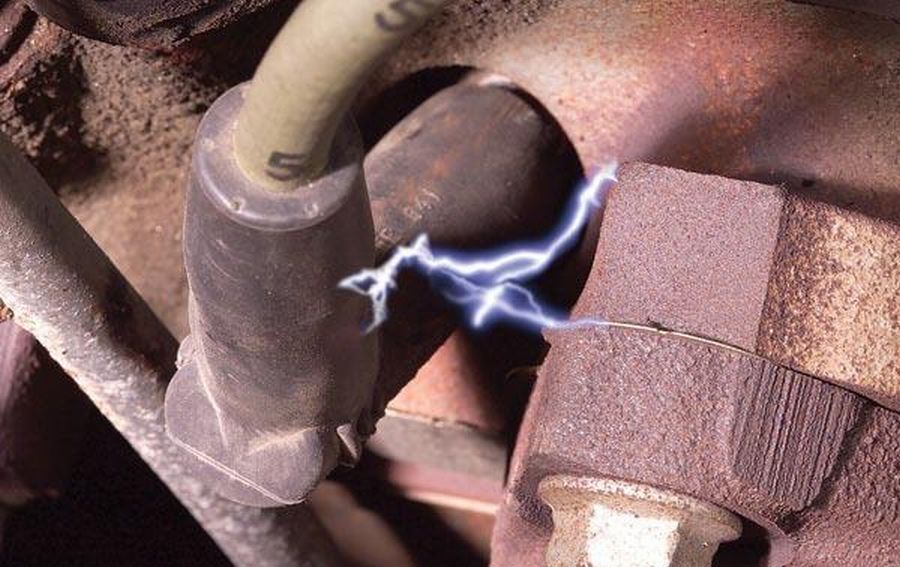
A particularly important sign of a bad spark plug wire is electrical arcing.
High-voltage electricity can escape through damaged insulation and find another path to ground.
In dark conditions, arcing may sometimes be visible as a small blue or purple flash.
You may also hear a faint clicking or snapping sound.
However, deliberately touching or handling ignition wires while the engine is running is unsafe. The ignition system can produce a very high voltage.
Engine Problems Become Worse in Wet Weather
Moisture can expose weaknesses in damaged ignition-wire insulation.
A vehicle that starts and runs relatively well in dry weather but develops misfires, hesitation, or difficult starting during rain or high humidity may have an ignition insulation problem.
This does not prove that the spark plug wire is faulty, but it is an important diagnostic clue.
Poor Fuel Economy and Exhaust Smell
A cylinder that fails to ignite its mixture properly can allow unburned fuel to enter the exhaust system.
The driver may notice an unusual fuel smell from the exhaust.
Continuous misfires can also increase the temperature inside the catalytic converter because unburned fuel may burn inside the exhaust system.
This can eventually damage the catalytic converter.
What Causes Spark Plug Wires to Fail?
Spark plug wires can deteriorate for several reasons.
Age and heat
Constant exposure to engine heat gradually hardens and deteriorates the insulation.
Moisture
Water and humidity can make an existing insulation problem more noticeable.
Oil contamination
Engine oil can damage some rubber and insulation materials over time.
Improper routing
If a wire touches or runs too close to hot engine or exhaust components, excessive heat can damage it.
Mechanical damage
Repeated bending, pulling, or incorrect removal can damage the conductor or terminals.
Rodent damage
In some vehicles, rodents can chew through ignition-wire insulation.
Poor-quality replacement wires
Incorrectly specified or low-quality wires may have unsuitable resistance, insulation, or terminal construction.
Can a Spark Plug Wire Become Internally Damaged?
Yes.
A wire may look normal from the outside while having an internal problem.
The conductor can develop increased resistance or an intermittent connection.
This can cause the ignition system to work normally under some conditions and fail under others.
For example, the engine may run relatively well at idle but develop a misfire under acceleration.
This is one reason why visual inspection alone cannot always identify a defective wire.
How Is a Spark Plug Wire Tested?
A technician can use several methods to evaluate ignition wires.
The first step is usually a visual inspection.
The wire should be checked for cracks, burns, contamination, damaged terminals, and incorrect routing.
Electrical resistance can also be measured with a multimeter. The measured value should be compared with the specification for that particular wire and ignition system.
However, resistance testing alone does not always identify every fault. A wire can show an apparently acceptable resistance value but still fail under the high voltage and load conditions experienced during actual engine operation.
A technician may therefore use additional diagnostic methods when necessary.
Does Every Misfire Mean the Spark Plug Wire Is Bad?
No.
This is an important distinction.
A misfire code identifies a combustion problem, not necessarily the exact component that caused it.
For example, a P0302 code means the ECU has detected a misfire associated with cylinder 2. It does not automatically mean the cylinder 2 spark plug wire needs to be replaced.
A proper diagnosis may involve checking:
-
Spark plug condition
-
Spark plug gap
-
Spark plug wire
-
Ignition coil
-
Fuel injector
-
Injector wiring
-
Compression
-
Vacuum leaks
-
Engine timing
-
Sensor readings
Parts should ideally be replaced only after the actual cause has been identified.
Spark Plug Wire vs. Ignition Coil
Spark plug wires and ignition coils perform different functions.
The ignition coil generates the high voltage required by the spark plug. The spark plug wire transfers that voltage from the coil or distributor to the plug.
If a vehicle has coil-on-plug ignition, the ignition coil is mounted directly on the spark plug and there may be no conventional spark plug wire.
Therefore, when diagnosing a modern engine, it is important to first determine which type of ignition system the vehicle uses.
Can a Bad Spark Plug Wire Damage the Engine?
A faulty spark plug wire does not normally cause immediate mechanical engine damage by itself.
However, prolonged misfiring should not be ignored.
Repeated misfires can send unburned fuel into the exhaust system and overheat or damage the catalytic converter.
A persistent misfire can also result in poor combustion, increased emissions, reduced performance, and increased fuel consumption.
The longer the engine operates with a significant ignition problem, the greater the risk of secondary damage.
Should Spark Plug Wires Be Replaced as a Set?
Not necessarily in every situation.
If one wire is confirmed to be defective and the remaining wires are relatively new and in good condition, replacing only the faulty wire may sometimes be appropriate.
However, if all of the wires are old and showing signs of deterioration, replacing the complete set may be more practical.
The manufacturer's recommendations and the actual condition of the ignition system should guide the decision.
Spark Plug Wire Maintenance
Spark plug wires normally do not require complicated maintenance, but their condition should be checked during ignition-system service.
Make sure the wires are correctly routed and secured away from hot exhaust components.
The terminals should fit firmly onto the spark plugs and ignition components.
Oil or coolant leaks around the ignition system should also be repaired because continued contamination can accelerate deterioration.
When removing a spark plug wire, pull from the proper connector or boot rather than pulling directly on the cable itself.
When Should You Have the Ignition System Checked?
An ignition-system inspection is worthwhile if the vehicle develops:
-
Rough idle
-
Misfires
-
Hesitation
-
Difficult starting
-
Sudden loss of power
-
Increased fuel consumption
-
A check engine light
-
Problems that become worse in wet weather
-
A fuel smell from the exhaust
If the check engine light is flashing while the engine is running roughly, avoid unnecessary driving and have the vehicle inspected promptly.
A simple ignition fault can sometimes be inexpensive to repair, but continued misfiring can turn it into a much more expensive catalytic-converter or engine-management problem.