TR
TR EN
EN

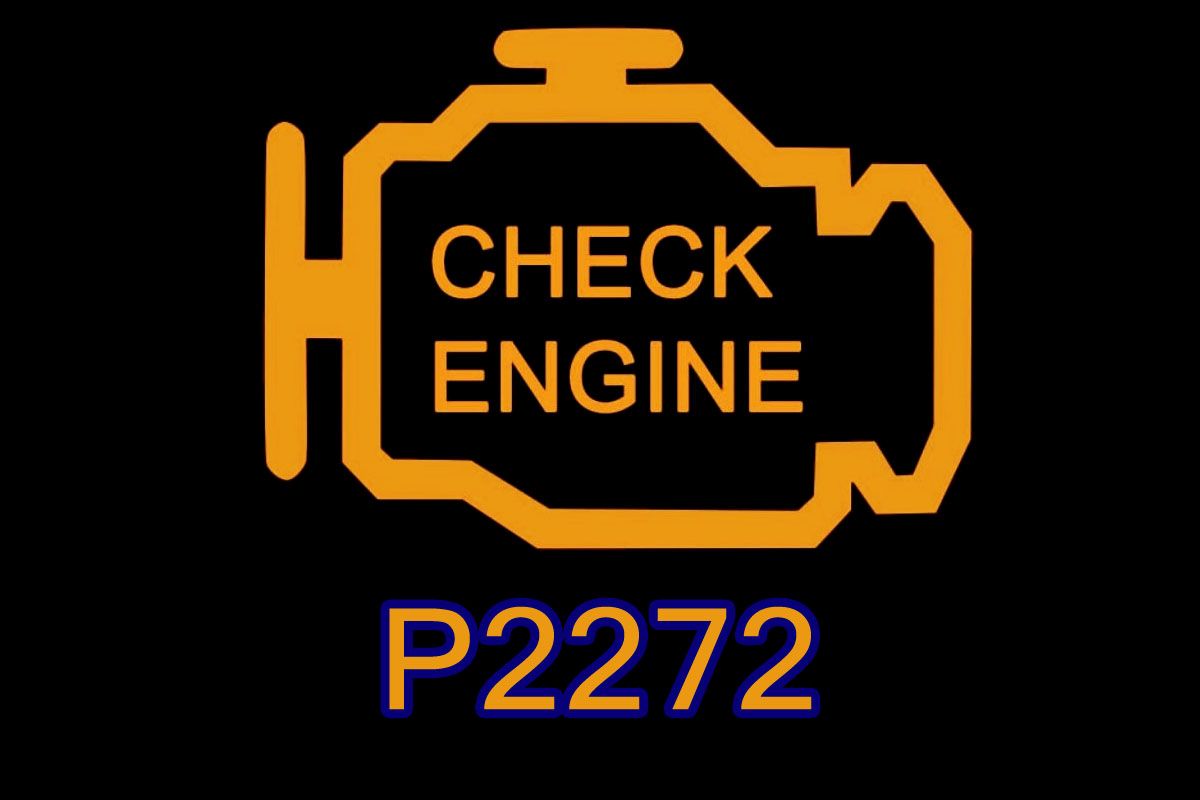
P2272 O2 Sensor Signal Biased/Stuck Lean (Bank 2 Sensor 2)
A vehicle can store P2272 even when the engine appears to be running normally. The code means that the engine control module (ECM/PCM) has detected an oxygen sensor signal that is biased or stuck lean on Bank 2 Sensor 2.
The important detail is that P2272 describes the oxygen sensor signal, not necessarily the actual air-fuel mixture inside the engine.
A downstream oxygen sensor can report a lean condition because the exhaust really contains more oxygen than expected. It can also report a lean condition because the sensor, wiring, connector, exhaust system, or another component is creating an incorrect signal.
That is why replacing the oxygen sensor immediately is not always the correct repair.
First, Understand Bank 2 Sensor 2
The terminology in the code provides useful information.
Bank 2 is the cylinder bank that does not contain cylinder number 1.
On engines with two cylinder banks, such as V6 and V8 engines, Bank 1 and Bank 2 are physically separate sides of the engine.
Sensor 2 generally refers to the oxygen sensor located downstream of the catalytic converter.
Therefore, P2272 normally concerns the post-catalyst oxygen sensor on the cylinder bank opposite the Bank 1 side.
The exact sensor arrangement varies between manufacturers, and some modern vehicles use air-fuel ratio sensors or other advanced exhaust-gas sensing technology rather than a conventional narrowband oxygen sensor.
What Does “Stuck Lean” Mean?
The ECM continuously monitors the oxygen sensor signal.
Under normal conditions, the signal should respond appropriately to changes in exhaust-gas composition and operating conditions.
With P2272, the ECM determines that the Bank 2 Sensor 2 signal is staying toward the lean side or is biased lean beyond the expected operating behavior.
This can happen in two fundamentally different ways.
The exhaust is genuinely lean.
There may actually be excessive oxygen in the exhaust reaching the sensor.
Or:
The sensor is falsely reporting a lean condition.
The sensor itself, its electrical circuit, or the exhaust system may be responsible for the abnormal reading.
This distinction is the foundation of a proper diagnosis.
What Does “Lean” Mean?
In general terms, a lean combustion condition means that there is too much air relative to fuel.
However, the wording of P2272 should not be interpreted as proof that the engine is running lean.
The ECM is specifically identifying an abnormal Bank 2 Sensor 2 signal.
Because Sensor 2 is normally located downstream of the catalytic converter, it does not have the same role as the upstream oxygen or air-fuel ratio sensor.
A downstream sensor is primarily involved in monitoring catalyst operation and exhaust behavior.
Consequently, a vehicle can have P2272 without having a severe engine-wide lean condition.
Symptoms You May Notice
P2272 can produce very different symptoms depending on the underlying problem.
Possible symptoms include:
-
Check Engine Light
-
Increased emissions
-
Reduced fuel economy
-
Rough engine operation
-
Hesitation
-
Reduced performance
-
Exhaust odor
-
Catalyst-related fault codes
-
Additional oxygen sensor codes
-
Fuel-trim-related codes
-
Misfire codes
In some vehicles, there may be virtually no noticeable drivability problem.
The driver may simply see the Check Engine Light while the vehicle continues to operate normally.
Why Bank 2 Is Important
If the vehicle has two cylinder banks, comparing Bank 1 and Bank 2 can be extremely useful.
Suppose Bank 1 Sensor 2 behaves normally while Bank 2 Sensor 2 remains lean.
That difference may point toward a problem affecting the Bank 2 sensor, its wiring, the Bank 2 exhaust system, or a condition specific to that cylinder bank.
On the other hand, if both banks show abnormal oxygen sensor behavior, a shared problem becomes more likely.
Possible shared causes include:
-
Fuel supply problems
-
MAF measurement errors
-
Intake problems
-
Exhaust conditions
-
Engine operating temperature
-
Common electrical power or ground issues
-
Software or control problems
This comparison is often more informative than looking at P2272 alone.
The First Diagnostic Question: Is the Engine Really Lean?
Before condemning Bank 2 Sensor 2, determine whether the engine is actually operating with a lean mixture.
Fuel-trim data can help.
Positive fuel trims mean the ECM is adding fuel to compensate for what it believes is a lean condition.
Negative fuel trims mean the ECM is removing fuel.
However, there is no universal fuel-trim number that proves a fault on every engine.
The important point is to compare fuel trims under different operating conditions.
Check them at:
-
Idle
-
Light cruise
-
Steady engine speed
-
Moderate load
-
Acceleration where appropriate
If Bank 2 shows significant positive correction while Bank 1 remains normal, a Bank 2-specific mixture problem becomes more interesting.
If both banks show similar positive correction, investigate common causes.
If fuel trims are normal while Bank 2 Sensor 2 remains stuck lean, the downstream sensor and its circuit deserve much closer attention.
Common Causes of P2272
Potential causes include:
-
Failed Bank 2 Sensor 2 oxygen sensor
-
Sensor contamination
-
Damaged oxygen sensor wiring
-
Open signal circuit
-
Shorted signal circuit
-
Poor connector contact
-
Corroded terminals
-
Damaged sensor heater
-
Exhaust leak
-
Intake or vacuum leak
-
Fuel delivery problem
-
Injector problem
-
MAF sensor error
-
MAP sensor error
-
EVAP purge problem
-
Engine misfire
-
Incorrect engine temperature information
-
Catalytic converter problem
-
ECM/PCM fault
Not all of these causes are equally likely on every vehicle.
The vehicle's engine design and sensor strategy determine which tests should be performed.
Inspect Bank 2 Sensor 2 Wiring
The oxygen sensor is mounted in a harsh environment.
The exhaust system creates high temperatures, vibration, and repeated thermal expansion and contraction.
As a result, wiring damage is relatively common.
Inspect the harness for:
-
Melted insulation
-
Burn marks
-
Chafing
-
Broken wires
-
Stretched wires
-
Incorrect routing
-
Contact with the exhaust
-
Previous repair work
-
Connector damage
A wire can appear intact externally while having an internal break.
This is particularly important when the code is intermittent or appears only after the engine reaches operating temperature.
Check the Connector and Terminals
The connector should be inspected carefully rather than simply disconnected and reconnected.
Look for:
-
Corrosion
-
Moisture
-
Bent pins
-
Loose terminals
-
Poor terminal tension
-
Heat damage
-
Contamination
-
Broken locking tabs
A poor electrical connection can produce an abnormal sensor signal even though the sensor itself is perfectly functional.
A simple continuity test may not reproduce a fault that occurs only under vibration or temperature changes.
Test the Heater Circuit
Many oxygen sensors use an internal electric heater.
The heater helps bring the sensor to operating temperature quickly and maintains the required operating range.
A heater problem can interfere with sensor operation.
Check the heater circuit according to the manufacturer's diagnostic procedure.
Depending on the vehicle, this may involve checking:
-
Heater power
-
Heater control
-
Ground
-
Fuse
-
Wiring
-
Connector
-
Heater resistance
-
Current consumption
Do not use a universal resistance value for every oxygen sensor.
Different sensor designs have different electrical characteristics.
Could an Exhaust Leak Cause P2272?
Yes.
An exhaust leak can introduce outside air into the exhaust stream.
Because atmospheric air contains a significant amount of oxygen, this can influence the oxygen sensor reading.
The location of the leak is especially important.
A leak close to the sensor can have a much greater effect than a leak farther downstream.
Inspect the Bank 2 exhaust system around:
-
Exhaust manifold
-
Manifold gasket
-
Exhaust flange
-
Flex section
-
Catalytic converter
-
Oxygen sensor mounting area
-
Welds
-
Cracks
A small leak may become more influential during certain operating conditions because of exhaust pressure and pulse behavior.
Could a Vacuum Leak Cause P2272?
A vacuum or intake leak can create a genuine lean condition, particularly at idle and light load.
However, because P2272 concerns Bank 2 Sensor 2, the relationship must be investigated carefully.
A large intake leak affecting the entire engine can cause both banks to show lean behavior.
A localized intake problem may affect one bank more strongly.
Fuel-trim behavior can help determine whether the engine is actually compensating for excess unmetered air.
If positive fuel trims are high at idle and improve significantly as engine speed increases, an intake or vacuum leak becomes more suspicious.
Fuel Delivery Problems Should Not Be Ignored
A lean condition can also result from insufficient fuel delivery.
Possible causes include:
-
Weak fuel pump
-
Restricted fuel filter
-
Low fuel pressure
-
Low fuel volume
-
Fuel pressure control problem
-
Restricted injector
-
Injector electrical problem
-
Fuel contamination
A vehicle may have normal fuel pressure at idle but fail to maintain adequate pressure or volume under load.
Therefore, a pressure test performed only at idle may not tell the whole story.
The manufacturer's fuel-pressure and fuel-volume specifications should be followed under the appropriate operating conditions.
Could an Injector Cause the Code?
Yes.
An injector that is restricted or not delivering the expected amount of fuel can create a lean condition in the affected cylinder or cylinder bank.
This becomes more suspicious if P2272 appears with:
-
Misfire codes
-
Bank-specific fuel-trim abnormalities
-
Rough idle
-
Poor acceleration
-
Uneven engine operation
-
Abnormal spark plug appearance
An injector should be tested rather than replaced simply because P2272 is present.
Depending on the engine, injector balance, flow, electrical operation, fuel pressure, or cylinder contribution may need to be evaluated.
MAF Sensor Problems Can Affect Both Banks
The mass airflow sensor is another important part of the diagnosis.
If the MAF sensor underestimates the amount of air entering the engine, the ECM may calculate too little fuel.
This can produce a genuinely lean condition.
Because the MAF normally measures airflow for the entire engine, a MAF problem often affects both cylinder banks rather than only Bank 2.
Therefore, if Bank 1 and Bank 2 fuel trims are both elevated, a common airflow or fuel-delivery problem deserves attention.
A dirty MAF sensor should not automatically be replaced. Its measured airflow should be compared with expected values and other engine parameters.
What About the MAP Sensor?
On engines that rely heavily on manifold absolute pressure, incorrect MAP information can also affect fuel calculations.
A MAP sensor that reports implausible pressure can cause the ECM to calculate an incorrect engine load.
Compare MAP readings with:
-
Engine RPM
-
Throttle position
-
Engine load
-
Barometric pressure
-
Intake conditions
The expected values depend on the engine and operating state.
EVAP Purge Can Affect Mixture
The EVAP purge system can introduce fuel vapor into the intake.
If the purge valve leaks or is stuck open when it should be closed, it can alter the air-fuel mixture.
Depending on the vehicle and operating conditions, the effect can appear more strongly at idle or during specific driving conditions.
Purge operation should therefore be considered when fuel trims and other data suggest an unexplained mixture disturbance.
Misfire Can Make Oxygen Sensor Data Misleading
A misfire does not simply mean “too much fuel” or “too little fuel.”
When combustion is incomplete, the exhaust composition changes significantly.
A cylinder that fails to burn its mixture properly can allow oxygen and unburned fuel to enter the exhaust.
The oxygen sensor may then report a condition that is difficult to interpret without considering the misfire.
If P2272 appears together with P0300 or cylinder-specific misfire codes, diagnose the combustion problem before assuming the downstream oxygen sensor is defective.
Compare Fuel Trims by Bank
On a V6, V8, or another engine with two banks, bank-to-bank comparison is particularly useful.
Imagine the following pattern:
Bank 1 fuel trims are normal.
Bank 2 fuel trims are strongly positive.
Bank 2 Sensor 2 appears lean.
This pattern increases suspicion of a Bank 2-specific problem.
Now consider:
Both banks have strongly positive fuel trims.
Both banks show lean-related behavior.
A common fuel, airflow, or engine-management problem becomes more likely.
Another useful pattern is:
Fuel trims are normal on both banks, but Bank 2 Sensor 2 remains stuck lean.
In this situation, the downstream sensor, wiring, connector, exhaust leak, or catalyst-related behavior deserves greater attention.
The Catalytic Converter May Be Part of the Picture
Because Sensor 2 is normally positioned after the catalytic converter, catalyst behavior must be considered.
However, P2272 does not automatically mean the catalytic converter has failed.
The converter affects the exhaust gas reaching Sensor 2, but the sensor itself and its electrical circuit must also be verified.
Before replacing an expensive catalytic converter, confirm:
-
Sensor 1 operation
-
Sensor 2 operation
-
Fuel trims
-
Exhaust leaks
-
Misfire status
-
Fuel system condition
-
Sensor wiring
-
Sensor heater operation
-
Catalyst-related diagnostic data
A catalyst should be replaced only when there is sufficient evidence that it is defective.
A Useful Sensor 1 vs Sensor 2 Test
One of the most useful observations is the relationship between the upstream and downstream sensors.
The upstream sensor reacts relatively directly to combustion mixture changes.
The downstream sensor is heavily influenced by what remains after the catalytic converter.
If Bank 2 Sensor 2 stays lean while the upstream Bank 2 sensor behaves normally, this can point toward a downstream sensing or exhaust-related issue.
If both sensors indicate abnormal behavior and fuel trims also show a lean correction, investigate the actual engine mixture.
The exact waveform and voltage behavior depend on the sensor technology, so manufacturer-specific data should be used.
Do Not Assume a Universal O2 Voltage
Older diagnostic procedures often describe oxygen sensors using approximate voltage ranges.
That approach can be misleading on modern vehicles.
A conventional narrowband oxygen sensor and a wideband air-fuel ratio sensor do not operate or communicate with the ECM in the same way.
Even among conventional sensors, the manufacturer's specified signal strategy should be followed.
For P2272, the correct question is not simply:
“Is the sensor showing less than a certain voltage?”
The better question is:
“Is the sensor's signal behaving as the manufacturer expects under the current operating conditions?”
A Practical Diagnostic Workflow
A logical P2272 diagnosis can proceed like this:
1. Scan the vehicle completely.
Record stored, pending, and manufacturer-specific codes.
2. Save the freeze-frame data.
Note engine speed, load, coolant temperature, fuel trims, and relevant sensor information.
3. Determine whether the engine is genuinely lean.
Evaluate fuel trims and engine operating data.
4. Compare Bank 1 and Bank 2.
Look for bank-specific abnormalities.
5. Compare Sensor 1 and Sensor 2.
Look at how the upstream and downstream signals relate to each other.
6. Inspect Bank 2 Sensor 2 wiring.
Check for heat damage, chafing, broken conductors, and poor routing.
7. Inspect the connector.
Check terminal condition and contact quality.
8. Test the heater circuit.
Use the vehicle's specified procedure.
9. Check the exhaust for leaks.
Pay special attention to the area around Bank 2 Sensor 2.
10. Investigate fuel and airflow if the engine is genuinely lean.
Check fuel pressure, fuel volume, injectors, MAF/MAP, EVAP purge, and other relevant systems.
11. Evaluate the catalytic converter if the evidence points toward it.
Do not condemn it from P2272 alone.
12. Consider the ECM/PCM only after the external causes have been eliminated.
Can P2272 Be Caused by the Oxygen Sensor?
Absolutely.
Aged or contaminated oxygen sensors can become slow, biased, or electrically abnormal.
A sensor may also develop an internal fault that is not obvious from a basic visual inspection.
But the correct diagnosis should establish that the sensor is actually responsible.
If the engine is genuinely lean because of low fuel pressure, a new sensor will simply report the same lean exhaust condition.
The code may return even though the sensor has been replaced.
Can P2272 Be Caused by Wiring?
Yes.
In fact, wiring should be considered early because the sensor operates in an environment that is particularly harsh on electrical harnesses.
A partially broken conductor, high-resistance connection, shorted signal wire, or poor terminal contact can distort the signal.
Voltage-drop and circuit testing under the appropriate conditions can be more informative than a simple continuity check.
Is P2272 a Serious Code?
The code itself does not necessarily mean the vehicle is in immediate danger.
The seriousness depends on the underlying cause.
If the problem is limited to a downstream sensor circuit, drivability may remain almost normal.
If the engine is genuinely running lean, however, the situation can become more important.
A severe lean condition can contribute to:
-
Misfire
-
Poor performance
-
Excessive combustion temperatures
-
Detonation under some conditions
-
Catalyst damage
-
Increased emissions
-
Engine damage in extreme cases
If P2272 is accompanied by severe hesitation, flashing Check Engine Light, heavy misfire, knocking, or significant loss of power, continued driving should be minimized until the cause is identified.
P2272 Does Not Mean “Replace Bank 2 Sensor 2”
This is probably the most important practical point.
The code identifies an abnormal signal condition.
It does not automatically identify a failed sensor.
A correct diagnosis should establish whether the lean signal is:
-
Real
-
Sensor-generated
-
Wiring-related
-
Connector-related
-
Exhaust-related
-
Catalyst-related
-
Caused by another engine-management problem
Only after these possibilities have been considered should the sensor itself be condemned.
Final Diagnosis
P2272 – O2 Sensor Signal Biased/Stuck Lean (Bank 2 Sensor 2) indicates that the ECM/PCM has detected a downstream oxygen sensor signal on Bank 2 that is biased toward or remains at the lean side.
Because Bank 2 Sensor 2 is normally located after the catalytic converter, the code does not automatically prove that the engine is running lean.
A proper diagnosis should begin by determining whether the lean indication is genuine. Fuel trims, Bank 1 versus Bank 2 comparison, Sensor 1 versus Sensor 2 behavior, exhaust inspection, fuel-pressure testing, MAF/MAP data, and misfire information can all help establish the real cause.
The sensor, wiring, connector, heater circuit, exhaust system, fuel system, and catalytic converter should be evaluated according to the evidence.
The key point is:
P2272 identifies an abnormal lean-biased oxygen sensor signal. It does not, by itself, identify the failed component.
Diagnosing the cause rather than simply replacing Bank 2 Sensor 2 is the best way to prevent repeat faults and unnecessary parts replacement.