TR
TR EN
EN

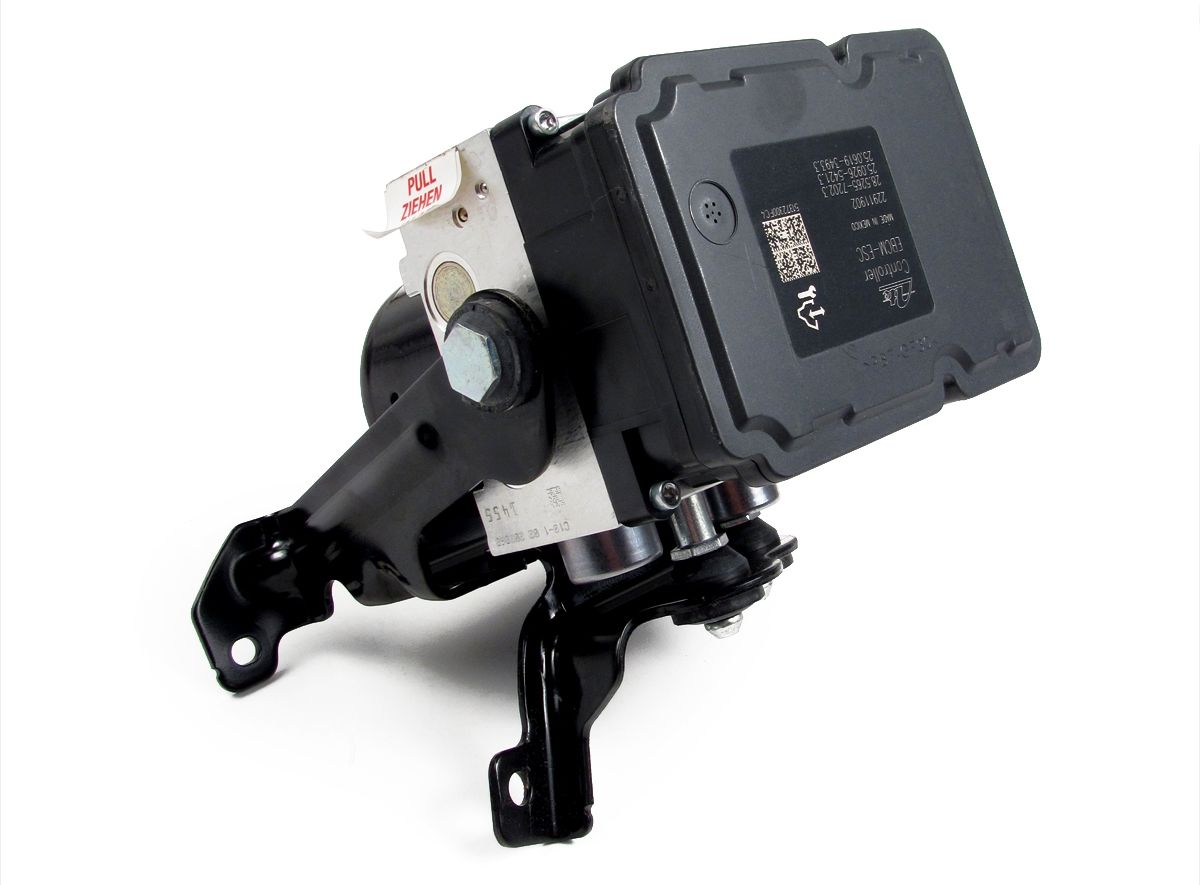
What Is an Electronic Brake Control Module (EBCM)? What Are the Symptoms of EBCM Failure?
The Electronic Brake Control Module (EBCM) is one of the most important electronic control units in a modern vehicle's braking and stability-control system.
It processes information from wheel-speed sensors, brake-related sensors, steering-angle sensors, and other vehicle systems to control functions such as ABS (Anti-lock Braking System), traction control, and electronic stability control.
Depending on the vehicle manufacturer, the same unit may be called an ABS Control Module, ABS ECU, Brake Control Module, Electronic Brake Control Module, or Electronic Stability Control Module.
The exact design varies between vehicles. In some systems, the electronic control module is mounted directly to the hydraulic ABS valve body, while in others the electronic and hydraulic components are arranged differently.
When the EBCM develops a fault, the vehicle may illuminate ABS, traction-control, or stability-control warning lights. However, these warning lights do not automatically mean that the EBCM itself has failed.
A defective wheel-speed sensor, damaged wiring, low battery voltage, hydraulic problem, or communication fault can create very similar symptoms.
What Does the EBCM Do?
The EBCM continuously monitors information from different sensors and uses this information to control the vehicle's braking and stability systems.
Its main responsibilities can include:
-
Monitoring wheel speeds
-
Controlling ABS operation
-
Managing traction control
-
Controlling electronic stability control
-
Monitoring brake-pressure information
-
Detecting wheel lock
-
Detecting wheel slip
-
Communicating with the engine ECU
-
Communicating with the transmission control module
-
Communicating with the steering system
-
Activating hydraulic brake-pressure control valves
-
Recording diagnostic trouble codes
The EBCM operates extremely quickly because ABS and stability-control systems need to react within fractions of a second.
How Does the Electronic Brake Control Module Work?
The EBCM receives information from several sensors.
The most important inputs often include wheel-speed signals.
Each wheel can have a speed sensor that continuously reports wheel rotation to the brake-control system.
If the module detects that one wheel is slowing much faster than the others during braking, it can determine that the wheel may be approaching a lock-up condition.
The EBCM can then command the hydraulic system to reduce, hold, and reapply brake pressure as necessary.
This process can occur many times per second.
The driver may feel this intervention as a rapid vibration or pulsing through the brake pedal during hard braking on a low-traction surface.
EBCM and ABS
The EBCM is closely associated with the ABS system.
During emergency braking, the module attempts to prevent individual wheels from locking.
Without ABS intervention, a locked wheel can lose directional control and reduce the driver's ability to steer around an obstacle.
The EBCM therefore continuously compares wheel-speed information and controls the hydraulic brake circuits when necessary.
If the module detects a problem with the ABS system, it can disable or limit ABS functionality while conventional braking may remain available.
The exact fail-safe strategy depends on the vehicle.
EBCM and Traction Control
The EBCM can also participate in traction-control operation.
When a driven wheel begins spinning faster than expected, the system can detect the difference through the wheel-speed sensors.
Depending on the vehicle architecture, the system can respond by applying brake pressure to an individual wheel and communicating with the engine ECU to request torque reduction.
This allows the vehicle to maintain better traction during acceleration.
A fault in the EBCM or its associated sensors can therefore cause the traction-control system to become unavailable.
EBCM and Electronic Stability Control
Electronic stability control uses information about the vehicle's direction, rotation, and wheel speeds.
The system can compare the driver's steering input with the vehicle's actual movement.
If the vehicle begins to understeer or oversteer, the stability-control system can selectively apply individual brakes and, depending on the system, request engine torque reduction.
The EBCM is therefore an important part of this process.
A malfunction can cause the stability-control warning light to illuminate and may disable electronic stability assistance.
Common Symptoms of EBCM Failure
A defective EBCM can produce several symptoms.
Common signs include:
-
ABS warning light
-
Traction-control warning light
-
ESC/ESP warning light
-
Brake-system warning message
-
Multiple warning lights appearing together
-
ABS becoming unavailable
-
Traction control becoming unavailable
-
Stability control becoming unavailable
-
Diagnostic trouble codes stored in the ABS module
-
Communication errors with other control modules
-
Wheel-speed information appearing incorrectly
-
ABS activating unexpectedly in some cases
-
Problems communicating with the ABS control module
-
Intermittent warning lights
-
EBCM-related faults returning after clearing
The exact symptoms depend on the type of failure.
ABS Warning Light Comes On
The ABS warning light is one of the most common signs of a problem in the brake-control system.
However, an illuminated ABS light does not prove that the EBCM is defective.
The system may illuminate the warning because it has detected:
-
Wheel-speed sensor failure
-
Sensor wiring damage
-
Sensor contamination
-
Damaged tone ring
-
Low system voltage
-
Hydraulic pressure problem
-
ABS pump problem
-
EBCM communication fault
-
Internal EBCM failure
A diagnostic scan should be performed before replacing the module.
Traction Control and ESC Warning Lights
If the ABS control system cannot reliably determine wheel speed, it may disable traction control and electronic stability control.
This can result in several warning lights appearing simultaneously.
For example, the driver may see:
ABS + traction control + ESC
at the same time.
This combination often indicates a fault somewhere in the shared ABS/ESC system rather than three separate failures.
Multiple Warning Lights Can Appear Together
Modern vehicles have highly interconnected electronic systems.
An ABS/EBCM problem can generate warnings in other modules because several systems depend on accurate wheel-speed information.
Possible warnings include:
-
ABS
-
ESC/ESP
-
Traction control
-
Hill-start assist
-
Adaptive cruise control
-
Collision avoidance systems
-
Lane-related systems
-
Tire-pressure monitoring systems on some vehicles
This is particularly common when a wheel-speed signal becomes unavailable.
Therefore, multiple warning lights do not necessarily mean multiple components have failed.
ABS May Stop Working
If the EBCM detects a serious fault, it can deactivate ABS functionality.
The vehicle may still have conventional hydraulic braking, depending on the fault and system design.
However, the driver may no longer have ABS assistance during emergency braking.
This is an important distinction.
A vehicle can still have normal-looking brake pedal operation while its ABS system is disabled.
For this reason, an ABS warning should not be ignored simply because the vehicle appears to stop normally.
Can EBCM Failure Affect Normal Braking?
In many vehicles, a fault in the electronic ABS control system does not eliminate the basic hydraulic braking function.
The conventional brake system may continue to operate while ABS, traction control, and stability-control functions are disabled.
However, this cannot be assumed for every vehicle.
Modern brake-by-wire and integrated braking systems can have more complex architectures.
If a vehicle displays a serious brake-system warning, has a change in pedal feel, loses braking assistance, develops a hydraulic leak, or behaves abnormally under braking, it should be inspected immediately.
ABS Activates Unexpectedly
An ABS system that activates when it should not can sometimes be related to incorrect wheel-speed information.
For example, if one wheel-speed sensor intermittently reports a much lower speed than the others, the EBCM may interpret the situation as wheel lock.
It may then activate ABS unnecessarily.
Possible causes include:
-
Damaged wheel-speed sensor
-
Damaged tone ring
-
Excessive wheel bearing play
-
Incorrect sensor air gap
-
Damaged wiring
-
Connector corrosion
-
EBCM signal-processing problem
Therefore, unexpected ABS activation should not automatically be blamed on the EBCM.
Wheel-Speed Sensor Problems Can Mimic EBCM Failure
Wheel-speed sensors are among the most important inputs to the EBCM.
A failed sensor can cause:
-
ABS warning
-
ESC warning
-
Traction-control warning
-
Cruise-control problems on some vehicles
-
Speed-related warning messages
-
ABS deactivation
A technician should check the live wheel-speed data before condemning the EBCM.
If three wheels show approximately the same speed while one wheel suddenly reads zero or an implausible value, the sensor or its circuit may be the real problem.
Damaged Tone Ring or Encoder
Some wheel-speed systems use a tone ring or magnetic encoder integrated into a wheel bearing or hub.
If the ring or encoder is damaged, contaminated, corroded, or incorrectly positioned, the wheel-speed signal can become unreliable.
The result can look exactly like an electronic control-module failure.
This is why replacing an EBCM without checking the wheel-speed signal can lead to unnecessary expense.
Wheel Bearing Problems Can Trigger ABS Faults
A worn wheel bearing can sometimes affect the relationship between the wheel-speed sensor and its tone ring or encoder.
Excessive bearing play can change the sensor gap and distort the signal.
Possible symptoms include:
-
ABS warning light
-
Intermittent ABS faults
-
Traction-control warning
-
Humming or rumbling noise
-
Wheel play
A wheel bearing should therefore be inspected when an ABS fault appears together with a noticeable wheel-bearing noise or looseness.
EBCM Wiring and Connector Problems
The EBCM depends on reliable electrical connections.
A loose, corroded, damaged, or contaminated connector can interrupt communication or sensor signals.
Potential problems include:
-
Corroded terminals
-
Water intrusion
-
Broken wires
-
Damaged harness
-
Loose connector
-
Poor ground
-
Poor power supply
-
Short circuit
-
Open circuit
Water intrusion is particularly important because the ABS control module may be located in the engine compartment or near hydraulic components.
Low Battery Voltage Can Cause EBCM Faults
Modern electronic modules are sensitive to system voltage.
A weak battery, charging-system problem, poor ground, or voltage drop can cause an ABS module to malfunction or store communication-related faults.
Possible causes include:
-
Weak battery
-
Alternator problem
-
Loose battery terminal
-
Corroded ground connection
-
Damaged power cable
-
Voltage drop under load
If several electronic systems suddenly report faults, battery and charging voltage should be checked before replacing individual modules.
CAN Communication Problems
The EBCM communicates with other vehicle control modules through the vehicle's communication network, commonly using CAN bus technology.
A communication problem can cause the EBCM to lose information from other modules or prevent other modules from receiving ABS-related information.
Possible causes include:
-
CAN wiring damage
-
Connector problems
-
Short circuit
-
Open circuit
-
Low system voltage
-
Ground problem
-
Faulty control module
-
Network termination issue
A communication code does not automatically mean that the EBCM itself is defective.
The entire communication network must be considered.
EBCM Diagnostic Trouble Codes
A professional scan tool can retrieve fault codes stored by the ABS/EBCM.
Depending on the manufacturer, codes may relate to:
-
Wheel-speed sensor circuits
-
Brake-pressure sensors
-
ABS pump
-
Solenoid valves
-
Internal module faults
-
Power supply
-
Ground
-
CAN communication
-
Steering-angle information
-
Yaw-rate information
-
Calibration
-
Configuration
The exact meaning of a code depends on the vehicle manufacturer and system.
The code should be treated as a diagnostic direction rather than proof that a particular component must be replaced.
How Is an EBCM Diagnosed?
A proper diagnosis should begin with a complete scan of the vehicle.
The technician should first determine which modules have stored faults.
The next step is to examine the fault-code details and live data.
Important checks can include:
-
Battery voltage
-
Charging voltage
-
ABS module power supply
-
ABS module grounds
-
Wheel-speed sensor signals
-
Brake-pressure sensor data
-
Steering-angle sensor data
-
Yaw-rate data
-
CAN communication
-
ABS hydraulic operation
-
Wiring and connectors
A road test may also be necessary to observe wheel-speed data and determine when the fault occurs.
Check Live Wheel-Speed Data
Live data is particularly valuable when diagnosing ABS problems.
During a controlled road test, the technician can compare all four wheel-speed signals.
Under normal conditions, the readings should correspond closely when the vehicle is traveling straight at a steady speed.
If one wheel repeatedly shows an abnormal value, the investigation should focus on that wheel's sensor, wiring, bearing, encoder, or related components before replacing the EBCM.
How Is an EBCM Electrically Tested?
Electrical testing depends on the specific vehicle.
A technician may check:
-
Module power supply
-
Ground voltage drop
-
Connector condition
-
Circuit continuity
-
Short circuits
-
CAN communication
-
Sensor supply voltage
-
Sensor signal circuits
Voltage-drop testing can be particularly useful because a circuit can show voltage with no load but fail when the system operates under load.
The manufacturer's wiring diagrams and test procedures should be used.
Can an EBCM Be Repaired?
In some cases, an EBCM can be repaired or electronically refurbished.
Whether this is appropriate depends on the failure.
Possible internal faults may involve:
-
Damaged electronic components
-
Failed solder joints
-
Corrosion
-
Internal circuit-board damage
-
Power-supply circuitry
-
Communication circuitry
However, not every EBCM is economically or technically suitable for repair.
A replacement module may be the correct solution when internal damage is extensive or when manufacturer procedures require replacement.
Does a Replacement EBCM Need Programming?
Often, yes.
Many modern vehicles require an EBCM replacement to be:
-
Programmed
-
Coded
-
Configured
-
Calibrated
-
Initialized
-
Matched to the vehicle
Some systems may also require steering-angle or other sensor calibration after installation.
Installing a physically compatible module does not necessarily mean that it will work correctly without configuration.
Used EBCM Replacement
A used EBCM can sometimes be a lower-cost alternative, but compatibility is critical.
The replacement unit may have differences in:
-
Hardware
-
Software
-
Vehicle configuration
-
Brake-system specification
-
Calibration
-
Communication configuration
A used module may also retain configuration information from the donor vehicle.
Therefore, the part number alone may not always be sufficient to guarantee compatibility.
EBCM vs ABS Module
The terms EBCM and ABS module are often used interchangeably, but terminology varies between manufacturers.
An ABS system may consist of:
-
Electronic control module
-
Hydraulic valve body
-
ABS pump
-
Pressure sensors
-
Solenoid valves
-
Wheel-speed sensors
In some vehicles, the EBCM is physically integrated with the hydraulic ABS unit.
In others, the electronic and hydraulic components are more clearly separated.
The manufacturer's terminology should therefore be used when ordering parts or interpreting diagnostic information.
EBCM vs ABS Pump
The EBCM and ABS pump perform different functions.
The EBCM is the electronic control unit that processes sensor information and commands the braking system.
The ABS pump is the hydraulic component responsible for generating or maintaining hydraulic pressure as required by the system.
They may be physically integrated into the same ABS assembly, but they are not the same component.
A pump fault does not automatically mean the EBCM has failed, and an EBCM fault does not automatically mean the hydraulic pump is defective.
Can EBCM Failure Cause a No-Start Condition?
Usually, an EBCM fault does not directly prevent the engine from starting.
However, modern vehicles communicate extensively between control modules.
In unusual circumstances, a severe communication problem involving the ABS system can contribute to other electronic faults or prevent certain vehicle functions from operating.
If a vehicle has both a no-start condition and ABS-related communication codes, the entire network should be diagnosed rather than replacing the EBCM immediately.
Can EBCM Problems Affect Cruise Control?
Yes, depending on the vehicle.
Cruise-control systems may use wheel-speed information and brake-system status.
If the EBCM cannot provide reliable information, the vehicle may disable cruise control as a safety precaution.
Adaptive cruise-control systems are even more dependent on communication between multiple control modules and sensors.
Therefore, cruise control becoming unavailable together with an ABS or ESC warning can be an important diagnostic clue.
Can EBCM Problems Affect the Speedometer?
On some vehicles, yes.
Vehicle speed information can be derived from wheel-speed sensors and distributed through the vehicle's electronic network.
If a wheel-speed signal or ABS module communication is lost, the speedometer or other speed-dependent systems may behave abnormally.
However, the exact architecture differs between vehicles.
Is It Safe to Drive With an EBCM Fault?
This depends on which functions have been disabled.
If only ABS, traction control, and stability control are unavailable while conventional braking remains normal, the vehicle may still have basic braking capability.
However, the safety margin is reduced, particularly during emergency braking or on slippery roads.
If the vehicle has:
-
Reduced braking performance
-
Soft or sinking brake pedal
-
Brake-fluid leakage
-
Serious brake warning
-
Unexpected ABS activation
-
Unusual braking behavior
-
Loss of brake assistance
the vehicle should not be driven until it has been inspected.
How Much Does EBCM Replacement Cost?
There is no universal replacement cost.
The price depends on:
-
Vehicle make and model
-
EBCM design
-
New or refurbished part
-
Labor
-
Programming requirements
-
Calibration requirements
-
Hydraulic assembly configuration
In some vehicles, the electronic module can be replaced separately.
In others, the manufacturer may supply a complete ABS hydraulic/control assembly.
This can make the repair significantly more expensive.
How to Prevent EBCM Problems
There is no special maintenance schedule for most EBCMs, but several practices can reduce the risk of related problems.
Keep the electrical system healthy and address:
-
Weak batteries
-
Charging problems
-
Corroded terminals
-
Poor grounds
-
Water leaks
-
Damaged wiring
Brake and wheel-related components should also be maintained correctly.
If an ABS warning appears, diagnosing the problem early can prevent secondary problems and unnecessary parts replacement.
Final Thoughts
The Electronic Brake Control Module (EBCM) is a central component of many modern vehicle safety systems.
It processes information from wheel-speed sensors and other inputs and controls or coordinates functions such as:
-
ABS
-
Traction control
-
Electronic stability control
-
Brake-pressure management
-
Communication with other control modules
When an EBCM problem occurs, the vehicle may display ABS, ESC, traction-control, or brake-related warning lights. However, these symptoms do not automatically prove that the EBCM itself has failed.
A defective wheel-speed sensor, damaged tone ring or encoder, wheel bearing, wiring, connector, power supply, ground, low battery voltage, hydraulic component, or CAN communication network can create very similar symptoms.
For this reason, EBCM diagnosis should begin with a complete scan, fault-code analysis, live-data inspection, electrical testing, and sensor checks.
Replacing an expensive EBCM without first checking the sensors, wiring, power supply, communication network, and hydraulic system can result in an unnecessary repair.
If the module itself is confirmed to be defective, replacement may require programming, coding, configuration, or calibration. Following the manufacturer's procedures is essential to ensure that the ABS and stability-control systems operate correctly after the repair.