TR
TR EN
EN

What Is a Blind Spot Warning System?
A Blind Spot Warning (BSW) system, also known as Blind Spot Monitoring (BSM), is an active safety technology designed to detect vehicles traveling in areas that the driver cannot easily see through the side mirrors or rear-view mirror.
The system is particularly useful when changing lanes. If another vehicle is detected in the blind spot, the system warns the driver using a visual indicator, an audible warning, steering-wheel vibration, or, on more advanced systems, limited steering intervention.
What Is a Vehicle Blind Spot?
A vehicle's blind spot is an area around the car that cannot be seen clearly by the driver.
Even when the side mirrors are adjusted correctly, there can still be areas alongside and slightly behind the vehicle where another car, motorcycle, or other road user may remain hidden.
Blind spots become particularly important when changing lanes on highways and multi-lane roads.
For example, a vehicle may be traveling alongside your car but slightly behind the driver's field of view. You may not see it in the side mirror, yet moving into that lane could create a collision risk.
The Blind Spot Warning System is designed to help identify this type of situation.
How Does Blind Spot Monitoring Work?
Most modern blind spot systems use radar sensors mounted toward the rear corners of the vehicle.
The sensors continuously monitor the areas beside and behind the vehicle. When another vehicle enters a monitored zone, the system evaluates its position and movement.
A typical system works in several stages:
1. The sensors monitor the surrounding area
Radar sensors scan the areas beside and behind the vehicle.
2. The system detects another vehicle
The system identifies an object and evaluates characteristics such as its location and movement.
3. The system determines whether the vehicle is in the monitored blind spot
If the detected vehicle is in an area where it could create a lane-change hazard, the warning system is activated.
4. The driver receives a warning
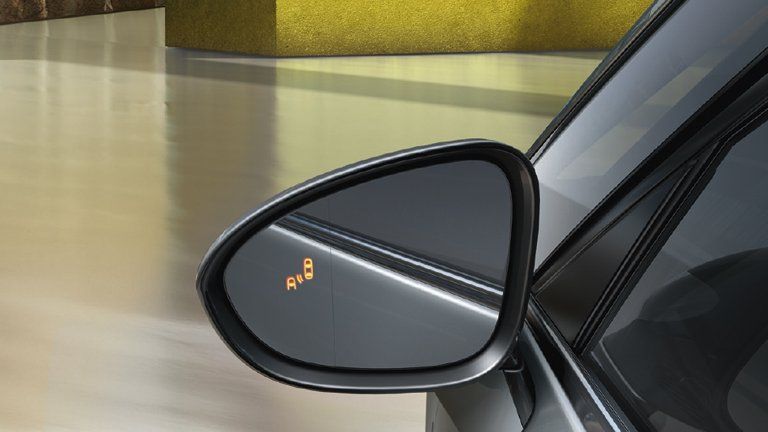
A warning light, usually located on the corresponding side mirror, illuminates to alert the driver.
Some vehicles provide a stronger warning if the driver activates the turn signal toward the occupied side.
What Does the Blind Spot Warning Light Mean?
Many vehicles have a small warning indicator built into the side mirrors.
For example, if another vehicle is detected on the left side, the left mirror indicator may illuminate. If a vehicle is detected on the right, the right indicator may illuminate.
Generally:
Warning indicator illuminated: A vehicle has been detected in the monitored area.
Warning becomes more noticeable when the turn signal is activated: The system may be warning that changing lanes toward the occupied side could be dangerous.
The exact warning strategy depends on the vehicle manufacturer and system configuration.
Does Blind Spot Monitoring Prevent Lane Changes?
A standard Blind Spot Warning system normally does not physically prevent the driver from changing lanes.
Its primary purpose is to provide information to the driver.
For example, if a vehicle is traveling in the blind spot, the system may illuminate the corresponding mirror warning indicator. The driver can still turn the steering wheel and change lanes.
More advanced vehicles may have a system capable of applying limited steering intervention when a lane change is detected as dangerous. This type of technology should not be confused with a basic blind spot warning system.
Blind Spot Warning vs. Blind Spot Assist
These terms are sometimes used interchangeably, but they can describe different levels of technology.
Blind Spot Warning / Blind Spot Monitoring
The system detects a vehicle in the blind spot and warns the driver.
Blind Spot Assist
A more advanced system may take additional action when it detects a dangerous lane-change maneuver. Depending on the vehicle, this can include steering intervention or other corrective assistance.
The exact functionality varies significantly between manufacturers and vehicle models.
Does Blind Spot Monitoring Detect Only Cars?
The system is primarily designed to detect nearby vehicles, but its ability to detect motorcycles, bicycles, and smaller objects depends on the vehicle's sensors and software.
Modern radar systems can detect many different types of road users under suitable conditions, but they should not be considered capable of detecting every object in every situation.
Performance can be affected by:
-
Very small objects
-
Rapidly approaching vehicles
-
Motorcycles
-
Bicycles
-
Stationary objects
-
Heavy rain
-
Snow and ice
-
Dirt covering the radar area
-
Unusual road geometry
For this reason, the system should always be considered a driver-assistance feature rather than a replacement for visual observation.
Where Are Blind Spot Radar Sensors Located?
Blind spot radar sensors are commonly installed near the left and right rear corners of the vehicle.
In many cars, they are mounted behind the rear bumper and cannot be seen from outside.
This makes the rear bumper particularly important to the operation of the system.
A collision, bumper replacement, incorrect repair, thick paint or coating, or incorrect sensor positioning can potentially affect radar performance.
Why Does a Blind Spot Warning System Stop Working?
A disabled blind spot system does not automatically mean that the radar sensor itself has failed.
Several different problems can cause the system to stop working.
Dirty or obstructed radar area
Mud, snow, ice, or other contamination around the radar sensor can interfere with detection.
Damaged radar sensor
A rear-end collision or bumper impact can damage the sensor even when the external damage appears minor.
Wiring or connector problems
A damaged wire, loose connector, corrosion, or poor electrical contact can interrupt communication between the radar sensor and the vehicle's electronic systems.
Incorrect bumper installation
If the bumper or radar sensor is not installed in the correct position, the radar's detection area can change.
Radar calibration problem
Some vehicles require radar calibration after sensor replacement, certain body repairs, or changes to the bumper.
Electronic communication fault
The radar module must communicate with other vehicle control units. A CAN-bus communication problem or another electronic fault can cause the blind spot system to become unavailable.
Can a Bumper Repair Affect Blind Spot Monitoring?
Yes.
This is an important consideration on vehicles equipped with radar-based blind spot monitoring.
The radar sensor is designed to operate from a specific position and orientation. If a bumper is repaired incorrectly, the sensor mounting position can change.
Problems may also occur after:
-
Rear bumper replacement
-
Accident repairs
-
Radar sensor replacement
-
Incorrect sensor mounting
-
Excessive paint thickness
-
Non-original bumper components
-
Incorrect brackets or mounting hardware
After certain repairs, the system may require inspection or calibration according to the vehicle manufacturer's procedures.
Does Blind Spot Monitoring Work in Rain?
Radar-based systems are generally designed to operate in normal weather conditions, including rain.
However, severe weather can reduce system performance.
Heavy rain, snow, ice, mud, or contamination around the radar area can interfere with detection. In some situations, the vehicle may temporarily disable the system and display a warning on the instrument cluster.
A temporary warning does not necessarily mean that the radar sensor has failed.
The sensor area should first be checked for contamination or obstruction. If the warning remains after the conditions have returned to normal, further diagnosis may be necessary.
Can Blind Spot Monitoring Detect a Fast-Approaching Vehicle?
The ability to detect a rapidly approaching vehicle depends on the radar system, vehicle speed, relative speed, road conditions, and the software's detection strategy.
Some advanced systems can monitor vehicles approaching from behind and may provide an alert before the vehicle reaches the immediate blind spot.
However, drivers should never assume that every fast-approaching vehicle will always be detected in time.
What Is the Difference Between Blind Spot Monitoring and Lane Keeping Assist?
These systems perform different functions.
Blind Spot Monitoring primarily monitors the areas beside and behind the vehicle and warns the driver about nearby vehicles.
Lane Keeping Assist monitors the vehicle's position relative to lane markings and can warn the driver or provide steering assistance if the vehicle begins to leave its lane unintentionally.
In simple terms:
Blind Spot Monitoring: "There is another vehicle beside you."
Lane Keeping Assist: "Your vehicle is moving toward the lane boundary."
Modern vehicles can combine these technologies as part of a larger driver-assistance package.
Does Blind Spot Monitoring Use Cameras?
Some blind spot systems can use cameras or combine camera information with radar and other sensors.
However, radar is particularly common because it can measure the position and movement of objects and can operate in conditions where a camera's visibility may be reduced.
The exact sensor configuration depends on the vehicle.
Some systems may use:
-
Radar
-
Cameras
-
Ultrasonic sensors
-
Steering-angle information
-
Vehicle-speed information
-
Turn-signal status
-
Other electronic vehicle data
The system then combines this information to determine whether a warning is necessary.
Can Blind Spot Monitoring Be Added Later?
In some vehicles, an aftermarket blind spot system can be installed.
However, adding a factory-style system is not always a simple modification.
An original equipment system may require:
-
Radar sensors
-
Wiring harnesses
-
Control modules
-
Mirror warning indicators
-
Communication with the vehicle's CAN network
-
Software coding
-
Radar calibration
A vehicle that was not originally equipped with the necessary hardware may therefore require significant modifications.
There are also aftermarket blind spot warning kits that use their own sensors and warning indicators. Their operation and detection performance can differ from factory-installed systems.
Does Blind Spot Monitoring Replace Checking the Mirrors?
No.
This is one of the most important points about the system.
Blind Spot Monitoring is a driver-assistance technology, not an autonomous driving system.
The driver should still:
-
Check the rear-view mirror
-
Check the relevant side mirror
-
Use the turn signal
-
Observe surrounding traffic
-
Check the vehicle's blind spot when necessary
-
Change lanes only when the maneuver is safe
A driver should never assume that a lane is clear simply because the blind spot warning light is not illuminated.
What Happens If the Blind Spot System Gives a False Warning?
Occasional warnings can occur depending on the road environment and the system's detection strategy.
For example, guardrails, barriers, road geometry, nearby vehicles, or other objects can sometimes influence the sensor's interpretation.
However, frequent or persistent false warnings should not simply be ignored.
If the system repeatedly warns when no vehicle is present, the radar sensors, mounting position, calibration, wiring, and related software should be checked.
Can a Blind Spot Sensor Be Damaged Without Visible Damage?
Yes.
Because radar sensors are often mounted behind the bumper, a relatively small impact can affect their position or mounting bracket without producing obvious external damage.
A vehicle may therefore have a blind spot warning problem after a minor collision even when the bumper appears visually acceptable.
If the problem started after bodywork or a bumper repair, the sensor mounting and calibration should be considered during diagnosis.
How Important Is Blind Spot Monitoring?
Blind Spot Monitoring is particularly useful during highway driving, heavy traffic, and frequent lane changes.
Its main advantage is that it provides continuous monitoring of areas that can be difficult for the driver to observe directly.
The technology does not eliminate blind spots completely and cannot guarantee that every nearby vehicle will be detected. Its purpose is to provide an additional layer of information so that the driver can make safer decisions.
For this reason, Blind Spot Warning is best understood as an additional set of electronic eyes around the vehicle, rather than a system that replaces the driver's responsibility to observe traffic.