TR
TR EN
EN

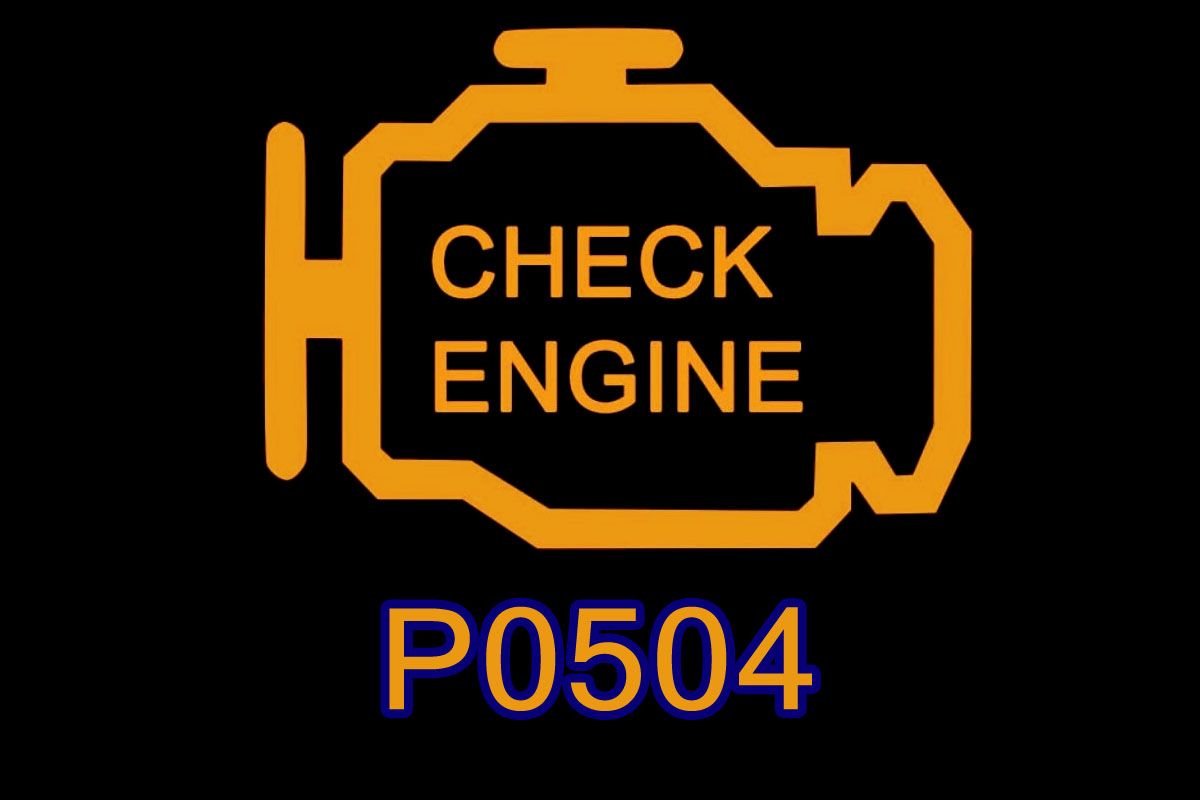
P0504 Brake Switch "A"/"B" Correlation
The P0504 trouble code means the engine control module (ECM/PCM) has detected a correlation problem between the Brake Switch "A" and Brake Switch "B" signals.
This code is commonly misunderstood because it does not necessarily mean that the brake switch has completely failed.
Many vehicles use more than one brake-switch signal for safety and plausibility monitoring. The ECM or another control module compares these signals and expects them to change state in a specific relationship when the brake pedal is pressed and released.
If the two signals disagree, change at the wrong time, remain in the same state, or show an implausible combination, P0504 can be stored.
Why Does the Vehicle Have Two Brake-Switch Signals?
A modern brake-pedal switch may contain two separate electrical circuits or contacts.
They can be referred to as:
-
Brake Switch A
-
Brake Switch B
Although both are associated with the same brake pedal, they do not necessarily operate identically.
One circuit may be used primarily for the brake lamps, while another provides a signal to the ECM or other control modules.
Depending on the vehicle, the two signals can have opposite logic.
For example, one circuit may be:
-
ON when the brake pedal is pressed
-
OFF when the pedal is released
while another may be:
-
OFF when the brake pedal is pressed
-
ON when the pedal is released
This allows the control module to perform a plausibility check.
If the signals are supposed to have opposite states but both indicate ON, or both indicate OFF when that combination is not expected, the module can recognize the discrepancy and set P0504.
The exact logic is manufacturer-specific.
What Does “Correlation” Mean?
“Correlation” is the most important word in P0504.
The ECM is not necessarily saying:
“Brake Switch A is defective.”
Instead, it is saying:
“The relationship between the brake-switch signals is not what I expect.”
This can be caused by:
-
A defective brake switch
-
Incorrect switch adjustment
-
A switch installed incorrectly
-
A damaged connector
-
Wiring problems
-
One circuit stuck high
-
One circuit stuck low
-
A blown fuse
-
Poor electrical contact
-
A brake-pedal mechanical problem
-
A problem in the module receiving the signals
This is why simply replacing the brake switch does not always solve P0504.
Common Symptoms of P0504
Possible symptoms include:
-
Check Engine Light
-
Cruise control not operating
-
Cruise control suddenly becoming unavailable
-
Cruise control canceling unexpectedly
-
Brake lights staying on
-
Brake lights not operating correctly
-
Difficulty shifting out of Park on some vehicles
-
Start/stop system disabled
-
Engine torque reduction under braking
-
Transmission control changes
-
ABS/ESC-related warnings on some vehicles
-
No obvious symptoms other than the stored code
The actual symptoms depend heavily on how the brake-switch information is shared between the ECM, BCM, ABS/ESC and transmission modules.
Common Causes of P0504
Faulty brake pedal switch
The internal contacts may wear, become contaminated or fail electrically.
A switch can sometimes operate one circuit correctly while the second circuit behaves incorrectly.
This is one reason the brake lights can appear normal while P0504 is still present.
Incorrect brake-switch adjustment
Many brake switches are positioned according to the brake-pedal's resting position.
If the switch is incorrectly adjusted, the two circuits may change state at the wrong point.
This can create a correlation error even though the switch itself is electrically functional.
Incorrectly installed switch
If the switch was recently replaced, its installation should be checked carefully.
Depending on the design, the switch may require a specific installation or adjustment procedure.
Damaged wiring
A broken conductor, short to ground, short to voltage or high-resistance connection can cause one of the two signals to disagree with the other.
Connector problems
Loose terminals, corrosion, moisture or damaged pins can affect one circuit while leaving the other apparently normal.
Fuse or power-supply problem
Some brake-switch circuits use separate power supplies or fuses.
A blown fuse can therefore cause one signal to disappear and produce a correlation fault.
Brake-pedal mechanical problem
If the pedal does not return completely, the switch may remain partially or fully activated.
Possible causes include:
-
Pedal obstruction
-
Binding
-
Damaged return mechanism
-
Incorrect switch installation
-
Mechanical interference
Control-module or communication problem
On some vehicles, the brake signal is processed by a BCM, ABS module or another control unit before the ECM receives the information.
A communication or module-input problem can therefore produce what appears to be a brake-switch correlation fault.
Brake Lights Can Still Work With P0504
This is an important diagnostic point.
Working brake lights do not automatically rule out a brake-switch problem.
A dual-circuit brake switch can have one healthy circuit and one faulty circuit.
For example:
-
Circuit A correctly activates the brake lights
-
Circuit B does not provide the expected ECM signal
The driver may see perfectly normal brake lights while the ECM detects a disagreement and stores P0504.
The opposite situation is also possible depending on the architecture.
Therefore, checking the brake lamps alone is insufficient.
How to Diagnose P0504 Correctly
The best diagnostic method is to determine what both brake-switch signals are doing electrically and what the control module sees in live data.
1. Scan all modules
Do not limit the diagnosis to the ECM.
Check the:
-
ECM/PCM
-
BCM
-
ABS/ESC module
-
Transmission control module
if those systems are available on the vehicle.
Look for additional brake-switch, ABS, communication or cruise-control codes.
2. Check live brake-switch data
This is one of the most useful tests.
With the brake pedal released, observe the status of:
-
Brake Switch A
-
Brake Switch B
Then slowly press the brake pedal and watch both signals.
The important question is:
Do both signals change state at the correct point and maintain the expected relationship?
If the scan tool shows the two states directly, this can quickly narrow the diagnosis.
3. Check the brake lights
Verify:
-
Brake lights with pedal released
-
Brake lights with pedal pressed
-
Whether they turn on immediately
-
Whether they remain on after releasing the pedal
-
Whether one side behaves differently
Do not stop the diagnosis here, because the lamp circuit may not be the circuit monitored by the ECM.
4. Inspect the brake switch
Look for:
-
Loose mounting
-
Incorrect adjustment
-
Physical damage
-
Incorrect installation
-
Contamination
-
Damaged connector
-
Terminals pushed backward inside the connector
If the switch was recently replaced, installation and adjustment become particularly important.
5. Test both circuits
Use the vehicle's wiring diagram to identify the terminals for Switch A and Switch B.
Check:
-
Power supply
-
Ground where applicable
-
Signal voltage
-
Continuity
-
Short to ground
-
Short to voltage
-
Resistance/high-resistance connections
Do not assume both circuits use the same voltage or logic.
6. Check the switch while operating the pedal
A multimeter or oscilloscope can be used to observe whether the switch contacts change state consistently.
The critical point is not merely whether the circuit has continuity.
You want to know whether:
-
Circuit A changes correctly
-
Circuit B changes correctly
-
The timing between them is correct
-
Either circuit intermittently drops out
An oscilloscope can be particularly useful for intermittent faults.
7. Check pedal adjustment
If the signals change too early or too late, inspect the physical relationship between the brake pedal and switch.
Some systems require a precise adjustment procedure.
Do not simply move the switch until the brake lights appear to work; the ECM may require a specific relationship between the two signals.
A Brake Switch Can Be Mechanically Good but Electrically Wrong
This is another important distinction.
The brake pedal may physically operate the switch, and the brake lights may function, but one internal contact can still produce the wrong signal.
Likewise, the switch can be electrically healthy but incorrectly positioned.
Therefore, P0504 requires both:
electrical testing and mechanical inspection.
P0504 and Cruise Control
Brake-switch signals are critical to cruise-control operation.
The cruise-control system normally needs to know when the driver applies the brakes so it can immediately disengage.
If the ECM cannot trust the brake signal, it may disable cruise control as a safety precaution.
Therefore, a vehicle can have:
P0504 + cruise control unavailable
even when the cruise-control system itself is perfectly functional.
This is particularly useful when diagnosing multiple seemingly unrelated symptoms.
P0504 and Automatic Transmission Problems
On some vehicles, brake-pedal information is also used by the transmission or body-control system.
For example, the brake signal may participate in:
-
Shift-lock operation
-
Start authorization
-
Stop/start strategy
-
Torque-management decisions
-
Transmission control logic
Consequently, a brake-switch correlation problem can sometimes create symptoms that initially appear to be transmission or starting-system faults.
Can P0504 Be Caused by a Brake Light Problem?
Yes, but the relationship is more complicated than simply saying “bad brake lights.”
If the brake-switch circuit that supplies the brake lamps is faulty, that can certainly contribute to P0504.
However, a brake-light problem is not required for P0504.
The ECM may be monitoring a separate brake-switch circuit that has failed while the brake lamps continue working normally.
Can P0504 Cause the Car Not to Start?
It can contribute to starting problems on certain vehicles, but it is not a universal consequence.
Some modern vehicles require a valid brake-pedal signal before allowing the engine to start, particularly vehicles using a push-button start system.
If the system cannot confirm that the brake pedal is being pressed, the vehicle may refuse to start or may behave differently.
However, if the vehicle starts normally, that does not rule out P0504.
P0504 After Brake Switch Replacement
If P0504 appears immediately after a brake-switch replacement, do not automatically assume the new switch is defective.
Check:
-
Correct part number
-
Correct switch type
-
Connector seating
-
Terminal arrangement
-
Switch installation
-
Pedal adjustment
-
Required initialization or calibration
-
Live-data state of both brake inputs
Some switches look physically identical but have different electrical contact arrangements.
P0504 vs P0571 and P0573
These codes are related but not identical.
P0504 focuses on correlation between brake-switch signals.
P0571 generally indicates a malfunction involving the brake-switch "A" circuit.
P0573 generally indicates a high electrical condition in the brake-switch "A" circuit.
Therefore, P0504 is primarily a plausibility/correlation problem, while P0571/P0573 can point more directly toward a particular circuit condition.
A Practical Diagnostic Sequence
A good diagnostic order is:
Scan all modules → check freeze-frame → monitor Brake Switch A/B live data → test brake-light operation → inspect switch installation and adjustment → test both electrical circuits → inspect wiring/connectors → check related modules and communication → perform any required calibration or relearn.
This is considerably more reliable than simply replacing the brake switch.
Final Diagnostic Summary
P0504 – Brake Switch "A"/"B" Correlation means the vehicle's control system has detected an unexpected relationship between two brake-switch signals.
It does not necessarily mean that both switches are bad—or even that there are two physically separate switches.
The vehicle may use a dual-contact switch, multiple circuits, or a networked brake-pedal signal depending on its architecture.
The most useful diagnostic test is to observe Brake Switch A and Brake Switch B in live data while slowly pressing and releasing the brake pedal.
If the two signals do not change state as expected, then determine whether the cause is the switch, adjustment, wiring, connector, power supply, pedal mechanism or control module.
And importantly, working brake lights do not rule out P0504, because the ECM may be monitoring a separate brake-switch signal from the circuit that operates the lamps.