TR
TR EN
EN

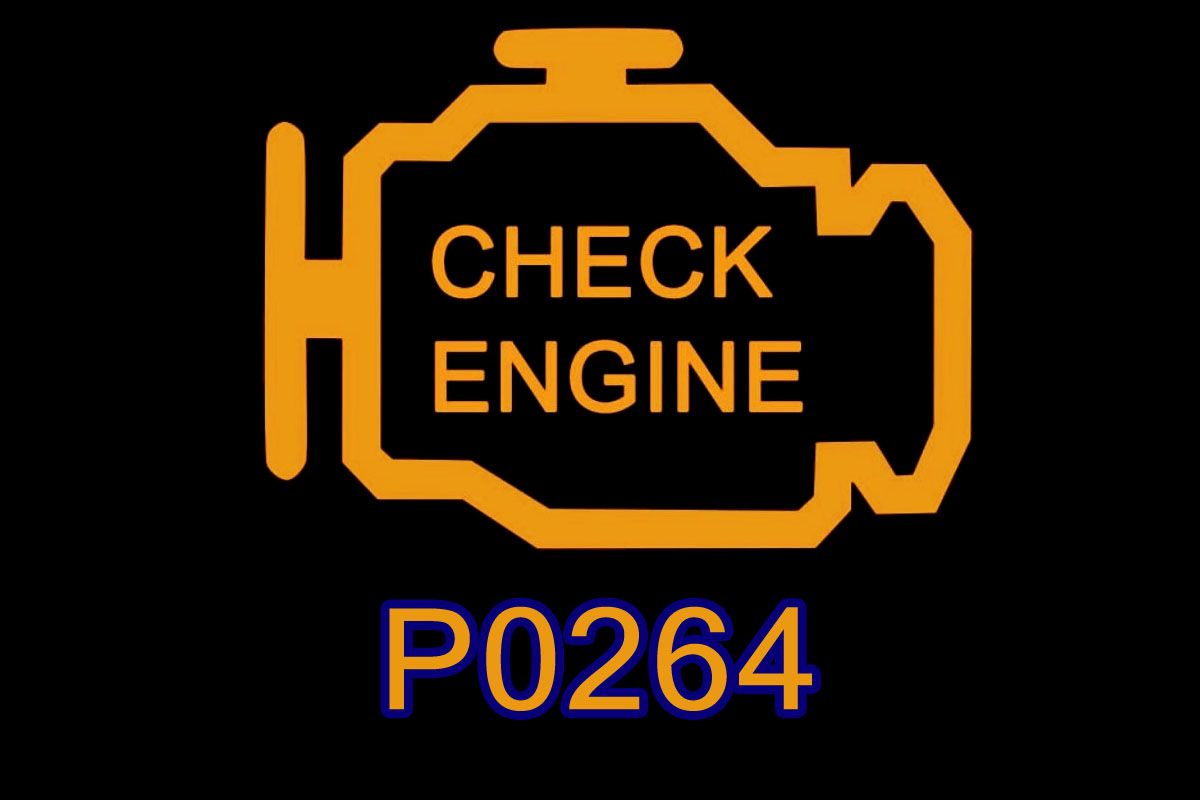
P0264 Cylinder 2 Injector Circuit Low
P0264 is a generic OBD-II diagnostic trouble code indicating that the engine control module (ECM/PCM) has detected an abnormally low electrical condition in the fuel injector circuit for cylinder 2.
The word “Low” refers to the electrical behavior of the injector circuit. It does not necessarily mean low fuel pressure, low fuel quantity, low engine speed, or low engine power.
This is primarily an electrical injector-circuit code. The injector itself may be faulty, but the problem can also be caused by wiring, connectors, power supply, circuit resistance, or the ECM's injector driver.
What Does P0264 Mean?
The ECM controls the cylinder 2 injector by switching its electrical circuit according to engine operating conditions.
When the electrical response from this circuit is lower than the value expected by the ECM, P0264 can be stored.
The exact electrical behavior depends on the vehicle's injector control system. Some engines use a shared injector power supply with the ECM controlling the opposite side of the circuit. Others use high-side drivers, low-side drivers, or more sophisticated current-controlled systems.
For this reason, the code should be interpreted using the vehicle's specific wiring diagram and diagnostic specifications.
In practical terms, P0264 means:
The ECM has detected an abnormally low electrical condition in the cylinder 2 injector circuit.
It does not automatically mean:
“Cylinder 2 injector needs to be replaced.”
What Can Cause P0264?
Possible causes include:
-
Faulty cylinder 2 fuel injector
-
Short to ground in the injector control circuit
-
Damaged injector control wire
-
Open or high-resistance circuit
-
Corroded injector connector
-
Loose or poorly tensioned connector terminal
-
Damaged injector power supply
-
Poor connection in a shared injector power circuit
-
Wiring damaged by heat or vibration
-
Internal electrical failure of the injector
-
Poor engine or ECM ground
-
ECM injector driver fault
The most important task is to determine where the low electrical condition is being created.
“Low” Does Not Mean Low Fuel Pressure
P0264 is sometimes misunderstood because it refers to an injector.
However, the word “Low” describes the electrical circuit, not the fuel system's pressure.
It does not directly indicate:
-
Low fuel pressure
-
Low fuel level
-
Low fuel quantity
-
Low RPM
-
Low compression
-
Low engine power
A fuel-pressure problem can certainly cause poor cylinder operation, but that is a separate issue unless it also affects the injector's electrical operation.
The Injector May Be Perfectly Good
An injector circuit can produce P0264 even when the injector itself is functioning correctly.
For example, a control wire could be shorted to ground. Depending on the circuit architecture, this can cause the ECM to detect an abnormally low electrical condition.
A damaged connector can produce the same type of problem.
This is why injector replacement should not be the first assumption.
The entire electrical circuit needs to be tested.
Start With All DTCs
The first diagnostic step should be a complete scan for stored and pending trouble codes.
P0264 becomes more meaningful when viewed together with other codes.
If several injector circuit codes appear at the same time, investigate common components such as:
-
Injector power supply
-
Fuse
-
Relay
-
Shared wiring
-
ECM power supply
-
Engine grounds
If P0264 is isolated to cylinder 2, the cylinder 2 injector, connector, and individual wiring deserve particular attention.
Inspect the Cylinder 2 Injector Connector
Start with a careful visual inspection.
Check for:
-
Corrosion
-
Bent terminals
-
Loose terminals
-
Terminals pushed backward into the connector
-
Broken locking mechanism
-
Water contamination
-
Oil contamination
-
Damaged wires immediately behind the connector
A connector may look completely normal while one terminal has lost its proper contact tension.
This can cause intermittent electrical faults as the engine vibrates.
Inspect the Injector Harness
Follow the cylinder 2 injector wiring back toward the main engine harness.
Look for:
-
Chafed insulation
-
Melted wires
-
Pinched wiring
-
Broken conductors
-
Poor previous repairs
-
Incorrect splices
-
Harness sections touching hot components
-
Wiring stretched by engine movement
Heat and vibration are particularly important because injector wiring operates in a harsh environment.
If P0264 occurs only when the engine is hot or under acceleration, an intermittent harness problem should be considered carefully.
Identify the Circuit Architecture
Before performing electrical measurements, use the manufacturer's wiring diagram to determine:
-
Injector power supply
-
Injector control wire
-
ECM connector and pin
-
Shared injector circuits
-
Fuse and relay connections
-
Ground paths
-
High-side or low-side driver arrangement
There is no universal injector voltage specification that applies to every vehicle.
The correct test depends on the specific injection system.
Check Injector Power Supply
Verify that the cylinder 2 injector is receiving the correct supply under the conditions specified by the manufacturer.
If multiple injectors use a common power supply, compare their supply voltage.
When several injector codes appear together, a common power-supply fault may be much more likely than several individual injector failures.
Voltage-drop testing can also reveal excessive resistance in the supply circuit.
A circuit may show acceptable voltage with little or no load but fail when the injector is actually operating.
Check for a Short to Ground
Because P0264 is a circuit-low code, a short to ground is an important possibility.
The technician should determine whether the injector control circuit is being pulled toward ground when it should not be.
However, this must be done according to the vehicle's injector-control architecture.
Do not simply ground an injector control wire as a test.
Doing so can damage the injector or the ECM driver.
Check for an Open or High-Resistance Circuit
An open or high-resistance connection can also cause abnormal injector operation.
The wire might be:
-
Completely broken
-
Partially broken
-
Corroded internally
-
Damaged near the connector
-
Poorly repaired
A simple continuity test may not reveal a high-resistance problem.
Where appropriate, a loaded-circuit test or voltage-drop test can provide more useful information.
Test the Injector
The cylinder 2 injector itself should also be tested.
Depending on the injector design, electrical testing can identify:
-
Open internal coil
-
Shorted coil
-
Resistance outside specification
However, resistance alone does not prove that the injector is healthy.
An injector can have normal resistance and still suffer from:
-
Restricted flow
-
Mechanical sticking
-
Contamination
-
Poor spray pattern
-
Incorrect fuel delivery
Electrical testing and mechanical injector testing should therefore be treated separately.
Oscilloscope Testing
An oscilloscope can be particularly useful when P0264 is intermittent.
The cylinder 2 injector waveform can be compared with a known-good injector.
Depending on the system, waveform analysis can reveal abnormalities in:
-
Control voltage
-
Switching behavior
-
Current rise
-
Injector activation
-
Inductive voltage
-
Driver operation
-
Circuit interruptions
-
Electrical noise
This can help distinguish an injector problem from a wiring or ECM-driver problem.
Can P0264 Cause a Misfire?
Yes.
If the cylinder 2 injector is not operating correctly, fuel delivery can become insufficient or inconsistent.
The engine may then develop:
-
Rough idle
-
Hesitation
-
Poor acceleration
-
Loss of power
-
Engine vibration
-
Difficult starting
-
Increased fuel consumption
-
Cylinder 2 misfire
A related code such as P0302 – Cylinder 2 Misfire Detected may therefore appear together with P0264.
If both codes are present, the cylinder 2 injector circuit should be investigated carefully.
However, a misfire code should not automatically be attributed to the injector. Ignition, compression, air supply, and mechanical problems can also cause P0302.
P0264 That Appears During Acceleration
An injector circuit fault that occurs only during acceleration can provide a useful clue.
Under acceleration:
-
Engine movement increases
-
Harness movement increases
-
Injector operating demand changes
-
Electrical loading changes
-
Engine temperature may increase
A damaged wire or weak connector terminal may therefore work normally at idle but fail when the engine moves under load.
In this situation, reproducing the fault while monitoring the circuit can be much more informative than checking resistance with the engine switched off.
Gasoline and Diesel Systems Differ
The diagnostic procedure depends heavily on the injection system.
A conventional gasoline port injector has very different electrical characteristics from a modern common-rail diesel injector.
Diesel systems may use specialized injector drivers and substantially different electrical operating strategies.
Therefore, there is no single injector resistance or voltage value that applies to all vehicles.
Always use the specifications for the particular engine.
Multiple Injector Codes
If P0264 appears together with other injector circuit codes, do not immediately assume that multiple injectors have failed.
Look for a common electrical problem.
Check:
-
Shared injector power
-
Fuse
-
Relay
-
Common harness
-
ECM power supply
-
Engine grounds
-
Shared connectors
This is especially important when several injector codes appear simultaneously after electrical work or engine repairs.
What About the ECM?
The ECM controls the injector circuit, so an internal injector-driver failure is possible.
However, the ECM should normally be considered after the injector and external circuit have been verified.
Before condemning the ECM, verify:
-
Injector condition
-
Connector condition
-
Power supply
-
Control circuit
-
Continuity
-
Short-to-ground condition
-
Short-to-voltage condition where applicable
-
Voltage drop
-
ECM command
Replacing the ECM simply because P0264 remains stored is not a sound diagnostic strategy.
P0264 vs P0265 and P0266
These codes all relate to cylinder 2 but describe different problems.
P0264 – Cylinder 2 Injector Circuit Low
The ECM detects an abnormally low electrical condition in the cylinder 2 injector circuit.
P0265 – Cylinder 2 Injector Circuit High
The ECM detects an abnormally high electrical condition in the cylinder 2 injector circuit.
P0266 – Cylinder 2 Contribution / Balance Fault
The ECM determines that cylinder 2 is not contributing the expected amount of power compared with the other cylinders.
The difference between P0264 and P0266 is especially important.
P0264 is primarily an electrical injector-circuit fault.
P0266 is primarily a cylinder contribution problem and can be caused by the injector, ignition, fuel delivery, compression, valve-train, timing, or other mechanical conditions.
A Practical Diagnostic Order for P0264
A logical diagnostic sequence is:
-
Scan all stored and pending DTCs.
-
Check freeze-frame information.
-
Confirm the physical location of cylinder 2 using manufacturer service information.
-
Inspect the cylinder 2 injector connector.
-
Inspect the complete injector harness.
-
Verify injector power supply.
-
Identify the injector control circuit from the wiring diagram.
-
Check for shorts and open circuits.
-
Perform voltage-drop testing where appropriate.
-
Test the injector's electrical characteristics.
-
Compare the injector control waveform with a known-good cylinder if necessary.
-
Perform injector flow or balance testing if the electrical circuit is good but fuel delivery remains questionable.
-
Test the ECM injector driver only after the external circuit has been verified.
-
Clear the code and verify the repair under the conditions that originally triggered P0264.
Final Diagnosis
P0264 – Cylinder 2 Injector Circuit Low means the ECM has detected an abnormally low electrical condition in the cylinder 2 injector circuit.
The word “Low” refers to the electrical circuit, not necessarily to fuel pressure or the amount of fuel entering the cylinder.
The cause may be a faulty injector, short to ground, damaged wiring, open or high-resistance circuit, poor connector contact, power-supply problem, or, less commonly, an ECM injector-driver failure.
The correct approach is to test the complete injector circuit before replacing parts. Once the electrical system has been verified, the injector's actual fuel-delivery performance can be evaluated. This distinction is important because P0264 identifies an electrical condition—not the specific component that caused it.