TR
TR EN
EN

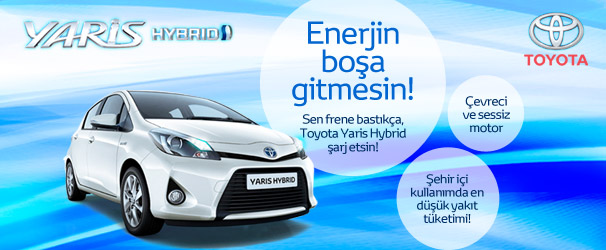
Toyota Hybrid Technology
Toyota hybrid technology combines a gasoline engine with one or more electric motor-generators and automatically manages these power sources according to driving conditions.
Toyota’s hybrid systems are designed to reduce fuel consumption and emissions while providing smooth and quiet driving, particularly in urban traffic. The system is not simply a gasoline engine combined with an electric motor. The gasoline engine, electric motor-generators, hybrid battery, power control unit, regenerative braking system, and electronic control software all work together.
One of the key characteristics of Toyota’s hybrid approach is that the driver normally does not need to manually decide when to use gasoline or electric power. The vehicle continuously determines the most appropriate operating mode.
How Is the Toyota Hybrid System Built?
Several major components work together to create the Toyota hybrid system.
Gasoline engine
The gasoline engine is one of the vehicle's primary energy sources. Depending on operating conditions, it can shut down completely, restart automatically, or operate together with the electric motor.
Electric motor-generators
The electric motor can provide propulsion, particularly during low-speed driving and acceleration. Depending on the hybrid system design, electric motor-generators can also recover energy during deceleration.
Hybrid battery
The high-voltage battery stores electrical energy used by the electric motor and receives energy recovered during regenerative braking.
Power control unit
The power control unit manages the flow of electrical energy between the battery, motor-generators, and other parts of the hybrid system.
Regenerative braking system
During deceleration, part of the vehicle's kinetic energy can be converted into electrical energy and returned to the hybrid battery instead of being lost entirely as heat through the friction brakes.
How Does a Toyota Hybrid Work?
The most important characteristic of Toyota hybrid technology is that the operating mode continuously changes according to driving conditions.
The vehicle does not have to operate exclusively with the gasoline engine or exclusively with electric power.
For example, when the vehicle starts moving, the electric motor may provide most or all of the propulsion when conditions allow. As speed and power demand increase, the gasoline engine can start automatically.
When more power is required, the gasoline engine and electric motor can operate together.
During deceleration, the electric motor can operate as a generator and recover energy.
These transitions are controlled automatically according to factors such as accelerator position, vehicle speed, battery state of charge, engine temperature, road conditions, and power demand.
What Happens When a Toyota Hybrid Starts Moving?
One of the advantages of Toyota hybrid technology is its smooth initial movement.
When the vehicle starts from a standstill, the electric motor can provide propulsion when conditions are suitable.
Because an electric motor can produce strong torque from very low rotational speed, the vehicle can move away from a stop smoothly and quietly.
The gasoline engine may remain off during this initial movement.
This can be particularly beneficial in situations such as:
-
Traffic lights
-
Stop-and-go traffic
-
Parking maneuvers
-
Low-speed urban driving
When Does the Gasoline Engine Start?
There is no single fixed speed or engine RPM at which the gasoline engine always starts.
The hybrid system evaluates several factors, including:
-
Accelerator position
-
Vehicle speed
-
Battery state of charge
-
Engine temperature
-
Outside temperature
-
Climate-control demand
-
Road gradient
-
Requested power
If the battery does not have enough available energy or the driver requests more power, the gasoline engine can start.
This automatic control is one of the fundamental characteristics of Toyota's hybrid system.
What Is Regenerative Braking?
One of the most important features of Toyota hybrid technology is regenerative braking.
In a conventional vehicle, much of the vehicle's kinetic energy is converted into heat through the brake discs and pads when the vehicle slows down.
In a hybrid vehicle, the electric motor can operate as a generator during deceleration.
The energy flow can be simplified as:
Wheels → Electric Motor/Generator → Electrical Energy → Hybrid Battery
Instead of losing all of this energy as heat, part of it can be recovered and stored for later use.
How Is the Toyota Hybrid Battery Charged?
Toyota's conventional self-charging hybrid systems generally do not need to be connected to an external charger.
The hybrid battery can receive energy mainly through two methods.
Regenerative braking
When the vehicle slows down, the electric motor can act as a generator and convert part of the vehicle's kinetic energy into electrical energy.
Energy generated by the gasoline engine
When necessary, the hybrid system can use some of the gasoline engine's output to generate electrical energy and support battery charging.
Therefore, the term self-charging hybrid means that the battery can be replenished during vehicle operation without requiring an external charging connection.
It does not mean that the battery is charged without using any gasoline energy.
What Is e-CVT in a Toyota Hybrid?
The e-CVT is an important part of Toyota's hybrid powertrain design.
Toyota's hybrid e-CVT is fundamentally different from a conventional belt-and-pulley CVT transmission.
Toyota's hybrid system uses a planetary gear set together with electric motor-generators to control the relationship between engine speed, electrical power, and wheel speed.
This allows the system to manage the gasoline engine and electric motors as part of an integrated powertrain.
As a result, drivers may not feel conventional gear changes in the same way they would in a traditional automatic transmission.
Why Does the Engine Sometimes Run at High RPM?
Toyota hybrid drivers sometimes notice that the gasoline engine becomes noticeably louder during acceleration.
This does not necessarily indicate a transmission problem.
The hybrid system does not always try to keep engine RPM as low as possible. Instead, it can operate the gasoline engine within an efficient operating range while the electric motors help manage the power delivered to the wheels.
During acceleration, the engine may therefore remain at a relatively high RPM for a period of time while vehicle speed increases progressively.
This behavior is largely related to the operating characteristics of the hybrid powertrain and e-CVT system.
Can a Toyota Hybrid Drive Only on Electric Power?
Yes, under suitable conditions.
Toyota hybrid vehicles can operate using electric propulsion for certain periods, particularly during low-speed driving and light acceleration.
The duration and conditions for electric-only operation depend on:
-
Hybrid system generation
-
Battery state of charge
-
Accelerator position
-
Vehicle speed
-
Engine temperature
-
Road gradient
-
Climate-control demand
For this reason, it is not accurate to give one universal speed or distance figure for all Toyota hybrid models.
What Is the Difference Between a Toyota Hybrid and a Plug-in Hybrid?
A conventional Toyota hybrid and a plug-in hybrid (PHEV) are not the same.
A conventional self-charging hybrid primarily replenishes its battery through regenerative braking and energy generated within the vehicle.
A plug-in hybrid has a larger battery and can also be connected to an external electrical power source.
Because of its larger battery, a plug-in hybrid can generally travel a significantly greater distance using electric power alone.
Therefore, not every Toyota vehicle marketed as a hybrid is a plug-in hybrid.
Why Can Toyota Hybrids Be Efficient in City Driving?
Hybrid systems can offer particularly strong efficiency advantages in urban driving because city traffic involves frequent acceleration, deceleration, and stops.
A conventional gasoline vehicle may keep the engine running during many of these situations.
A hybrid can instead:
-
Use electric propulsion at low speeds when conditions allow
-
Shut the gasoline engine off while stopped
-
Recover energy during deceleration
-
Use the gasoline engine closer to efficient operating conditions
-
Reduce unnecessary idling
This combination can significantly improve fuel efficiency in stop-and-go traffic.
How Does a Toyota Hybrid Work on the Highway?
The operating strategy changes during highway driving.
At sustained higher speeds, the gasoline engine may remain active for longer periods.
The electric motor can still provide assistance, but continuous electric-only operation may be less common than during low-speed urban driving.
This is why the fuel-economy advantage of a hybrid can vary significantly depending on driving conditions.
Urban stop-and-go driving is generally one of the situations in which hybrid technology can provide particularly noticeable benefits.
How Long Does a Toyota Hybrid Battery Last?
Toyota hybrid batteries are designed for long-term operation, but their service life can be influenced by several factors.
These include:
-
Vehicle age
-
Climate
-
Operating temperature
-
Battery cooling performance
-
Driving conditions
-
Charge and discharge cycles
-
Maintenance condition
A hybrid battery fault does not necessarily mean that the battery cells themselves have failed.
The battery cooling system, cooling fan, electrical connections, sensors, and power electronics may also need to be checked.
Why Is Hybrid Battery Cooling Important?
A high-voltage battery produces heat during operation.
Maintaining the battery within an appropriate temperature range is therefore important for performance, efficiency, and durability.
Toyota hybrid systems use dedicated battery cooling arrangements. Depending on the vehicle, air is drawn through designated vents and passed through the battery cooling system.
If these cooling passages or intake areas become blocked by dust, debris, or other material, battery thermal management can be affected.
For this reason, the battery cooling system should not be ignored during maintenance.
Why Can Toyota Hybrid Brake Pads Last Longer?
Regenerative braking can reduce the amount of work performed by the conventional friction brakes.
When the vehicle slows down, the electric motor can recover part of the kinetic energy while simultaneously contributing to vehicle deceleration.
This can reduce the frequency and intensity of conventional brake-pad use, particularly in urban driving.
As a result, brake pads can potentially last longer than those on some conventional vehicles.
However, this does not mean the mechanical braking system is maintenance-free. Brake pads, discs, calipers, brake fluid, and related components still need to be inspected regularly.
Is Toyota Hybrid Maintenance Different?
Hybrid vehicles require many of the same maintenance procedures as conventional gasoline vehicles, but they also have additional hybrid-specific components that may require inspection.
Depending on the model, maintenance and diagnostic procedures can involve:
-
Hybrid battery
-
Battery cooling system
-
Power control unit
-
High-voltage cables
-
Motor-generators
-
Hybrid-system fault codes
-
12-volt auxiliary battery
At the same time, conventional maintenance items remain important, including engine oil, filters, coolant, brakes, tires, suspension components, and other vehicle systems.
Does a Toyota Hybrid Have a 12-Volt Battery?
Yes.
Toyota hybrid vehicles have a 12-volt auxiliary battery in addition to the high-voltage hybrid battery.
The two batteries perform different functions.
The high-voltage battery provides energy for the hybrid propulsion system and electric motor operation.
The 12-volt battery supports the vehicle's low-voltage electrical systems and helps power electronic control systems.
A weak 12-volt battery can therefore cause various electrical warnings or starting-related problems even when the high-voltage hybrid battery is functioning normally.
Advantages of Toyota Hybrid Technology
Toyota hybrid technology offers several potential advantages, including:
-
Low fuel consumption potential in urban driving
-
Reduced emissions
-
Quiet initial acceleration
-
Smooth power delivery
-
Regenerative braking
-
Efficient operation of the gasoline engine
-
Reduced use of conventional brakes in certain driving conditions
-
No external charging requirement for conventional self-charging hybrid models
The exact benefits depend on the vehicle model, driving conditions, climate, traffic, and driving style.
Disadvantages of Toyota Hybrid Technology
Hybrid systems also have some disadvantages.
For example:
-
The powertrain is more complex than a conventional gasoline system
-
High-voltage components require appropriate technical knowledge
-
Hybrid diagnostics may require specialized equipment
-
Battery and power-electronics repairs can be more expensive
-
Hybrid fuel-economy advantages may be less pronounced during sustained high-speed driving
-
Specialized procedures are required when working on high-voltage components
The additional complexity, however, is part of a system designed to improve energy efficiency and reduce unnecessary fuel consumption.
Is a Toyota Hybrid Suitable for Long-Term Use?
A properly maintained Toyota hybrid can be suitable for long-term use.
However, long-term reliability depends on more than the engine itself.
The hybrid battery, cooling system, power electronics, gasoline engine, transmission system, brakes, 12-volt battery, and electrical connections all contribute to the vehicle's overall reliability.
Regular maintenance and correct diagnosis are therefore important.
If a hybrid warning appears, replacing the battery immediately is not necessarily the correct solution. The entire hybrid system should be diagnosed to determine the actual cause.
The Basic Principle Behind Toyota Hybrid Technology
Toyota hybrid technology should not be viewed simply as “a gasoline engine plus an electric motor.”
Its main advantage comes from managing these components as a single energy-management system.
During acceleration, the electric motor can provide assistance. When additional power is required, the gasoline engine can start or increase its contribution. During deceleration, electrical energy can be recovered. When the vehicle stops, the gasoline engine can shut down and restart automatically when necessary.
All of these operations are coordinated electronically without requiring the driver to manually select the power source.
The fundamental goal of Toyota hybrid technology is therefore not simply to drive farther on electricity. It is to combine the gasoline engine, electric motors, and hybrid battery in a way that uses available energy as efficiently as possible under different driving conditions.