TR
TR EN
EN

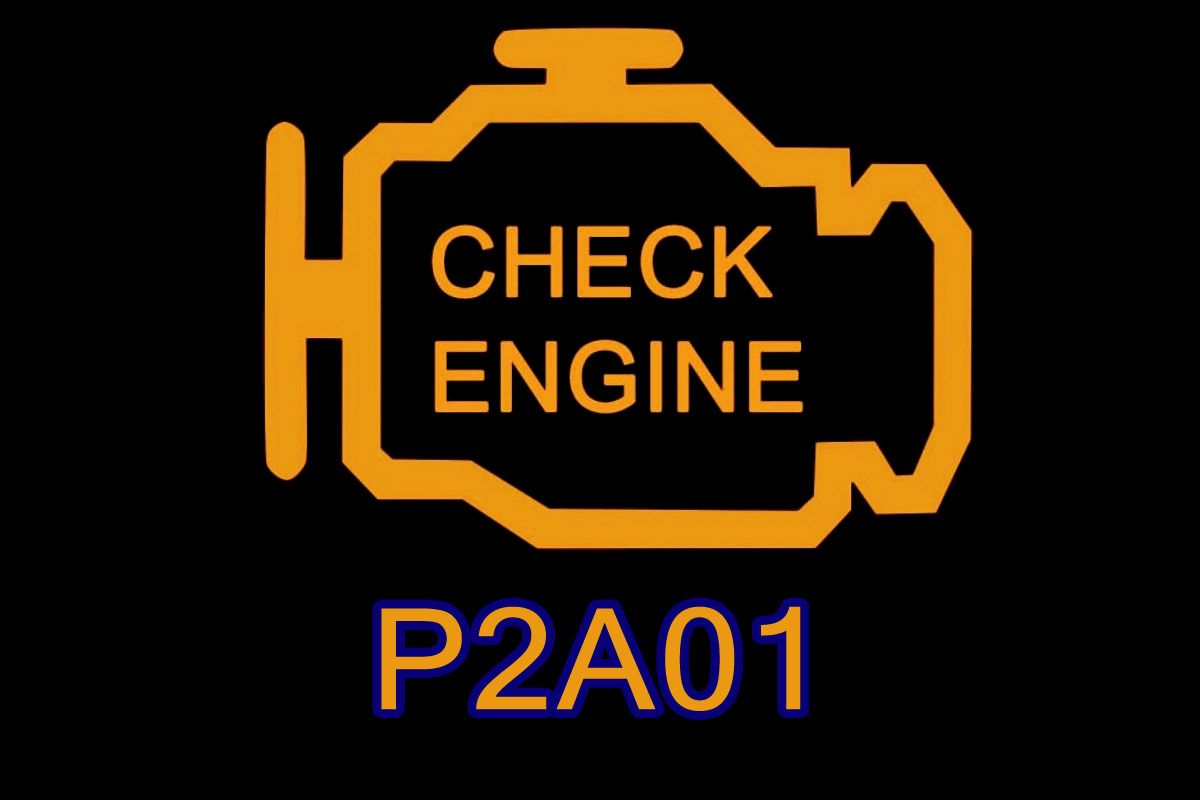
P2A01 O2 Sensor Circuit Range/Performance (Bank 1 Sensor 2)
The diagnostic trouble code P2A01 means the engine control module (ECM/PCM) has detected a range or performance problem in the oxygen sensor circuit for Bank 1 Sensor 2.
Unlike a simple “low voltage” or “high voltage” oxygen-sensor code, P2A01 generally means the sensor signal is present, but the module does not see the response or operating behavior it expects under the current engine conditions.
This does not automatically mean that the oxygen sensor itself has failed. An exhaust leak, wiring problem, incorrect air-fuel mixture, sensor contamination, catalytic-converter problem, or another engine-management issue can cause the ECM to interpret the sensor behavior as abnormal.
What Does Bank 1 Sensor 2 Mean?
Understanding the location described by the code is important before replacing anything.
Bank 1 refers to the side of the engine containing cylinder number 1. On an inline four-cylinder or inline six-cylinder engine, there is normally only one cylinder bank, so Bank 1 is the only bank.
Sensor 2 normally refers to the oxygen sensor located after the catalytic converter.
This is commonly called the downstream oxygen sensor, although the exact sensor arrangement varies between manufacturers.
Therefore, P2A01 generally points toward:
Bank 1 → downstream oxygen sensor → circuit/signal performance
The exact sensor type and location should always be confirmed using the vehicle's service information because modern vehicles can use different oxygen-sensor and air-fuel-sensor technologies.
What Does “Range/Performance” Mean?
The wording Range/Performance is different from a straightforward electrical fault such as “Circuit Low” or “Circuit High.”
With P2A01, the ECM is essentially saying:
The oxygen-sensor signal is not behaving within the expected operating range or is not responding as expected.
The sensor may still produce a signal. The problem is that the signal's behavior does not correspond to what the control module expects.
For example, the ECM may observe a signal that:
-
changes too slowly
-
remains too stable
-
moves outside the expected operating characteristics
-
does not respond appropriately to changes in engine operation
-
does not correspond reasonably with other sensor information
-
behaves differently from the expected downstream oxygen-sensor pattern
Because of this, P2A01 is fundamentally a performance diagnosis, not simply a continuity test.
How the Downstream Oxygen Sensor Works
The oxygen sensor measures the oxygen content of exhaust gases.
The ECM uses information from the sensor to understand combustion and emissions behavior. The downstream sensor, positioned after the catalytic converter, is particularly useful for monitoring catalytic-converter operation and exhaust-gas behavior.
A conventional narrowband oxygen sensor produces a changing voltage according to exhaust oxygen conditions. Other vehicles use wideband or air-fuel-ratio sensors with considerably more complex electronic control.
This distinction matters because the diagnostic procedure for one sensor type cannot automatically be applied to another.
The ECM does not simply look at one fixed voltage and decide whether the sensor is good or bad. It evaluates the signal in relation to engine speed, load, temperature, fuel control, catalyst operation, and other information.
Why Can P2A01 Appear?
There are several possible causes, and they range from a relatively simple wiring problem to an underlying engine or exhaust problem.
Aging or contaminated oxygen sensor
An oxygen sensor can become slower or less accurate with mileage. Exposure to oil ash, coolant contamination, excessive fuel, silicone contamination, or other substances can affect its response.
A sensor may still produce a signal while becoming too slow or abnormal for the ECM's diagnostic strategy.
Damaged wiring or connector
The oxygen sensor is exposed to substantial heat underneath the vehicle.
The harness can become:
-
melted against the exhaust
-
rubbed against another component
-
stretched
-
broken internally
-
contaminated with oil or water
-
corroded at the connector
-
damaged during previous exhaust work
A connection that looks acceptable externally can still have excessive resistance or an intermittent terminal problem.
Exhaust leak
An exhaust leak near the oxygen sensor can introduce outside air into the exhaust stream.
That additional oxygen can change what the sensor detects and may cause the ECM to see an unexpected signal pattern.
This is particularly important when P2A01 appears together with other oxygen-sensor or fuel-trim codes.
Incorrect air-fuel mixture
The oxygen sensor may be reporting a genuine abnormal exhaust condition rather than causing the problem itself.
Possible causes include:
-
vacuum or intake leaks
-
fuel-pressure problems
-
leaking injectors
-
restricted injectors
-
MAF sensor errors
-
MAP sensor errors
-
excessive fuel pressure
-
insufficient fuel pressure
-
ignition misfires
-
EGR-related problems
-
PCV system problems
If the engine is operating abnormally, the downstream oxygen sensor can report the resulting exhaust condition.
Catalytic converter problems
Because Sensor 2 is normally located after the catalytic converter, catalyst performance can influence the oxygen content seen by the sensor.
A damaged, contaminated, overheated, or chemically degraded catalytic converter may alter the expected downstream oxygen pattern.
However, P2A01 should not automatically be interpreted as “the catalytic converter is bad.”
Engine misfire
A misfire can send unburned oxygen and fuel into the exhaust.
This can create unusual oxygen-sensor readings and may cause the ECM to set additional codes.
If P2A01 appears with misfire codes, those codes should be investigated before condemning the oxygen sensor.
Symptoms You May Notice
The symptoms associated with P2A01 vary considerably.
Some vehicles may show only the Check Engine Light with no noticeable driving problem.
Other vehicles may experience:
-
increased fuel consumption
-
unstable fuel trims
-
hesitation
-
rough running
-
reduced engine performance
-
unstable idle
-
increased emissions
-
exhaust odor
-
difficulty passing an emissions inspection
-
additional oxygen-sensor or catalyst-related fault codes
Because Sensor 2 is normally downstream of the catalytic converter, P2A01 does not necessarily produce dramatic drivability symptoms.
In many cases, the vehicle continues to drive normally while the emissions system is no longer operating or being monitored correctly.
P2A01 Diagnosis: Where Should You Start?
A good diagnosis begins with the complete vehicle scan rather than immediately removing the oxygen sensor.
1. Scan all stored and pending codes
Check for other DTCs before concentrating on P2A01.
Codes related to:
-
fuel mixture
-
misfire
-
oxygen sensors
-
catalyst efficiency
-
fuel pressure
-
MAF/MAP sensors
-
exhaust leaks
may provide a much more important clue to the root cause.
Freeze-frame data should also be examined. Engine speed, coolant temperature, load, fuel trims, and other parameters can show the operating conditions under which P2A01 was detected.
2. Confirm the exact sensor
Verify which oxygen sensor the manufacturer identifies as Bank 1 Sensor 2.
Do not assume that every vehicle uses the same sensor arrangement.
The wiring diagram and service information should be used to identify the sensor and its circuits.
3. Inspect the wiring
Follow the sensor harness from the connector toward the main engine harness.
Look for:
-
melted insulation
-
contact with the exhaust
-
broken wires
-
stretched wires
-
previous repairs
-
corrosion
-
loose terminals
-
pushed-back connector pins
-
contamination
Pay particular attention to areas where the harness passes close to the exhaust system.
4. Check the connector
Disconnect the connector and inspect the terminals carefully.
A connector can look connected while a terminal inside it has lost proper tension.
Water intrusion or corrosion can also produce a performance problem without creating an obvious open circuit.
5. Inspect the exhaust system
Look for exhaust leaks around:
-
exhaust manifold areas
-
catalytic converter connections
-
exhaust flanges
-
oxygen-sensor mounting points
-
welded joints
-
cracked pipes
A small leak can have a surprisingly large effect on oxygen-sensor readings.
6. Examine live data
This is one of the most useful parts of diagnosing P2A01.
The behavior of Bank 1 Sensor 2 should be observed under the operating conditions specified by the manufacturer.
Depending on the vehicle, the scan tool may provide:
-
O2 sensor voltage
-
air-fuel ratio information
-
sensor current
-
fuel trims
-
catalyst monitoring data
-
sensor response information
-
heater status
A single number is rarely enough to determine whether the sensor is functioning correctly.
The pattern and response are often more informative than the instantaneous value.
Do Not Diagnose the Sensor With a Universal Voltage Rule
A common mistake is assuming that every oxygen sensor should always produce a particular voltage.
That approach is unreliable.
Different vehicles use different sensor technologies, and even conventional oxygen sensors need to be evaluated under the correct operating conditions.
For example, a traditional narrowband sensor and a modern wideband air-fuel sensor do not operate or communicate with the ECM in the same way.
For P2A01, use the manufacturer's specifications for:
-
sensor signal
-
sensor response
-
heater circuit
-
power supply
-
ground
-
reference circuits
-
resistance, where applicable
-
control strategy
A generic internet voltage value should not be used as a replacement for vehicle-specific diagnostic information.
Can the Oxygen Sensor Be Tested Directly?
Yes, but the appropriate test depends on the sensor design.
A technician may use a scan tool, multimeter, oscilloscope, or manufacturer-specific diagnostic equipment.
For some systems, an oscilloscope can be especially useful because it allows the technician to observe the sensor waveform and response rather than looking at a single value.
On systems using more sophisticated air-fuel sensors, current and control signals may need to be evaluated according to the manufacturer's procedure.
Testing the sensor while considering engine operating conditions is much more useful than simply measuring resistance and declaring the component defective.
P2A01 and the Catalytic Converter
The relationship between P2A01 and the catalytic converter deserves special attention.
Because Bank 1 Sensor 2 is normally positioned downstream of the catalyst, abnormal downstream oxygen behavior can sometimes be associated with catalyst problems.
However, replacing the catalytic converter solely because P2A01 is stored can be an expensive mistake.
Before condemning the catalyst, check for:
-
engine misfires
-
incorrect fuel mixture
-
exhaust leaks
-
oxygen-sensor problems
-
fuel-pressure problems
-
injector problems
-
excessive oil consumption
-
coolant entering the combustion chamber
-
previous overheating
-
catalyst damage
A catalytic converter can be damaged by an engine problem, meaning the catalyst may be the consequence rather than the original cause.
P2A01 vs Oxygen Sensor Circuit Low or High Codes
These codes should not be confused.
P2A01 – Range/Performance
The ECM sees abnormal sensor behavior or operation.
O2 Sensor Circuit Low
The ECM detects an electrically low signal or circuit condition according to that manufacturer's diagnostic strategy.
O2 Sensor Circuit High
The ECM detects an electrically high signal or circuit condition.
O2 Sensor Slow Response
The sensor signal exists but does not respond quickly enough to expected changes.
The exact diagnostic definitions can vary between manufacturers, so the vehicle-specific service information remains the final authority.
Is P2A01 Caused by a Bad Oxygen Sensor?
It can be, but the code alone does not prove it.
A useful way to think about P2A01 is:
The ECM has detected abnormal oxygen-sensor behavior. The technician must determine why that behavior is abnormal.
The sensor itself may be the cause.
But the sensor could also be correctly reporting an abnormal exhaust condition caused by another system.
This is why replacing the sensor without testing the surrounding system can result in the same code returning.
What Happens If You Ignore P2A01?
If the vehicle drives normally and the Check Engine Light remains steady, P2A01 is generally not an indication of an immediate mechanical emergency.
Nevertheless, it should not be ignored indefinitely.
A malfunctioning oxygen-sensor system can affect emissions monitoring and, depending on the vehicle, fuel-control strategy.
If the underlying problem is a rich mixture, lean condition, misfire, or exhaust problem, continued driving can create additional damage.
For example, a persistent misfire can overheat and damage the catalytic converter.
When Should You Stop Driving?
A vehicle with only a steady Check Engine Light and normal operation may often be driven a short distance to a repair facility.
The situation is different if P2A01 is accompanied by:
-
a flashing Check Engine Light
-
severe engine misfire
-
major loss of power
-
stalling
-
strong fuel odor
-
heavy smoke
-
overheating
-
unusual exhaust noise
-
severe hesitation
In those circumstances, continued driving can increase the risk of expensive engine or catalytic-converter damage.
A Practical Diagnostic Sequence
For P2A01, an efficient diagnostic approach is:
Full scan → freeze-frame data → identify Bank 1 Sensor 2 → inspect sensor and wiring → check connector → inspect exhaust for leaks → examine live sensor data → evaluate fuel trims and engine operation → test sensor according to manufacturer procedure → evaluate catalytic-converter operation if required.
This sequence helps prevent unnecessary parts replacement.
Final Diagnosis
P2A01 O2 Sensor Circuit Range/Performance (Bank 1 Sensor 2) indicates that the ECM has detected oxygen-sensor behavior outside the expected range or performance characteristics for the downstream oxygen sensor on Bank 1.
The possible cause can be as simple as damaged wiring or an exhaust leak, but it can also involve the oxygen sensor, air-fuel mixture, fuel system, engine misfire, catalytic converter, or another related system.
The most reliable repair is therefore not simply “replace Bank 1 Sensor 2.” The correct repair is the one that explains why the ECM saw abnormal sensor behavior in the first place.