TR
TR EN
EN

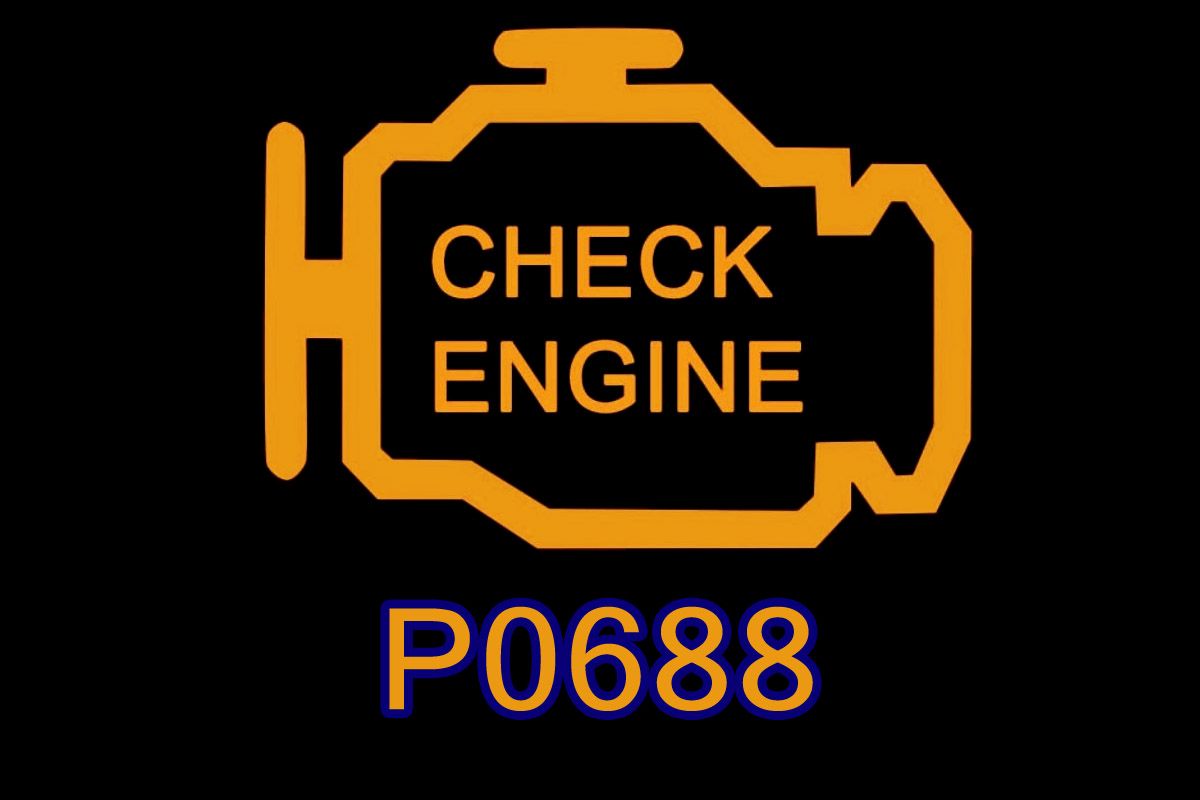
P0688 ECM/PCM Power Relay Sense Circuit/Open
The P0688 – ECM/PCM Power Relay Sense Circuit/Open diagnostic trouble code (DTC) indicates that the Engine Control Module (ECM) or Powertrain Control Module (PCM) has detected an open or interrupted condition in the circuit used to monitor the ECM/PCM power relay.
The power relay is responsible for supplying electrical power to the ECM/PCM and, depending on the vehicle, several other engine-management components. The control module monitors the relay circuit to verify that the expected voltage is present.
When the ECM/PCM cannot detect the expected electrical signal because the circuit is open or interrupted, it can store P0688.
What Does P0688 Mean?
In simple terms:
The ECM/PCM cannot properly detect the electrical signal from its power relay sense circuit.
A simplified system can be represented as:
Battery → Fuse → ECM/PCM Power Relay → ECM/PCM
The ECM/PCM monitors a portion of this circuit.
If the expected voltage disappears because of an open circuit, disconnected terminal, broken wire, faulty relay, or related electrical problem, P0688 may be stored.
What Is the ECM/PCM Power Relay?
The ECM/PCM power relay is an electrically controlled switch that supplies power to the engine-management system.
Depending on the vehicle, the relay may provide power to:
-
ECM/PCM
-
Fuel injectors
-
Ignition coils
-
Engine sensors
-
Emission-control solenoids
-
Actuators
-
Other engine-management circuits
The exact configuration varies by manufacturer.
What Is the Relay Sense Circuit?
The relay sense circuit allows the ECM/PCM to monitor the voltage associated with its power relay.
The module expects to see a specific electrical condition when the relay is activated.
For example:
Relay OFF → Expected voltage condition
Relay ON → Expected voltage condition
If the circuit becomes disconnected, broken, or otherwise interrupted, the ECM/PCM may detect an open circuit and set P0688.
What Causes P0688?
Common possible causes include:
-
Broken relay sense wire
-
Disconnected connector
-
Loose terminal
-
Corroded terminal
-
Faulty ECM/PCM power relay
-
Damaged relay socket
-
Blown fuse
-
Open fuse connection
-
Faulty ignition-switch circuit
-
Damaged ECM/PCM power supply wiring
-
Poor electrical repair
-
Aftermarket electrical modification
-
Internal ECM/PCM fault
The exact cause depends on the vehicle's electrical architecture.
Can a Bad Relay Cause P0688?
Yes.
A defective power relay can prevent the expected voltage from reaching the monitored circuit.
Possible relay problems include:
-
Burned contacts
-
Internal open circuit
-
Failed relay coil
-
Mechanical failure
-
Internal corrosion
However, the relay should be tested before replacing it.
Can a Broken Wire Cause P0688?
Yes.
A broken sense wire is one of the most direct causes of an open-circuit code.
The wire may be:
-
Completely broken
-
Partially broken
-
Corroded internally
-
Pulled out of a connector
-
Damaged by heat
-
Chafed against another component
Can a Loose Connector Cause P0688?
Yes.
A connector that is not fully seated can interrupt the relay-sense circuit.
Check for:
-
Loose connector locks
-
Bent pins
-
Pushed-back terminals
-
Corrosion
-
Water intrusion
-
Damaged connector housings
Can a Blown Fuse Cause P0688?
Yes, depending on the vehicle's wiring design.
If the fuse supplies the power relay or the circuit being monitored, an open fuse can cause the ECM/PCM to detect an unexpected electrical condition.
However, a blown fuse may also generate additional DTCs.
The cause of the blown fuse should always be investigated rather than simply installing another fuse.
Can a Bad Ignition Switch Cause P0688?
Yes, on some vehicles.
The ignition switch may provide the signal needed to activate the ECM/PCM power relay.
If the switch or its wiring has an open circuit, the relay may not activate correctly.
This can result in an ECM/PCM power problem and P0688.
Can a Bad Relay Socket Cause P0688?
Yes.
The relay itself may be perfectly functional while the socket has:
-
Burned terminals
-
Loose contacts
-
Corrosion
-
Broken wiring
-
Damaged internal connections
A poor relay socket can interrupt the circuit.
Can a Bad Ground Cause P0688?
A poor ground is not the most direct explanation for an open sense circuit, but it can cause abnormal ECM/PCM electrical behavior and should be checked when diagnosing power-relay problems.
Important grounds include:
-
Battery negative
-
Engine ground strap
-
Chassis grounds
-
ECM/PCM ground connections
Can the ECM/PCM Cause P0688?
Yes, but this is less common.
The ECM/PCM contains the circuitry used to monitor the relay sense signal.
An internal failure could prevent it from correctly detecting the relay state.
However, the ECM/PCM should only be considered after the external circuit has been thoroughly tested.
Symptoms of P0688
Possible symptoms include:
-
Check Engine Light
-
Hard starting
-
Extended cranking
-
Intermittent no-start
-
Engine stalling
-
No-start condition
-
Reduced engine performance
-
Transmission-related problems
-
Multiple warning lights
-
Intermittent electrical faults
The symptoms depend on whether the open circuit affects only the monitoring circuit or the actual ECM/PCM power supply.
Can P0688 Cause a No-Start Condition?
Yes.
If the open circuit is associated with the actual ECM/PCM power supply, the control module may not receive the power required to operate.
A possible sequence is:
Open power-relay circuit → ECM/PCM loses or fails to receive proper power → Engine control unavailable → No-start
However, an open sense circuit by itself does not always mean the ECM has completely lost power.
Can P0688 Cause Engine Stalling?
Yes, potentially.
If the power relay or its wiring intermittently disconnects while the engine is running, the ECM/PCM can lose power or reset.
This can result in:
-
Sudden engine stall
-
Loss of fuel injection
-
Loss of ignition control
-
Loss of throttle control
-
Multiple warning lights
Can P0688 Cause Limp Mode?
Potentially.
The exact response depends on the vehicle.
If the ECM/PCM detects an important power-supply problem, it may activate a fail-safe strategy.
Can P0688 Cause Transmission Problems?
Yes.
On vehicles where the PCM controls the transmission, unstable power can interfere with:
-
Shift solenoid operation
-
Gear selection
-
Torque converter control
-
Transmission communication
Additional transmission DTCs may appear.
How Is P0688 Diagnosed?
A systematic electrical diagnosis is important.
1. Scan all control modules
Record:
-
Stored DTCs
-
Pending DTCs
-
Communication codes
-
Voltage-related codes
Look for other codes that may identify the source.
2. Check battery condition
Verify that the battery has sufficient voltage.
3. Check charging voltage
Make sure the alternator is operating within the manufacturer's specified range.
4. Identify the ECM/PCM power relay
Use the vehicle-specific fuse and relay diagram.
5. Inspect the relay
Look for:
-
Heat damage
-
Burn marks
-
Corrosion
-
Incorrect relay
-
Damaged terminals
6. Test the relay
Check the relay coil and switching contacts according to specifications.
7. Check the relay socket
Inspect each terminal for looseness, corrosion, or heat damage.
8. Test the sense circuit
Check continuity between the relevant relay circuit and the ECM/PCM connector.
9. Inspect the wiring
Look for:
-
Broken wires
-
Chafing
-
Melted insulation
-
Corrosion
-
Previous repairs
10. Check connector terminals
A terminal may look connected but have insufficient contact pressure.
11. Check ECM/PCM power and ground
Verify both power and ground circuits under operating conditions.
12. Evaluate the ECM/PCM
Only after the external circuit has been verified should internal module failure be considered.
Can a Multimeter Diagnose P0688?
Yes.
A multimeter is very useful for diagnosing this code.
You can test:
-
Battery voltage
-
Relay coil resistance
-
Relay output
-
Sense-circuit continuity
-
Voltage at the relay
-
Voltage at the ECM/PCM
-
Voltage drop
-
Grounds
For an open-circuit fault, continuity testing can be useful, but it should be combined with voltage testing.
Why Is Voltage-Drop Testing Important?
A circuit may appear continuous while still having a poor connection.
For example:
Relay → Connector → ECM
A corroded terminal may provide enough contact for a basic continuity test but fail under load.
Therefore, voltage-drop testing can help identify:
-
High-resistance connections
-
Poor relay contacts
-
Corroded terminals
-
Damaged grounds
Can a Scan Tool Help?
Yes.
A scan tool can provide:
-
System voltage
-
ECM/PCM communication status
-
Freeze-frame data
-
Stored and pending DTCs
If communication with the ECM/PCM is intermittent, this can be an important clue.
What If P0688 Appears With Multiple U-Codes?
This can be a strong indication of a power problem.
For example:
ECM/PCM power interruption → ECM shuts down → Communication is lost → Multiple modules store U-codes
In this situation, do not immediately assume that several control modules have failed.
Check the ECM/PCM power and ground circuits first.
What If P0688 Appears Only Occasionally?
An intermittent open circuit can be caused by:
-
Loose relay
-
Loose terminal
-
Corroded connector
-
Partially broken wire
-
Faulty ignition switch
-
Relay contacts failing intermittently
A wiring harness inspection while monitoring the circuit can help identify the problem.
What If P0688 Appears After Battery Replacement?
Inspect:
-
Battery terminals
-
Positive cable
-
Negative cable
-
Engine ground
-
Fuse box
-
ECM/PCM relay
-
Relay connections
A loose connection created during battery service can produce intermittent electrical problems.
What If P0688 Appears After Jump-Starting?
Check:
-
Battery condition
-
Charging system
-
ECM/PCM power relay
-
Fuses
-
Grounds
-
Electrical connections
The timing of the fault is an important diagnostic clue.
What If P0688 Appears After Engine Repair?
Inspect the wiring around the engine bay.
Pay particular attention to:
-
Ground straps
-
ECM connectors
-
Relay wiring
-
Battery cables
-
Harness routing
A harness or ground connection can easily be disturbed during engine work.
Is P0688 a Serious Code?
It can be.
The ECM/PCM power system is essential to engine operation.
Depending on the fault, P0688 can cause:
-
No-start
-
Engine stalling
-
Loss of engine control
-
Transmission problems
-
Intermittent electrical failures
A vehicle that stalls unexpectedly should not be treated as safe to drive until the cause is identified.
Can You Drive With P0688?
If the vehicle runs normally and the code is stored without symptoms, a short trip to a repair facility may be possible.
However, avoid driving if you experience:
-
Engine stalling
-
Intermittent no-start
-
Sudden loss of power
-
Multiple warning lights
-
ECM communication loss
A power-relay circuit that intermittently opens can cause the engine to stop unexpectedly.
How Is P0688 Repaired?
The repair depends on the confirmed cause.
Possible repairs include:
-
Replacing the ECM/PCM power relay
-
Repairing a broken sense wire
-
Repairing damaged power wiring
-
Replacing a damaged connector
-
Repairing relay-socket terminals
-
Cleaning corrosion
-
Replacing damaged terminals
-
Repairing an ignition-switch circuit
-
Replacing a blown fuse after correcting its underlying cause
-
Repairing ECM/PCM grounds
-
Repairing or replacing the ECM/PCM when internal failure is confirmed
Does P0688 Require Relay Replacement?
Not automatically.
An open circuit can exist anywhere between the relay and ECM/PCM.
The relay, socket, wiring, connectors, and sense circuit should all be tested.
Does P0688 Require ECM Replacement?
Usually not.
The ECM should be considered only after the external electrical circuit has been verified.
A sensible diagnostic order is:
Battery → Fuses → Relay → Relay socket → Sense circuit → Wiring → Connectors → Grounds → ECM/PCM
Common Diagnostic Mistakes
Replacing the ECM immediately
An open wire or loose terminal is much more likely than an internal ECM failure.
Replacing the relay without checking the socket
A damaged relay terminal can cause the same problem.
Checking only continuity
A circuit can pass a basic continuity test but still have excessive resistance.
Ignoring battery and charging voltage
Electrical problems elsewhere can affect ECM/PCM operation.
Ignoring ground connections
Poor grounds can create confusing electrical symptoms.
Replacing a blown fuse without finding the reason it failed
A fuse normally opens because of an underlying electrical problem.
P0688 vs. P0689 vs. P0690
These codes are closely related but describe different relay-sense conditions.
P0688 – ECM/PCM Power Relay Sense Circuit/Open
The monitored relay-sense circuit is open or interrupted.
P0689 – ECM/PCM Power Relay Sense Circuit Low
The relay-sense voltage is lower than expected.
P0690 – ECM/PCM Power Relay Sense Circuit High
The relay-sense voltage is higher than expected.
The key distinction is:
P0688 → Open/interrupted circuit
P0689 → Sense voltage too low
P0690 → Sense voltage too high
How Do You Clear P0688?
The proper diagnostic sequence is:
Scan all modules → Record DTCs → Check battery → Check charging system → Identify ECM/PCM relay → Inspect relay → Inspect relay socket → Test sense-circuit continuity → Check wiring and connectors → Check ECM/PCM power and grounds → Repair the confirmed fault → Clear DTCs → Start vehicle → Road test → Rescan
If P0688 returns, the open or interrupted condition in the ECM/PCM power relay sense circuit has not been properly corrected.
Final Thoughts on P0688
P0688 – ECM/PCM Power Relay Sense Circuit/Open indicates that the ECM or PCM has detected an open or interrupted condition in the circuit used to monitor its power relay.
Possible causes include a broken wire, disconnected connector, loose terminal, faulty relay, damaged relay socket, blown fuse, ignition-switch problem, wiring fault, or, less commonly, an internal ECM/PCM failure.
The important point is that P0688 does not automatically mean the ECM/PCM itself is defective.
The best diagnostic approach is:
Check battery → Check fuses → Test relay → Inspect relay socket → Test sense circuit → Inspect wiring → Check connectors → Verify power and grounds → Evaluate ECM/PCM.
If the vehicle has intermittent stalling or no-start problems, the fault should be diagnosed promptly because an interruption in ECM/PCM power can potentially cause the engine to shut down unexpectedly.