TR
TR EN
EN

What Is the K-Jetronic Fuel Injection System?
K-Jetronic is a mechanical, continuous fuel injection system developed by Bosch and widely used in gasoline-powered vehicles from the 1970s through the 1980s and, in some applications, into the early 1990s.
Unlike modern electronic fuel injection systems, K-Jetronic does not normally use an ECU to open and close the fuel injectors individually. Instead, it uses a combination of mechanical air measurement, fuel pressure, and a fuel distributor to continuously meter gasoline according to the amount of air entering the engine.
For its time, K-Jetronic was a major technological step beyond carburetors and helped manufacturers achieve better fuel metering, throttle response, cold-start performance, and emissions control.
How Does K-Jetronic Work?
The basic operating principle is relatively straightforward.
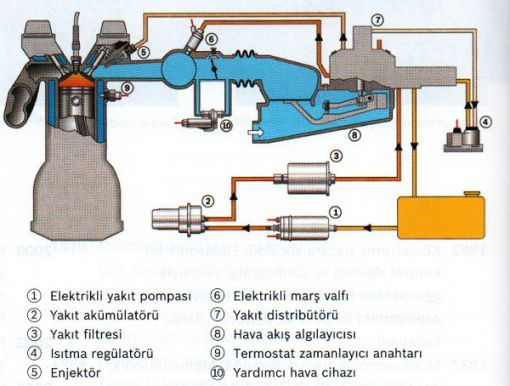
As the engine draws air through the intake system, the incoming airflow moves a sensor plate inside the air-flow measuring assembly. The movement of this plate is mechanically transferred to the fuel distributor.
The fuel distributor then adjusts the amount of fuel delivered to the injectors according to the position of the sensor plate.
In simplified form, the process is:
Airflow → Sensor plate → Fuel distributor → Mechanical injectors → Engine
The fuel pump supplies pressurized gasoline to the system. The fuel distributor regulates and divides this fuel between the engine's cylinders.
The greater the engine's airflow demand, the further the sensor plate moves and, under normal operating conditions, the greater the amount of fuel supplied.
What Makes K-Jetronic Different From Modern Injection Systems?
The biggest difference is the way fuel delivery is controlled.
A modern gasoline engine generally uses electronically controlled injectors. The engine control unit determines when an injector opens and how long it remains open.
K-Jetronic works differently. Its basic injectors are mechanical injectors that continuously spray fuel when the required fuel pressure is reached.
There is therefore no conventional injector pulse width in a classic K-Jetronic system.
This mechanical approach made K-Jetronic highly sophisticated for its era, but it also means that diagnosing the system requires a good understanding of fuel pressure and mechanical adjustment.
Main Components of a K-Jetronic System
A K-Jetronic system consists of several components that work together. A problem with one component can affect the operation of the entire fuel system.
Fuel pump
The fuel pump delivers gasoline from the tank to the injection system at the required pressure.
Fuel pressure is particularly important in K-Jetronic because the system relies heavily on hydraulic pressure for fuel metering.
A weak pump can cause difficult starting, hesitation, loss of power, and poor engine operation.
Fuel filter
The fuel filter protects the precision components of the injection system from contamination.
Because the fuel distributor contains very small and precisely manufactured passages, dirt or particles in the fuel can cause serious problems.
Fuel distributor
The fuel distributor is one of the most important parts of K-Jetronic.
It receives pressurized fuel and distributes it to the individual injectors. Its internal metering mechanism works together with the airflow sensor plate to determine how much fuel reaches each cylinder.
The fuel distributor contains precision components, so contamination, corrosion, incorrect adjustment, or improper disassembly can cause significant problems.
Airflow sensor plate
The airflow sensor plate measures the amount of air entering the engine mechanically.
As airflow increases, the plate moves. This movement is transmitted to the fuel distributor and changes the fuel flow.
This is one of the defining features of the K-Jetronic system.
Mechanical fuel injectors
K-Jetronic injectors are different from modern electronic fuel injectors.
They do not receive an electrical pulse from the ECU in the classic system. Instead, they operate mechanically according to fuel pressure.
The injectors continuously spray fuel while the engine is running and the system pressure is sufficient.
Warm-Up Regulator (WUR)
The Warm-Up Regulator, commonly abbreviated as WUR, controls the control pressure of the fuel system.
Control pressure affects how the fuel distributor responds to the movement of the airflow sensor plate.
The WUR has different operating characteristics when the engine is cold and when it reaches operating temperature. This allows the system to provide the enrichment required during cold operation.
What Is the Warm-Up Regulator?
The WUR is particularly important during cold starting and warm-up.
A cold engine generally requires a richer mixture than a fully warmed engine. The WUR changes the control pressure according to operating conditions, influencing the fuel distributor's metering behavior.
As the engine warms up, the control pressure changes toward its normal operating range.
A faulty WUR can therefore produce symptoms that are strongly dependent on engine temperature.
For example, a vehicle may:
-
Start poorly when cold.
-
Start normally when warm.
-
Run too rich during warm-up.
-
Run too lean during warm-up.
-
Hesitate after starting.
-
Have unstable idle during the warm-up period.
Diagnosis should be based on actual control-pressure measurements rather than replacing the WUR based only on symptoms.
Does K-Jetronic Have an ECU?
A classic K-Jetronic system performs its fundamental fuel-metering function mechanically.
However, the Bosch K-Jetronic family evolved over time, and some versions incorporated electronic control.
For example, certain applications used lambda feedback and an electronically controlled fuel-mixture correction system. These versions should not be confused with a completely mechanical K-Jetronic installation.
This is why the exact version of the injection system matters when diagnosing or repairing a vehicle.
K-Jetronic and KE-Jetronic
KE-Jetronic is a further development of the K-Jetronic concept.
The basic K-Jetronic system relies primarily on mechanical fuel metering, whereas KE-Jetronic introduces a greater degree of electronic control.
KE-Jetronic can use information from sensors and an electronic control unit to influence fuel metering.
Depending on the application, information such as:
-
Engine temperature
-
Throttle position
-
Lambda sensor feedback
-
Engine operating conditions
can be used to correct the fuel mixture.
KE-Jetronic can therefore be viewed as a bridge between traditional mechanical fuel injection and the fully electronic fuel-injection systems that became standard later.
How Does K-Jetronic Handle Cold Starting?
Cold engines require different fueling strategies than warm engines.
K-Jetronic systems can use a cold-start valve to provide additional fuel during starting under cold conditions.
The cold-start valve is typically controlled according to engine temperature and starting conditions. It supplies additional fuel to help the engine start more easily.
The WUR then influences fuel enrichment during the warm-up period.
These functions should not be confused with one another. The cold-start valve primarily assists starting, while the WUR affects the control pressure and mixture characteristics during operation.
Why Is Fuel Pressure So Important?
Fuel pressure is one of the most important diagnostic parameters in a K-Jetronic system.
Unlike a modern electronic injection system, where injector timing and pulse width play a major role, K-Jetronic depends heavily on hydraulic pressure and mechanical fuel metering.
Several problems can alter the system's fuel pressure:
-
Weak fuel pump
-
Restricted fuel filter
-
Faulty pressure regulator
-
Incorrect system pressure
-
Incorrect control pressure
-
Faulty WUR
-
Restricted fuel lines
-
Contamination in the fuel distributor
-
Internal fuel leaks
A proper K-Jetronic diagnosis should therefore include system-pressure and control-pressure measurements using suitable test equipment.
What Happens If the Airflow Sensor Plate Is Incorrect?
The sensor plate is a critical part of the mechanical metering system.
Its position, movement, and relationship with the fuel distributor must be correct.
If the plate is damaged, incorrectly adjusted, sticking, or mechanically disturbed, the relationship between airflow and fuel delivery can become incorrect.
Possible symptoms include:
-
Poor idle
-
Hesitation
-
Difficult starting
-
Poor throttle response
-
Rich or lean running
-
Uneven acceleration
The sensor plate should not simply be adjusted until the engine "sounds better." Incorrect adjustment can mask another problem and make proper diagnosis more difficult.
Why Are Vacuum Leaks Important on K-Jetronic?
Vacuum and intake leaks can be particularly troublesome on K-Jetronic engines.
The airflow sensor measures incoming air mechanically. If unmetered air enters the intake system downstream of the airflow measurement point, the actual amount of air entering the engine can differ from the amount measured by the system.
This can disturb the air-fuel mixture.
Possible sources include:
-
Cracked vacuum hoses
-
Intake manifold gaskets
-
Injector seals
-
Crankcase ventilation hoses
-
Throttle-body connections
-
Auxiliary air system connections
-
Other intake-system seals
Symptoms can include high idle speed, unstable idle, hesitation, lean running, and difficult starting.
A smoke test or other appropriate intake-leak test is generally safer and more informative than spraying flammable chemicals around a running engine.
K-Jetronic Injector Testing
K-Jetronic injectors should be tested as mechanical fuel-delivery components.
Important checks include:
Opening pressure
The injector should open within the specified pressure range for the particular system.
Spray pattern
The spray should be appropriate and consistent.
Fuel delivery
All injectors should deliver reasonably consistent quantities under the specified test conditions.
Leak-down behavior
An injector that leaks after the system pressure falls can contribute to hard starting, flooding, or poor running.
Simply confirming that fuel comes out of an injector is not enough to determine whether it is operating correctly.
Common K-Jetronic Problems
K-Jetronic vehicles are now generally several decades old, so age-related problems are extremely common.
Hard starting
The engine may take longer than normal to start, especially when cold or hot.
Possible causes include incorrect fuel pressure, WUR problems, cold-start system faults, leaking injectors, fuel-pressure loss, or intake leaks.
Rough idle
A rough or unstable idle can result from vacuum leaks, incorrect mixture, fuel-pressure problems, injector differences, ignition faults, or airflow-meter issues.
Hesitation during acceleration
If the engine hesitates when the throttle is opened, the airflow measurement system, fuel distributor, control pressure, injectors, fuel pump, ignition system, or intake system may need to be investigated.
Poor cold running
Cold-running problems often point toward the WUR, cold-start system, auxiliary air system, intake leaks, or incorrect fuel pressure.
High fuel consumption
Excessively rich operation can increase fuel consumption.
However, high fuel consumption does not automatically mean that the fuel distributor is defective. Fuel pressure, sensor-plate adjustment, WUR operation, lambda control where equipped, injectors, ignition timing, and engine condition should all be considered.
Black exhaust smoke
Black smoke can indicate excessive fueling, but it should be treated as a symptom rather than proof of a specific failed component.
K-Jetronic Fuel Distributor Problems
The fuel distributor deserves special attention because it contains precision mechanical components.
Contaminated fuel can cause small internal passages or metering components to malfunction.
Possible symptoms include:
-
Uneven cylinder fueling
-
Rough idle
-
Hesitation
-
Poor acceleration
-
Difficult starting
-
Excessive fuel consumption
-
Lean or rich operation
A fuel distributor should not automatically be replaced simply because the engine runs poorly.
Fuel pressure and control pressure should be checked first, along with the airflow measurement mechanism and injectors.
K-Jetronic and Ignition Problems
Not every running problem on a K-Jetronic engine is caused by the injection system.
These vehicles also use conventional or electronically assisted ignition systems, depending on the model and production year.
Problems with:
-
Spark plugs
-
Ignition wires
-
Distributor components
-
Ignition coil
-
Ignition timing
-
Ignition control module
can produce symptoms that look similar to fuel-system problems.
For example, a weak ignition spark can cause hesitation, rough idle, misfire, and poor acceleration. Adjusting the fuel system without checking the ignition system can therefore lead to incorrect diagnosis.
K-Jetronic vs. Carburetor
K-Jetronic and carburetors are both older technologies, but their operating principles are fundamentally different.
A carburetor uses airflow and pressure differences, particularly through a venturi, to draw fuel into the engine and create an air-fuel mixture.
K-Jetronic uses a pressurized fuel system and a mechanical fuel distributor to continuously deliver fuel through individual injectors.
K-Jetronic therefore provides more precise fuel distribution than many conventional carburetor systems and offered significant advantages in drivability and emissions control for its time.
Advantages of K-Jetronic
K-Jetronic was an advanced system when it was introduced.
Its main advantages included:
-
More precise fuel metering than many carburetors.
-
Continuous fuel injection.
-
Good throttle response when properly adjusted.
-
Individual fuel delivery to each cylinder.
-
Effective cold-start strategies.
-
Reduced dependence on complex electronic controls in its classic form.
-
Good drivability for the technology of its era.
The system also demonstrated that sophisticated fuel metering could be achieved through mechanical and hydraulic engineering before modern engine-management computers became widespread.
Disadvantages of K-Jetronic
The same mechanical design that made K-Jetronic impressive also created several disadvantages.
Complex mechanical adjustment
The system contains precision components that must work together correctly.
Sensitive to fuel contamination
Dirty fuel can affect the fuel distributor and injectors.
Pressure-dependent operation
Incorrect system or control pressure can significantly affect engine performance.
Difficult diagnosis without proper equipment
A scan tool alone is not sufficient for diagnosing a classic K-Jetronic system. Fuel-pressure gauges and other mechanical testing equipment are often essential.
Aging components
Many K-Jetronic vehicles are now several decades old. Rubber hoses, seals, fuel lines, electrical connections, pumps, injectors, regulators, and other components may deteriorate simply because of age.
Parts availability
Some original K-Jetronic components can be increasingly difficult or expensive to source, particularly for less common vehicle applications.
How Should a K-Jetronic System Be Diagnosed?
A systematic approach is much more effective than randomly replacing components.
A sensible diagnostic process begins with the basics.
1. Check the fuel supply
Verify fuel quality, fuel level, filter condition, pump operation, and electrical supply to the pump.
2. Measure system pressure
The system pressure should be measured against the specification for the particular vehicle.
3. Measure control pressure
Cold and warm control pressure should be checked where applicable. This is especially important when investigating WUR-related problems.
4. Inspect the airflow sensor
The sensor plate should move smoothly and correctly without sticking.
5. Check for intake leaks
Vacuum hoses, intake connections, injector seals, gaskets, and related components should be inspected.
6. Test the injectors
Check opening pressure, spray pattern, delivery quantity, and leakage.
7. Evaluate the fuel distributor
If other tests indicate a problem, the fuel distributor can then be investigated more closely.
8. Check the ignition system
Spark quality, timing, plugs, wires, distributor components, and ignition control should be evaluated.
9. Check mixture and lambda control where applicable
If the particular K-Jetronic version includes electronic mixture correction or lambda feedback, those systems should also be tested.
This approach prevents unnecessary replacement of expensive components.
Which Vehicles Used K-Jetronic?
K-Jetronic was used by numerous European manufacturers during the period when mechanical fuel injection was becoming increasingly popular.
Applications can be found in certain models from manufacturers such as:
-
Mercedes-Benz
-
Volkswagen
-
Audi
-
BMW
-
Porsche
-
Volvo
-
Saab
-
Peugeot
-
Citroën
-
Ferrari
-
Lamborghini
The exact system can vary considerably between vehicles, even when the Bosch K-Jetronic name is used.
For this reason, diagnosis should always be based on the specific vehicle, engine code, Bosch system version, and fuel-system specifications.
Why Is K-Jetronic Still Relevant?
Although K-Jetronic is no longer used in modern vehicle production, it remains important for classic and enthusiast vehicles.
Many owners of older European cars want to preserve the original mechanical injection system rather than replace it with a modern electronic conversion.
Understanding K-Jetronic is also useful because many of these systems can still provide excellent drivability when correctly maintained.
The key is proper diagnosis. A K-Jetronic engine should not be treated like a modern electronically injected engine where replacing a sensor or clearing a fault code may solve the problem.
Instead, the system needs to be understood as a combination of air measurement, hydraulic pressure, mechanical fuel metering, injectors, temperature-dependent control, and ignition management.
When system pressure, control pressure, airflow measurement, injector performance, intake sealing, and ignition operation are all within specification, a properly maintained K-Jetronic system can continue to operate remarkably well even after many decades.